



How Do Solar Panels Support Farming Operations Day to Day?
They reduce how much grid electricity a farm needs while work is actually happening.
That’s the practical role solar plays on agricultural sites.
On most farms, electricity demand builds steadily through the day. Milking routines start, refrigeration and ventilation run continuously, pumps switch on, and workshops and yard equipment stay active for long periods. These aren’t brief spikes; they’re sustained, working-day loads.
Solar panels for agriculture in the UK support those loads by feeding electricity directly into the farm’s system while they’re running. When the sun is up and the farm is active, solar generation replaces part of the power that would otherwise be imported from the grid.
In real terms, solar energy for farming is typically supporting:
- milking parlours and wash-down systems
- refrigeration and cold storage
- ventilation and environmental controls
- irrigation pumps and water systems
- workshops, charging points, and yard equipment
What makes this effective in agriculture is timing. Unlike domestic energy use, farm electricity demand doesn’t peak late in the evening. Much of it happens during daylight hours, which means solar energy is often used immediately rather than exported. That direct, on-site use is where most of the value comes from.
Agricultural solar systems are designed to sit quietly in the background. Staff don’t need to change routines or think about when to “use” the solar. Parlours still run to schedule, cooling systems cycle as needed, and equipment operates exactly as it always has, just with less reliance on grid electricity during the working day.
That’s how solar supports farming operations in practice: by reducing daytime grid imports and smoothing energy costs, without changing how the farm functions.
Where Does Solar Energy for Farming Get Used on Site?
On a working farm, electricity isn’t spread evenly. It’s concentrated in a small number of processes that keep the operation moving day to day. This is why solar panels for agriculture in the UK tend to be most effective when they’re designed to support those core activities, rather than trying to power everything at once.
Because much of farm electricity use happens during daylight hours, agricultural solar systems are often able to feed power straight into operations that are already running while work is being done. The focus isn’t on changing routines or adding new electrical demands, but on reducing how much grid electricity those essential processes rely on.
Across UK farms, solar energy for farming is most commonly used to support:
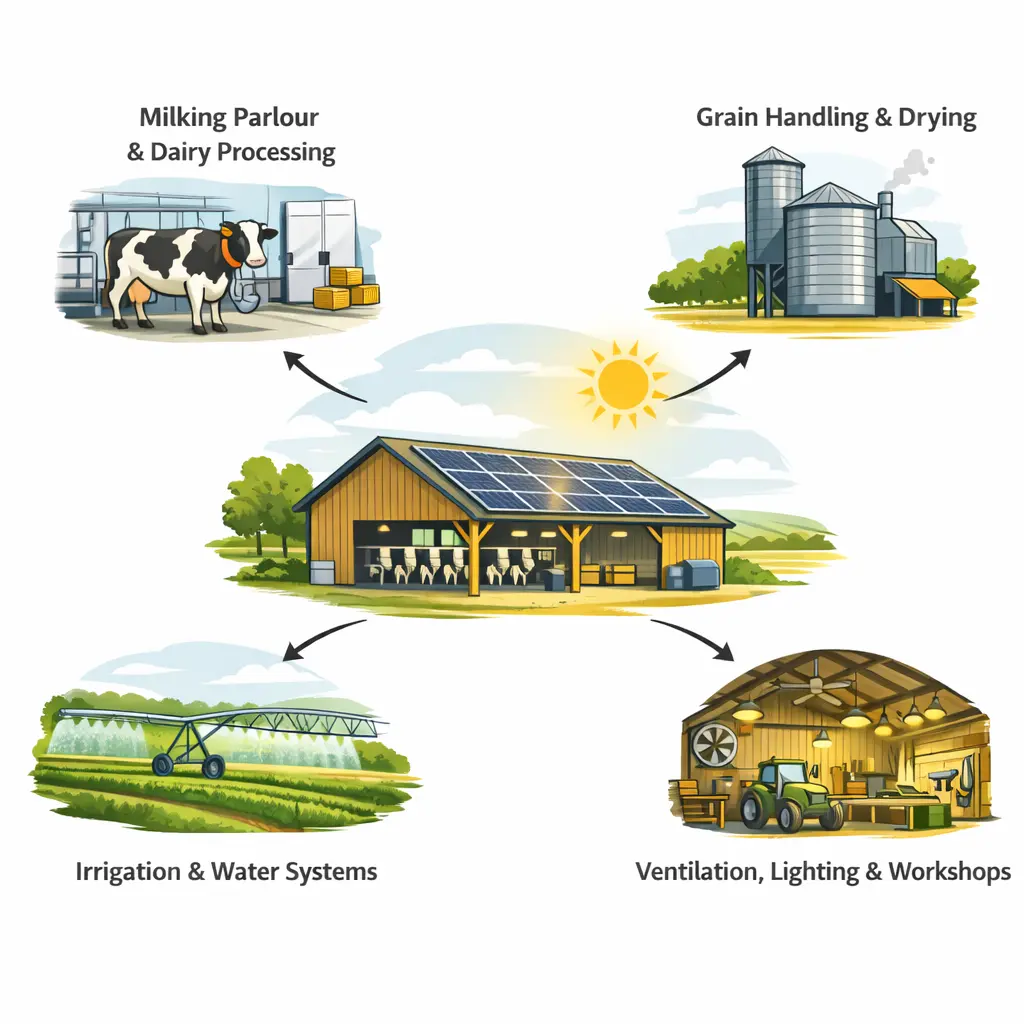
In these scenarios, solar panels for agriculture in the UK don’t replace the grid; they reduce dependence on it during the hours when electricity is most expensive.
How Agricultural Solar Systems Fit Different Farm Layouts
No two farms are laid out the same, and that’s why agricultural solar systems don’t follow standard templates. What determines whether solar actually supports farm operations isn’t panel efficiency or orientation alone, but how easily the electricity generated can be delivered to the places that use it every day.
On working farms, layout decisions are practical ones. Buildings are spread out, yards have grown over time, and electrical infrastructure often reflects decades of change. Solar works best when it fits into that reality rather than trying to work around it.
In practice, solar panels tend to support operations most effectively when they’re installed:
- on buildings close to the main electrical boards, where power can be fed straight into active loads
- on sheds or barns serving high-demand processes, such as parlours, refrigeration, or drying equipment
- in yard areas where cabling runs are short and workable, avoiding unnecessary trenching and complexity
Seen this way, layout isn’t a constraint; it’s a design input. A layout-first approach is what allows agricultural solar systems to support day-to-day farm operations quietly and effectively, rather than existing as standalone infrastructure that looks good on paper but struggles to integrate in practice.
How Does Solar Energy for Farming Support Seasonal Workloads?
Seasonality isn’t an edge case in agriculture; it’s the baseline. That’s why solar energy for farming is planned around how workloads rise and fall across the year, not around flat monthly averages.
Farms don’t use electricity in the same way every month. Demand shifts with planting, harvesting, storage, livestock housing, and weather conditions. Well-designed agricultural solar systems don’t try to smooth that variation away. They work with it, supplying power most effectively during the periods when the farm is already busiest.
Across a typical year, farm energy demand often looks like this: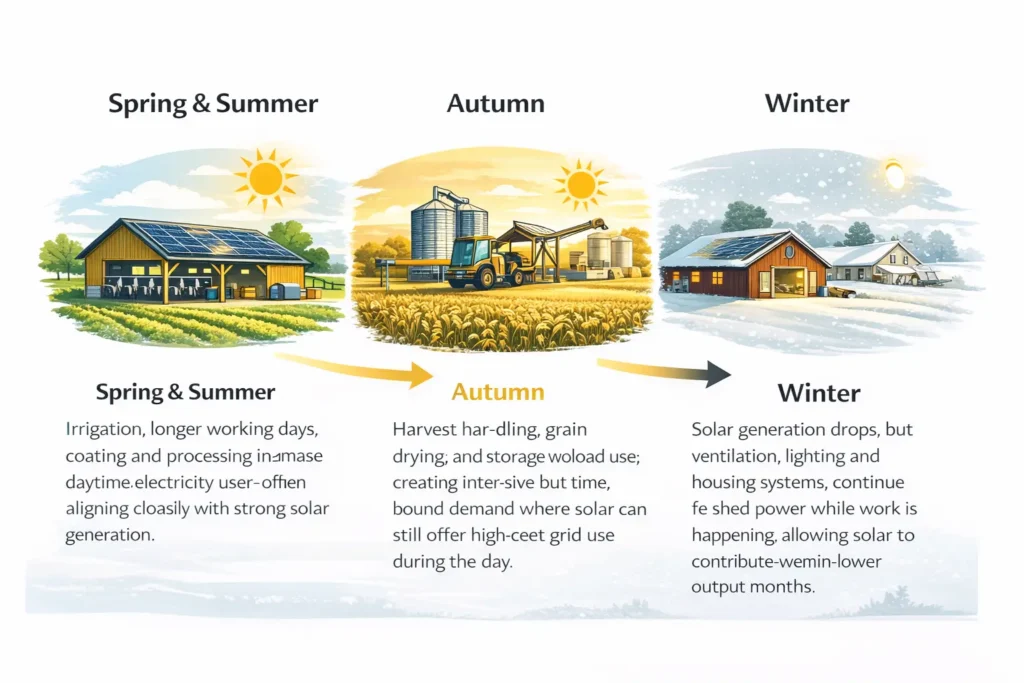
Because solar output naturally peaks during the same seasons when farm activity is highest, agricultural solar systems are assessed across the full year rather than judged on winter performance alone. The aim isn’t to eliminate seasonal variation, but to make sure generation supports workloads when they matter most.
In that sense, seasonality isn’t a weakness of solar on farms; it’s a design input that shapes how solar energy for farming delivers consistent, long-term support.
What Affects How Well Solar Panels Work on Farms?
On farms, solar performance is less about how much electricity a system can generate on paper and more about how well that generation lines up with real workloads.
A system can produce plenty of energy and still feel underwhelming if it doesn’t support the moments when the farm actually needs power.
This is why solar panels for agriculture in the UK are usually assessed against demand patterns first, not panel counts. Farming electricity use isn’t evenly spread across the day or the year, and systems that ignore that reality tend to underperform operationally.
In practice, agricultural solar systems tend to work best when:
- Electricity demand is concentrated during daylight hours
Milking, cooling, pumping, ventilation, and processing loads that run while the sun is up are easier for solar to support directly. - Generation is positioned close to where power is used
Shorter cable runs and fewer distribution losses mean more of the generated energy actually reaches working equipment. - System size reflects operational demand, not export ambitions
Systems designed to offset on-site use usually deliver more value than those sized to maximise output and push surplus to the grid.
Where problems tend to arise is when solar is treated as a generic add-on. Oversized systems, panels installed far from the main loads, or designs that ignore seasonal demand can still generate electricity, but they don’t always reduce grid reliance in a meaningful way.
This is why solar energy for farming works best when it’s planned around how energy flows through the site, rather than how much roof or land happens to be available.
What Should Farms Check Before Adding Solar Panels?
These checks work best when they’re done with a qualified installer, because the “right answer” depends on your site layout, load profile, grid limits, and future plans. Solar4Good offers a free farm consultation where we review those details properly and give you a realistic recommendation (not a generic system size).
Step 1: Identify the farm’s biggest daytime electricity drivers
Start with what’s actually pulling power while work is happening. On many sites, that’s things like refrigeration, milking routines, ventilation, irrigation, pumping, grain handling, or workshops.
If you can’t point to the main drivers, it’s easy to design agricultural solar systems that generate well but don’t reduce the costs you care about.
Step 2: Check when those loads run across a normal day
You’re looking for daylight overlap. Solar energy for farming tends to deliver the most value when demand is highest between late morning and late afternoon. If your heavier loads mostly run at night (or in short bursts), the system design needs a different approach (sometimes that’s where batteries or a smaller system make more sense).
Step 3: Map where the load sits on the site
Don’t pick a roof just because it “looks ideal”. Pick the roof (or yard area) that connects most cleanly to the farm’s real working loads. Long cable runs, trenching, and awkward connections can quietly add cost and complexity, and they can also affect performance if the design becomes compromised.
Step 4: Confirm roof condition or ground constraints before sizing anything
For roofs: age, structure, and remaining roof life matter. For ground-mounted options: access for machinery, drainage, foundations, and whether the array will get in the way of operations over time. This is one of the most common places farms get caught out after they’ve already started planning.
Step 5: Sanity-check seasonal demand against seasonal generation
Farming demand often peaks around irrigation, harvest handling, or storage, and solar output peaks in spring/summer. That can be a good match, but it should be checked properly. The goal isn’t “perfect year-round matching”; it’s making sure solar panels for agriculture in the UK are supporting the parts of the year where costs bite most.
Step 6: Check grid connection limits early
This is the step people skip, then regret. Export limits, DNO requirements, and site electrical capacity can cap what’s viable or change how the system must be designed. A consultation should confirm what the connection can handle before you fall in love with a system size that isn’t feasible.
Step 7: Plan for what might change on the farm
If you’re considering electrification, automation, new cold storage, processing, or diversification, say it upfront. Agricultural solar systems should be designed so they can adapt — not so they’re “maxed out” on day one.