How does the Smart Export Guarantee (SEG) work for home solar in the UK?
Your supplier pays you for surplus electricity you send back to the grid. Rates are set by each supplier rather than by government, so they vary and it is worth comparing them separately from your import tariff. You need an MCS certificate and a smart meter to qualify. Export is worth a fraction of what you save by using the power yourself, which is the argument for a battery.
How long do UK solar panels last and what warranties do they have?
25 to 30 years, often longer. The panels we fit carry a 25-year product warranty and a 30-year performance warranty. They are guaranteed to lose no more than 1% in year one, then no worse than 0.35% a year for AIKO and 0.4% for DMEGC, which leaves AIKO at 88.85% of original output at year 30 and DMEGC at 87.4%.
Will solar panels work on a shaded or partially shaded roof?
Yes, with the right design. Shade on one panel drags down the whole string it sits in, so the fix is electrical rather than structural: optimisers or microinverters isolate each panel so a shaded one stops affecting its neighbours. What matters is where the shade falls and when. A chimney shading two panels at nine in the morning costs far less than a tree covering half the roof at midday.
How disruptive is a solar panel installation in a UK home?
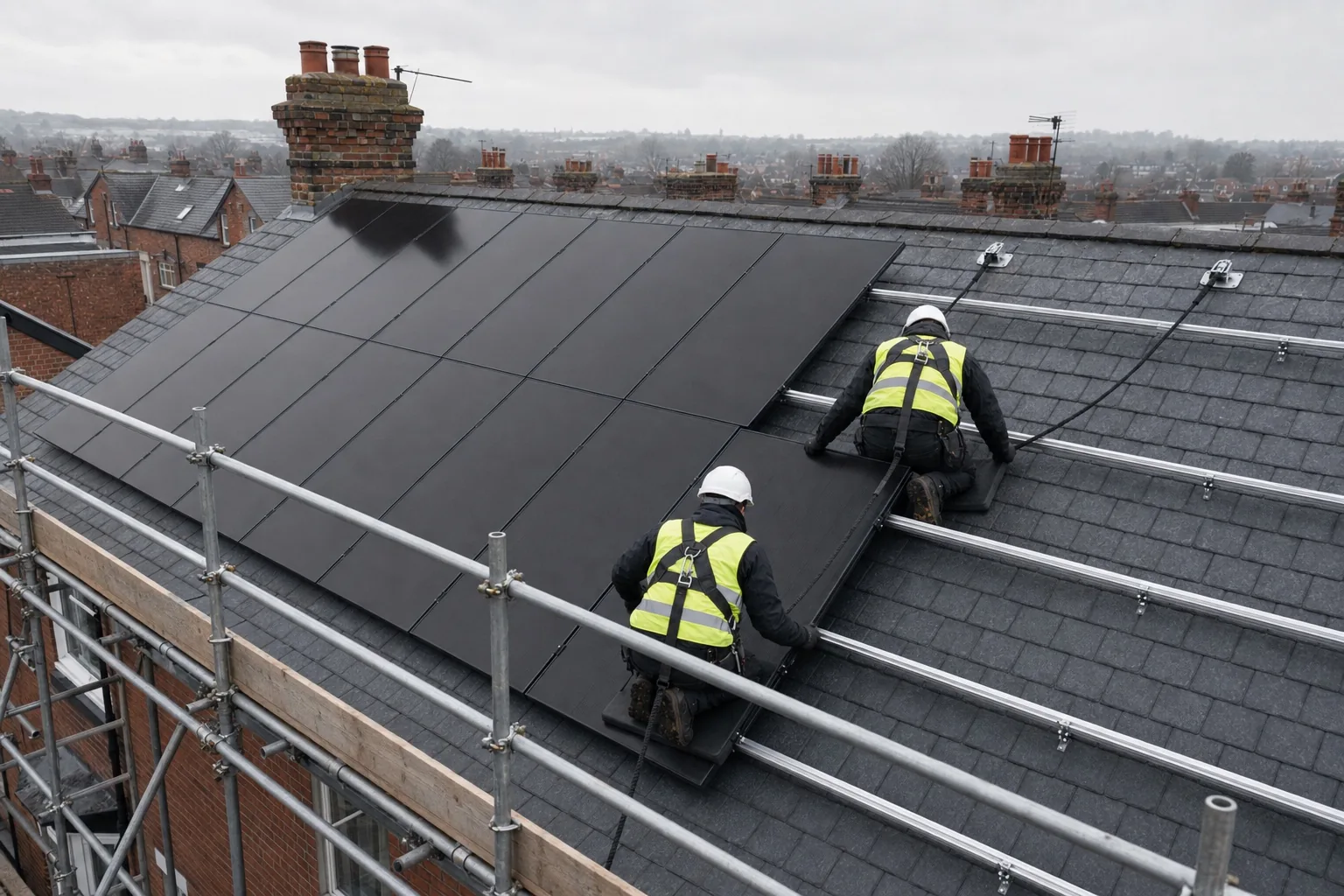
Less than most people expect. Scaffolding goes up first, then most of the work happens on the roof rather than inside. Expect one to two days on a typical house, with a short spell indoors to fit the inverter and connect to your consumer unit. Power is off for under an hour during that connection. Scaffolding is usually up longer than the installers are.
Can I still use my solar panels during a power cut?
No, not with a standard system. Solar shuts down automatically in an outage so it cannot feed electricity into lines engineers may be working on, which is a safety requirement rather than a limitation of the panels. A battery with backup capability changes that: it isolates your house from the grid and keeps chosen circuits running. Ask for it specifically, because not every battery includes it.
How do solar panels work?
Sunlight knocks electrons loose in a silicon cell, which produces direct current. An inverter converts that to the alternating current your house runs on. Anything you do not use goes to the grid, and your meter records it for export payments. There are no moving parts, which is why panels outlast almost everything else attached to a house.
How does a solar panel work?
A panel is dozens of silicon cells wired together behind glass. Each cell produces a small voltage in daylight, and wiring them in series adds those voltages into something useful. The panels we fit use back-contact cells, which put the wiring behind the cell rather than across the front, so nothing shades the part doing the work.
How do solar panels work on a house?
Panels sit on rails bolted through your roof covering into the rafters. Cabling runs to an inverter, usually in the loft or garage, then into your consumer unit. From there the electricity behaves like any other supply in the house. A generation meter records what you make, and your smart meter records what you export.
Do solar panels work in winter?
Yes, and better than most people expect. Panels run on daylight rather than heat, and they are more efficient when cold. A UK system generates roughly a fifth of its annual output between November and February. The days are shorter, so you make less, but a December morning with clear sky still produces real power.
Do solar panels work on cloudy days?
Yes, at reduced output. Cloud scatters light rather than blocking it, so a panel still receives diffuse daylight and still generates. Expect somewhere between a tenth and a third of bright-day output depending on how heavy the cloud is. This matters in the UK, where a large share of annual generation arrives on days that are not sunny.
Do solar panels work at night?
No. Panels need daylight, so overnight your house draws from the grid or from a battery. This is the single strongest argument for storage: it moves the power you generated at midday into the evening, when most households actually use it. Without a battery, everything you generate after dark comes from the grid.
Do solar panels need direct sunlight?
No, but they produce most in it. Direct sun gives peak output. Diffuse daylight through cloud still generates, at a lower rate. What genuinely hurts output is shade falling on the array itself, from a chimney, a tree or a neighbouring roof, because a shaded section drags down the string it sits in.
What are solar panels made of?
Silicon cells, laminated behind toughened glass, sealed in a weatherproof backsheet and held in an aluminium frame. Silicon is the second most abundant element in the earth's crust. The frame and glass are the parts that determine how long the panel survives British weather, which is why panel warranties are measured in decades rather than years.
How many solar panels do I need?
Start from your electricity use, not your roof size. A UK panel generates roughly 850 kWh per kW installed each year, so a household using 3,500 kWh a year is served by a system in the region of four kilowatts. Your usage pattern matters more than the total: power you use is worth far more than power you export.
How many solar panels do I need UK?
Take your annual kWh from a recent bill and divide by about 950 to get the system size in kilowatts. Divide that by your panel wattage for a panel count. That gives a starting point. the site visit then adjusts it for roof pitch, orientation, shading and how much of your usage falls in daylight hours.
How many solar panels to power a house?
Most UK homes are served by somewhere between eight and sixteen panels. The range is wide because household consumption varies by more than the roof does. A two-person house working away all day needs a different system from a family home with an electric car and a heat pump. Half-hourly consumption data settles it properly.
How many solar panels can I fit on my roof?
Measure the unshaded area and allow about two square metres per panel, then subtract edge zones and any walkway the installer needs. A typical UK pitched roof face takes eight to fourteen panels. Fitting the maximum is rarely the right answer: a system sized past your usage exports the surplus at a fraction of what it saves you.
How much energy does a solar panel produce?
About 850 kWh per kW installed per year in the UK. A single 480 W panel therefore produces roughly 450 kWh a year. Southern England sits at the top of that range and northern Scotland the bottom, though the gap is narrower than most people assume. Orientation and shading move the number more than latitude does.
How much electricity do solar panels generate?
A four kilowatt system generates roughly 3,800 kWh a year in the UK, which is close to the annual use of a typical household. That does not mean it covers your bill, because generation and consumption happen at different times of day. What you save depends on how much of it you use as you make it.
Are solar panels worth it?
If someone is home during the day, yes. Payback now runs seven to eleven years against more than fifteen a decade ago, because installation costs fell while electricity rose. The deciding factor is not your roof, it is how much of what you generate you use yourself. A unit you use is worth the full rate. A unit you export is worth a fraction.
Are solar panels worth it UK?
Yes for most UK homes with unshaded roof space and daytime occupancy. The Ofgem cap is 26.32p per kWh for October to December 2026, so every unit you self-consume avoids that price. UK weather is not the obstacle people expect: panels run on daylight, not heat, and Britain has more usable daylight than its reputation suggests.
Are solar panels worth installing?
Worth it when you can use the output, marginal when you cannot. A house empty from eight until six, with no battery and no electric car, exports most of what it makes and pays back at the slow end. Add storage, or shift heavy loads into daylight, and the same system pays back years earlier.
Is it worth getting solar panels?
For most homeowners staying put, yes. The system outlives its payback by fifteen years or more, so everything after that point is saved rather than spent. If you are likely to move within five years the calculation is different, and it turns on what the panels add to the sale price rather than on the bill saving.
Why solar panels are not worth it?
There are honest cases against. A heavily shaded roof, a household away all day with no battery, a north-facing slope, a roof needing replacement within a few years, or a short expected stay in the property. We say so at the site visit rather than after you have signed. A system that does not suit the house is a bad system at any price.
Do solar panels increase home value?
Evidence points to yes, though the size of the effect varies by region and buyer. What is certain is the EPC rating: solar improves it, and the rating is on every listing. Owned systems add value in a way leased ones do not, because a buyer inherits the benefit rather than a contract. Keep the paperwork, MCS certificate and warranties together for the sale.
How long do solar panels last?
Twenty-five to thirty years, and often longer. The panels we fit are guaranteed to lose no more than one percent in year one, then no worse than 0.35 percent a year for AIKO and 0.4 percent for DMEGC. Those are warranty floors, not predictions. The honest part most installers skip: the panels rarely fail first, the inverter does.
How are solar panels installed?
Scaffolding goes up, then roof anchors are fixed through the covering into the rafters, rails are mounted, and panels are clamped to the rails. Cabling runs to the inverter and into your consumer unit. Most domestic installs take one to two days on the roof. The scaffolding is usually the longest part of the whole process.
Can solar panels be recycled?
Yes. Panels are around ninety percent recoverable by weight, mostly glass and aluminium frame, both of which have established recycling routes. UK producers are covered by WEEE regulations, so the obligation to take panels back sits with the supply chain rather than with you. This matters less than people fear, given a panel outlasts most roofs.
Do you need planning permission for solar panels?
No, not for a typical house. Roof-mounted panels are permitted development in most cases, provided they do not project more than 200mm from the roof slope and sit below the highest part of the roof. Listed buildings and conservation areas are the common exceptions, and we check before you commit rather than after.
Do I need planning permission for solar panels?
No for most homes, because domestic roof panels fall under permitted development. You will need permission for a listed building, and often within a conservation area or on a world heritage site. Ground-mounted arrays have their own limits on size and siting. We confirm your position at the site visit and tell you if it changes the job.
Can you put solar panels on a flat roof?
Yes, on a ballasted or mechanically fixed frame that tilts the panels toward the sun. Flat roofs often suit solar better than pitched ones, because the frame sets the optimum angle rather than the roof dictating it. The structure has to carry the extra load, so a flat roof install always includes a structural check.