


How Do Solar Panels Work on UK Farm Buildings?
Solar panels on farm buildings operate in the same fundamental way as other commercial systems, but they are designed around agricultural energy patterns, which are often more varied and equipment-driven than office or retail use.
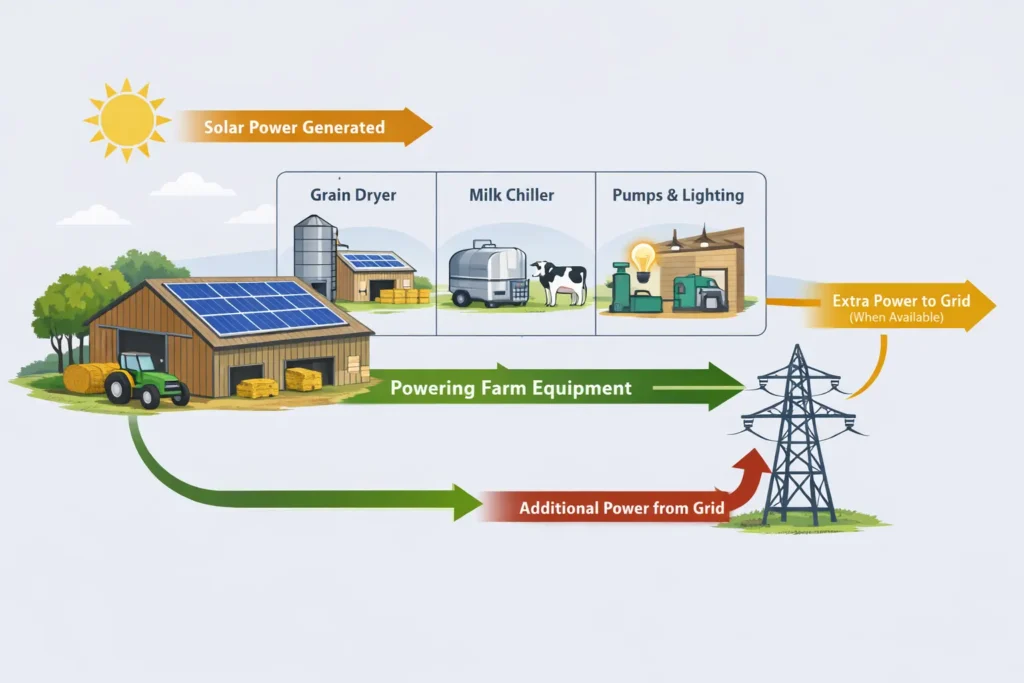
In most cases, solar panels on agricultural buildings are installed on large roof areas such as barns, machinery sheds, grain stores, or livestock housing. Electricity generated during daylight hours is used on-site first, powering systems that are already running, refrigeration units, grain dryers, milking equipment, pumps, lighting, and workshops.
Any shortfall is supplied by the grid. In some cases, surplus electricity may be exported, but for most farms, the real value comes from self-consumption, not export.
What makes agricultural solar different is timing. Many farm operations draw power steadily through the day, particularly during harvesting, drying, or milking cycles. When generation aligns with these loads, solar becomes a practical energy input rather than a passive investment.
This is why agricultural building solar panels are usually designed around how and when energy is used, not just how much roof space is available.
Which Agricultural Buildings Are Suitable for Solar Panels?
On most farms, the decision to install solar panels on agricultural buildings isn’t limited by roof space. It’s shaped by whether specific buildings can support a solar system reliably over the long term.
Farm buildings vary widely in structure, condition, and day-to-day use. Some are well-suited to solar and can support generation for decades with minimal intervention. Others may appear suitable at first glance but introduce risks related to roof integrity, load capacity, or limited future use.
This is why suitability is driven less by age alone and more by how a building is constructed, how it’s used operationally, and how long it’s expected to remain in service. For farm solar panels UK projects, assessments focus on whether installing solar panels on farm buildings makes sense over the next 20–30 years, not just whether panels can be fitted today.
Most solar panels on farm buildings are installed on:
General-purpose barns and sheds
Machinery and equipment stores
Grain stores and drying facilities
Livestock housing (where roof condition allows)
Cold storage and packhouse buildings
These buildings tend to work well because they offer:
large, unobstructed roof spans
minimal shading from trees or adjacent structures
electricity demand nearby during daylight hours
Some buildings require more careful review before solar is considered:
Older asbestos-cement roofs
Structures nearing the end of their working life
Buildings used only seasonally
Roofs with limited load-bearing capacity
This is why farm solar panels UK projects typically begin with a structural survey and electrical assessment. The aim isn’t just to confirm whether panels can be installed, but whether they make sense over the next 20–30 years.
What Benefits Do Solar Panels Offer UK Farms?
For most UK farms, the case for solar isn’t built on abstract sustainability goals or headline savings. It’s driven by the day-to-day realities of running an agricultural business where energy is a growing and often unpredictable cost.
Farms tend to use electricity differently from offices or retail sites. Demand is often tied to specific processes, such as refrigeration, drying, pumping, ventilation, milking, or on-site processing, many of which run during daylight hours. This makes solar panels on agricultural buildings particularly relevant, because generation can align closely with how energy is actually used on the farm.
The benefits of installing solar panels on farm buildings are therefore practical: reducing exposure to volatile grid prices, making better use of existing assets, and creating flexibility as operations evolve.
Lower and more predictable energy costs
Many farms use electricity during the day, and refrigeration, drying, pumping, ventilation, and processing often run continuously during working hours. Solar panels on agricultural buildings generate power at the same time these systems are operating, reducing reliance on peak grid electricity. Over time, this helps stabilise energy costs, which is particularly valuable in agriculture where margins are sensitive to input price volatility.
Better use of existing assets
Installing agricultural building solar panels allows farms to extract value from roof space that would otherwise sit unused. Importantly, this is done without taking land out of production, preserving agricultural output while improving energy resilience.
Support for diversification and future growth
Many farms are diversifying into storage, processing, retail, or tourism, all of which increase electricity demand. Farm solar panels in the UK can be designed to scale over time, supporting these changes without requiring a complete redesign later.
How These Benefits Tend to Show Up in Practice
Taken together, these benefits change how farms think about energy rather than simply reducing a bill. Agricultural building solar panels turn electricity from a variable overhead into something that can be planned around, especially on farms with steady daytime demand.
For many operations, the value isn’t just in immediate savings, but in resilience, knowing that a portion of energy needs is covered on-site using infrastructure the farm already owns. As farms expand, diversify, or introduce new energy-intensive activities, farm solar panels UK systems can continue to support those changes rather than becoming a constraint.
What Do Solar Panels on Agricultural Buildings Cost?
There’s no standard price for solar panels on agricultural buildings, because farm sites differ widely in how buildings are constructed, how electricity is used, and how systems need to be integrated.
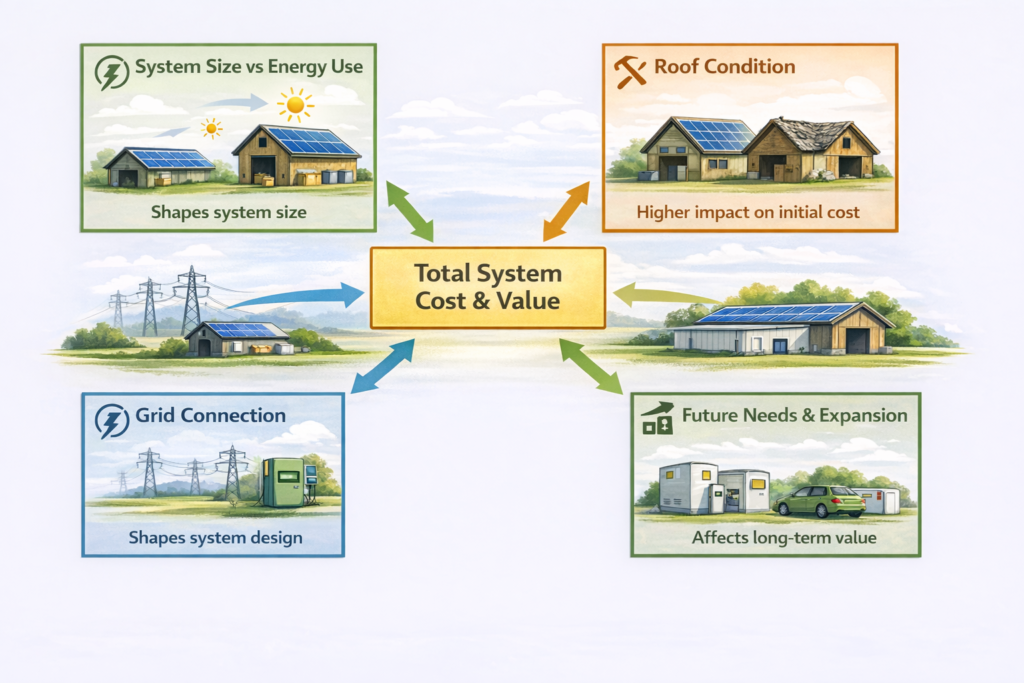
Two farms installing similar-sized systems can receive very different quotes once roof condition, electrical infrastructure, and future plans are taken into account. The panels themselves are only one part of the overall cost.
System size and how energy is used on the farm
Larger solar systems usually have higher upfront costs, but system size alone does not determine overall value.
Farms with steady daytime electricity demand can use more of their solar generation directly on-site.
Dairy farms running milking parlours, refrigeration, water heating, and ventilation throughout the day often achieve strong payback.
Designing the system around consistent demand reduces wasted or exported energy.
Arable farms typically have seasonal electricity use rather than constant demand.
For arable farms, sizing the system to average demand rather than maximum roof space can avoid low-value surplus generation.
Roof condition and structural requirements
Roof condition directly affects installation complexity and cost.
Modern steel-framed barns and machinery sheds usually require minimal preparation.
Older buildings may need structural reinforcement before installation.
Asbestos-cement roofs often require replacement prior to solar installation.
Roof upgrades increase upfront costs but can align with planned maintenance or long-term improvements.
Grid connection and electrical infrastructure
Grid access varies significantly between farm sites.
Some farms can connect solar systems with little or no network upgrades.
Others face export limits, import constraints, or required electrical upgrades.
Grid conditions influence system size, inverter selection, and export viability.
For many UK farm solar panel projects, grid limitations are as important as roof availability.
Allowance for future expansion
Farm electricity demand often increases over time.
New cold storage, processing equipment, EVs, or diversification projects can raise energy use.
Systems designed for expansion may include larger inverters or upgraded cabling.
Planning ahead increases initial cost slightly but avoids major changes later.
Future-ready designs reduce disruption and improve long-term return on investment.
How payback should be viewed
For most farms, the relevant question isn’t “How much do solar panels cost?” but “How much grid electricity will this replace?” Payback depends on how closely generation matches on-site demand. Agricultural building solar panels that support everyday operations tend to deliver more consistent long-term value than oversized systems that rely heavily on export.
Planning Permission and Rules for Agricultural Solar in the UK
Planning is one of the first questions most farms raise when considering solar, and often the area with the most confusion.
The good news is that many solar panel installations on agricultural buildings can be straightforward from a planning perspective, particularly when panels are added to existing farm structures. The challenge is knowing when planning is likely to apply, what triggers it, and how to avoid unnecessary delays by making the right assumptions early.
In the UK, planning rules for agricultural solar are shaped by a combination of:
- the Town and Country Planning (General Permitted Development) (England) Order
- local authority planning policies
- building status (e.g. listed or not)
- and how visibly the installation changes the site
Understanding how these interact is far more useful than trying to memorise rules in isolation.
| When planning is often straightforward | When planning permission is more likely to be required | Planning is only one part of the approval process |
|---|---|---|
| For many farms, rooftop solar on existing buildings falls under permitted development, meaning full planning permission is not required. | Full planning permission becomes more likely when solar affects the character or use of the site, rather than just the roof. | Even where planning permission is straightforward, it’s rarely the only approval that matters. |
| This commonly applies where: | This often applies where: | Agricultural solar projects must also consider: |
| solar panels are installed on existing agricultural buildings | the building is listed or curtilage-listed | Grid connection approval from the local Distribution Network Operator (DNO) |
| the installation does not significantly alter the building’s external appearance | the site sits within a conservation area, National Park, or Area of Outstanding Natural Beauty | Structural sign-off, confirming the building can safely support the system |
| the site is outside conservation areas or protected landscapes | the proposal involves ground-mounted solar that changes land use | Electrical compliance, ensuring the installation meets UK safety standards |
| panels follow the roofline rather than introducing new structures | solar forms part of a larger diversification or redevelopment project | These approvals often influence system design, capacity, and timelines just as much as planning itself. |
| In these cases, development is allowed in principle, although prior approval may still be required. | In these situations, planning discussions are usually less about whether solar is acceptable and more about how it integrates with the farm and surrounding landscape. | This is why they are usually assessed together during feasibility, rather than treated as steps to deal with later. |
What this means for farms in practice
For most farms, planning is not a barrier, but assumptions can be.
Projects tend to move more smoothly when:
- building status is checked early
- permitted development is confirmed rather than assumed
- grid and structural considerations are reviewed alongside planning
This approach reduces the risk of redesigns, delays, or unexpected costs once a project is already underway.
How Long Does Installation Take on a Working Farm?
For farms installing solar panels on agricultural buildings, timelines matter because they affect access, safety, seasonal workloads, and cash-flow planning. The physical install is only one part of the project. A farm-friendly timeline includes the stages below.
Step 1: Site survey and roof checks
This is the “can and should we install here?” stage. It covers the basics that affect safety and design: roof condition, structure, access, and any obvious constraints like shading or fragile roofing materials. For solar panels on farm buildings, this stage is where issues such as asbestos-cement sheets, ageing purlins, or limited safe access are usually identified early.
Step 2: Electrical assessment and system sizing
Next comes the electrical side: where the system connects, how the farm is currently metered, and how energy is used across the day. This is also where agricultural building solar panels are sized around real demand (for example: steady dairy loads vs seasonal arable demand), and where decisions about export limitation or future expansion are made.
Step 3: Outline design and quotation
Once the site and electrical picture are clear, the layout is mapped and the system design is finalised. This is where mounting approach, inverter location, cable routes, and safety planning are confirmed. At this point, farms usually get a quote that reflects the real constraints of the site rather than a “per panel” assumption.
Step 4: Approvals and permissions
Any required permissions and approvals are handled here. This stage often determines the overall timeline, but the detail sits in the previous section. For farm solar panels UK projects, what matters from a planning perspective is building status and location; what matters from a grid perspective is what the network can support.
Step 5: Installation scheduling and farm coordination
Before installers arrive, the project is planned around how the farm operates. This is where access routes, working zones, livestock movement, delivery times, and any seasonal pressure points (harvest, lambing, calving) are accounted for. Good scheduling is one of the biggest reasons solar can be installed without disrupting operations.
Step 6: Installation and commissioning
The physical installation is usually completed in weeks rather than months, depending on system size and weather. Commissioning and testing follow shortly after installation, allowing solar panels on agricultural buildings to begin generating electricity once sign-off is complete.
Step 7: Handover, monitoring, and aftercare
Once the system is live, the farm receives handover documentation and guidance on what to expect from generation and monitoring. This is also where ongoing support is confirmed, if included.
What farms need to plan around
Most disruption risk comes from access and timing, not from the panels themselves. Farms that schedule installation outside peak periods and keep vehicle/livestock routes clear tend to have smooth projects.
What’s the Maintenance and Lifespan of Farm Solar Systems in the UK?
Solar panels on agricultural buildings are designed to operate for decades, but the way they age, and the maintenance they require, depends heavily on how each building is used. On UK farms, the difference between livestock housing and arable or storage buildings has a direct impact on long-term performance.
Understanding those differences helps farms set realistic expectations around inspections, component replacement, and system reliability over a 20–30 year period.
Maintenance on livestock buildings | Maintenance on arable and storage buildings | Lifespan expectations across different farm buildings |
Livestock buildings are tougher environments for fixed electrical systems than most commercial sites. Moisture levels are higher, temperatures fluctuate, and ammonia from animal waste can affect exposed components over time. Because of this, solar panels on farm buildings used for livestock are usually specified with additional protection around cabling, inverters, and connection points. Electrical enclosures and seals are checked more closely, and cable routes are planned to avoid wash-down areas and moisture-prone zones. The panels themselves are rarely the issue. Once installed, solar panels on agricultural buildings used for livestock housing tend to perform consistently, as long as fixings and electrical components are inspected at planned intervals. For most farms, these checks align with existing building and welfare inspections rather than adding a new routine. | Arable and storage buildings present a different set of conditions. Moisture is usually less of a concern, but dust from grain, chaff, and machinery can build up around electrical equipment during busy periods. On grain stores, machinery sheds, and workshops, agricultural building solar panels typically benefit from inspections after harvest or processing activity, when dust levels are highest. Ventilation around inverters is kept clear, and panels may be cleaned occasionally if output drops due to surface build-up. Because these buildings often have large, open roof spans and simpler internal environments, farm solar panels installations in the UK on arable sites are generally straightforward to maintain over the long term. | Across both livestock and arable settings, solar panels on agricultural buildings are designed to operate for 25–30 years or more. Output reduces gradually over time, rather than failing suddenly, which allows farms to plan energy use with confidence. The main differences appear in non-panel components:
This is normal for long-life infrastructure and is accounted for when farm solar panel systems are designed. |
H3: What this means for UK farms
Whether installed on livestock housing or arable buildings, solar panels on farm buildings are not high-maintenance assets. They are designed to integrate into existing farm infrastructure and routine maintenance schedules.
When Solar4Good installs solar panels on agricultural buildings, systems are specified with building use in mind, and ongoing monitoring and support can be included so performance issues are identified early without adding to day-to-day workload.
For most farms, this results in steady, predictable generation over decades, with maintenance that works around farming, not against it.