




Why Are Businesses Starting to Look at Car Parks Differently?
Because car parks are often the last large, usable spaces commercial sites still control outright, and they’re increasingly being seen as wasted potential. Across many sites, rooftop solar has already been explored or installed. Roof space fills up, structural limits emerge, or ownership and lease terms make further expansion difficult. At the same time, dedicating open land to energy generation can conflict with future development plans. That’s why attention is shifting to parking areas that already exist and are unlikely to change use.
On sites such as retail parks, office campuses, hospitals, universities, and logistics hubs, parking areas share a few useful characteristics:
- They’re typically open and relatively unshaded
- They’re in use during the same hours electricity demand is highest
- They’re already embedded in daily operations
These conditions are what make solar panels installed over parking areas an increasingly practical option, particularly in the UK, where adding new generation space is often constrained.
Rather than relying on roofs alone, many organisations are now exploring solar panel car park solutions in the UK as a way to add capacity without disrupting how a site functions. Vehicles still park as normal, access routes remain unchanged, and circulation stays familiar. The difference is that the space above the bays is put to work.
When designed at scale, this approach becomes a commercial solar car park, a setup where car park solar panels generate electricity every working day, supporting on-site demand without competing with buildings, land use, or future expansion.
What Is a Solar Panel Car Park, and How Is It Different from Rooftop Solar?
When businesses first hear the term solar panel car park, they often picture something experimental or purely cosmetic. In reality, the technology is the same as any other solar PV system; what changes is where it’s installed and how it integrates with the site.
The difference matters because many commercial sites run into limits with rooftop solar far sooner than expected. Roofs may already be full, structurally constrained, visually sensitive, or tied up in lease arrangements. A solar panel car park shifts the conversation away from the building, and onto the space the business already controls day to day.
Solar panel car park vs rooftop solar (commercial sites)
Consideration | Solar Panel Car Park (Carport) | Rooftop Solar |
Relies on roof condition | No. Independent of the building’s age or structural integrity. | Yes. Requires a roof in good condition with 20+ years of life remaining. |
Impacted by leases | Less often. Usually built on common ground; easier to separate from building tenant terms. | Frequently. Requires landlord/tenant alignment; roof access and “make-good” clauses are complex. |
Ease of expansion | Higher. Limited only by car park size; easier to add “wings” or modular sections. | Often limited. Strictly capped by the usable roof area and HVAC obstructions. |
Maintenance access | Highly accessible. Reachable via standard lifts/ladders without building entry. | Restricted. Requires safety systems (harnesses), building access, and permits. |
Visibility & ESG Signalling | High. Visible to every customer and employee; acts as a “green billboard.” | Low to Moderate. Often invisible from the street; requires signage to signal ESG efforts. |
Installation Cost | High. Requires civil works, foundations, and significant steel structures. | Lower. Utilises the existing building structure; minimal “extra” materials. |
Operational Impact | Moderate. Installation can temporarily disrupt parking and traffic flow. | Low. Most work happens overhead; minimal impact on daily business operations. |
A solar panel car park in the UK isn’t a replacement for rooftop solar, it’s often the next option once roof-based systems stop being practical.
How Do Solar Carports Turn Parking Areas into Energy Assets?
Car parks are usually treated as fixed infrastructure: they serve vehicles and little else. Solar carports change that by adding a second function, energy generation, without altering how the space is used.
Once solar canopies are installed, the area above parked vehicles starts producing electricity during working hours. For most commercial sites, that generation lines up well with existing demand, which is where the value comes from.
What typically changes after installation
- Part of the site’s daytime electricity is supplied on-site
- Grid imports drop during the most expensive hours
- The car park becomes part of the energy strategy, not just a convenience
Where the electricity usually goes
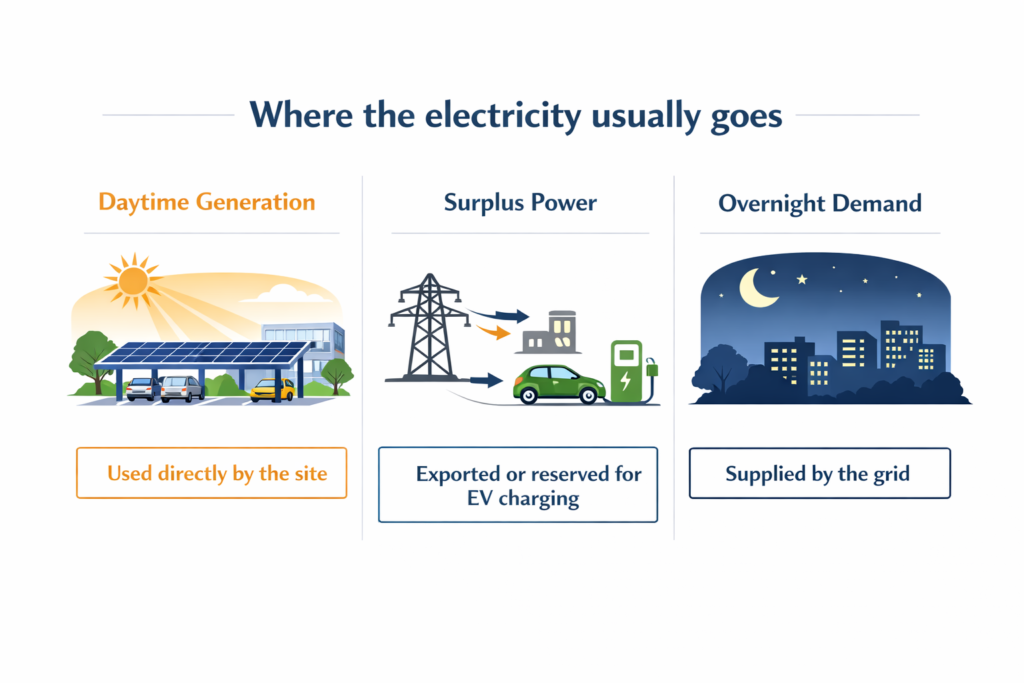
This is what turns a parking area into a commercial solar car park. It’s not about aesthetics, it’s about changing how the site sources and uses energy.
How Much Power (and Value) Can a Solar Carport Actually Generate?
A solar carport doesn’t need to create a new business model to be valuable.
It only needs to turn space that already exists into electricity that replaces grid purchases.
In UK conditions, commercial solar PV typically generates around 850–1,000 kWh per kWp per year, depending on location, orientation, and shadiAng. Because car parks often allow larger system sizes than rooftops, the total output can be materially higher than incremental roof extensions.
What does that look like in simple terms
Carport system size | Typical annual generation (UK) |
50 kWp | ~42,000–50,000 kWh |
100 kWp | ~85,000–100,000 kWh |
250 kWp | ~210,000–250,000 kWh |
For most commercial sites, the majority of this electricity is used on site during the day, when business demand and grid prices are highest.
Why on-site use matters more than export
Under the UK’s Smart Export Guarantee, exported electricity is paid at variable rates that are usually far lower than commercial daytime electricity prices.
That means the main financial value of a solar panel car park in the UK comes from:
- electricity not bought from the grid, rather than
- electricity sold back to it
When generation lines up with daytime demand, which is common for retail parks, offices, healthcare sites, and logistics hubs, the car park effectively becomes a long-term source of avoided energy cost. That’s what turns car park solar panels from a sustainability feature into a measurable commercial asset.
Why Does a Solar Panel Car Park Make Sense in the UK Context?
In the UK, commercial solar projects are often shaped more by constraints than by ambition. Roof age, planning sensitivity, and fragmented ownership can all limit how much a site can generate.
A solar panel car park in the UK works around those issues by using space that’s already open, visible, and operational. While planning still matters, car parks often provide a clearer route to additional capacity than retrofitting older buildings.
There’s also a demand match that shouldn’t be overlooked. UK businesses typically use electricity during the day, the same period solar generates. That alignment means solar panels for parking areas can deliver useful on-site power even without batteries.
Common UK constraints solar carports help bypass
- Lightweight or ageing roofs
- Listed or visually sensitive buildings
- Short or complex roof leases
- Insufficient roof area for demand
When roof space is limited by age, ownership, or planning sensitivity and electricity demand remains concentrated during the working day, parking areas become one of the few places where additional generation can be added without triggering the same constraints. In that context, solar panels for parking areas aren’t a workaround; they’re often the most straightforward way for UK businesses to expand on-site generation within the rules and realities they already operate under.
When Does a Car Park Become the Right Place to Add Solar?
For many commercial sites, the decision to use a car park for solar doesn’t start with the car park itself. It starts when other options stop delivering meaningful gains.
Rooftop solar may already be installed, capped, or ruled out altogether. Additional panels might only offer marginal improvements or introduce structural, planning, or lease complications. Ground-mounted systems may be impractical because available land is reserved for future development, logistics, or access. At that point, the question shifts from “Should we add more solar?” to “Where can we realistically add capacity at scale?”
This is where car park solar panels come into the conversation.
The situations that usually push sites toward car park solar
A car park tends to become the focus when one or more of the following are true:
- Energy demand has outgrown existing solar capacity
New loads from cooling, IT systems, electrification, or EV charging can’t be supported by rooftop solar alone. - Additional generation needs to be added at scale
A small rooftop extension won’t materially change grid reliance or operating costs. - Export limits are already constraining value
Keeping generation close to on-site demand becomes more important than maximising theoretical output. - The car park layout is stable long term
Parking bays, access routes, and circulation aren’t expected to change, making overhead structures viable infrastructure rather than temporary additions.
Why the car park works at this stage
At this point, the car park isn’t being treated as spare space. It’s being used as one of the few remaining surfaces where generation can be added without forcing trade-offs elsewhere on site. Unlike roofs or open land, parking areas sit alongside existing demand, access, and grid connection. Installing solar panels for parking areas allows a business to add capacity without altering buildings, changing land use, or disrupting day-to-day operations.
In that context, a solar panel car park in the UK often becomes the most straightforward way to expand on-site generation within the constraints a site is already dealing with. When designed at scale, this approach forms a commercial solar car park, not as a first-choice solution, but as a practical response once other solar options have reached their limit.