
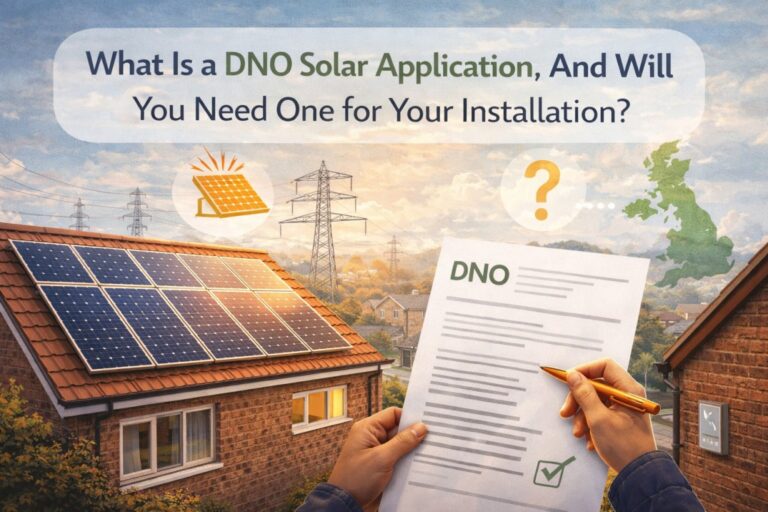
What Is a DNO Solar Application, And Will You Need One for Your Installation?

Last Updated 1 day ago
If you've come across the term 'DNO application' while researching solar, here's what you need to know — and why it matters for your installation.
- 1. What Is a DNO and Why Does It Matter for Solar?
- 2. What Is a DNO Solar Application?
- 3. When Do You Need Approval vs Notification? (G98 and G99 Explained)
- 4. Every UK DNO Solar4Good Has Worked With
- 5. What Happens During the DNO Process?
- 6. How Long Does a DNO Application Usually Take?
- 7. Does a DNO Application Cost Anything?
- 8. Conclusion
- 9. Frequently Asked Questions (FAQs)
Summary
If you have started researching solar panels for your home, you may have come across something called a ‘DNO application.’ It’s a term that often appears in installation quotes or initial surveys and can seem technical and unfamiliar if you have not encountered it before.
In the UK, every property is connected to a Distribution Network Operator (DNO). These organisations manage the local electricity infrastructure — the cables, transformers and substations between the national grid and individual properties. When solar panels are installed, they generate electricity for the property during daylight hours. Sometimes that production is higher than what the household is using, and the surplus is exported back into the grid. This affects the local network — and that is why the DNO needs to be informed.
For most homeowners, this process happens quietly in the background. Installers usually handle the technical details, submit the required paperwork and liaise with the DNO directly. Understanding what is involved, however, helps you ask the right questions before signing off on an installation.
What Is a DNO and Why Does It Matter for Solar?
A Distribution Network Operator (DNO) is the organisation responsible for managing the electricity network in your local area. They maintain the infrastructure that physically delivers electricity to homes and businesses — separate from the company that sells you electricity.
It is important to understand that a DNO is not the same as your energy supplier.
Sells electricity and sends energy bills
Manages the physical electricity network
How solar changes the way electricity flows
Traditionally, electricity only moved from the grid into properties. When solar panels are installed, that flow can change. Solar systems often produce more electricity than the household is using in real time, especially during sunny summer days. The excess is fed back into the local grid rather than being wasted.
This applies to both:
- Homes with rooftop solar panels
- Businesses with larger commercial solar systems
Why the DNO needs to be involved
The DNO’s job is to make sure the local electricity network can safely handle that extra generation. If too many systems export electricity in the same area simultaneously, it can cause voltage fluctuations that affect nearby properties. To manage this, the DNO monitors things like:
- How much electricity is being exported into the grid
- Whether local cables or transformers could become overloaded
- Voltage levels across the network
Because of this, solar systems are usually registered with the local DNO. Smaller domestic installations are often simply notified after installation, while larger systems — including most commercial projects and larger residential solar systems — may require formal approval before work can begin.
What Is a DNO Solar Application?
A DNO solar application is the formal process of registering your solar installation with the local electricity network. It tells the DNO what type of system is being installed, how powerful it is, and how much electricity it could potentially export.
The application allows the DNO to check that:
- The local network can support the additional generation
- Voltage levels will remain stable for nearby properties
- The system is correctly documented for future upgrades and inspections
There are two types of application, depending on the size and export capacity of the system: G98 notification and G99 approval. These are explained in detail in the next section.
💡 Ask your installer
“Will you be handling the DNO application for my installation, and is that included in my quote?” A qualified MCS-certified installer will confirm which application type applies to your system, manage the submission, and keep you updated on timelines. At Solar4Good, this is managed in-house by a dedicated DNO team.
When Do You Need Approval vs Notification? (G98 and G99 Explained)
Most homeowners and businesses do not need to worry about the technical codes behind grid applications. However, you may hear installers mention G98 or G99 when discussing your system design — and it is worth understanding what these mean.
The difference mainly depends on how powerful the system’s inverter is and how much electricity it could export to the grid.
Applies when: Inverter output up to 3.68 kW (single-phase) or 11.04 kW (three-phase)
What it means: The installer notifies the DNO after installation — no pre-approval required
Applies when: Inverter output above these limits
What it means: Approval required before installation begins
Single-phase properties (most homes) — usually G98
Most UK homes run on a single-phase electricity supply, and many residential solar systems fall within the G98 limit of 3.68 kW per phase. In these cases, the installer can proceed with installation and notify the DNO afterwards. There is no waiting period, and the process does not affect the installation timeline.
Three-phase properties (most businesses) — often G99
Commercial buildings usually have a three-phase electricity supply, which increases the G98 threshold to 11.04 kW. However, many commercial solar installations exceed even this threshold. In those cases, a G99 application is required, and the DNO may:
- Approve the system as designed
- Apply export limits
- Request small network upgrades
When G99 applications are most common
G99 approval is usually required for:
- Larger residential systems with inverters above 3.68 kW on single-phase properties
- Most commercial solar installations
- Battery systems capable of exporting electricity to the grid
- Hybrid solar-battery systems that exceed export thresholds
⚠️ Honest note
Battery systems only require a G99 application if they are configured to export electricity to the grid. Systems set to ‘no export’ mode may not need G99, depending on total inverter capacity. Your installer should confirm this during system design — it is not a detail that homeowners need to resolve themselves.
The difference between G98 and G99 is not about whether a solar system is better or worse. It simply ensures that the system’s output matches what the local grid can safely handle.
Every UK DNO Solar4Good Has Worked With
The UK is divided into licensed distribution network areas, each managed by a different DNO. Solar4Good’s in-house DNO team has submitted over 2,000 DNO applications across all of these network areas.
London, South East England, East of England
East Midlands, West Midlands, South West England, South Wales
North East England, Yorkshire
North West England (Greater Manchester, Lancashire, Cumbria)
North Wales, Merseyside, Cheshire
Central and Southern Scotland
North of Scotland, including Highlands and Islands
South East England (Hampshire, Isle of Wight, Surrey, Berkshire)
Northern Ireland
📃 Solar4Good installation data
2,000+ DNO applications submitted across all UK network areas. Our in-house DNO team knows what each operator needs, how local grid conditions vary and how to structure applications that avoid unnecessary back-and-forth.
What Happens During the DNO Process?
For most customers, the DNO process happens almost entirely behind the scenes. As part of the Solar4Good installation workflow, our team prepares and submits all required documentation.
Step 1: System design and technical submission
Once your solar system has been designed, Solar4Good prepares the required documentation for the DNO. This typically includes:
- System design diagrams
- Inverter specifications
- Export capacity details
- Installation address and network information
Step 2: DNO review
The DNO reviews the proposal to confirm that the local electricity network can support the system, voltage levels will remain stable, and nearby properties will not be affected by exported electricity.
💡 Ask your installer
Having submitted over 2,000 DNO applications across every UK network area, the Solar4Good team knows exactly what each DNO expects — the right documentation format, the technical thresholds that trigger additional review and the fastest submission routes available for each network.
Step 3: Installation and registration
Once the installation is complete, Solar4Good submits the final documentation and registers the system with the DNO. After this stage, the DNO issues a connection reference number, confirming the system is officially registered on the local network.
Step 4: Documentation for export payments
After installation, customers may need certain documents to apply for the Smart Export Guarantee (SEG) with their electricity supplier. These often include:
- MCS certificate
- Paid installation invoice
- Schematic diagram (if requested)
- DNO acknowledgement or Export MPAN
⚠️ Honest note
Sometimes the DNO may suggest export limits or small design adjustments. This is a normal part of integrating solar systems into the existing grid and does not mean your installation will be refused. Solar4Good’s DNO team handles these conversations and adjusts system designs where needed to maintain approval timelines.
★★★★★ TrustATrader
“From initial survey to flawless installation, Solar4Good delivered an exceptional solar experience. The team installed 12 premium panels with a FOX 6kW hybrid battery system in a single day, working meticulously and leaving the site spotless. Clear explanations, transparent pricing with no hidden fees, and prompt support throughout.”
— Verified customer
How Long Does a DNO Application Usually Take?
One of the most common questions homeowners and businesses ask is whether the DNO process will delay installation. The answer depends largely on whether the system falls under G98 or G99.
G98 notification (smaller systems)
Most standard residential solar systems fall within G98 limits. The solar system is installed and commissioned, the installer submits the DNO notification afterwards, and the DNO records the system on the local network. Because the notification happens after installation, G98 rarely affects project timelines.
G99 approval (larger systems)
Systems that exceed G98 limits require G99 approval before installation begins. Typical response times:
~4–12 weeks
~8–12 weeks
3–6 months or longer
Solar4Good factors G99 timelines into project planning from the outset, so customers are not caught off guard by delays.
★★★★★ Trustpilot
“We were considering solar via a local council scheme but a friend recommended Solar4Good — and we’re really glad we made the switch. A site visit was booked the very next day after we confirmed. Scaffolders were in within the week, and our system was live just 10 days after commissioning.”
— Verified customer
Does a DNO Application Cost Anything?
Another common question is whether a DNO application adds extra cost to a solar installation.
G98 notifications (smaller residential systems)
For most standard home installations, the DNO itself does not charge a fee to process a G98 notification. Some installers may include a small administration charge (~£50–£150) to cover their time managing the submission.
G99 approval applications (larger systems)
~£300–£750
~£500–£2,500
The exact fee depends on the size of the solar system, the complexity of the grid connection review, and the local DNO handling the application.
★★★★★ Trustpilot
“I sought quotes from 5 companies — Solar4Good came out best on all counts. The service was fantastic, from initial contact with Manan just 2–3 hours after my online enquiry. Professional throughout, and the final cost matched what was quoted.”
— Verified customer
Conclusion
The DNO process is simply part of how solar systems are safely integrated into the UK electricity network. While the terminology can sound technical, the practical impact on most homeowners is minimal — particularly for standard residential systems that fall under G98.
What matters most for homeowners and businesses is having a solar system that is designed correctly from the start. A well-planned installation takes DNO requirements into account during system design, chooses the right inverter and export settings, and manages all submission paperwork so the customer does not need to.
If you are considering solar panels and want to understand how DNO approvals, system size and installation timelines might apply to your property, the Solar4Good DNO team can advise during a free no-obligation consultation. With 2,500+ installations completed, 2,000+ DNO applications submitted across all UK network areas and a 4.9/5 rating on Trustpilot, every system is designed with grid compliance built in from day one.
Frequently Asked Questions
Usually not. A qualified installer submits the DNO application as part of the design process. Solar4Good handles all DNO submissions in-house as part of every solar installation.
Solar panels do not just power your home — they can also send electricity back into the grid. The DNO checks that local cables and infrastructure can handle that additional generation.
Outright refusals are uncommon. More often, the DNO may apply export limits or suggest small design changes if local grid capacity is tight. Solar4Good’s DNO team has managed over 2,000 applications across all UK network areas.
It depends on system size. Smaller domestic solar systems are often just notified after installation, while larger setups needing G99 approval can add a few weeks or months.
Sometimes, yes. Batteries and EV chargers affect how electricity flows through your home and back to the grid. A battery set to export to the grid may trigger a G99 requirement; a battery in ‘no export’ mode often will not.
Ready To Go
Solar ?
