
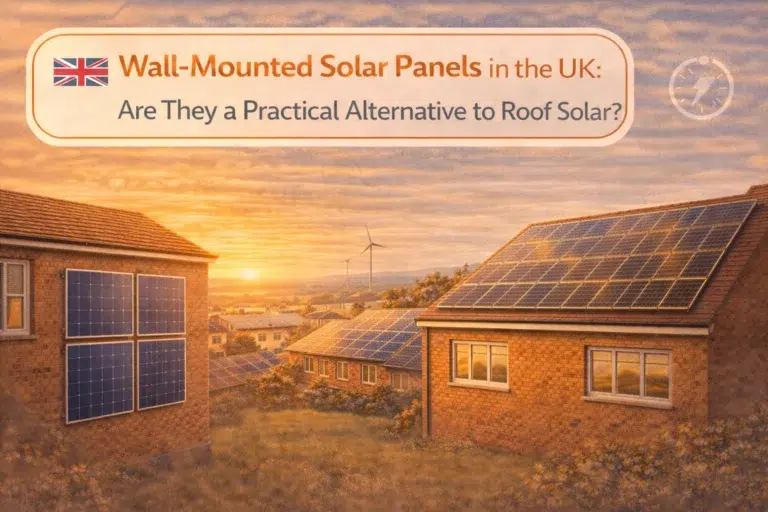
Wall-Mounted Solar Panels in the UK: Are They a Practical Alternative to Roof Solar?

Last Updated 3 weeks ago
Solar Guides
What happens if your roof isn’t suitable for solar panels? Can a wall-mounted system still deliver meaningful electricity savings, or is it a compromise that rarely pays off?
Table of Contents
Solar panels have become a familiar feature on rooftops across the UK, and for good reason. A well-positioned roof usually offers the best balance of space, sunlight exposure, and installation simplicity, making it the default choice for most solar PV systems. But not every property fits that mould. Some homes have roofs that face the wrong direction, are heavily shaded for much of the day, or don’t offer enough uninterrupted space to install a meaningful number of panels. In other cases, access to the roof may be restricted altogether, particularly in flats, mixed-use buildings, or certain commercial properties.
When the roof isn’t a viable option, wall mounted solar panels are sometimes suggested as an alternative. Instead of placing panels on the roof, they are fixed to an external wall, allowing properties with limited roof potential to still consider generating their own electricity. This can make solar possible where it might otherwise be ruled out entirely, especially if there is a clear, south-facing wall with minimal shading.
That said, wall mounted solar panels are not a like-for-like replacement for roof-mounted systems. They typically generate less electricity over the course of a year, often support fewer panels, and can be more complex to install. The decision to mount panels on a wall is usually driven by site constraints rather than preference. Understanding how wall-mounted systems perform in UK conditions, what they cost, and when they make sense in practice is essential before committing to this type of installation.
Summary
Wall mounted solar panels can work in the UK, but they’re usually a secondary option when roof installation isn’t viable. They tend to generate less electricity than roof-mounted systems and often cost more to install due to added complexity. A clear, south-facing wall with minimal shading is essential if a wall-mounted system is going to make financial sense.
What are Wall-mounted Solar Panels?
Wall-mounted solar panels are standard solar PV panels that are fixed to the exterior wall of a building rather than installed on the roof. The panels themselves are no different from roof-mounted panels; the distinction lies purely in how and where they are mounted.
They can be installed close to vertical, sitting parallel to the wall, or mounted on brackets that allow a small degree of tilt away from the building. In some cases, panels are installed in a canopy-style arrangement above doors or walkways, although this is less common for residential systems.
How Well Do Wall-mounted Solar Panels Perform in the UK?
In most UK installations, wall mounted solar panels produce less electricity over the course of a year than roof-mounted systems. The main reason for this is the angle at which the panels are installed and how that angle affects sunlight exposure.
Solar panels typically perform best when they are:
- Angled between 20° and 50°
- Facing south, or close to south
Roof installations can often achieve something close to this ideal setup. Wall-mounted panels, by comparison, are usually installed close to vertical, which limits how much direct sunlight they receive across the year.
Although wall-mounted systems can be fitted with brackets that tilt the panels slightly away from the wall, the amount of adjustment is usually limited by practical considerations such as structural safety and wind loading. As a result, they rarely match the year-round output of a well-positioned roof system.
That said, performance always depends on the specific property. In practice:
- A south-facing wall can outperform a north-facing roof
- Wall-mounted panels may perform relatively better in winter, when the sun sits lower
- Heavily shaded roofs can reduce output more than expected
For these reasons, wall-mounted solar panels are best viewed as a practical alternative when roof installation isn’t viable, rather than a direct replacement for roof-mounted solar.
How Much Electricity Can Wall-mounted Solar Panels Generate?
The amount of electricity a wall-mounted solar system can generate is usually limited by how many panels can physically fit on the wall. On many UK homes, usable wall space often only allows for two or three panels to be installed.
For context, a typical roof-mounted solar PV system in the UK is around 4 kWp, which usually means 8–10 panels depending on panel size. Under average conditions, a system of this size can generate roughly 3,400 kWh of electricity per year.
A wall-mounted system is usually much smaller. For example:
- Three 400W panels (around 1.2 kWp total) might generate around 1,000 kWh per year
- The average UK household uses roughly 2,700 kWh of electricity annually
This means a wall-mounted system on its own is unlikely to cover a large share of a home’s electricity demand. Instead, it typically contributes a partial offset, reducing reliance on grid electricity rather than replacing it entirely.
Because of these limits, wall-mounted solar panels are most often used where a roof installation isn’t possible. In those cases, generating some solar electricity is usually preferable to generating none at all, as long as expectations around output are realistic.
What Affects the Performance of Wall-mounted Solar Panels?
The performance of wall-mounted solar panels depends largely on site conditions rather than the panels themselves. Because wall-mounted systems usually support fewer panels and operate at less optimal angles than roof installations, factors like orientation and shading tend to have a bigger impact on overall output.
Factor | Why it matters for wall-mounted solar |
Direction | South-facing walls generally perform best in the UK, as they receive the most consistent sunlight across the day. East- and west-facing walls can work, but typically generate less electricity. North-facing walls are usually unsuitable due to limited direct sunlight. |
Shading | Wall-mounted panels are more likely to be affected by shading from nearby buildings, trees, or fences. Even partial shading can significantly reduce output, especially on smaller systems. |
Tilt angle | Panels installed close to vertical receive less sunlight for much of the year. Using brackets to tilt panels slightly can improve performance, but the degree of tilt is often limited by structural and safety constraints. |
Available wall space | Wall installations usually allow for fewer panels than roofs. With fewer panels generating electricity, total output is lower, and any losses from shading or orientation become more noticeable. |
Surroundings | Properties in open or rural areas often provide better conditions for wall-mounted systems than dense urban settings, where nearby buildings can block sunlight for long periods. |
In some situations, a clear south-facing wall can outperform a poorly oriented or heavily shaded roof. For that reason, the performance of wall-mounted solar panels is always assessed on a site-specific basis, rather than treated as a standard alternative to roof-mounted systems.
How Much Do Wall mounted Solar Panels Cost?
Wall-mounted solar panels typically cost more to install than roof-mounted systems of a similar size. The panels themselves are the same price, but installation is more involved.
Additional costs can come from:
- Specialist wall mounting brackets and fixings
- Structural checks to ensure the wall can support the load
- Longer installation time
- Access equipment such as scaffolding
While the total system cost may be lower simply because fewer panels are installed, the cost per panel is often higher than for a standard roof installation.
How Are Wall-mounted Solar Panels Installed?
Installing wall-mounted solar panels is a slightly more involved process than a standard roof installation, but it is still straightforward for professional installers.
Typically:
- The full installation takes around two to three days, depending on the number of panels and site complexity.
- Panels are fixed to the wall using specialised mounting brackets, usually positioned as high as possible to maximise sunlight exposure.
- Scaffolding or access equipment is normally required to allow installers to reach the mounting points safely.
- Once the panels are in place, they are connected to an inverter and tied into your property’s electrical system, just like a roof-mounted setup.
The main difference from a roof installation is the mounting method; wall systems rely on secure fixings that can handle wind loads and ensure the panels remain stable and weatherproof over time.
Do Wall-mounted Solar Panels Need Planning Permission in The UK?
In most cases, wall-mounted solar panels can be installed under permitted development rights, so you do not need planning permission.
However, there are some situations where extra checks or formal consent may be required, including if:
- The property is listed
- The building is in a conservation area
- The appearance of the building is significantly altered
Because wall-mounted panels are often more visible than roof-mounted systems, planning issues can arise more frequently. It’s a good idea to check with your local planning authority early in the process to confirm whether any permissions are needed for your specific property.
What Are the Pros and Cons of Wall-mounted Solar Panels
H3: Advantages
- Wall-mounted solar panels make solar possible for properties where roof installation isn’t suitable, such as homes with limited roof space, complex roof shapes, or roofs that mainly face north.
- Vertical panels are less prone to dirt and debris build-up, which can make maintenance slightly easier over time.
- Wind loading can be lower than with roof-mounted systems, reducing strain on the building structure.
- Any excess electricity generated can still be exported to the grid through the Smart Export Guarantee (SEG).
Disadvantages
- Wall-mounted systems usually generate less electricity than roof-mounted alternatives due to panel angle and limited space.
- Shading from nearby buildings or trees can have a greater impact on performance.
- Fewer panels can typically be installed, which limits total output.
- Installation is more complex, which can increase costs, even though overall system prices may appear lower due to smaller system sizes.
Wall-mounted vs Roof Mounted Solar Panels
Wall-mounted and roof-mounted solar panels use the same technology, but how and where they’re installed has a noticeable impact on performance, system size, and overall value.
Feature | Roof-mounted solar panels | Wall-mounted solar panels |
Typical performance | Higher annual output | Lower annual output |
Panel angle | Often close to optimal | Usually near-vertical |
System size | Easier to install larger systems | Usually limited to fewer panels |
Shading risk | Depends on roof position | Often higher due to nearby buildings or trees |
Installation complexity | Generally simpler | More bespoke and labour-intensive |
Best suited for | Homes with usable roof space | Properties where the roof isn’t viable |
For most UK properties with suitable roof space, a roof-mounted system remains the most efficient and cost-effective option. It allows for better panel positioning, more panels overall, and more consistent electricity generation throughout the year.
Wall-mounted solar panels are typically considered when roof installation isn’t practical, for example, where the roof faces predominantly north, is heavily shaded, structurally unsuitable, or not accessible. In these cases, wall mounting can provide a workable alternative, even though overall generation is usually lower.
Who Are Wall-mounted Solar Panels Suitable For?
Wall-mounted solar panels are generally best suited to properties where a standard roof installation isn’t practical. This can include:
- Homes with a clear, south-facing wall and limited usable roof space, where the wall receives more consistent sunlight than the roof
- Properties with roofs that face predominantly north or are heavily shaded for much of the day
- Buildings with structural limitations, where the roof cannot safely support the additional weight of solar panels
- Homes with complex or unusual roof layouts, where installing panels would be difficult or inefficient
In these situations, wall-mounted solar panels can provide a workable alternative, allowing some level of solar generation where a roof-mounted system may not be viable.
Who are Wall-mounted Solar Panels Not Suitable For?
Wall-mounted solar panels are generally not the best choice for properties that already have suitable roof space. In many cases, a roof-mounted system will deliver better performance and value.
Wall-mounted solar panels may not be suitable for:
- Homes with ample, well-oriented roof space, particularly roofs that face south, south-east, or south-west
- Properties where a larger solar system is needed, as wall installations usually limit the number of panels that can be fitted
- Homes in areas with heavy surrounding shade, where nearby buildings or trees block sunlight for much of the day
- Properties where appearance is a major concern, as wall-mounted panels are often more visible than roof installations
If a roof-mounted system is viable, it will almost always be the more efficient and cost-effective option. Wall-mounted solar panels are best viewed as a practical fallback when roof installation simply isn’t possible, rather than a direct alternative when good roof space is available.
Bottom Line
Wall-mounted solar panels can be a viable option when roof installation isn’t possible, but they’re rarely the first choice. Performance is usually lower, installation is more complex, and system size is often limited. The decision only makes sense when the site conditions support it.
Wall-mounted solar panels aren’t a like-for-like replacement for a well-designed roof system, but they can be a practical option when roof installation isn’t possible. For properties with a clear, south-facing wall and limited roof potential, wall mounting can still provide meaningful electricity generation, as long as expectations around output, system size, and cost are realistic.
Because wall-mounted systems are highly site-specific, the right approach is always to assess the property as a whole. Factors like shading, wall orientation, structural suitability, and alternative roof options all play a role in whether wall mounting makes sense in practice.
If you’re unsure whether wall-mounted solar panels are suitable for your property, Solar4Good offers an obligation-free consultation. Our team can review your site, compare wall-mounted and roof-mounted options, and give you a clear, honest view of what’s likely to work best for your home or business, without any pressure to proceed.
Wall mounted solar panels can work in the UK, but they’re usually a secondary option when roof installation isn’t viable. They tend to generate less electricity than roof-mounted systems and often cost more to install due to added complexity. A clear, south-facing wall with minimal shading is essential if a wall-mounted system is going to make financial sense
Ready to go Solar ?
FAQs
In most cases, yes. Roof-mounted systems can usually achieve better angles and accommodate more panels.
They can be tilted slightly using brackets, but not usually enough to match the performance of a well-angled roof system.
They can perform relatively better in winter due to the lower sun angle, but overall annual output is still typically lower.
They often cost more per panel due to additional mounting hardware, access requirements, and installation complexity.
Not always, but listed buildings and conservation areas usually require additional checks.

About the author -
Manan Shah
Leader without Title, Solar4Good
London, United Kingdom
Manan helps homeowners and businesses understand solar with clear, honest advice rooted in real-world experience. He has led national solar education seminars and spoken at major events including Everything Electric Show and The Care Show.