

What Are the Commercial Solar Panel Regulations in the UK?


Last Updated 1 month ago
Commercial Solar
What planning and building rules apply to commercial solar panel installations? How can businesses ensure compliance before starting their solar project?
Table of Contents
- 5. What are permitted development rights?
- 6. How do building regulations apply to solar installations?
- 7. How are listed buildings and conservation sites handled?
- 8. What are the key environmental and health safety obligations?
- 9. How does grid connection approval work (DNO process)?
- 10.Why is MCS certification important for businesses?
- 10. Why working with certified installers matters
- 10. Botton line
- 11. Final thoughts
- 12. Faq
If you’re a business in the UK thinking about going solar, you might already know that commercial installations come with a few more steps than residential ones. And yes, there are some rules to follow. You’ll need to think about the strength of your roof, electrical safety, and whether any planning or grid permissions are needed before work begins.
But here’s the reassuring part: once you understand the basics, the process is far less daunting than it might seem at first. The regulations are really just there to make sure two things are true: that your building can safely support the system, and that the installation is completed to a standard that protects you long-term. In other words, it’s about making sure the investment actually performs the way you expect it to.
In this guide, we’ll walk through the key points every business should know before installing solar panels, from planning permission and building control to fire safety, grid approval, and installer certification. Whether you’re looking at panels for a warehouse, office, school, retail unit, or farm building, these same principles apply. The aim here isn’t to make things complicated, but to give you a clear picture of what’s involved, so you can move forward confidently and avoid any surprises down the line.
TL:DR (Summary)
Commercial solar systems do need to meet certain planning and building requirements, but most projects fall under permitted development, so full planning permission often isn’t required unless the building is listed or in a protected area. Building control approval is usually needed to confirm the roof can safely take the weight of the panels and that the electrical and fire safety standards are properly met. You’ll also need approval from your local grid operator (the DNO) if your system will export electricity. And finally, make sure your installer is MCS-accredited — not just for peace of mind, but because it’s essential for compliance, insurance validity, and claiming export payments. Once you know these steps, the whole process is much smoother than it first appears.
Why Do Businesses Need to Understand Solar Regulations?
Installing solar is a long-term investment, and the last thing any company wants is a compliance issue down the line.
Understanding commercial solar regulations helps you:
- Avoid costly rework or delays.
- Qualify for export payments through the Smart Export Guarantee.
- Ensure your installation meets insurance and warranty requirements.
- Maintain building integrity and safety standards.
This is groundwork, before panels ever touch your roof, these rules are there to ensure the system is structurally sound, electrically safe, and legally compliant so you avoid possible red tape and issues in future. If your is the type to have fingers in many pies or in this case multiple sites, understanding solar panel installation regulations in the UK also helps standardise installations nationwide.
Do Commercial Solar Systems Need Planning Permission?
For most businesses, the answer is no, thanks to something called permitted development rights. This means you can usually install panels without a full planning application, as long as you meet a few basic conditions.
However, there are exceptions. You’ll need permission if:
- The installation protrudes more than 200mm from the roof.
- Your property is a listed building or located in a conservation area.
- The panels would cause significant glare or visual impact to nearby properties or roads.
- The array is being installed on the ground and exceeds 9 square metres.
The best way to think about it is like this: if your panels will noticeably change how your property looks or behaves, check with your local authority first.
What’s The Difference Between Planning Permission and Building Regulations?
Here’s a simple comparison of when planning permission applies and how building control solar panels requirements fit in:
Installation Type
Planning Permission Required?What Happens
Building Regulations Apply?
Notes
Rooftop solar panels on commercial buildings
Usually not (under permitted development)
Yes – structural and electrical checks required
Must not extend more than 200mm above the roof surface
Ground-mounted solar arrays (under 9m²)
Not required
Yes
Must not exceed 4m in height or be near property boundaries
Ground-mounted solar arrays (over 9m²)
Yes
Yes
Planning approval required from local council
Listed buildings or conservation areas
Always
Yes
Requires heritage and visual impact assessment
Flat roofs on warehouses or offices
Usually not
Yes
Mounting angle and ballast must meet building control solar panels standards
Tip: Even if planning permission isn’t needed, you’ll still need to comply with solar panels building regulations to ensure your system is safe and insurable..
Ready to go Solar ?
What Are Permitted Development Rights?
Permitted development rights let businesses carry out certain improvements, like solar installation, without applying for formal planning permission.
For most commercial sites, the conditions are simple:
- The panels shouldn’t extend more than 200mm from the surface of the roof.
- They shouldn’t sit higher than the highest part of the roof.
- Any wall-mounted systems must not face onto a main road.
- Panels must be sited to minimise visual impact and avoid glare.
While these are national rules, local authorities can have variations, especially in areas with unique planning restrictions. Always confirm with your council before installation, it’s quick, free, and can prevent unnecessary back-and-forth later.
How Do Building Regulations Apply to Solar Installations?
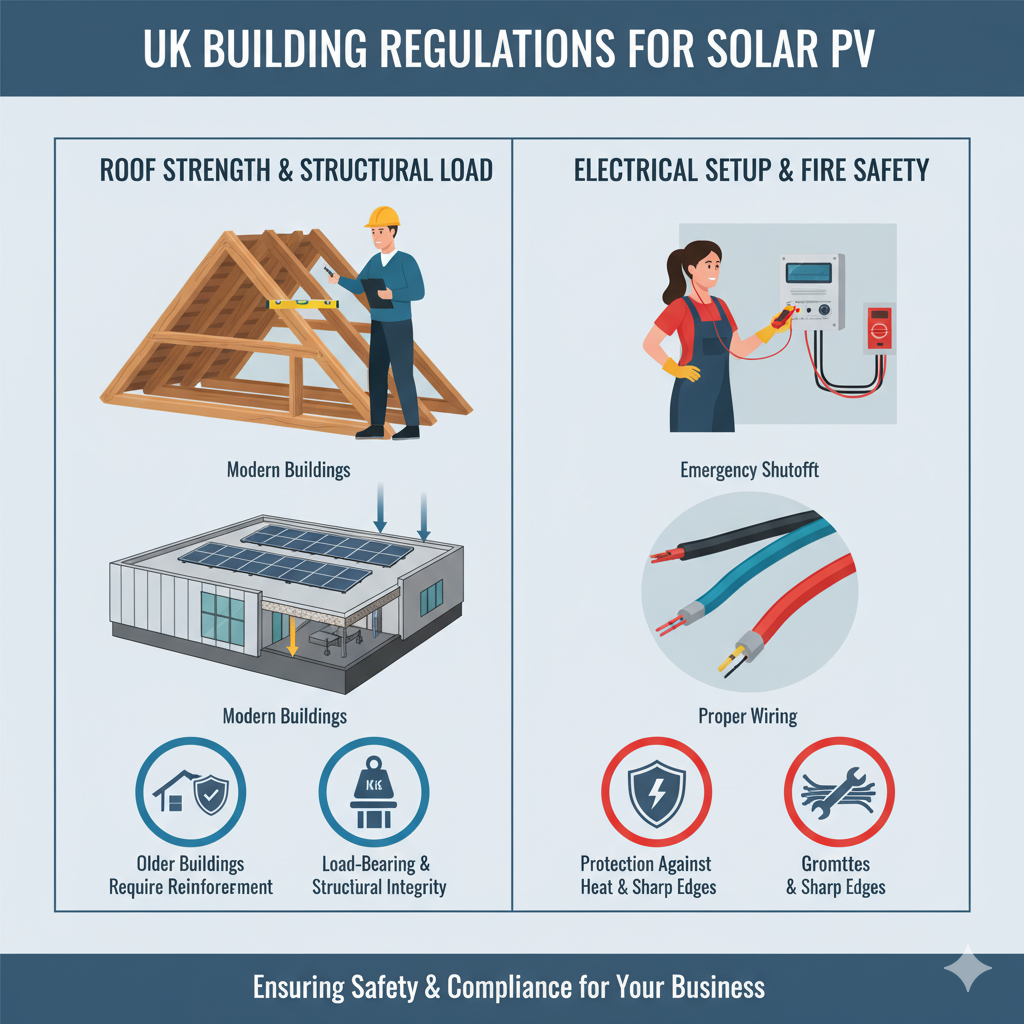
Even if planning permission isn’t needed, your solar setup still has to meet building regulations; it’s basically a safety check. Panels add weight, and they catch the wind, so your roof needs to be able to handle it. The rules are there to make sure everything is secure and wired properly, nothing more complicated than that.
1. Roof Strength and Structural Load
Before any panels go up, someone needs to take a look at the roof and make sure it can support them. Most modern buildings are fine, but some setups need a little reinforcement.
For example:
- Big warehouse roofs with thin metal sheets sometimes need extra support underneath.
- Older buildings may need a structural engineer to sign everything off first.
This isn’t a paperwork burden; it’s just making sure your roof is safe and won’t end up under strain once the panels are installed. Once that’s confirmed, you’re good to move on.
2. Electrical Setup and Fire Safety
After the roof is cleared, the next check is the wiring. All the electrical work has to follow UK safety standards, and it needs to be done by someone qualified — usually an MCS-accredited installer.
A few simple things are looked at here:
- Making sure there are easy-to-reach emergency shutoff switches.
- Keeping cables tidy, well-secured, and protected from heat or sharp edges.
- Routing wiring in a way that avoids unnecessary fire risks.
Nothing dramatic, just sensible, everyday safety steps to make sure the system runs smoothly and stays safe long-term.
How Are Listed Buildings and Conservation Sites Handled?
If your business operates in a conservation area or a listed property, you’ll almost always need explicit planning permission before installing solar.
The main concern here is visual impact. Panels should complement, not dominate, historic architecture. Ground-mounted systems or discreet roof placements are often approved faster.
What Are the Key Environmental and Health & Safety Obligations?
Every business is legally required to meet workplace health and safety standards. For solar installations, that means following the Construction (Design and Management) Regulations 2015 (CDM).
Your installer should provide:
- A site-specific risk assessment.
- Fall protection for rooftop work.
- Certified mounting systems for wind and snow loads.
- Proper disposal or recycling of packaging and waste materials.
For environmental compliance, ensure your panels come from traceable sources and meet UK recycling directives at end-of-life.
Ready to go Solar ?
How Does Grid Connection Approval Work (DNO Process)?
If your system connects to the national grid, you’ll need approval from your local Distribution Network Operator (DNO).
Small commercial systems under 16A per phase (around 3.68 kW per phase) are usually approved automatically under the G98 process. Larger installations fall under G99 regulations, which require prior approval before connection.
Your installer handles this paperwork, but you’ll need DNO confirmation before energising your system — it’s one of the key checkpoints for solar panel installation regulations in the UK.
Why Is MCS Certification Important for Businesses?
The Microgeneration Certification Scheme (MCS) is the industry standard for renewable energy installations in the UK.
Working with an MCS-accredited installer ensures:
- Your system meets quality and performance standards.
- You’re eligible for export payments (SEG).
- Warranties remain valid.
- Your installation complies with all relevant solar panels building regulations.
Without MCS certification, most insurers and finance providers won’t recognise your system.
Why Working With Certified Installers Matters
When it comes to commercial solar, who you work with makes a big difference, that’s because it’s not just about having someone who can fit panels to a roof; it’s about making sure the whole setup is safe, properly approved, and built to last. A certified installer understands the regulations, knows how to handle the paperwork, and makes sure everything is signed off correctly so you’re covered from day one.
At Solar4Good, we look after the full process for you. That includes the system design, the grid (DNO) application, structural checks, and the final MCS certification that proves your installation meets UK standards. You don’t have to chase different contractors or guess what comes next; it’s all handled in one place.
We’ve helped a wide range of businesses, from offices and warehouses to retail spaces, cut their energy costs and lower their carbon footprint without hassle or shortcuts. If you’d like to see how we approach compliance and project planning, take a look at our Commercial Solar Installation page. It gives a clear idea of how we work and what you can expect along the way.
Bottom Line:
Commercial solar systems are more than just panels and wiring; they’re regulated energy installations. Understanding solar panel installation regulations in the UK keeps your project safe, insurable, and compliant.
Most businesses won’t need planning permission, but every system must follow building control solar panels rules for structure, safety, and electrical integrity.
Do it right, and your installation will pay for itself faster, run longer, and boost your reputation for sustainability.
Final Thoughts
Navigating commercial solar panel regulations might sound like a hassle, but with the right partner, it’s a smooth, one-time process. Solar4Good takes care of every step, from planning and DNO approval to certification and sign-off, so you can focus on running your business, not chasing paperwork.
Ready to go solar the right way? Contact us for a free, no-obligation site assessment today and get expert guidance on every compliance step.
FAQs
Usually not. Most systems qualify under permitted development rights, unless you’re in a listed or protected area.
A qualified structural engineer or building control officer. This check is required under UK building regulations.
Yes, as long as the tilt and ballast meet structural and wind-load requirements.
G98 approvals are near-instant. G99 can take 8–12 weeks depending on your local grid capacity.
They may, depending on your local authority and system size. Your installer will liaise with them if needed.

About the author -
Manan Shah
Leader without Title, Solar4Good
London, United Kingdom
Manan helps homeowners and businesses understand solar with clear, honest advice rooted in real-world experience. He has led national solar education seminars and spoken at major events including Everything Electric Show and The Care Show.