
How Solar Panels Power Factories: Reducing Energy Costs in Manufacturing
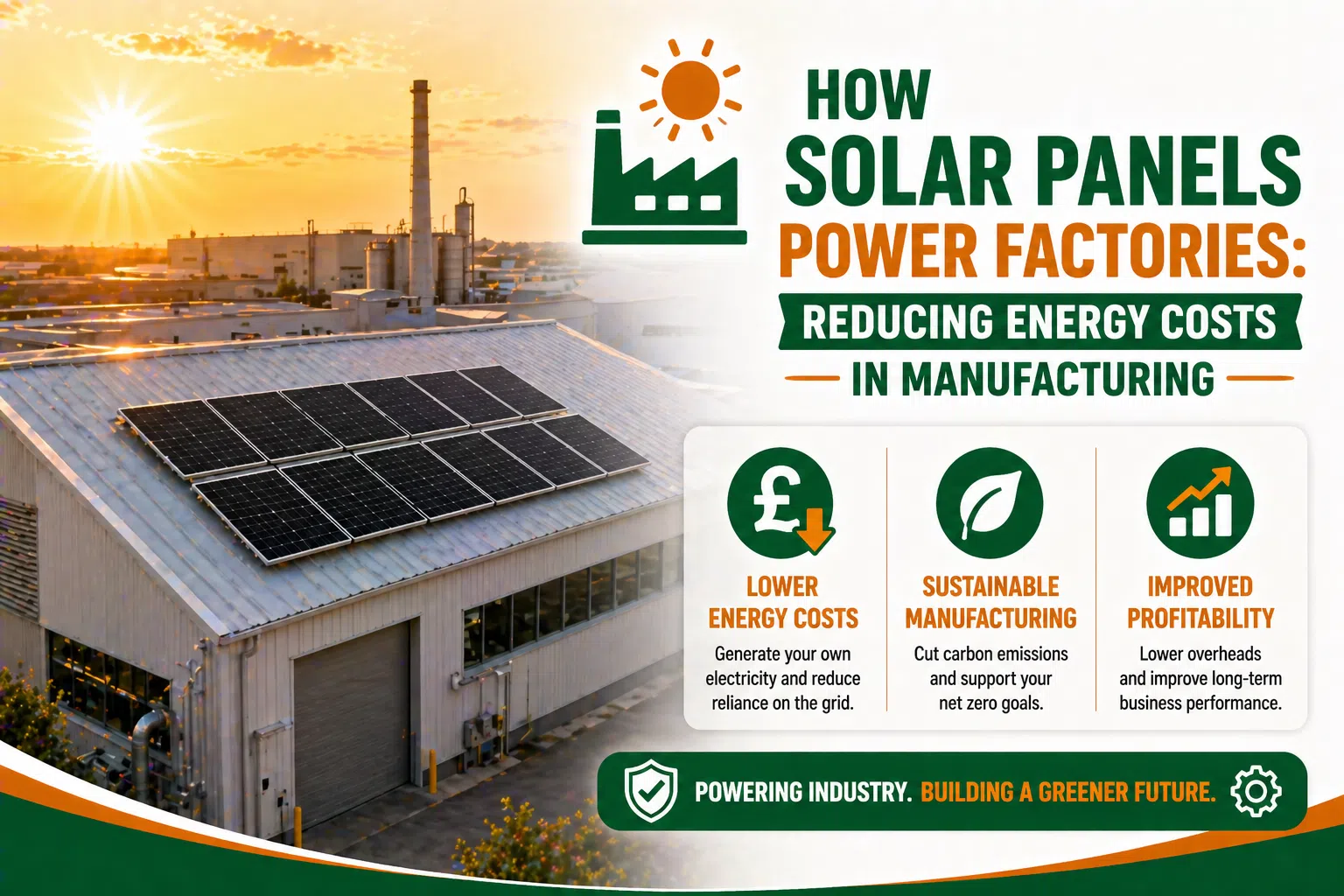

Solar panels for factory buildings are commercial photovoltaic systems that generate electricity on site during production hours, allowing UK manufacturers to reduce grid reliance without disrupting operations. Because manufacturing demand is steady and concentrated in daylight hours, factories typically self-consume 70–90% of what they generate — far more than offices or retail. This guide explains where the electricity goes, how it supports production, and what determines whether a system delivers real value.
- 1. Why solar panels work so well on factory sites
- 2. How factory solar panels generate usable power
- 3. Where factory solar energy is actually used on site
- 4. How solar supports production through the working day
- 5. What types of factory solar systems are used in manufacturing
- 6. How solar affects manufacturing energy costs
- 7. What manufacturers should check before installing solar
- 8. Are solar panels the right fit for your factory?
- 9. Frequently Asked Questions
The Short Version (Read This First)
Key facts about solar panels for factory buildings:
- Solar panels for factory buildings work best because manufacturing energy demand is high, steady, and concentrated during daylight hours
- Factory solar systems feed power directly into operations without changing how the site works or requiring staff to manage anything
- Solar reduces grid reliance and stabilises energy costs without disrupting production
- When designed around real production loads, solar delivers operational value rather than just good-looking numbers
- The strongest results come from sizing the system to support on-site baseline demand, not to maximise export
- Solar4Good® is MCS certified (NAP/72775/25/4), HIES protected (S4G/A/1484), and has completed 2,610+ UK installations across residential, commercial, and industrial sites
Manufacturing sites operate under constant energy pressure. Electricity is not just a background cost; it powers production lines, machinery, compressed air systems, ventilation, lighting, and increasingly automated processes. Therefore, when tariffs rise or peak charges increase, those costs hit margins directly.
That is why more manufacturers now look at solar not as a sustainability add-on, but as an operational tool. Solar panels for factory buildings let businesses generate electricity on site during the same hours production is running, which reduces reliance on grid power when it is most expensive.
What makes factories particularly well-suited to solar is predictability. Unlike offices or homes, manufacturing plants often run on fixed schedules with steady daytime demand. As a result, factory solar systems can feed power directly into operations without changing how the site works. This guide explains how solar panels power factories in practice, where the electricity is actually used, how solar affects costs, and what determines whether a system delivers real operational value.
Why Solar Panels Work So Well on Factory Sites
Factories are one of the most predictable energy users in the built environment, and that predictability is exactly what makes solar panels for factory buildings effective.
Unlike offices or residential properties, manufacturing sites do not see short, irregular bursts of electricity use. Production lines, machinery, and environmental systems typically run continuously for long stretches while work is happening. Consequently, that creates a steady, daytime energy load rather than a series of peaks and troughs.
On most factory sites, a small number of core systems drive electricity demand, each operating for hours at a time:
- production lines and automated machinery
- motors, pumps, and compressed air systems
- ventilation, extraction, and process cooling
- lighting across large manufacturing and storage areas
Because these systems are active during the working day, they draw power at the same time solar panels generate electricity. This overlap is the key reason solar panels for factory sites tend to achieve high on-site use, rather than exporting large amounts of power back to the grid.
📊 Why factories self-consume 70–90% of their solar
A factory’s electricity demand is steady and concentrated during daylight hours, which is exactly when solar generates. That overlap means most factories use 70–90% of their solar output directly on site — compared with roughly 40–60% for offices and 30–50% for retail. Higher self-consumption is what makes factory solar effective, because every unit used on site displaces a unit the factory would otherwise import from the grid.
Solar fits around how factories already run
The important point is that solar does not require factories to change how they operate. There is no need to reschedule production or manage loads manually. Once installed, solar simply feeds electricity into the site while production runs, which reduces how much grid power the factory needs during the most energy-intensive hours. In practical terms, this is why solar panels for factory buildings are usually assessed around baseline operational demand, not peak output. The value comes from supporting work that is already happening, not from generating electricity for its own sake.
★★★★★ Trustpilot
“From initial survey to flawless installation, Solar4Good delivered an exceptional solar experience. The team worked meticulously and left the site spotless. Clear explanations, transparent pricing with no hidden fees.”
— Verified commercial customer
How Factory Solar Panels Generate Usable Power
For manufacturing sites, the key question is not whether solar can generate electricity, but whether the factory can use that electricity directly while production runs. Understanding how solar panels for factory buildings connect into the electrical system explains why they reduce costs without changing operations.
Solar panels on factory roofs generate electricity from daylight throughout the working day. That electricity passes through inverters, which convert it into usable power, and then feeds directly into the factory’s existing electrical infrastructure alongside the grid connection.
From that point, electricity flows in a simple priority order:
- The factory uses solar-generated electricity first
- The grid supplies any additional demand automatically
- Surplus electricity may export if generation exceeds on-site load
This process happens continuously and automatically. Staff do not need to manage switches, adjust production schedules, or monitor the system day to day. Factory solar systems operate quietly in the background, supplying power whenever daylight is available. As a result, by supplying part of the factory’s daytime demand on site, solar displaces grid electricity during the most expensive operating hours, without interrupting production or requiring behavioural changes. For many sites, that is the practical value of solar power for manufacturing plants: less exposure to peak-rate imports while the factory is active.
Where Factory Solar Energy Is Actually Used on Site
In a factory, electricity demand is not evenly spread across the building. Instead, it concentrates in the systems that keep production running hour after hour. That concentration is what allows solar panels for factory sites to deliver practical value, even when they only cover part of the total demand.
Ready to go Solar?
Most factories draw a steady baseline load during operating hours. Solar generation feeds directly into that baseline, which reduces how much electricity the site imports from the grid while production is active. Therefore, well-designed factory solar systems are planned around these core loads rather than peripheral or occasional use.
In practice, solar power for manufacturing plants most commonly supports:
- Production machinery and automated lines: Equipment that runs continuously during shifts is often the largest daytime electricity draw, and solar supports these loads directly while production is underway.
- Motors, pumps, and compressed air systems: These systems operate for long periods and form a consistent background load that solar can offset reliably.
- Ventilation, extraction, and process cooling: Environmental control systems are essential during production hours and often scale with activity levels, which aligns well with daytime solar output.
- Lighting across large factory floors and storage areas: High-bay lighting runs throughout the working day and absorbs solar generation without needing any operational changes.
Because these systems already run while work is happening, the factory usually consumes electricity from solar panels immediately on site. That direct use is what makes solar effective in manufacturing environments, because it supports production quietly in the background rather than creating a separate energy workflow.
How Solar Supports Production Through the Working Day
Factory energy demand usually follows a rhythm that changes little from one day to the next. As shifts begin, machinery, ventilation, and lighting all come online together. Once production runs, electricity use stays relatively steady for hours, before dropping again as operations wind down.
Solar generation follows a similar pattern. Output builds through the morning, reaches its strongest levels around the middle of the day, and then gradually tapers off later in the afternoon. That overlap is what allows solar panels for factory sites to support production without interfering with how the plant operates.
When those two curves line up, factory solar systems can:
- reduce how much electricity the site imports from the grid during the most expensive daytime periods
- smooth energy costs across long production runs rather than short peaks
- support continuous manufacturing without requiring load shifting or schedule changes
The important point is that solar does not need to power everything to be effective. Even when solar power for manufacturing plants only covers part of the baseline load, it can still displace a meaningful amount of grid electricity during high-use hours. Over weeks and months, that partial coverage is often enough to make a noticeable difference to energy spend, without disrupting production or adding complexity.
★★★★★ Trustpilot
“Solar4Good provided excellent service from beginning to end within 2 weeks. Their advice and professionalism guiding me through the best suitable system for now and the future were excellent.”
— Verified customer
What Types of Factory Solar Systems Are Used in Manufacturing
Most manufacturing sites do not start by choosing a “type” of solar system. Instead, they start by looking at the space they control, how production runs during the day, and how much electricity they want to offset. The solar solution then follows from those realities.
In practice, factory solar systems used in manufacturing tend to fall into a small number of proven approaches. Manufacturers choose these systems for reliability and integration with production, not for novelty or complexity.
Rooftop solar on factory buildings
For many manufacturers, rooftop solar is the most straightforward starting point. Factory buildings often have large, unobstructed roof areas located directly above production floors, warehouses, or plant rooms. Installing solar panels for factory roofs keeps generation close to where the site actually uses electricity. Therefore, it reduces cabling distances, limits losses, and allows solar power to feed directly into daytime operations without changing how the site runs.
Larger rooftop systems sized for baseline demand
On higher-energy sites, manufacturers often install larger rooftop systems designed to offset a consistent portion of baseline demand rather than chasing peak output. Instead of trying to cover every possible load, these factory solar systems focus on supporting the electricity the site uses continuously during production hours. This approach usually improves self-consumption and avoids oversizing systems that would export large amounts of unused power.
Phased and expandable installations
Many manufacturers do not install everything at once. They start with a system sized for current operations and expand later as production grows, new lines are added, or operating hours increase. This phased approach allows solar power for manufacturing plants to scale alongside the business. It also reduces upfront risk, since the team can review performance before committing to additional capacity.
Taken together, these system types reflect how manufacturing sites actually operate. The most effective factory solar systems are not the biggest or most complex; rather, they are the ones that fit the site’s layout, production schedule, and long-term plans.
How Solar Affects Manufacturing Energy Costs
Solar does not reduce a factory’s energy use. Instead, it changes where the electricity comes from during the most expensive hours of operation. That distinction matters, because manufacturing costs are often driven by when power is bought, not just how much.
In a typical factory, electricity demand stays steady while production runs. Without solar, the site imports nearly all of that power from the grid at daytime commercial rates. When solar panels for factory buildings are installed, part of that daytime demand comes from on-site generation instead. The factory still draws from the grid, but less of it, and crucially, less during peak pricing periods.
Where the cost impact usually shows up
Factories tend to see the financial impact of solar power for manufacturing plants in three specific areas:
| Cost area | What changes with solar | Why it matters |
|---|---|---|
| Daytime grid imports | Reduced | These units are often the most expensive on a factory bill |
| Exposure to tariff volatility | Lower | A portion of energy cost becomes fixed once solar is installed |
| Budget predictability | Improved | Generation is stable year to year compared with grid pricing |
The value does not come from exporting electricity. Export rates are usually far lower than what factories pay to import power during the day. Therefore, the strongest savings come when factory solar systems are sized to support on-site production rather than generate surplus energy.
When solar has the biggest impact on factory costs
Solar tends to shift the numbers most clearly when:
- production runs consistently during daylight hours
- baseline demand is high and steady, not spiky
- the system is sized to offset part of that baseline rather than peak load
In these cases, even partial coverage can make a noticeable difference. Solar does not need to power the entire factory to reduce costs; it only needs to displace grid electricity during the hours the factory is already operating.
When expectations need adjusting
Solar has a smaller financial impact when most energy use happens overnight, when production is irregular or highly seasonal, or when systems are oversized and export a large share of output. In those situations, solar panels for factory sites still generate electricity, but less of it replaces high-cost grid power. That is why cost modelling for manufacturing needs to rest on real load profiles, not headline system size. In short, solar improves factory energy costs when it meaningfully replaces daytime grid imports. If it does not do that, the numbers rarely stack up as expected.
★★★★★ Trustpilot
“A site visit was booked the very next day after we confirmed. Scaffolders were in within the week, and our system was live just 10 days after commissioning.”
— Verified customer
What Manufacturers Should Check Before Installing Solar
Before committing to solar panels for factory buildings, the most important step is not choosing panels or comparing system sizes; rather, it is understanding how solar would actually interact with your site. A few things usually determine whether a factory solar project works well or struggles to deliver value:
- How electricity demand behaves across shifts: Whether production runs steadily through the day, ramps up in blocks, or changes seasonally affects how much solar the site can use directly.
- Which buildings and roof areas are under long-term control: Solar only makes sense where the factory expects to control the roof or site for many years, not where leases or future changes create uncertainty.
- How production may change over time: Planned expansion, new lines, automation, or electrification can all shift energy demand and belong in the plan early.
- What the grid connection realistically allows: Import limits, export constraints, and existing electrical infrastructure often shape what is possible more than roof space does.
These checks are difficult to do accurately from desk-based assumptions alone. Instead, professional installers who understand both factory operations and energy system design are best placed to carry them out. At Solar4Good, we offer a free consultation where we review your site layout, energy data, and production patterns together. The goal is not to sell a system; it is to give manufacturers a clear view of whether factory solar systems will deliver real operational and cost benefits for their specific site.
Conclusion: Are Solar Panels the Right Fit for Your Factory?
Solar panels for factory buildings are not a one-size-fits-all upgrade, but for many manufacturing sites, they have become a practical way to reduce exposure to rising energy costs. Factories that run during the day, control their buildings long term, and have consistent baseline demand are often well-positioned to benefit from solar power for manufacturing plants.
The key is not guessing. Whether solar delivers meaningful savings depends on how your factory actually uses electricity, how production may change, and what your grid connection allows. Those answers do not come from averages or headline system sizes; instead, they come from a proper site assessment.
If you want a clear, site-specific view of whether solar panels for factory operations would work for your business, contact us today for a free consultation. We review roof space, energy data, and production patterns to help you understand what is realistically achievable, and whether factory solar systems would deliver long-term operational value for your site.
★★★★★ TrustATrader
“The system’s performance has exceeded expectations, reducing our grid dependence significantly, with clear savings on electricity. Clear explanations, transparent pricing with no hidden fees.”
— Verified customer
Frequently Asked Questions
Performance and operations
Do solar panels for factory buildings work reliably in the UK climate?
Yes. Solar panels for factory sites generate electricity from daylight rather than direct heat, so they continue producing power on overcast days. While output is lower in winter, manufacturing demand during daylight hours means solar can still offset grid electricity across much of the year.
Will installing solar disrupt factory operations or production schedules?
No. Factory solar systems operate automatically once installed. They do not require production to be rescheduled, machinery to be switched manually, or staff to manage loads. From an operational point of view, the factory runs exactly as it did before.
Can solar support factories with high or continuous energy demand?
Yes, although solar usually offsets part of the demand rather than replacing the grid entirely. For most sites, solar power for manufacturing plants supports baseline daytime loads, which is often enough to deliver meaningful cost reduction without trying to cover peak or overnight demand.
Scaling, installation and planning
Are factory solar systems scalable as production grows?
In many cases, yes. Manufacturers often install solar in phases, starting with a system sized for current operations and expanding later as production lines, shifts, or electrification increase energy demand. This phased approach reduces upfront risk and lets the system scale with the business.
How long does a factory solar installation take?
Most commercial rooftop installations take from a few days to several weeks of on-site work, depending on system size and roof complexity. The wider project — covering survey, system design, DNO approval, and commissioning — usually runs over a number of weeks. Crucially, most of the work happens externally on the roof, so production continues while installation is underway. Solar4Good coordinates each stage as one managed project to minimise disruption.
Do factories need planning permission to install solar panels?
In most cases, no. Most rooftop installations on factory buildings fall under permitted development in the UK. However, site-specific checks are always sensible, particularly for listed buildings, visually sensitive locations, or very large systems. Grid approvals can also affect what is possible, so a professional assessment confirms the route early.
About the Author
Manan Shah
Co-Founder of Solar4Good UK. Leads Solar4Good's commercial strategy and customer relationships, and is quoted as a clean-energy authority by some of the UK's most trusted news publications. Quoted in the Financial Times and The Times on UK solar.
📞 Book a free solar consultation
Call us on 0800 999 1454 or visit solar4good.co.uk
Read over 775+ verified five-star reviews on Trustpilot and Checkatrade
Solar4Good Ltd · 79 College Road, Harrow, HA1 1BD · MCS: NAP/72775/25/4 · HIES: S4G/A/1484