★★★★★ 4.9MCS-certified1,000+ reviewscovering all of Greater London
As featured in
Solar, built for London
Solar in London: Residential and Commercial Installation Experts
Looking for trusted solar panel installers in London? If you’re searching for reliable solar panels in London, you’ve come to the right place. At Solar4Good, we work with both homeowners and businesses across the city to design and install solar systems that make sense, systems that actually save money, perform well, and last.
Choosing local solar panel installers in London matters. London solar projects come with their own mix of planning quirks, conservation areas and roof types, from Victorian terraces to new-build flats and flat commercial roofs. As solar panel installers in London who are actually based here, we certify every London solar and battery install under our own MCS registration, so whether it is a London solar and battery retrofit or a full commercial system, you deal with people who know the boroughs, not a national call centre.
Is your London property suitable for solar?
Four things decide it. Most homes pass on all four, and the one people worry about most is rarely the problem.
01
Which way the roof faces
The question we are asked most, and the one people get wrong. Due south is best, but in London an east-facing roof still returns about 80% of a south-facing one and west about 78%. South-east and south-west are within 7%. A roof that is not south facing is usually still worth doing.
02
How much roof there is
A 4kW system needs roughly 9 panels and about 18 square metres of usable roof. Panels can be split across two faces where one is not big enough, which is common on terraces and on houses with a rear extension.
03
Shading
A chimney, a dormer or a neighbour's tree costs more than people expect, because shade on one panel used to drag down the whole string. Panel-level optimisers or microinverters fix that, and the survey is where we work out whether you need them.
04
The roof itself
We check age, covering and structure before anything else. If a roof needs work in the next few years, it is cheaper to do it before the panels go on, and we will say so rather than fit around it.
Solar panels, battery storage and installation solutions in London
Solar Panel Installation for Homes in London
Our team looks at your roof, energy habits, and future plans to build a home solar that fits neatly into your daily life. We keep things simple, tidy, and efficient, so you start seeing the benefits without the hassle.
Commercial Solar in London
For offices, shops, and warehouses, we design commercial solar systems that go beyond saving money; they make your business more self-sufficient. Generating your own power helps stabilise costs, strengthen your green credentials, and reduce your dependence on the grid.
Battery Storage & EV Charging
Store the power you generate and charge your car on sunshine. We fit home and commercial battery storage, a matched inverter and a home EV charger across London.
Does your roof have to face south in London?
No, and the gap is smaller than most people expect. In the UK the sun sits in the southern sky, which is why a south-facing roof is the 100% case and every other direction is measured against it. Modelled for London.
Roof orientation
West78%Relative annual outputLondon home · 4kW · 35° pitch
Each figure is that orientation’s own annual output in London. The compass turns with the house, so the reading is for the way it is facing. Tap any of the five to hold it.
PVGIS (EU Joint Research Centre), 4kW system at a 35 degree pitch. An east or west facing roof in London still returns around four fifths of a south-facing one, which is usually the difference between worth doing and not.
What size system fits a London home?
Start with the one figure you already know off your bill. What comes back is what we actually quote a home that uses that much, and what it would make in London.
5,000kWh
E median
2,00015,000
It starts at 5,000 kWh, the middle of the 1,700+ quotes we hold a usage figure for. The mark shows E: a median of 4,500 kWh across 29 quotes.
What we typically quote a home like that
13panels6.2 kW
Modelled to make 6,213 kWh a year in London, against the 5,000 kWh you use. Over a year that is more than the house gets through, though not at the hours it gets through it.
Every panel above is drawn, so the count is exactly the count. How they sit is down to your roof, and that is what the survey settles.
What each size makes in London
System
Panels
Generation a year
Typically suits
3kWp
6 panels
2,987 kWh
Smaller homes, or a roof with one usable face
4kWp
8 panels
3,983 kWh
Around the size we fit most often
6kWp
13 panels
5,975 kWh
Larger homes, or a household with an EV
8kWp
17 panels
7,966 kWh
High usage, an EV and a heat pump
Generation from PVGIS (EU Joint Research Centre), 35 degree pitch, due south. The size we suggest is the median we quote homes in your usage band, across the 1,700+ of those quotes where we also hold the system size, not a rule of thumb: real quoting is much flatter than usage, because roof space caps the top of it. Panels at 480W, the AIKO module in most of our quotes; the 470W DMEGC needs one more for the same output. The table models whole kWp sizes, so its panel counts are the nearest module. What you save depends on your tariff and how much you use during daylight, which is what the free assessment works out. We will not put a figure on it before we have seen your bill.
What a London roof makes month by month
A 4kW system, modelled across the year. Summer does the heavy lifting, winter keeps going: 486 kWh in Jul against 148 kWh in Dec.
kWh generated per month
0200400600
155Jan
209Feb
343Mar
445Apr
471May
475Jun
486Jul
433Aug
375Sep
260Oct
184Nov
148Dec
PVGIS (EU Joint Research Centre), 4kW at a 35 degree pitch, due south. This is why a battery earns its keep in summer and the grid still carries you in December.
What people near London are specifying
Not a national average. This is our own quote book for the E postcode area, and these are quotes rather than completed installs.
5.64kW
The median system we are asked to quote in the E postcode area. Half are smaller, half larger, which is a more honest middle than an average.
10panels
What that size usually works out to on a roof here, at the panel wattages we fit today.
94%with battery
Of quotes in this area include battery storage. Almost nobody near London is now asking for panels on their own.
Median of 43 sized quotes in E, April to September 2026. Medians rather than averages: one unusually large property would otherwise drag the figure somewhere no ordinary home recognises.
Free, no obligation
Get your London solar quote
Tell us where you are and how to reach you. An MCS-certified Solar4Good engineer will talk you through what your roof can do, what it would cost and what it would save, with no pushy sales visit.
450 installs already completed around the London area
A real engineer, not a call centre
Your own figures, not a national average
We never pass your details to anyone else
UKPN London network
The grid London actually runs on
143g CO2 per kWh
The 12 British grid regions run from 7 g to 249 g, so London sits cleaner than 6 of them. It is what a unit of grid electricity actually costs in carbon here.
Imports30.7%Gas28.0%Wind25.0%Nuclear8.2%Solar6.1%
The London region's 12-month average, 16,908 half-hourly readings to the 12 months to September 2026. Source: National Grid ESO Carbon Intensity API (CC BY 4.0).
Technology partners
Trusted kit, installed properly.
Tesla Powerwall, SigEnergy, Fox ESS, Duracell and more, we fit trusted, tier-one panels and batteries built for British weather.
Real numbers · not stock photos
Solar panels London, by the numbers
London is the heart of our patch: 450 installs across the capital, concentrated around Finchley, Mill Hill and Golders Green in the north and reaching out to Ealing, Wimbledon and Leytonstone, all fitted by our own local teams. Every figure here is a real aggregate from our own completed jobs, part of 3,000+ installs and 50,000+ panels nationwide.
450+installs across the London area
12postcode districts named
2021installing here since
Jul 2026most recent install
4kWmost-fitted system size
Live install data · updated July 2026
Add your roof to the map, free assessment from your local London team.
What London homes are actually fitting
Ranked by real volume across our London-area installs, not a manufacturer’s suggested spec. The panels, inverters and batteries we fit most, and the system sizes London roofs actually take.
Panel brands we fit
Canadian Solar34 installs
Jinko18 installs
JA Solar27 installs
Trina15 installs
Canadian Solar34
JA Solar27
Jinko18
Trina15
Based on the 94 installs around London where the panel brand was recorded.
Inverters and batteries we fit
Fox ESS271 installs
Sigenergy33 installs
Fox ESS271
Sigenergy33
Based on the 304 installs around London where the inverter or battery brand was recorded.
System sizes London roofs take
2kW56 installs
3kW21 installs
4kW117 installs
5kW42 installs
6kW21 installs
8kW17 installs
Based on the 274 installs around London where the system size was recorded.
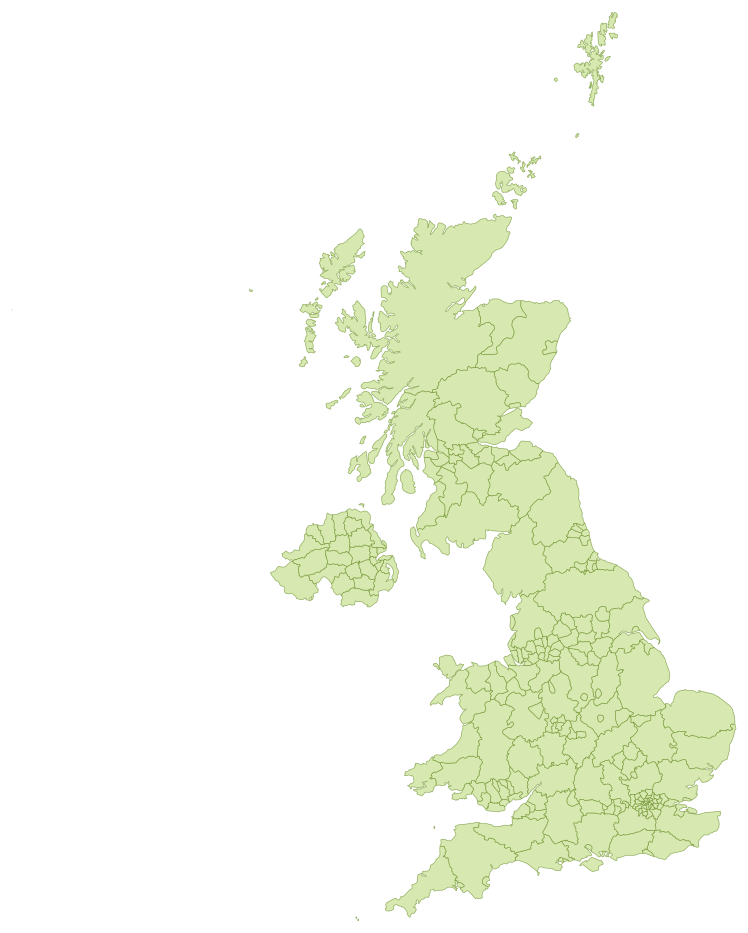
We install right across the London area
We have completed 450 installs across London. Search your postcode or tap the map to find your nearest; the map highlights our busiest London areas, with the rest spread across smaller postcodes. Wherever you are in the London postcodes you have a genuinely local team, based here, not a call centre. We cover the whole London area.
Mill HillNW7 · 25 installs near here
East FinchleyN2 · 19 installs near here
ColindaleNW9 · 16 installs near here
FinchleyN3 · 15 installs near here
EalingW5 · 15 installs near here
WhetstoneN20 · 14 installs near here
LeytonstoneE11 · 12 installs near here
WillesdenNW10 · 12 installs near here
CricklewoodNW2 · 11 installs near here
Golders GreenNW11 · 10 installs near here
WimbledonSW19 · 10 installs near here
Forest HillSE23 · 9 installs near here
Other London areassmaller postcodes · 282 installs
Covering Colindale, Cricklewood, Ealing, East Finchley, Finchley, Forest Hill, Golders Green, Leytonstone, Mill Hill, Whetstone, Willesden, Wimbledon and more. Do not see your street? Search above, we very likely still cover you.
Free assessment, no obligation, usually within a week.
How it works
Go solar in three easy steps
STEP 01
Complete a quick form
Answer a few simple questions about your London home or business. It takes about 30 seconds, and there is no pressure.
STEP 02
Choose your solar solution
Talk it through with our local London experts and get a clear quote for the right system for your roof.
STEP 03
We handle the installation
Our MCS-certified local engineers carry out the full installation professionally, around your schedule.
Key benefits of installing solar panels for your home or business in London
Reduce energy bills
Solar PV installation can significantly reduce your electricity bills, providing long-term savings.
Environmental benefits
Solar energy is clean and renewable, reducing greenhouse gas emissions and helping combat climate change
Energy independence
By generating your own electricity, you can reduce reliance on the grid and protect against rising energy costs.
Increased property value
Solar panels can increase the value of your property and make it more attractive to potential buyers.
Why choose certified solar panel installers in London?
That’s where we’re different. Solar4Good isn’t a faceless nationwide installer. We’re a hands-on team that actually knows London, the rooftops, the regulations, the weather, and what it really takes to make solar work in this city.
We only use technology we’d trust on our own homes. That means strong, efficient London solar panels, reliable inverters, and solid battery systems that handle the city’s changing seasons without fuss.
We believe in honesty. You’ll always know what’s happening and why, no fine print, no inflated promises.
It’s straightforward, professional service, from a team that genuinely enjoys helping London homes and businesses get more from solar.
At Solar4Good, we don’t just fit panels and call it a day, we build full solar energy setups that make sense for how you live or work. Whether you’re trying to cut bills, reach sustainability goals, or add EV charging to your site, we’ll guide you through it all from start to finish.
How much do solar panels cost in London?
Typical home installation
£5,000 to £10,000
in the London area
There is no special London price for solar. What you pay depends on your roof, how much power you use and whether you add a battery, not your postcode. Around London the system we fit most is about 4kW, and a typical home installation lands in this band, confirmed exactly with a clear, itemised quote after a free assessment.
Including 2 verified reviews from the London area, alongside more from homeowners across the UK.
★★★★★
4.9out of 5 · 1,000+ verified reviews Trustpilot · TrustATrader · Google
01
Couldn't be happier. From the first consultation to switch-on the team was professional and easy to work with. The whole process was stress-free.
Harish P.London · 5 ★★★★★ · checkatrade
02
Great service. Professional, knowledgeable team who installed panels and a battery. Very helpful with the wiring route. Looks exactly as I hoped.
Dr Kumail VersiNW London · 5 ★★★★★ · checkatrade
03
Good service Andy the electrician and the roofing team were great.
ChrisGB · 5 ★★★★★ · trustpilot
04
these people are absolutely excellent they arrived on time. They were fast, efficient and did an excellent job of setting up the solar power, battery, and organising all the cables will definitely recommend this team to everyone
Lee FranklinGB · 5 ★★★★★ · trustpilot
05
Very good experience. System well explained.installed efficiently and painlessly. Solar4good always easy to contact. Would recommend them
Francesco Luigi Giovanni CamisGB · 5 ★★★★★ · trustpilot
06
Excellent service! Good communication all the way through, quick efficient install. I had a technical question the next day and they got back to me immediately with the fix. Special shout out to Rommel from tech support!
Simon PhillipsGB · 5 ★★★★★ · trustpilot
07
The team showed up on time. Installed all the equipment to a high standard. The work area was swept and left clean and tidy. Cannot recommend highly enough.
Jack BarkerGB · 5 ★★★★★ · trustpilot
08
Competitive price, with great communication throughout the whole process. Experienced fitters who made the process as seamless as it could be and achieved everything that I expected. Thank you.
The things London homeowners and businesses actually ask before going solar.
How much does solar PV installation cost for a home in London?
The cost of solar panels for a home in London can vary depending on factors such as the size of the system, the type of panels chosen, and installation costs. On average, a typical residential solar panel installation in London can range from £5,000 to £10,000. However, government incentives and financing options may help offset some of these costs.
Do I need planning permission to install solar panels on my home in London?
In most cases, solar panel installations on residential properties in London are considered permitted development and do not require planning permission as long as specific criteria are met. However, it’s recommended to check with your local planning authority or consult with a professional installer to ensure compliance with regulations.
What is the lifespan of solar panels installed in London?
Solar panels installed in London typically have a lifespan of 25 to 30 years or more. While the initial investment in solar panels is significant, their long lifespan ensures that they provide a reliable and sustainable source of energy for decades to come.
How efficient are solar panels in London?
The efficiency of solar panels in London depends on various factors, including the orientation of the panels, shading, and weather conditions. On average, solar panels installed in London can have efficiency ratings between 15% to 22%, meaning they can convert 15% to 22% of sunlight into usable electricity. Across our London installs, 4kW is the system size we fit most.
Are there incentives available for solar panel installations in London?
Yes, there are several incentives available for solar panel installations in London, including the Smart Export Guarantee (SEG) and the Renewable Heat Incentive (RHI). These schemes offer financial incentives and payments for generating renewable energy, helping to offset the cost of solar panel installations.
Can I install solar panels if my roof is not south-facing in London?
Yes, solar panels can still be installed on roofs that are not south-facing in London. While south-facing roofs typically receive the most sunlight throughout the day, solar panels can still generate significant electricity on east-facing or west-facing roofs. A professional installer can assess the orientation and suitability of your roof for solar panel installation.
What is the payback period for solar panel installations in London?
The payback period for solar panel installations in London can vary depending on factors such as the cost of the system, energy savings, and available incentives. Payback depends on system size and how much of the electricity you use during daylight. As a guide, most home systems in London typically pay back in 8 to 12 years, and larger commercial systems are usually faster. Our calculator gives you a figure for your own roof in about a minute. With 450 installs completed around London, we base your estimate on real nearby jobs, not a generic average.
Why get solar panels?
Generate clean, renewable electricity Reduce your energy bills by up to 70% Get paid for unused electricity *Dependent on the customer’s consumption, generation and electricity cost at the time of install.
Are solar panels worth it in London?
It depends on your roof and how much electricity you use, not on the town. Modelled by PVGIS, a 4kW system in London returns about 3,983 kWh a year, and the median system we are asked to quote in the E postcode area is 5.64 kW. Whether that adds up for you comes down to your tariff and how much you use during daylight, which is what the free assessment works out. We will not put a figure on it before we have seen your bill.
How much electricity will solar panels generate in London?
About 3,983 kWh a year from a 4kW system, modelled for London by PVGIS (the EU Joint Research Centre) at a 35 degree pitch facing south. It is not spread evenly: roughly 471 kWh in May against 148 kWh in December. Your own figure depends on which way the roof faces, its pitch and any shading, which is what the survey measures.
Do solar panels need direct sunlight?
No. They run on daylight rather than heat or direct sun, so they generate on overcast days too. London shows it plainly: the same 4kW system still returns about 148 kWh through December, the dullest month of the year here.
Do you cover London?
Yes. We survey and install across the NW postcodes, including NW7, N2, NW9, N3, W5, N20, E11 and NW10. If your postcode is not in that list it is still worth asking, because the list is drawn from where we actually work rather than a radius drawn on a map.
Are your installers MCS certified?
Yes. Work is carried out under our own MCS registration. That matters beyond the badge: MCS is the UK government-recognised standard for solar installations and it is what the Smart Export Guarantee requires, so without it you cannot be paid for what you export. You can check any installer, us included, by name at mcscertified.com before you commit.
How do I choose a solar installer in London?
Check three things before you compare prices. That the installer is MCS certified, because the Smart Export Guarantee depends on it. That the quote is itemised, so you can see the panel, the inverter and the battery separately instead of one number. And that the workmanship warranty is written down, with who honours it named. It is also worth asking who files your DNO paperwork, because that is the step most often left to the customer.
Do solar panels save money?
They cut what you buy from the grid, and how much depends on your tariff, when you use power and whether you add a battery. In the E postcode area 94% of the systems we are asked to quote include storage, which is what lifts the share of your own generation you actually use. We will not put a saving figure on it before we have seen your bill.
How do solar panels work?
Solar panels turn daylight into electricity: the panels generate DC power, an inverter converts it to the AC your home uses, and anything you do not use can charge a battery or export to the grid. They run on daylight rather than direct heat, so they work all year round. Every system we fit in London is sized and wired to your own roof and usage.
How many solar panels do I need in London?
It depends on how much electricity you use, your roof space and whether you add a battery, not your postcode. The system we fit most around London is about 4kW; after a free assessment we size it to your actual bills so you are not over- or under-panelled.
Do solar panels work in winter and on cloudy days?
Yes. Solar panels run on daylight rather than heat, so they still generate on overcast days and through winter, just less than at the height of summer. For London that is about 148 kWh in December against 471 kWh in May from the same 4kW system, which is why we size systems around your annual usage rather than a single sunny day.
Do solar panels add value to my home?
As well as cutting your bills, solar and battery systems can make a home more appealing to buyers, and several studies link them to a modest uplift in value. In London, the day-to-day saving on your electricity is usually the bigger draw, with any resale benefit on top.
Ready to switch to solar in London?
Free assessment, honest numbers, and your MCS-registered installers, based right here in London.
Explore what we install
Location pages are just the start. Dig into the service that fits your roof.
★★★★★4.9 on Trustpilot · MCS-certified · 1,000+ reviews
Get your quote
Free quote. No pressure. Takes 30 seconds.
Step 2 of 2
A few more details to prepare your quote
Helps our team prep before your call. Takes 15 seconds.
Two cookies. Here's exactly what each one does.
The first tells us which pages actually helped you, and which wasted your time. The second tells us which advert you came from, so we can stop paying for the ones that don't work.
Nothing is stored on your device until you say yes.
Functional
Always active
The technical storage or access is strictly necessary for the legitimate purpose of enabling the use of a specific service explicitly requested by the subscriber or user, or for the sole purpose of carrying out the transmission of a communication over an electronic communications network.
Preferences
The technical storage or access is necessary for the legitimate purpose of storing preferences that are not requested by the subscriber or user.
Statistics
The technical storage or access that is used exclusively for statistical purposes.The technical storage or access that is used exclusively for anonymous statistical purposes. Without a subpoena, voluntary compliance on the part of your Internet Service Provider, or additional records from a third party, information stored or retrieved for this purpose alone cannot usually be used to identify you.
Marketing
The technical storage or access is required to create user profiles to send advertising, or to track the user on a website or across several websites for similar marketing purposes.