
How many solar panels do I need in the UK: A Practical Guide for Homeowners (2026)
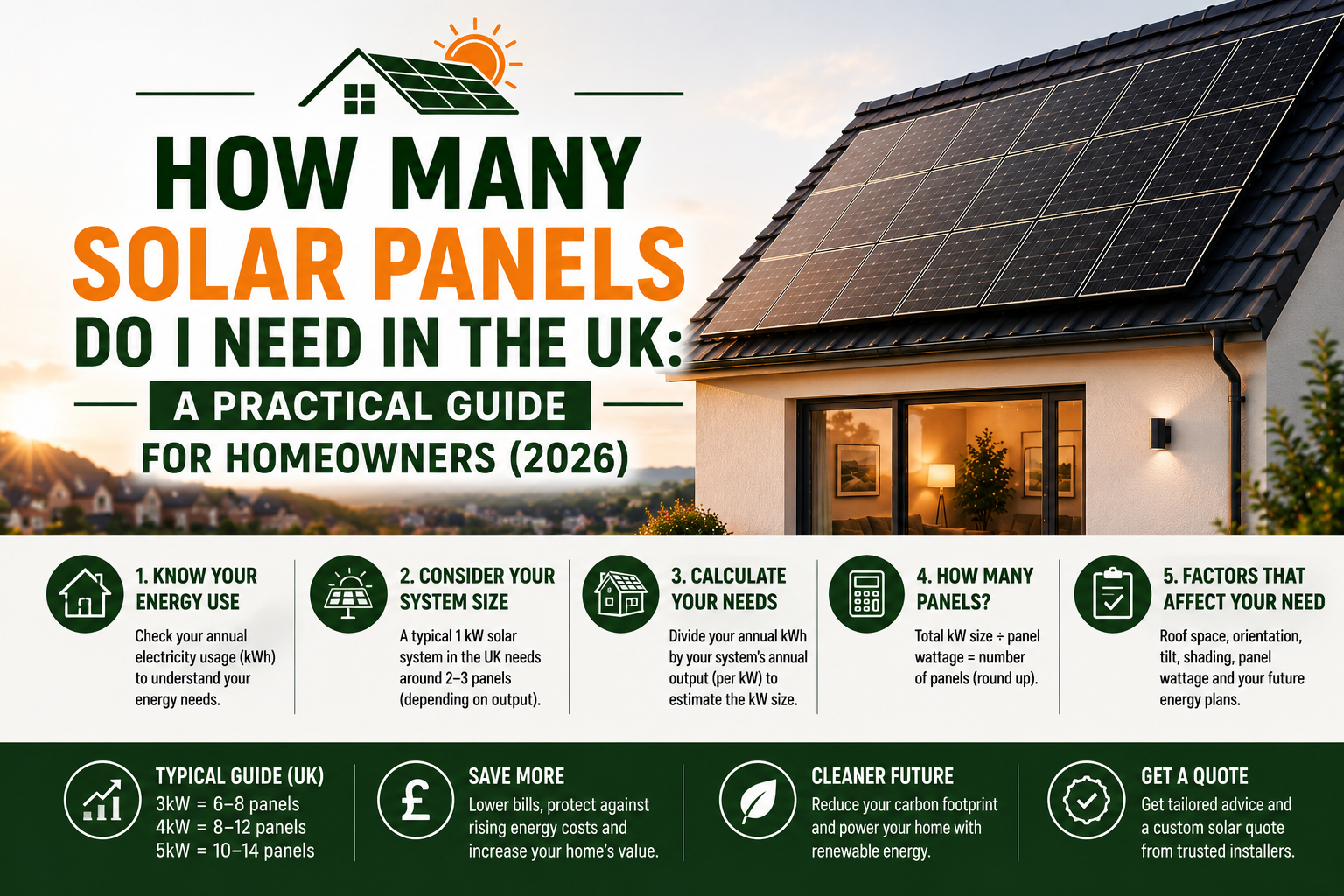
How much power your family uses, the direction and slope of your roof, the kind of panels you choose, and even the weather where you live, all of that affects how many panels you’ll need and how much energy they’ll actually produce. That’s why we wrote this blog, as a guide. Before sizing a system, it helps to check whether solar panels are worth it in the UK for your home.
- 1. How Can You Work Out How Many Panels You Need?
- 2. Estimating Solar Needs Based on Size of Home and Energy Use
- 3. What Factors Affect How Many Solar Panels Fit on Your Roof?
- 4. How do smart Add-Ons Improve Efficiency for Home Solar Panels?
- 5. How Can You Ensure You Get the Right System?
Summary (TL;DR)
Key facts about this topic:
- Most UK homes need 8-12 solar panels to cover usual electricity use
- Modern systems can trim electricity bills by 60-70% and cut around a tonne of CO₂ each year
- Panel efficiency affects how many you need – single panels can generate 350-450 kWh per year
- Roof orientation, shading, and size all impact how many panels will fit and perform optimally

How Can You Work Out How Many Panels You Need?
Figuring out the right number of solar panels for your home might seem like guesswork at first, but it’s easier than it looks once you break it down. The key is to look at how your household uses energy, what your roof can handle, and the performance you want from your system.
Here are the main factors to consider.
1. Your Household’s Energy Use
Start by checking how much electricity your home actually uses in a year, that’s the foundation for everything else. Most UK households sit somewhere between 2,500 and 4,000 kWh annually. The more you use, the more panels you’ll need to cover it.
Things like electric heating, a home office, large appliances, or an EV can push your usage higher. On the flip side, if you’re energy-conscious or live alone, you’ll likely need fewer panels to meet your needs.
2. Panel Efficiency
Today’s innovations and those nifty new-age home solar panels are making efficiency a breeze. Just a simple single panel (around 1.7m x 1m) can generate roughly around 350–450 kWh per year, depending on the orientation and location, of course. So basically, if you choose higher efficiency panels, you can reduce the total number of panels you need for the same energy output, and save yourself some extra change.
3. Your Generation Goal
Do you want to cover all of your electric usage with solar, or just offset part of it? Some homeowners target to cover 60–80% of their energy, leaving the rest to the grid. Others go further by adding storage or planning around time-of-use.
Estimating Solar Needs Based on Size of Home and Energy Use
While every household is unique, it helps to have a rough starting point. The table below gives a general guide based on typical UK homes, from cosy flats to large family houses, even those with electric vehicles. Think of it as a quick snapshot to help you picture what a solar setup could look like for your home:
| Household Type | Estimated Usage (kWh/year) | Recommended Panel Count | Roof Area Needed (approx.) |
|---|---|---|---|
| 1–2 person flat or small home | 2,000–2,500 | 5–7 panels | 9–12 m² |
| 3–4 person household | 3,000–4,000 | 8–10 panels | 14–18 m² |
| Large family or EV owner | 4,500+ | 12–14 panels | 22–26 m² |
Tip: Your installer will always tailor this based on real roof space, shading, and your energy profile.
What Factors Affect How Many Solar Panels Fit on Your Roof?
You might assume that fitting solar panels is just a case of measuring your roof and placing them in neat rows, but there’s actually a bit more to it. Things like roof shape, orientation, and even nearby trees can all affect how many panels will comfortably fit and perform at their best. Understanding these factors helps you see why no two solar installations are exactly the same:
Ready to go Solar ?
1. Roof Size and Shape
Pitched roofs, dormers, skylights, and chimneys can impact layout. Installers use clever designs (split arrays or staggered strings) to fit panels around obstacles.
2. Roof Orientation
South-facing roofs capture the most sun, but east- and west-facing roofs are excellent too. You may need a few extra panels to match output on non-south-facing homes, but performance is still solid across the UK.
3. Shading
Nearby trees, TV aerials, or neighbouring buildings can cause shade. Installers account for this using tools like optimisers and layout changes to minimise energy loss.
4. Angle and Tilt
Most UK roofs are naturally tilted between 30–40 degrees, perfect for solar. Flat roofs or steep angles may require mounting frames to achieve the best position.
How do smart Add-Ons Improve Efficiency for Home Solar Panels?
You might not need more panels, you might just need smarter ones. Here’s what homeowners are adding to get more from their system:
| Add-On | How It Helps Panel Output | Ideal For |
|---|---|---|
| Battery Storage | Stores unused solar for evening use, reducing wastage | Homes with high evening use or EV charging |
| Panel Optimisers | Prevent one shaded panel from dragging down the whole system | Roofs with trees, chimneys, or split angles |
| Smart Monitoring | Lets you see exactly how much power you’re making and using | All households who want more control |
| East–West Array | Captures morning and afternoon sun for longer daily coverage | Homes with split roofs or limited south face |
How Can You Ensure You Get the Right System?
Choosing a solar system can feel like a big decision, and it’s easy to get caught up in the numbers, panel types, and “what ifs.” But the truth is, it doesn’t have to be complicated. A good installer will do the heavy lifting for you, guiding you through each step so you end up with a system that suits your home, habits, and budget. The process is simpler than most people think, and here’s what it usually looks like:
- Assessment: A certified installer checks your roof, energy bills, and usage patterns.
- Design: They model your roof and recommend a system size, layout, and performance estimate.
- Installation: Panels, inverter, and (if selected) battery are installed, usually within 1–2 days.
- Monitoring: You track your generation live and adjust usage to maximise efficiency.
There’s no pressure to “go big” or overspend. A small system can still deliver excellent savings and impact. The best system is the one designed just right for your lifestyle and space.
Bottom Line:
You don’t need to fill your roof; just make the space you already have work smarter, one panel at a time.
Switching to solar isn’t about cramming as many panels as possible onto your roof; it’s about finding what works best for your home and how you live. Maybe that’s a small system to take the edge off your electricity bills, or a full setup with smart storage for long-term savings. Either way, every panel helps you use cleaner energy and rely less on the grid.
At Solar4Good®, we’re here to make that process straightforward. We’ll look at your home, talk through your options, and guide you from start to finish. If you’re curious about how many panels your home might need, just reach out to our team. We’ll help you figure it out and see what a switch to solar could look like for you.
Frequently Asked Questions
Can I get just a few panels if I have a small roof?
Yes. Many UK homes start with 4–6 panels and still see meaningful results. You can often add more later if needed.
Do I need a battery to make solar worthwhile?
Not at all. While batteries improve flexibility, many households run solar-only systems and reduce their daytime grid usage significantly
Will a larger system always give better results?
Not always. Oversizing can lead to unused power unless you have a way to store or use it. Balance is key.
Can I power my entire home with solar alone?
Yes, in some cases, but you’ll likely still use some grid electricity, especially in winter. Most systems are designed to reduce, not eliminate, grid use.
What if I plan to get an EV or heat pump later?
Let your installer know. They can design a system that’s future-ready, even if you don’t need full capacity today.
About the Author
Matthew
Solar Consultant with over a decade of UK solar experience, helping homeowners and businesses make clear, confident renewable energy decisions.
📞 Book a free solar consultation
Call us on 0800 999 1454 or visit solar4good.co.uk
Read over 800+ verified five-star reviews on Trustpilot and Checkatrade
Solar4Good Ltd · 79 College Road, Harrow, HA1 1BD · MCS: NAP/72775/25/4 · HIES: S4G/A/1484