
Commercial Solar Carports: A Complete Guide for UK Businesses
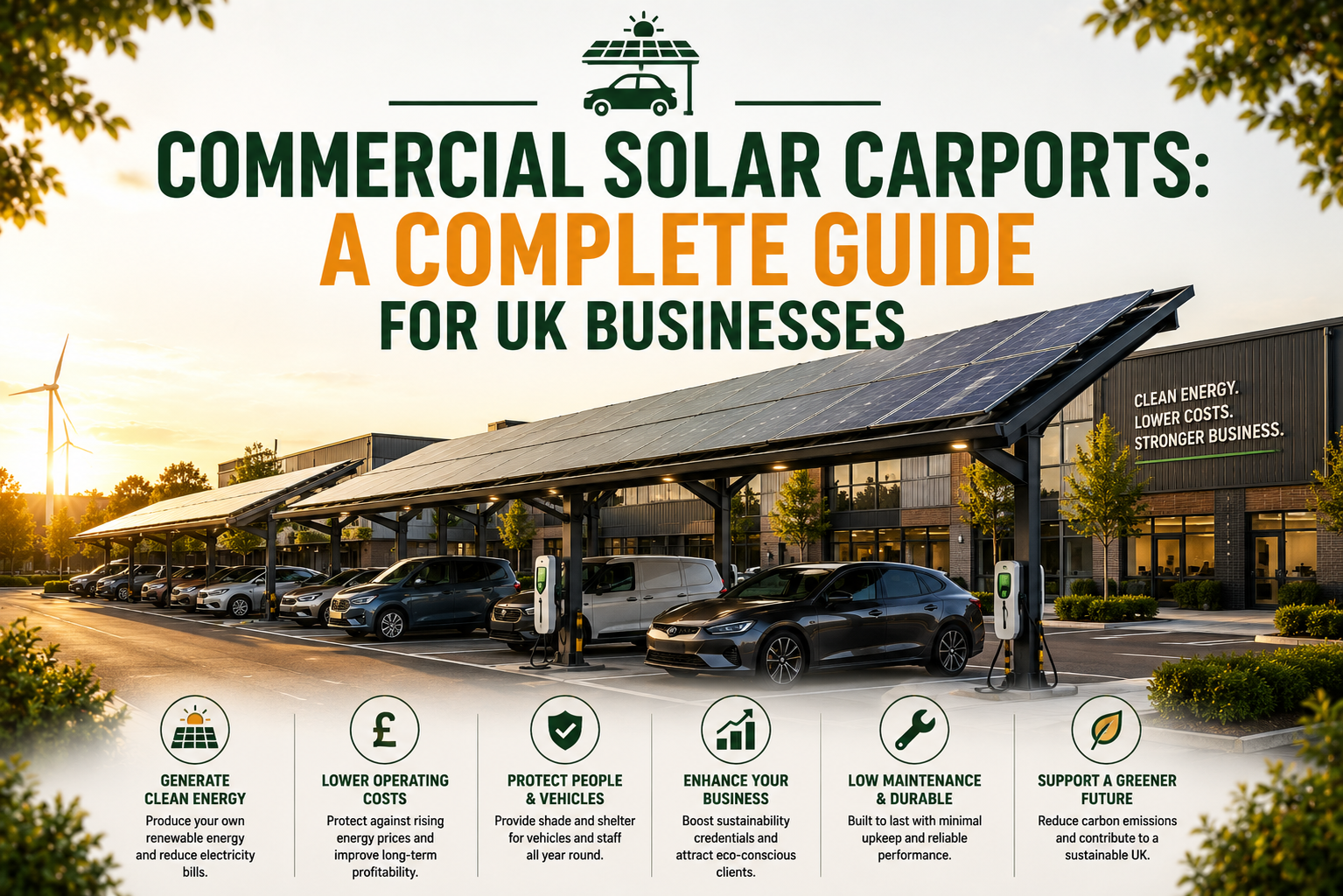

Table of Contents
Key Takeaways
- Solar carports generate electricity using existing parking space without relying on roof condition or capacity limits
- They’re ideal when rooftop solar is insufficient, EV charging is planned, or future energy demand is expected to grow
- Best suited for sites with consistent daytime activity like retail parks, office campuses, and industrial facilities
- ROI depends on high daytime electricity consumption and strong alignment between generation and on-site demand
For many UK businesses, energy is no longer a background operational cost. Electricity prices fluctuate, EV charging requirements are accelerating, and sustainability targets are increasingly tied to procurement decisions, compliance frameworks, and brand reputation. At the same time, many commercial sites have extensive outdoor car parks that remain unused for anything other than vehicle storage.
This is where commercial solar carports are beginning to play a practical role.
A solar panel car park allows a business to generate electricity using space it already owns, without relying solely on rooftops or sacrificing operational land. Instead of treating parking areas as passive infrastructure, solar carports turn them into part of the site’s energy system, producing power during working hours when demand is often highest.
Interest in solar carports has grown as organisations look for flexible ways to expand on-site generation, support EV charging, and demonstrate progress toward net-zero commitments. Unlike rooftop systems, carports are not constrained by roof condition, loading limits, or future roof replacement plans. They can also be built in phases, which is often why they come up when demand is expected to grow rather than stay flat.
Whether a solar carport makes sense, though, depends on the site itself. Layout, grid capacity, planning context, and how the space is actually used all influence the outcome.
This guide is intended to help you work through those questions, so you can understand where solar carports fit, what needs to be checked early, and whether they’re worth taking further for your business.
What Are Commercial Solar Carports, and How Do They Work?
A commercial solar carport is not just a canopy with panels attached. It is a ground-mounted solar generation system designed specifically around parking layouts, vehicle movement, and commercial electricity demand.
Structurally, a solar carport uses steel columns and beams to support solar panels above parking bays. Unlike rooftop systems, the structure is engineered independently of the building, which means panel layout, tilt, and orientation can be optimised for generation rather than dictated by roof shape or condition.
From an electrical perspective, a solar panel car park operates in the same fundamental way as other commercial solar PV systems, but with some important practical differences.
How electricity flows in a commercial solar carport system
This flow is why commercial solar carports are designed around self-consumption rather than export. The value comes from using electricity on site during working hours, not from selling surplus back to the grid.
How solar carports differ from rooftop solar in practice
Because solar carports are ground-supported structures:
- They are not limited by roof strength, age, or membrane condition
- Layout can be adjusted to reduce shading and improve yield
- Capacity can often be expanded in phases as energy demand grows
This makes them particularly useful for sites where rooftop solar is restricted, already fully utilised, or insufficient to meet long-term energy needs.
In practical terms, a commercial solar carport turns a car park into part of the site’s electrical infrastructure, not an add-on, but an integrated generation asset designed around how the business actually uses energy.
Why Are Businesses Choosing Solar Carports Over Rooftop Solar?
Rooftop solar usually comes first. It’s familiar, relatively quick to install, and for many sites it does a decent job. The issue is what happens next. Once a roof is full, or once EV charging, higher demand, or future expansion enters the picture, there often isn’t anywhere left to go. At that point, the limitation isn’t solar itself, it’s the building.
That’s where car parks start to matter.
A solar panel car park gives businesses a way to add generation without relying on roof condition, layout, or long-term plans for the building itself. It’s less about replacing rooftop solar and more about what you do when the roof has already done what it can.
Rooftop solar vs solar carports
|
Consideration |
Rooftop solar |
Solar carports |
|
Roof condition |
Dependent on roof strength, age, and orientation |
Independent of existing buildings |
|
Scalability |
Limited by available roof area |
Can be expanded across additional parking bays |
|
Civil works |
Minimal, mainly fixings and electrical routing |
Requires foundations, trenching, and steel structures |
|
EV integration |
Indirect, often routed through the building |
Direct, with chargers mounted at parking level |
|
Upfront cost |
Typically lower |
Higher due to structural elements |
|
Visibility / ESG impact |
Often out of sight |
Highly visible on site |
In practice, many sites use both, rooftops first, with solar carports used to extend generation capacity beyond what roofs alone can support.
How Do Solar Carports Turn Car Parks Into Energy Assets?
For many commercial sites, car parks exist purely out of necessity. They take up space, need lighting and upkeep, and sit exposed to the elements for most of the day, but they don’t usually contribute to how the business operates.
That’s why commercial car park solar has started to attract attention, particularly across the commercial solar carports UK market. These spaces are typically open, lightly shaded, and active during working hours, the same hours when offices, retail units, equipment, refrigeration, and IT systems are drawing electricity.
When solar carports for businesses are installed, electricity generation moves into a part of the site that’s already in daily use. Power is produced when demand is highest, rather than being generated elsewhere and exported back to the grid. In practice, more of the electricity generated is consumed on site.
Ready to explore solar options for your business?
Get a free assessment of your commercial site’s solar potential, including carport feasibility and energy savings projections.
Why this matters commercially
A solar panel car park generates electricity during the day, when most commercial demand occurs. For many sites, this reduces reliance on daytime grid electricity and helps limit exposure to peak tariffs, which are often the hardest to manage.
|
Over time, this changes how the car park is viewed internally. Instead of being space that only adds overheads, it begins to support day-to-day operations by contributing directly to energy cost control. Because business solar carports sit outside the building structure, generation capacity can often be increased later without altering the roof or disrupting internal activity. |
It also affects how projects are planned. Solar generation, EV charging, lighting upgrades, and sustainability targets don’t need to be treated as separate initiatives competing for space or budget. With commercial solar carports UK installations, these elements are often considered together, which makes future changes easier to manage. |
Additional operational benefits
There are also practical effects that tend to become obvious once systems are in place.
Vehicles benefit from shade and weather protection. Staff and visitors notice the improvement immediately. And because solar carports for businesses are visible on site, they provide tangible evidence of sustainability investment rather than something hidden out of sight.
Taken together, this is why business solar carports are increasingly viewed as more than a technical add-on. For the right sites, commercial car park solar becomes part of how the site functions, supporting current operations, accommodating future electrification, and contributing to longer-term cost control without changing how the building itself is used.
What types of businesses use commercial solar carports?
Commercial solar carports are most effective on sites with consistent daytime activity and large areas of surface-level parking. In practice, adoption tends to cluster around sectors where energy demand, parking use, and long-term site control overlap.
Rather than being sector-specific, the decision is usually driven by how a site operates day to day.
Where Solar Carports Are Most Commonly Used
|
Site Type |
Typical Use Case |
Why Solar Carports Work Well |
|
Retail Parks & Shopping Centres |
Customer parking during peak daytime trading hours. |
High Self-Consumption: Solar generation peaks coincide perfectly with retail trading hours. They also act as “Marketing Infrastructure,” providing visible shade that attracts shoppers in hot weather. |
|
Office Campuses & Business Parks |
Staff and visitor parking (Monday–Friday). |
Workplace Charging: Simplifies the installation of EV chargers for employees. It supports Scope 2 emissions reduction for tenants and provides a premium amenity for high-value talent. |
|
Industrial & Logistics Facilities |
Staff, fleet, and heavy vehicle parking. |
Infrastructure Resilience: Ideal for facilities with older roofs that cannot support PV weight. For logistics, they provide critical charging hubs for transition-ready electric delivery fleets. |
|
Hospitals & Healthcare Estates |
24/7 staff and patient parking. |
Continuous Demand: Hospitals have very high “base loads” (lighting, cooling, life-support); every kWh generated is used instantly. Carports also protect sensitive patients from weather during transit to the entrance. |
|
Universities & Public Sector |
Large-scale multi-user parking. |
Public Accountability: Demonstrates a visible commitment to Net Zero. As long-term asset owners, these institutions benefit from the high Return on Investment (ROI) over the 25+ year lifespan of the structure. |
How much do commercial solar carports cost in the UK?
There is no single, fixed price for a commercial solar carport, and that uncertainty is often what makes businesses hesitate early on. Unlike rooftop solar, where costs are largely driven by panel count and roof access, solar carports combine energy infrastructure with civil and structural works. This means pricing is shaped as much by the site itself as by the size of the system.
Key cost drivers include:
- Steel structure design and foundations
- Groundworks, drainage, and reinstatement
- Electrical cabling distances and routing
- Inverter and switchgear integration
- Grid connection requirements
- EV charger and load-management integration
Because of these variables, pricing is rarely based on simple “per bay” figures. Instead, costs are assessed through feasibility and outline design stages.
What drives ROI most strongly?
- High daytime electricity consumption
- Strong alignment between generation and demand
- Minimal reliance on export
- Long-term site ownership or lease security
For UK businesses, the key question is not “How much does a solar carport cost per space?” but “How well does this site convert generation into usable savings?” A proper feasibility study will assess these factors together.
About the Author
Matthew
Solar Consultant with over a decade of UK solar experience, helping homeowners and businesses make clear, confident renewable energy decisions.
📞 Book a free solar consultation
Call us on 0800 999 1454 or visit solar4good.co.uk
Read over 800+ verified five-star reviews on Trustpilot and Checkatrade
Solar4Good Ltd · 79 College Road, Harrow, HA1 1BD · MCS: NAP/72775/25/4 · HIES: S4G/A/1484