
Solar Panel Grants in the UK: What Funding Is Available in 2026?
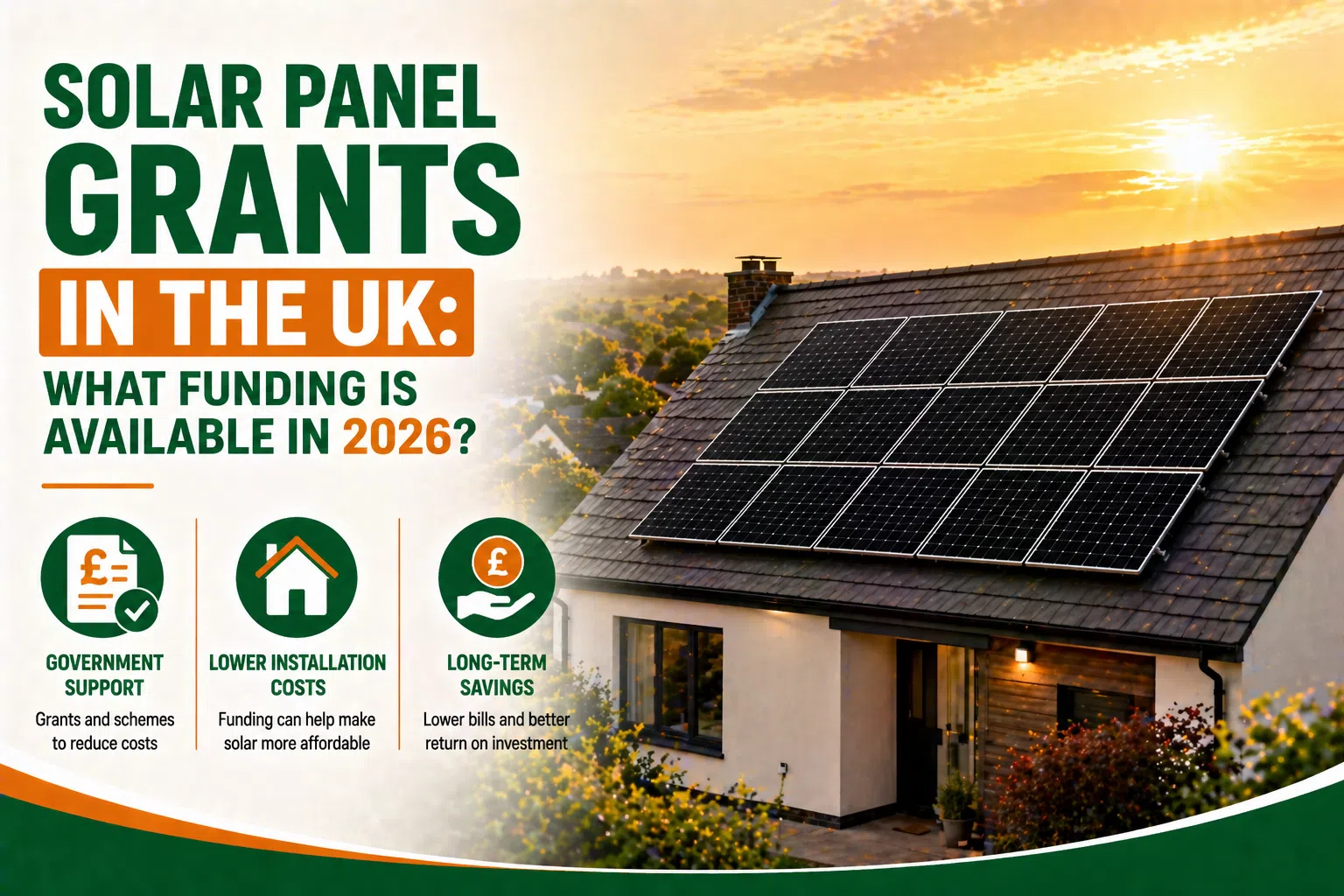

If you have started researching solar panels, you have probably seen headlines about grants, funding schemes or even claims of ‘free solar’. The reality in 2026 is more balanced: there is no universal grant for every homeowner, but several schemes can still reduce costs for eligible households. Here is what genuinely applies.
The Short Version (Read This First)
What UK homeowners need to know about solar grants and funding in 2026:
- There are no universal solar panel grants for all UK homeowners, but several schemes can still reduce costs for eligible households
- The Warm Homes Plan (the successor to previous energy efficiency schemes) supports eligible lower-income and lower-EPC households — solar panels can be included as part of wider energy upgrades
- The Smart Export Guarantee (SEG) pays for surplus electricity exported to the grid — it’s not a grant but provides ongoing income that offsets installation costs over time
- Zero VAT on residential solar installations applies until March 2027, automatically reducing upfront costs
- For most homeowners, solar savings come from lower electricity bills over time rather than large upfront grants
- Solar panels are increasingly funded through straightforward self-investment, with the financial case standing on its own — call 0800 999 1454 or visit solar4good.co.uk for a free no-obligation assessment
Are There Solar Panel Grants Available in 2026?
Yes, but they are more targeted than many people expect. Unlike older nationwide schemes, most solar funding in 2026 is aimed at households that need energy-efficiency support the most. That means eligibility often depends on income level, your home’s EPC rating, or whether your local authority is running a specific improvement programme.
Rather than looking for a single ‘solar grant’ that applies to everyone, it is usually more useful to understand where support actually comes from. In practice, homeowners tend to benefit through a mix of energy-efficiency schemes run by councils or regional programmes, incentives linked to improving overall home performance, and export payments or tax advantages that reduce long-term costs. A helpful approach is to ask a few practical questions: does my property qualify for wider energy-efficiency funding? Is there a local or regional scheme currently running where I live? How much could ongoing incentives offset costs over time?
★★★★★ Trustpilot
“From initial survey to flawless installation, Solar4Good® delivered an exceptional experience. The team worked meticulously and left the site spotless. Clear explanations and no hidden fees.” — Verified customer
Which UK Schemes Can Help Reduce Solar Costs?
Several current programmes can support solar installations, either directly or indirectly.
The Warm Homes Plan
The Warm Homes Plan is the government’s current energy efficiency scheme for homes in England, aimed at lower-income households and properties with lower EPC ratings (typically bands D–G). Solar panels can be included as part of a broader package of improvements. Eligibility depends on household income, property energy rating and local authority participation. It is not available to all homeowners — it is designed for those who would most benefit from energy-efficiency upgrades. Contact your local council to check whether your household qualifies.
Local authority and regional schemes
A number of local authorities run their own decarbonisation programmes or participate in regional funding rounds. Availability varies by area and changes from year to year, so checking with your local council’s housing or sustainability team is the most reliable way to find what is currently running where you live.
Smart Export Guarantee (SEG)
The SEG pays homeowners for surplus electricity exported to the grid. While not a grant, it provides ongoing income that offsets installation costs over time. Rates vary by energy supplier and eligibility, so it is worth comparing the tariffs available when you set up your system. MCS certification is required to register — see our MCS certificate guide for what certification involves, and the Ofgem SEG pages for the official scheme rules.
0% VAT on residential solar installations
Solar panel installations currently benefit from zero VAT until March 2027, reducing upfront costs automatically for residential homeowners. This is not a grant but has the same effect of reducing the final price you pay. After March 2027, VAT is expected to revert to 5% rather than the standard rate, so it is still worth factoring into your planning.
💡 Did you know?
The 0% VAT on residential solar panels applies automatically — you don’t need to apply or qualify. Any quote you receive from a reputable installer should already reflect this, so it is one less thing to arrange yourself.
Ready to go Solar?
★★★★★ Trustpilot
“Solar4Good provided excellent service from beginning to end within 2 weeks. Their advice guiding me through the best suitable panels and battery for now and the future was excellent.” — Verified customer
Can You Really Get Free Solar Panels?
Occasionally, but only in very specific situations. Fully funded solar installations do exist — usually through the Warm Homes Plan or certain local authority programmes — but they are designed for households that meet strict criteria. Eligibility often depends on factors such as income level, benefits received, or whether the property needs significant energy-efficiency improvements.
For most homeowners, solar panels will not be completely free, and that is where some of the confusion online comes from. Many adverts use the phrase ‘free solar’, but in reality the majority of installations are privately funded, with the financial benefit coming through long-term savings rather than upfront grants. Instead of expecting zero cost, it is more helpful to think about what solar reduces over time: lower reliance on grid electricity, export payments for unused energy, and more predictable energy costs as prices fluctuate. If you do qualify for fully funded support, an installer or local scheme provider will usually confirm this early during the assessment stage.
How to Check If You Qualify for Support
Working out whether you are eligible for funding usually starts with a few practical checks. Most solar-related schemes in 2026 sit within wider energy-efficiency programmes, so the criteria tend to focus on the household and the property rather than the solar system itself.
- Your EPC rating: many schemes prioritise homes with lower efficiency ratings where upgrades will have the biggest impact
- Household circumstances: some funding targets lower-income households or those receiving certain benefits
- Local authority programmes: grants are often delivered regionally, so availability can vary depending on where you live
- Ownership and property type: whether you own, rent or live in a flat can affect what support is possible
Instead of trying to decode everything yourself, it is usually easier to check your local council’s website and independent energy-advice services. Installers can also help identify whether a scheme might apply during an early consultation. The key is to treat eligibility as something to confirm early, so you can plan your system around what is actually available rather than assumptions.
What Most Homeowners Actually Do Instead of Grants
Because large, nationwide grants are no longer the main driver for solar in the UK, most homeowners now plan their systems around long-term savings rather than waiting for funding that may never apply to them. The mindset has shifted from ‘How do I get solar for free?’ to ‘How do I make solar work financially over time?’
Designing systems around real household usage
Instead of installing the biggest system possible, many homeowners size solar based on daytime consumption, future plans like EV charging, or expected lifestyle changes. A well-matched system delivers stronger returns than an oversized one.
Adding battery storage to increase self-use
Batteries help you use more of the energy you generate rather than exporting it, which often improves long-term savings even without grant support. See our solar battery cost guide for a full breakdown of storage options.
Using smart tariffs and scheduling
Pairing solar with time-of-use tariffs allows households to buy electricity when it is cheaper and rely less on peak pricing.
Treating solar as an energy upgrade, not a short-term deal
People are increasingly viewing solar the same way they view insulation or a new boiler — a practical improvement that reduces running costs year after year. Grants can still make a difference where they apply, but they are rarely the deciding factor anymore. For many homes, the combination of lower bills, greater control over energy use and protection from rising prices is enough to make solar worthwhile on its own.
★★★★★ Trustpilot
“We were considering solar via a local council scheme but a friend recommended Solar4Good — and we’re really glad we made the switch. A site visit was booked the very next day, and our system was live shortly after commissioning.” — Verified customer
Conclusion
Solar funding in the UK has not disappeared — it has just become more targeted. The Warm Homes Plan, SEG payments and VAT relief can reduce costs, but eligibility varies widely. For most homeowners, the biggest financial benefit still comes from generating and using their own electricity over time.
The most useful approach is to look at funding as one piece of the decision, not the entire reason to go solar. When a system is designed around how your home actually uses energy, the savings tend to make sense even without large grants. If you are unsure what support applies to your situation, or whether solar makes financial sense without funding, Solar4Good offers obligation-free consultations — a chance to understand your options clearly, based on your roof, your energy use and the schemes currently available in your area.
📞 Get a free solar assessment from Solar4Good
Call us on 0800 999 1454 or visit solar4good.co.uk. Read over 800+ verified five-star reviews on Trustpilot and Checkatrade.
Solar4Good Ltd · 79 College Road, Harrow, HA1 1BD · MCS: NAP/72775/25/4 · HIES: S4G/A/1484
Frequently Asked Questions
Are there government grants for solar panels in the UK right now?
Yes, but most are targeted schemes such as the Warm Homes Plan or local authority funding rather than nationwide grants for all homeowners. Eligibility usually depends on income, EPC rating and where you live.
Can solar panels be completely free?
In some cases, eligible households may receive fully funded installations through energy-efficiency programmes like the Warm Homes Plan, but this is not typical for most homeowners.
Do you still get paid for solar electricity?
Yes, through the Smart Export Guarantee, which pays for electricity exported back to the grid. Rates vary by supplier and eligibility. MCS certification is required to register.
Are older schemes like the Feed-in Tariff still available?
No. The Feed-in Tariff is closed to new applicants, though existing users continue receiving payments. The current export scheme is the Smart Export Guarantee.
Is solar still worth it without grants?
For many households, yes. Lower energy bills and long-term savings are now the main drivers rather than upfront incentives. A system designed around how your home uses energy tends to make financial sense on its own.
About the Author
Matthew
Solar Consultant with over a decade of UK solar experience, helping homeowners and businesses make clear, confident renewable energy decisions.
📞 Book a free solar consultation
Call us on 0800 999 1454 or visit solar4good.co.uk
Read over 800+ verified five-star reviews on Trustpilot and Checkatrade
Solar4Good Ltd · 79 College Road, Harrow, HA1 1BD · MCS: NAP/72775/25/4 · HIES: S4G/A/1484