
What Size Solar Battery Do You Need in the UK
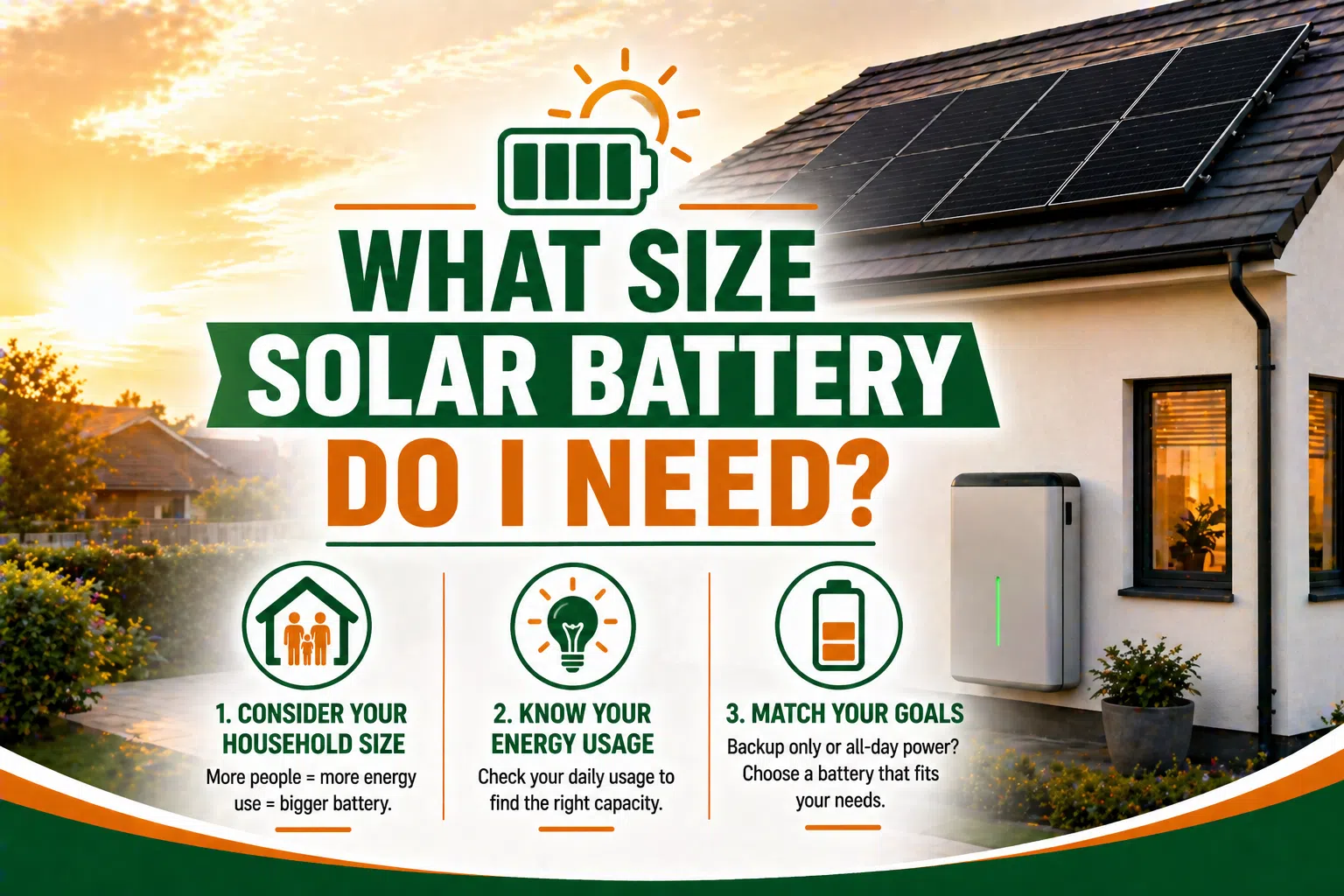

For most UK homes, the right solar battery size is between 8 kWh and 16 kWh of usable capacity, sized to cover winter evening demand rather than average daily use. But how do you avoid buying too little or far more than you will ever need? This guide breaks the sizing decision down clearly.
- 1. Why battery size causes so much confusion
- 2. How much battery storage do UK homes typically need?
- 3. How to size a solar battery properly
- 4. What battery specifications matter besides size?
- 5. Why does getting battery size right really matter?
- 6. Can you add more battery storage later?
- 7. Frequently Asked Questions
The Short Version (Read This First)
Key facts about solar battery size in the UK:
- Battery size means usable energy capacity in kilowatt-hours (kWh), not the physical dimensions of the unit
- For most UK homes, a battery between 8 kWh and 16 kWh of usable capacity covers typical evening and overnight demand
- Winter usage often needs more capacity than people expect, because demand rises just as solar generation falls
- The right size depends on your annual consumption, seasonal patterns, and whether the battery is used purely for solar storage or also for tariff optimisation
- Usable capacity and discharge rate (kW) matter as much as the headline size
- Solar4Good® is MCS certified (NAP/72775/25/4), HIES protected (S4G/A/1484), and designs battery systems sized to each home
Home battery storage has moved quickly from a “nice-to-have” add-on to a central part of many UK solar installations. As electricity prices remain high and time-of-use tariffs become more common, batteries are no longer just about storing spare solar; instead, they are about controlling when you buy, use, and export electricity.
That is why battery sizing is such a common sticking point. With systems available from 5 kWh to 30 kWh and beyond, it is easy to feel like you are guessing. Too small, and the battery empties before the evening peak; too large, and you pay for capacity that rarely gets used. Marketing makes this worse, because headline numbers do not always reflect how much energy you can actually use.
In reality, sizing becomes straightforward once you understand a few principles: how much electricity your home uses, how that usage changes across the year, and what role the battery plays. This guide breaks those principles down using the same approach we apply when designing battery systems for UK homes in 2026.
Why Battery Size Causes So Much Confusion
When people ask “what size battery do I need?”, they are not talking about the physical dimensions of the unit. Battery size refers to energy storage capacity, measured in kilowatt-hours (kWh).
This matters because:
- Headline vs usable: two batteries with the same advertised size can deliver very different usable energy
- Nominal capacity: manufacturers often quote nominal capacity, not what you can actually use
- Built-in reserves: internal limits protect battery lifespan and reduce the usable figure
What powers your home is usable capacity, not the marketing number. A battery advertised as 10 kWh may only allow 8–9 kWh to be discharged in practice, while others allow nearly full use of their stated capacity. This difference becomes critical when a battery is expected to cover evening demand, winter usage, or peak-rate periods.
★★★★★ Trustpilot
“Solar4Good provided excellent service from beginning to end within 2 weeks. Their advice and professionalism guiding me through the best suitable system and battery for now and the future were excellent.”
— Verified customer
How Much Battery Storage Do UK Homes Typically Need?
There is not a single “right” battery size for UK homes. The starting point is how much electricity you actually use, not how big your house is or how many solar panels you plan to install. Battery sizing always begins with annual electricity use, because this shows how much energy your home needs across the year and, more importantly, how that demand shifts between summer and winter.
Typical UK electricity usage looks roughly like this:
| Household type | Annual electricity use |
|---|---|
| Low-usage home | ~2,500 kWh |
| Average home | 3,500–5,000 kWh |
| High-usage home | 6,000 kWh+ |
| Homes with heat pumps | 8,000–12,000 kWh |
| EV charging (added) | +2,000–4,000 kWh |
These figures give a useful baseline, but they do not translate directly into battery size. Two homes with the same annual usage can need very different batteries depending on when that energy is used. That is why daily usage matters, and why seasonal demand matters even more. In winter, electricity use rises just as solar generation falls, which is when battery sizing really gets tested. If you size a battery only for summer performance, it can feel underpowered for half the year.
How to Size a Solar Battery Properly
Ready to go Solar?
Step 1: Find your annual electricity usage
This appears on your electricity bill as estimated or actual annual consumption. It is the single most reliable starting point for sizing.
Step 2: Convert it to daily usage
Divide annual usage by 365. For example, 5,000 kWh ÷ 365 works out at roughly 13.7 kWh per day.
Step 3: Account for UK winter demand
Electricity usage does not spread evenly across the year. In the UK, homes use roughly 60% of their electricity between October and March, and 40% between April and September. Applying that split, winter usage works out at around 16–17 kWh per day, while summer usage falls to around 10–11 kWh per day. This is why batteries sized to “average daily usage” often feel fine in summer and disappointing in winter. A battery that comfortably covers winter evenings is usually the right size.
What Battery Specifications Matter Besides Size?
Battery size gets most of the attention, but it is not the only thing that affects how a system feels day to day. Two batteries with the same headline size can behave very differently once they are actually powering a home. The specs below make the biggest practical difference.
Usable capacity (kWh)
This is the amount of energy the battery will actually let you use. Some batteries advertise a large capacity but keep part of it in reserve to protect the cells, so the usable energy is lower than the number on the box. Usable capacity determines how long your home can run on battery power, whether the battery lasts through the evening, and whether you avoid overnight grid use. When comparing batteries, usable capacity is the number that really counts.
Charge and discharge rate (kW)
This controls how quickly the battery charges and how fast it delivers power to your home. A battery can be large but still feel weak if it cannot move energy fast enough. In practice, low power output can mean the battery struggles to run several appliances at once, keep up with evening demand, or take full advantage of cheap overnight tariffs. As a general guide, batteries with a discharge rate below 3 kW tend to limit flexibility in modern UK homes, especially where cooking, heating, or EV charging overlaps.
Why Does Getting Battery Size Right Really Matter?
Choosing a battery is not just about having some storage; it is about whether that storage actually fits how your home uses electricity. A battery that is too small, or poorly matched, to your home can limit savings and quickly feel frustrating, especially in winter or during peak pricing hours. The size of your battery directly affects when you rely on the grid, how much of your solar you actually use, and how flexible your system is over time.
What happens if a battery is too small?
An undersized battery often looks fine on paper, but in day-to-day use it can empty early in the evening, force you back onto expensive peak-rate electricity, and export solar during the day only for you to buy power back later. It also limits how much benefit you get from your solar panels. This is one of the most common reasons people feel disappointed with battery performance.
What a correctly sized battery does better
When you size a battery properly for your home, it covers most evening and overnight electricity use, reduces reliance on peak tariffs, increases how much of your own solar you use, and provides more consistent savings across the year. For more on the costs involved, see our solar battery cost guide.
Why larger batteries can unlock more value
Larger systems also open the door to smarter energy strategies. With spare capacity, a battery can charge cheaply overnight on off-peak tariffs, store energy for use during expensive periods, and export electricity when prices are higher, where tariffs allow. This flexibility simply is not practical with very small batteries, which tend to fill and empty too quickly to take advantage of tariff-based optimisation. In short, battery size is not about buying the biggest option; rather, it is about choosing a size that works reliably across seasons, tariffs, and future energy needs.
★★★★★ Trustpilot
“From initial survey to flawless installation, Solar4Good delivered an exceptional solar experience. The team sized the battery perfectly for our usage and left the site spotless. Clear explanations, transparent pricing with no hidden fees.”
— Verified customer
Can You Add More Battery Storage Later?
Usually, yes, but it is not something you should assume will always be easy. Some battery systems let you add more storage later without much hassle, while others are more “what you install on day one is what you are stuck with”. The difference comes down to how the system is built, not just the battery itself.
What determines whether you can expand
Whether you can expand later depends on a few practical things:
- The battery brand you choose: some brands only let you add storage in set sizes, while others allow smaller add-ons over time.
- How many batteries the system allows: every system has a maximum, and once you hit it, adding more usually means replacing equipment.
- Whether new batteries must match the old ones: in most cases they do, so if a model changes or is discontinued, expansion can get tricky.
- The inverter behind the system: even if the battery can expand, the inverter still needs to handle it.
- How your energy use might change: an EV, heat pump, or air conditioning can quickly make a “fine for now” battery feel too small.
Plan for expansion from the start
If there is a good chance you will want more storage later, it is worth planning for that from the start. Doing so is usually cheaper and simpler than trying to retrofit flexibility after everything is already installed. The Energy Saving Trust also offers independent guidance on solar and storage worth reviewing.
📊 Bottom line
The right solar battery size is not about buying the biggest unit you can afford. It is about matching usable capacity to your winter electricity demand and how you plan to use energy across the day. Most UK homes benefit from more storage than they initially expect, especially once tariffs and seasonal usage are taken into account.
Battery storage plays a growing role in how UK households manage energy costs in 2026. While solar panels reduce how much electricity you buy, the battery determines when you buy it, and at what price. Sizing a battery properly means understanding your annual usage, recognising how winter demand shifts the balance, and choosing a system that delivers usable energy at the right time. Done correctly, battery storage increases solar savings, reduces exposure to peak prices, and adds long-term stability to household energy costs.
If you are unsure what size battery makes sense for your home, contact us today for an obligation-free assessment and our team will size a system around your actual usage.
Frequently Asked Questions
What size solar battery is best for an average UK home?
Most average homes benefit from 8–16 kWh of usable battery storage, depending on winter usage and evening demand. The key is to size for winter daily usage rather than the annual average, because demand is highest when solar generation is lowest. A site assessment confirms the right figure for your home.
Is it better to oversize a battery?
Slightly oversizing can improve flexibility and help with tariff optimisation, but excessive capacity may never be fully used. The goal is balance, not maximum size. A battery sized to cover your winter evening demand, with a little headroom for future needs like an EV, usually strikes the right balance.
Does battery size affect solar savings?
Yes. Larger usable capacity generally increases solar self-consumption and reduces peak-rate imports, because you store more of your own generation instead of exporting it cheaply. However, the gains level off once the battery comfortably covers your daily demand, which is why correct sizing matters more than maximum size.
Can a battery work without solar panels?
Yes. Batteries can charge from the grid on cheap off-peak tariffs and discharge during expensive peak periods, which still saves money. However, pairing a battery with solar significantly improves its long-term value, because you also store free daytime generation rather than relying on the grid alone.
Do batteries still work in winter?
Yes, but solar generation is lower in winter, so the battery does more of the work. This is exactly why correct sizing is critical: a battery sized only for summer will feel underpowered from October onward. Sizing for winter evening demand keeps the system useful all year round.
About the Author
Matthew
Solar Consultant with over a decade of UK solar experience, helping homeowners and businesses make clear, confident renewable energy decisions.
📞 Book a free solar consultation
Call us on 0800 999 1454 or visit solar4good.co.uk
Read over 750+ verified five-star reviews on Trustpilot and Checkatrade
Solar4Good Ltd · 79 College Road, Harrow, HA1 1BD · MCS: NAP/72775/25/4 · HIES: S4G/A/1484