
Solar Panels for Factory Buildings: A Complete Guide for UK Manufacturers

Solar panels for factory buildings give UK manufacturers a direct way to cut energy costs, because factories consume most of their electricity during exactly the hours solar panels generate. That alignment is why factory buildings deliver some of the strongest returns on commercial solar in the UK, with self-consumption rates of 70–90% — far higher than offices. As a result, this guide covers what manufacturers actually want to know: how the savings work, the cost drivers, the available tax relief, and whether your specific site stacks up.
- 1. Why factories get more from solar than any other building
- 2. How much can a factory save with solar panels?
- 3. What drives the cost of factory solar panels?
- 4. What tax relief can manufacturers claim?
- 5. How much energy can a factory solar system generate?
- 6. Will your factory roof take the load?
- 7. How does grid capacity affect what you can install?
- 8. Is battery storage worth it for a factory?
- 9. How disruptive is installation to production?
- 10. Do you need planning permission?
- 11. How long do factory solar systems last?
- 12. How does factory solar support ESG and net-zero?
- 13. Is factory solar worth it? The decision framework
- 14. FAQs: Solar panels for factory buildings
The Short Version (Read This First)
Key facts about solar panels for factory buildings in the UK:
- Factories achieve self-consumption rates of 70–90% — far higher than offices (40–60%) or retail (30–50%) — because daytime manufacturing demand aligns directly with solar generation hours
- Every unit generated and used on site displaces grid electricity at the full commercial rate, while exported surplus earns far less — which is why self-consumption is what drives the return
- Solar panels qualify for the Annual Investment Allowance (AIA): the capital cost can be deducted against taxable profits in year one, reducing the effective net cost
- Commercial solar is also exempt from business rates on the additional rateable value it creates, until April 2035 under current policy
- Viability depends on daytime demand, roof condition and load capacity, grid headroom, and length of site tenure — a feasibility study confirms it against your real meter data
- Solar4Good® is MCS certified (NAP/72775/25/4), HIES protected (S4G/A/1484), and has completed 2,610+ UK installations across residential, commercial, and industrial sites
For decades, electricity was a fixed operational cost in manufacturing — budgeted for, absorbed when prices rose, and otherwise ignored. That approach no longer works. Rising prices, volatile wholesale markets, tighter grid capacity, and decarbonisation pressure have turned energy into a strategic issue.
Factories are uniquely exposed: heavy machinery, extended hours, continuous power demand, and energy costs that feed directly into product margins. But they also share one underused asset — large, structurally robust, unshaded roofs. That is why solar panels for factory buildings are now evaluated as long-term infrastructure investments, not sustainability projects

Why Factories Get More From Solar Than Any Other Building
Factories are the single best-suited building type for commercial solar in the UK — not because of roof size alone, but because of when they use electricity. The financial value of solar comes almost entirely from self-consumption: using the power on site rather than exporting it.
Daytime demand aligns with solar generation
Most factories operate primarily during daylight hours. Even night-shift facilities maintain strong daytime base loads for preparation, maintenance, logistics, and continuous processes. Because solar generates during the day, factory installations regularly hit 70–90% self-consumption. Every self-consumed unit avoids buying from the grid at the full commercial rate — worth considerably more than the surplus earned on export.
Large, unobstructed, structurally robust roofs
Typically, factory roofs are flat or shallow-pitched, free from shading, and large enough to support systems from 50kW to several megawatts — allowing solar to be installed at meaningful scale with straightforward logistics.
Predictable demand profiles
Because manufacturing loads are stable and repeatable, systems can be sized accurately against half-hourly meter data rather than estimates. This reduces oversizing, improves self-consumption, and protects ROI from day one.
| Factor | Factory Buildings | Offices | Retail / Hospitality |
|---|---|---|---|
| Daytime electricity demand | High and consistent | Moderate | Variable |
| Alignment with solar output | Strong | Medium | Weak |
| Roof size and layout | Large and simple | Limited | Fragmented |
| Typical self-consumption rate | 70–90% | 40–60% | 30–50% |
| Suitability for large systems | Very high | Medium | Low |
How Much Can a Factory Save With Solar Panels?
Ultimately, savings come from displacing grid electricity at the commercial rate during working hours. The single biggest variable is self-consumption rate — the percentage of generated electricity used on site rather than exported.
📊 Why self-consumption is the metric that matters
Two factories with the same system size can see very different returns depending on how much of the generated electricity they use on site. A factory using most of its generation directly saves far more than one exporting a large share at the lower export rate. System size gets the headlines; self-consumption rate drives the return. The exact figures for your site are confirmed against your half-hourly meter data during the feasibility study.
Factories with the strongest savings share a few characteristics:
- High daytime demand: Most solar electricity is consumed instantly at full grid rate
- Continuous base load: Refrigeration, compressed air, and process loads run through the day
- Correct sizing: Annual generation set to roughly 30–40% of annual consumption keeps self-consumption above 80%
- Rising tariff exposure: Every future price increase widens the gap between solar and grid cost
★★★★★ Trustpilot
“From initial survey to flawless installation, Solar4Good delivered an exceptional solar experience. The team worked meticulously and left the site spotless. Clear explanations, transparent pricing with no hidden fees.”
— Verified commercial customer
What Drives the Cost of Factory Solar Panels?
There is no single fixed price for factory solar panels UK installations. Cost is driven by system size, roof access, structural requirements, electrical integration, and grid connection. Because of these variables, a site-specific feasibility assessment confirms the price rather than a headline figure. However, the cost drivers themselves are predictable.
- System size: Larger systems achieve lower cost per kWp, as fixed design and mobilisation costs spread across greater capacity
- Roof access and safety: Height, roof type, and working over live production areas affect labour time
- Structural reinforcement: Required only where the roof cannot support panel load without modification
- Electrical integration: Distance to main distribution boards, protection upgrades, and control systems
- Grid connection: DNO requirements, export limiting, or network reinforcement where capacity is constrained
| ROI Factor | Impact | Why It Matters |
|---|---|---|
| High daytime demand | Very high | Solar consumed instantly at full grid rate |
| Long-term site ownership | High | Full 25-year system value captured |
| Good roof condition | High | Avoids costly removal and reinstallation |
| Low export reliance | Positive | Self-consumed units are worth far more than exported surplus |
| AIA tax relief claimed | High | 100% first-year capital deduction cuts net cost |
Ready to go Solar?
What Tax Relief Can Manufacturers Claim on Factory Solar?
Importantly, tax relief is one of the most overlooked factors in the commercial solar decision — and it materially lowers the effective net cost below the headline installation price.
Annual Investment Allowance (AIA)
HMRC classes solar panels as plant and machinery for tax purposes. Under the Annual Investment Allowance, UK businesses can deduct the capital cost from taxable profits in the year of purchase, subject to the annual allowance limit — which covers the vast majority of factory installations in full. This reduces the effective net cost of the system in year one. The exact benefit depends on your profits and corporation tax position, so confirm the figures with your accountant.
Business rates exemption
Solar panels on commercial buildings in England are exempt from business rates on the additional rateable value they create. Under current policy this exemption applies to installations completed before April 2035, removing an ongoing cost that would otherwise erode the return.
📊 How tax relief changes the maths
Deducting the capital cost under AIA reduces the net cost of the system in year one — improving payback and ROI without changing the installation price. Combined with the business rates exemption, the after-tax economics of factory solar are considerably stronger than the headline figure suggests. Solar4Good can connect you with specialist commercial finance advisers to structure the investment correctly.

How Much Energy Can a Factory Solar System Generate?
However, total generation matters less than how much is used on site. The table below gives indicative annual generation by system size, based on UK average irradiance — your feasibility study refines this for your roof orientation, pitch, and location.
| System Size | Approx. Roof Area Needed | Annual Generation (UK avg) | Typical Factory Type |
|---|---|---|---|
| 50 kWp | ~250–300 m² | ~42,500 kWh/year | Small factory / light industrial unit |
| 100 kWp | ~500–600 m² | ~85,000 kWh/year | Medium manufacturing unit |
| 250 kWp | ~1,250–1,500 m² | ~212,500 kWh/year | Large factory / distribution centre |
| 500 kWp+ | ~2,500 m²+ | ~425,000 kWh/year+ | Heavy industrial / logistics hub |
💡 Rule of thumb for sizing
1 kWp of solar needs roughly 5–6 m² of usable roof with modern 550W+ panels. Subtract 15–25% of gross roof area for plant, rooflights, parapets, and access. Size annual generation to about 30–40% of annual consumption to keep self-consumption above 80% — oversizing simply means exporting at low rates instead of self-using at full rate.
Typical factory loads offset by solar: production machinery, CNC and robotics, compressed air systems, refrigeration and cooling, and lighting across production and warehouse areas.
Will Your Factory Roof Take the Load?
In practice, most factory roofs — steel profile, concrete, or built-up felt — can support solar panel loads when in sound condition. Modern commercial panels weigh approximately 11–13 kg/m², and the mounting system spreads that load across roof purlins and structural steelwork. Solar is typically viable where the roof has 20+ years of remaining life, structural load capacity can be confirmed, and the site is owner-occupied or under a long lease.
Common constraints to check early:
- Roof nearing end of life: If replacement is due within 5–10 years, complete roof works first, then install
- Missing structural drawings: A structural engineer’s assessment may be required before sign-off
- Constrained grid capacity: May limit system size or require export limiting
- Planned redevelopment: Affects whether the full system lifespan can be captured
These do not automatically rule out a project, but they shape timing, design, and ROI. Solar4Good includes structural review as standard in the feasibility process.
★★★★★ Trustpilot
“Solar4Good provided excellent service from beginning to end within 2 weeks. Their advice and professionalism guiding me through the best suitable system for now and the future were excellent.”
— Verified customer
How Does Grid Capacity Affect What You Can Install?
Grid capacity is one of the most common constraints on factory solar, and often determines maximum system size. Even where you intend to use the electricity entirely on site, the installation must still connect to the grid. Therefore, the local Distribution Network Operator (DNO) must confirm the network can safely accommodate it.
How grid constraints are managed:
- Zero-export design: Configured so no electricity is exported — removes the need for export approval
- Export limiting devices: Dynamically cap output to stay within the DNO-approved limit
- Phased installation: Capacity added gradually as grid conditions permit
- Battery storage: Excess generation stored on site rather than exported
Therefore, a grid feasibility assessment at the design stage avoids unexpected restrictions or redesigns. Solar4Good carries these out as part of feasibility and, where pre-approval is required, manages the full G99 application end-to-end.
Is Battery Storage Worth It for a Factory?
For some factories, battery storage adds strategic value beyond simply increasing cost. It makes sense when one or more of these conditions apply:
- Significant peak demand charges: Stored energy reduces short bursts of expensive grid import, lowering maximum demand charges
- Generation exceeds daytime use: Surplus is stored rather than exported at low SEG rates
- Grid export is restricted: Battery absorbs generation that cannot be sent back to the network
- Resilience is a priority: Provides limited backup during grid instability or planned outages
Of course, battery storage is not essential for every factory. However, where these conditions apply, it improves flexibility and energy performance. Solar4Good installs commercial battery systems from Sigenergy, Tesla Powerwall, FoxESS, GivEnergy, and other leading brands.
How Disruptive Is Installation to Production?
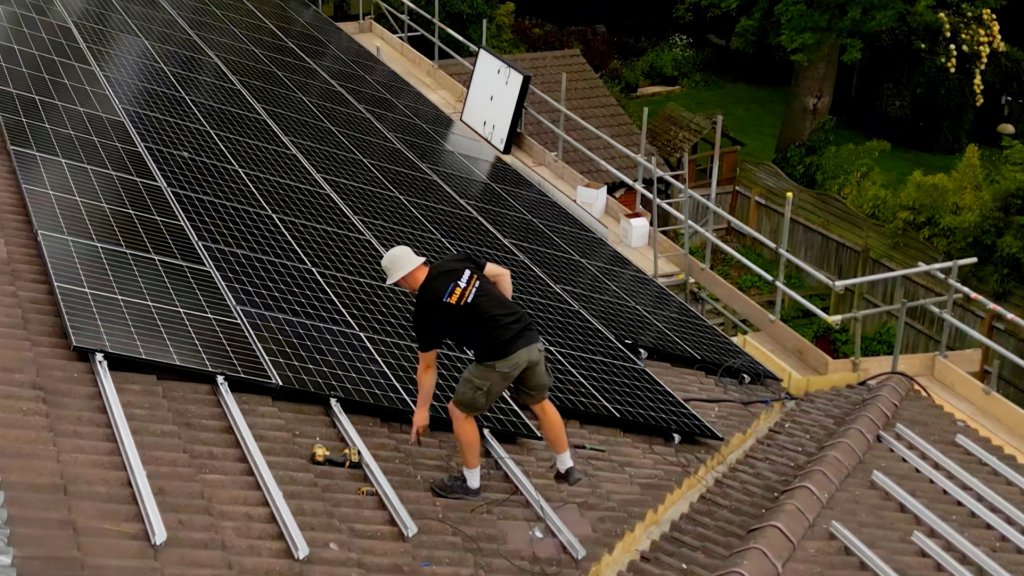
In most cases, disruption is minimal when projects are planned properly. Most work takes place externally on the roof, so production continues unaffected. Access routes, lifting equipment, and working areas are planned in advance around production schedules, logistics, and staff safety.
In addition, the team carries out electrical connections in phases and coordinates them with site managers. Where short shutdowns are unavoidable, they fall outside critical production periods or during planned maintenance windows. For the vast majority of projects, factory solar is installed while the site remains fully operational.
★★★★★ Trustpilot
“A site visit was booked the very next day after we confirmed. Scaffolders were in within the week, and our system was live just 10 days after commissioning.”
— Verified customer
Do You Need Planning Permission for Factory Solar?
In most cases, no. Roof-mounted solar panels on factory buildings in England fall under Permitted Development rights under Class A of Schedule 2, Part 14 of the GPDO 2015, provided conditions are met.
Planning permission is usually not required when:
- Panels sit flush with the roof and project no more than 200mm
- The installation does not extend above the highest part of the roof (excluding chimneys)
- The building is not listed and is not in a conservation area
- The system is not ground-mounted above 9m² within the site boundary
Full planning permission is more likely when:
- The building is listed or in a conservation area
- Panels project above the roofline or face a highway
- Ground-mounted systems exceed 9m² within the curtilage
- An Article 4 Direction has withdrawn Permitted Development rights locally
Therefore, confirming the planning route at feasibility stage avoids delays later. Solar4Good checks this for every site before work begins.
How Long Do Factory Solar Systems Last?
Crucially, factory solar should be treated as permanent infrastructure. Once installed, it generates electricity daily with minimal input. Typical lifespans:
- Solar panels: 25–30 years, with most manufacturers guaranteeing at least 80% of rated output after 25 years
- Inverters: 10–15 years, replaceable without removing the panels — a straightforward mid-life task
- Mounting systems: Designed to last as long as the factory roof itself
With routine maintenance, factory systems keep producing useful electricity long after they have paid for themselves — typically 15+ years of low-cost power after break-even, rarely modelled in initial ROI calculations.
How Does Factory Solar Support ESG and Net-Zero Goals?
Factory solar reduces emissions in a way that is measurable, auditable, and linked directly to operations — which is increasingly what customers, investors, and regulators demand. Unlike offsets, generation happens on site and can be tracked with real performance data.
- Reduced Scope 2 emissions: Lowering grid electricity purchased reduces the carbon intensity of production
- Verifiable generation data: Usable for ESG reporting, supply-chain audits, and disclosures
- Reduced offset reliance: Increasingly scrutinised under frameworks like Science Based Targets (SBTi)
- Visible investment: Tangible on-site evidence of operational decarbonisation
For manufacturers facing supply-chain scrutiny, industrial solar demonstrates real action rather than symbolic commitments.
Is Factory Solar Worth It? The Decision Framework
For most UK factories with sufficient daytime demand, good roof conditions, and long-term site control, solar panels are financially worthwhile. Above all, the return depends on how the building actually uses energy. The biggest savings come from displacing grid electricity at commercial rates during working hours — every unit generated and used on site is a unit not bought from the grid.
Factory solar delivers the strongest returns where:
- Daytime demand is high: Self-consumption of 80%+ maximises savings per kWh generated
- Site tenure is long: 20+ years of ownership or lease captures the full system life
- AIA relief is claimed: 100% first-year capital deduction cuts the effective net cost
- Business rates exemption applies: No additional rates on the solar asset until April 2035
- Grid constraints are understood upfront: Correct sizing avoids stranded capacity
Because every factory is different, a site-specific feasibility study is the most reliable way to confirm the financial case. Solar4Good provides free consultations covering roof layout, energy demand, grid position, and funding — with honest advice on whether the investment stacks up for your site, or whether your capital is better used elsewhere.
★★★★★ TrustATrader
“The system’s performance has exceeded expectations, reducing my grid dependence by 80%, with immediate 70% savings on electricity bills. Clear explanations, transparent pricing with no hidden fees.”
— Verified customer
Frequently Asked Questions: Solar Panels for Factory Buildings
How much can a factory save with solar panels?
Savings depend on system size and, crucially, on self-consumption rate — the share of generated electricity used on site rather than exported. A factory using most of its generation directly saves significantly more than one exporting a large share at the lower export rate. AIA tax relief, the business rates exemption, and protection against future price increases all add to the return. The exact saving for your site is confirmed against your half-hourly meter data during the feasibility study.
What tax relief is available on factory solar panels in the UK?
Solar panels qualify for the Annual Investment Allowance (AIA), allowing the capital cost to be deducted from taxable profits in the year of purchase, subject to the annual allowance limit which covers most factory installations in full. This reduces the effective net cost in year one — the exact benefit depends on your profits and tax position. Installations also qualify for the business rates exemption on the additional rateable value created, which runs until April 2035 under current policy. Confirm the figures with your accountant.
Installation, roof and feasibility questions
Do solar panels work for factories running multiple shifts?
Yes. Multi-shift factories usually maintain strong daytime base loads for preparation, maintenance, logistics, refrigeration, and building systems. A factory running three shifts often achieves 70–80% self-consumption because of this consistent background demand. The feasibility study confirms the exact self-consumption rate from your half-hourly meter data, so the system can be sized accurately.
Can older factory roofs support solar panels?
Often yes, subject to a structural assessment. Most factory roofs — steel profile, concrete, and built-up felt — can support solar loads when in sound condition. Modern commercial panels weigh approximately 11–13 kg/m², distributed across purlins and steelwork by the mounting system. Where structural drawings are missing or the roof is near end of life, a structural engineer’s assessment is carried out first. Solar4Good includes structural review in the feasibility process.
What if the factory roof needs replacing after solar is installed?
If the roof needs replacing within the system’s lifespan, installers must remove and refit the panels, which adds cost and disruption. For this reason, the survey team assesses roof condition and remaining life before installation. Where a replacement is due within 5–10 years, the most cost-effective approach is to complete the roof works first, then install panels on the new surface. Solar4Good flags this during the survey and recommends the right sequence.
Timeline and project questions
How long does it take to install solar panels on a factory?
A 100kWp installation typically takes 3–7 days of on-site work once scaffolding is in place. Larger systems of 250kWp or more may take 2–4 weeks. The full project timeline from survey to commissioning is usually 8–16 weeks, depending on DNO approval and any structural works required. Solar4Good coordinates survey, design, DNO application, installation, and commissioning as one managed project.
Can factory solar panel systems be installed in phases?
Yes. Many factory solar panels UK installations are phased to match budget, business growth, or grid capacity. A common approach installs phase one to cover current peak daytime demand, then expands when the business grows or grid constraints clear. Solar4Good designs systems with future expansion in mind — ensuring electrical infrastructure, inverter configuration, and roof space support additional capacity without major rework.
Is a feasibility study a commitment to install?
No. A feasibility study confirms viability, system sizing, expected generation, financial return, and any site constraints — without committing to installation. It gives manufacturers the data to make an informed capital decision based on their actual site, not generic estimates. Solar4Good provides free initial consultations and feasibility reviews with no obligation to proceed.
About the Author
Matthew
Solar Consultant with over a decade of UK solar experience, helping homeowners and businesses make clear, confident renewable energy decisions.
📞 Book a free solar consultation
Call us on 0800 999 1454 or visit solar4good.co.uk
Read over 750+ verified five-star reviews on Trustpilot and Checkatrade
Solar4Good Ltd · 79 College Road, Harrow, HA1 1BD · MCS: NAP/72775/25/4 · HIES: S4G/A/1484