Published 4 August 2026
This story uses expert counsel to ask if economics, not ecology, is the prime reason for installing solar power in the UK. Installing green technology used to be a decision for the heart. Now purchasing solar panels from a reputable installer is a decision for the head.
Rising electricity prices paired with falling hardware costs make going green a financial choice, not an environmental one. While the benefit to the planet is real, “90% of Brits invest in solar panels because it makes economic sense according to our customer feedback,” says Manan Shah, co-founder of Solar4Good.
Has the tipping point between installing solar or paying traditional energy bills been crossed?
We asked Kingsmill Bond, an energy strategist for Ember, whether the tipping point has been reached for Britain’s 29 million households, where it is cheaper to purchase solar panels rather than importing energy from the grid.
“Yes,” says Bond, an energy expert of 30 years standing, who worked as a financial market analyst for Deutsche Bank and Citibank. “The average price per unit of electricity in 2026 is over 30p per kilowatt hour (or kWh, the standard unit price of electricity). If you figure out the cost of putting in solar panels plus a battery, it’s going to be much cheaper.”
Reader, I did the same calculations when I installed solar panels in 2024. The annual energy bill for my three bedroom home, containing three energy-hungry children, was £2,500 per year. The installation of solar panels, a battery and an inverter (the magic box that changes direct current electricity from solar panels into alternating current electricity for use by home appliances) cost £11,000. Since then, I haven’t received a single energy bill. Zero. Nada. Nilch.
My mathematical equation was completed by the 1.7 million other British households who have installed solar (according to 2026 government figures). The tipping point between investing in solar or importing grid energy has been comprehensively crossed.
01How three recent economic factors have made solar installation a sound financial decision
During the last five years, three unrelated economic factors have made a foolproof case for installing solar panels in the UK: energy prices went up, hardware prices went down and VAT became zero.
First, electricity got expensive. Very expensive. The energy price shock that began in 2021 and continued through Covid, the Ukraine war and the Iran conflict is still ongoing. According to data from MoneySavingExpert, a typical household using a standard amount of energy, and paying via direct debit, will have an average annual bill of £1,862 in 2026. In 2020, the average energy bill was just £1,042, an increase of 79% in six years. British domestic energy prices are almost at an all time high.
Second, the price of solar panels and batteries got cheaper. “The price of batteries has fallen by 90% in about 10 years,” confirms energy analyst Kingsmill Bond. Batteries are a crucial part of a solar installation in Britain as they can store power generated by the panels by day. Because most Brits go out to work or school during daylight hours, a typical home uses only around 30 to 50% of what its panels produce. Add a battery and that self-consumption figure typically rises to 70 to 80%. “Batteries really add value,” says Bond. “Because when you have just solar panels, you have to be quite careful about when you use the electricity.”
Third, VAT was reduced to nothing. Since 2022, domestic solar and battery installations in the UK have carried 0% VAT. That straightforward 20% cut to the total installation’s cost shortened the return on investment horizons overnight.
In summary, dearer grid power, cheaper solar kit and zero VAT have made investing in green technology financially beneficial, compared to continuing to purchase grid energy. “The ROI on our latest installations can be as little as five and a half years,” says Shah at Solar4Good.
02How does avoiding energy imports cut my British household energy bill?
A solar array installed in a British home cuts bills in two ways: energy avoidance and solar export.
Avoiding energy costs is the biggest factor for meaningfully slashing an electricity bill. Energy that a household generates and consumes on site replaces power that would otherwise be purchased. Put simply, every kilowatt you generate and use yourself is a kilowatt you don’t buy at retail price.
There’s another big advantage to owning solar panels in the UK. Customers with heat pumps, batteries or solar panels are allowed to import energy using cheaper, specialised tariffs. I import electricity using Octopus Energy’s Cosy tariff, which costs 12.54p per kWh during three specific time periods each day. That’s around half the cost that non-solar households pay. Believe me, accessing half price energy is one of the biggest bonuses to green tech owners in Britain.
03How can exporting excess solar energy to the grid further reduce my energy bill?
Export payments can net the two million residential and commercial solar installations across Britain (according to government figures from March 2026) a small fortune. Under the Smart Export Guarantee, energy suppliers must pay households for surplus solar power exported back to the grid.
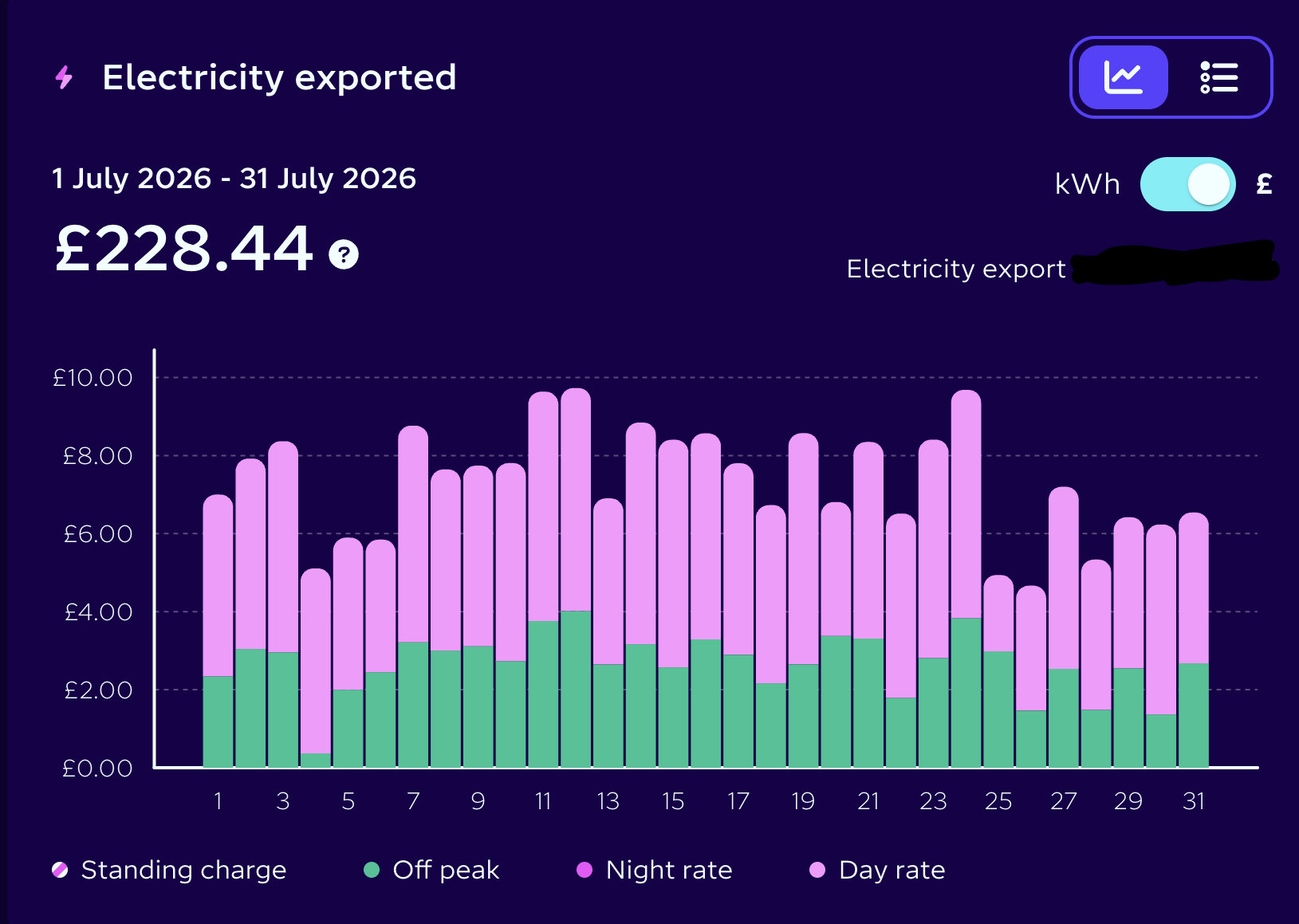
Dozens of big suppliers like E.ON and British Gas compete to offer customers the highest tariff for exporting energy. I export using Octopus Energy’s Flux Export tariff, which pays me 27.81p per kWh. In July 2026 I exported £228.44 of energy. Here’s a screenshot to prove it. This sum is automatically subtracted from my energy bill. Or I can withdraw the money into my bank account at any time.
04How much does installing solar help the environment?
Using green British energy instead of imported fossil fuels has a positive effect on the environment, as well as on customers’ bank accounts.
The UK government estimates that if every UK home had rooftop solar, it could save between 40 to 55 TWh of electricity every year, around 13 to 18% of Britain’s total electricity demand. It would be the equivalent to removing around 8 to 10 million petrol cars from the road.
In terms of climate change, installing solar panels en masse across British household rooftops would save around 5 to 6 million tonnes of CO². That amount is roughly equivalent to the annual emissions of one large coal-fired power station. And if everyone had solar, the amount of nitrogen oxides, carbon monoxide and particle pollution would radically fall. Respiratory issues would decrease in tandem. Not burning coal, oil or gas is a positive thing for planet earth.
05Why has energy security made solar investment a choice for the head, not the heart?
Aside from the environment and the economics, there is a third reason why Brits are choosing to install solar panels in the UK in record numbers. In May 2026, for example, the Department for Energy Security and Net Zero announced that a record breaking 269,000 solar installations were completed across the UK during 2025, the highest annual amount ever recorded.
That final topical reason is energy security. Global conflict continues in the bottlenecks of fossil fuel transportation, like the Strait of Hormuz and the Caspian Sea. Given the current geopolitical situation, it’s unlikely that electricity prices will fall soon. British households can negate the dramatic peaks and troughs in energy tariffs, or guard against outages and grid hacks, by installing solar today.
In summaryIn summary: is installing solar in Britain a wise economic decision?
Is purchasing solar and storage batteries a savvy economic choice? Energy expert Kingsmill Bond believes so. “It’s an exciting moment,” says Bond. “A combination of cheap solar, cheap batteries, fairly open regulation in the UK and good software mean that these technologies start to pay for themselves quite quickly.”
The record amount of solar installations in Britain has been fuelled by rising energy prices, falling hardware prices and 0% VAT. Added to this financial gain is an additional income from energy exported back to the grid using the Smart Export Guarantee, which replaced the old Feed-in Tariff scheme in 2020.
Carbon reduction still helps the environment. It’s just no longer the main argument for installing solar. For most UK households in 2026, the question isn’t solely whether solar is good for the planet, it’s whether it’s good for their wallet too.
Tabular summary of how economics, not the environment, has made solar panel investment a financial win.
| Energy event | Factual analysis | Impact on solar investment |
|---|---|---|
| Energy prices increased due to global conflict | Since 2021, conflicts in Russia, Ukraine, Venezuela, Iran and the Arabian Gulf have pushed energy prices higher than ever before. | UK customers generating electricity from their own solar panels save money by avoiding increasingly expensive energy from the grid. |
| Battery prices have dropped by around 90% in ten years | “The price of batteries has fallen by 90% in about 10 years,” confirms energy analyst Kingsmill Bond, reducing the cost of crucial solar hardware. | It’s now cheaper than ever for British households to store energy they generate during the day, when residents might be at work or school, to use each evening. |
| VAT reduced to Zero | In April 2022, VAT on residential solar panels and energy storage installation was reduced to 0%. | The total cost of installing solar power in British households dropped by 20% overnight and remains zero-rated for VAT today. |
| Solar export rates come with a Smart Export Guarantee | From 2020, energy suppliers have competed to offer the best tariffs to import excess energy from British households, following Smart Export Guarantee legislation. | UK customers are paid up to £1 per kWh to export energy back to the grid. This further reduces the payback horizon of their solar investment. |
Thinking about solar for your home?
Get a free, no-pressure survey from our MCS-registered installers, and see what your roof could return.

Manan co-founded Solar4Good to do solar differently — as a partner, not a salesperson. After 15 years in London finance, he treats a solar system as the financial decision it is: every customer gets an honest, numbers-first projection of cost, savings and payback, not a sales promise.