
5 Reasons to Add Battery Storage to Your Existing Solar System (UK 2026)
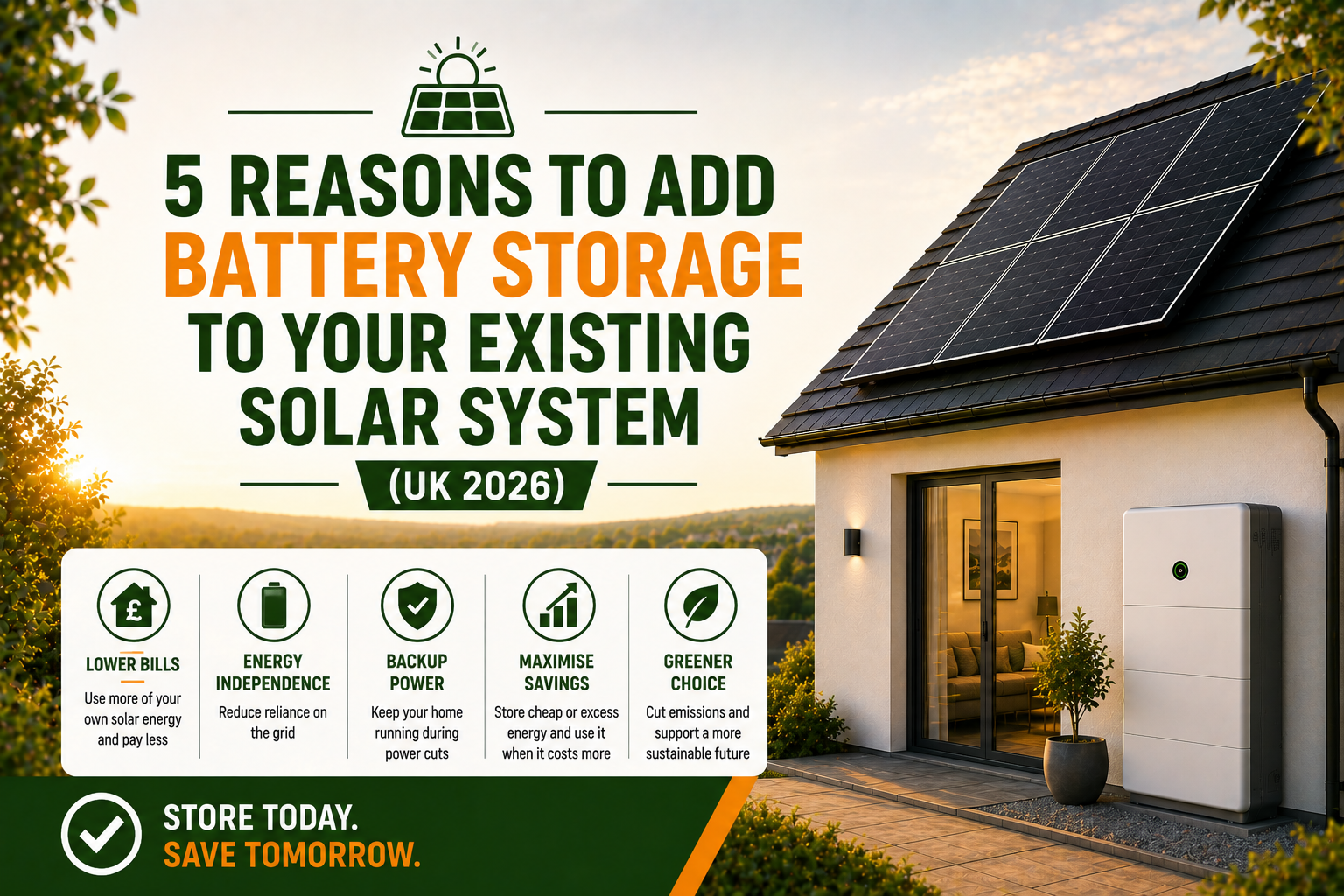

You already have solar panels — so why add a battery now? And what actually changes once you do?
- 1. Why UK homeowners are adding battery storage to existing solar systems in 2026
- 2. Why add a battery to an existing solar system? (5 key reasons)
- 3. You’re exporting at low rates and buying back at higher prices
- 4. A battery lets you use cheaper electricity and avoid peak rates
- 5. Your FiT payments stay protected while you increase self-consumption
- 6. A battery can keep your home running during a power cut
- 7. Battery storage supports EV charging, EPC improvements and long-term value
- 8. Cost and payback: what to expect
- 9. Conclusion
- 10. FAQs
Short Summary
What UK solar owners need to know about adding battery storage in 2026:
- Battery storage can be retrofitted to most existing solar systems via AC coupling — without replacing your current inverter
- Your FiT payments are unaffected — a battery installs after the generation meter and does not change how your payments are calculated
- Self-consumption typically rises from 35–50% to 70–80%, meaning more of your generation is used rather than exported at low rates
- Smart tariffs like Octopus Go (~7p/kWh overnight) can be combined with a battery to stack savings beyond solar self-consumption alone
- Backup power during a grid outage is available with the right system design — but must be specified at survey stage, not assumed
- 0% VAT currently applies to battery retrofits — the saving is applied automatically through a qualified MCS-certified installer
- Solar4Good® surveys your existing setup and recommends what’s right for your home — call 0800 999 1454 or visit solar4good.co.uk for a free consultation
⚡ Solar4Good: MCS-certified battery storage installer
Solar4Good holds MCS certification (NAP/72775/25/4) for solar panel and battery storage installation across the UK. With 2,500+ completed installations and a 4.9/5 rating on Trustpilot, we survey your existing solar setup and design the right retrofit — whether that’s a Tesla Powerwall, Sigenergy SigenStor, GivEnergy, or FoxESS. See our battery storage page for more detail.
If you installed solar panels a few years ago, there’s a good chance you did it without a battery — and at the time that was a perfectly reasonable decision. Battery systems were more expensive, export tariffs were simpler, and for many homes the numbers still worked without storage.
That context has shifted. In 2026, the gap between what you’re paid to export electricity and what you pay to buy it back has widened significantly. Smart tariffs have created clear windows of very cheap and very expensive electricity. And battery systems can now be added to most existing setups without replacing your current inverter.
Adding a battery doesn’t change how much your solar panels generate. What it changes is how much of that energy you keep and use at the right time. This guide explains exactly where that difference shows up in practice.
Why UK Homeowners Are Adding Battery Storage to Existing Solar Systems in 2026
Most solar systems installed before the last few years were designed without storage. The assumption was simple: use what you can during the day and export the rest. That approach still works — but it leaves a gap.
Electricity is most expensive in the evening, when solar panels aren’t generating. Without a battery, that’s exactly when you start buying energy back from the grid — often at two to three times the value of what you exported earlier in the day.
Several things have changed to make this more relevant in 2026:
- Electricity prices have become more volatile, with a wider spread between cheap and expensive periods
- Time-of-use tariffs have widened the gap between overnight off-peak rates and daytime/peak pricing
- Battery systems can now be added to most existing setups via AC coupling — without replacing your current inverter
- Retrofit costs have fallen and 0% VAT now applies to standalone battery installations
The result is that storage is no longer just an add-on. For many existing solar owners, it’s the change that makes the system perform as it should have all along.
★★★★★ Trustpilot
“We had solar fitted a few years ago and always wondered if we were getting the full benefit. Solar4Good surveyed our system, added a battery and configured it with our Octopus tariff. The difference in our bills was immediate — we wish we’d done it sooner.”
— Verified customer
Why Add a Battery to an Existing Solar System? (5 Key Reasons)
For most existing solar owners, the decision to add a battery isn’t driven by one single benefit. It’s usually a combination of gaps in how the system currently performs — some financial, some practical, some forward-looking — that become clearer over time.
The five reasons below reflect the most common situations homeowners are now responding to. Not theoretical benefits, but what tends to come up once a system has been running for a while.
You’re Exporting Solar Energy at Low Rates and Buying It Back at Higher Prices
Without a battery, most solar systems export their surplus energy in the middle of the day — when you’re least likely to be using it. That exported energy is paid at Smart Export Guarantee (SEG) rates, typically between 6p and 12p per kWh depending on your supplier. Later that same day, when you need electricity in the evening, you’re buying it back from the grid at around 24–27p per kWh.
That gap — roughly 15p to 20p per unit — is where the value is lost.
A typical UK home with a 4 kWp system generates around 3,400 kWh per year. Without storage, only 35–50% of that is used directly in the home. The rest is exported. A battery changes that significantly:
- Self-consumption typically rises to 70–80%
- More of your solar generation is used when it’s most valuable — rather than sold cheap and bought back expensive
- In practical terms, this often translates to an additional £200–£300+ per year in savings on top of what your panels already deliver
Ready to go Solar ?
⚠️ The arithmetic is straightforward
Exporting earns 6–12p per kWh. Avoiding a grid import saves around 25p. Every kWh you store and use yourself is worth approximately 15–20p more than exporting it. Over a full year, that adds up quickly.
For existing systems, this doesn’t require starting again. AC-coupled batteries can be added alongside your current inverter — allowing the system to store energy without replacing what’s already working.
A Battery Lets You Use Cheaper Electricity and Avoid Peak Rates
A battery doesn’t just store solar energy. It also lets you take advantage of how electricity is priced throughout the day. With time-of-use tariffs now widely available, electricity can be very cheap overnight and significantly more expensive during peak hours.
In 2026, the spread on smart tariffs can look like this:
| Tariff period | Typical rate (2026) |
|---|---|
| Off-peak overnight (e.g. Octopus Go) | ~4–7p per kWh |
| Standard daytime rate | ~24–32p per kWh |
| Peak periods on dynamic tariffs (e.g. Agile) | 30–50p+ per kWh |
A battery can be programmed to charge overnight when electricity is cheapest and discharge during the evening when grid prices are highest. Some tariffs — like Agile Octopus — also include periods where electricity drops to near zero or goes negative. A battery can automatically charge during these windows.
Research suggests that combining solar, battery storage and tariff optimisation can reduce electricity costs by 20–60% depending on usage patterns. Modern systems from brands like Sigenergy, GivEnergy, FoxESS and Tesla Powerwall all support smart scheduling through their apps.
💡 Worth noting
To access off-peak overnight rates you’ll need to switch to a compatible time-of-use tariff and have a smart meter capable of half-hourly readings. For most homeowners this is a straightforward step — and in many cases the tariff savings alone contribute significantly to the overall return from the battery.
★★★★★ Trustpilot
“Solar4Good added a GivEnergy battery to our existing system and set us up with Octopus Go. Between the tariff savings and the extra self-consumption, our electricity bills dropped by more than half. The whole process took one day and they managed all the paperwork.”
— Verified customer
Your FiT Payments Stay Protected While You Increase Self-Consumption
One of the biggest concerns for homeowners with older systems is whether adding a battery will affect their Feed-in Tariff (FiT) payments. The answer is no.
FiT payments are based on how much electricity your system generates — not how it’s used. A battery is installed after the generation meter, so your payments continue exactly as before. In many cases, FiT customers are on deemed export, meaning they’re paid for a fixed percentage of generation regardless of how much is actually sent to the grid.
Note for metered export customers
A small number of FiT customers have actual metered export rather than deemed. If that applies to you, adding a battery will reduce your recorded export volume — and therefore your export payment. Check with your FiT licensee before proceeding. Solar4Good establishes this during your free survey.
From April 2026, FiT payments will be indexed to CPI rather than RPI — meaning the generation payment grows more slowly in real terms than it has historically. That makes the case for a battery stronger, not weaker: with the generation income growing more slowly, the bigger financial lever becomes how much of your solar you use yourself, displacing grid electricity at 24p+ rather than exporting it at 6–12p. A battery is the most direct way to capture that value.
A Battery Can Keep Your Home Running During a Power Cut
Solar panels on their own don’t provide power during a grid outage. For safety reasons, they shut down when the grid goes down. A battery changes that — but only if the system is designed to support it.
With the right setup, including a backup gateway or equivalent switching device, a battery can keep essential parts of your home running during a power cut. What that looks like depends on system size:
- A 5 kWh battery can typically cover essential loads — fridge, lights, Wi-Fi, devices — for around 5–7 hours
- A 10 kWh system can extend that through most of an evening or overnight
- During daylight hours, your solar panels can continue generating and recharging the battery, helping sustain the system through longer outages
⚠️ Important
Not all battery systems provide backup by default. This depends on how the system is configured and whether a backup gateway and dedicated backup circuits are included. Systems such as Tesla Powerwall, Sigenergy SigenStor and GivEnergy AIO all support backup functionality — but the scope of protection depends entirely on how the system is designed and wired. This must be specified at survey stage, not assumed.
Battery Storage Supports EV Charging, EPC Improvements and Long-Term Value
Adding a battery isn’t just about what your system does today. It also affects how your home performs over the next few years.
Electric vehicles
If you’re planning to get an electric vehicle — or already have one — a battery helps bridge the gap between when solar energy is generated and when it’s needed for charging. Instead of exporting that surplus, you store it and use it to charge the car later. Combined with smart EV chargers, this allows solar surplus to charge the vehicle during the day and cheap overnight electricity to top up when needed.
EPC ratings
Under the current EPC framework, battery storage is recorded as part of a home’s assessment. The new multi-metric framework expected from late 2026 is designed to recognise how well a home reduces grid dependency — which is exactly what a battery supports. Installing one now means your home is already set up to perform well under the incoming standard. For landlords, minimum EPC requirements are tightening, and solar-plus-battery is one of the most effective ways to move a property up a rating band.
Property value
Solar panels already contribute to higher EPC ratings and are consistently linked to increased home values. Battery storage strengthens that picture — particularly as energy performance becomes more important in buying and rental decisions and as EPC methodology evolves to recognise actual grid independence.
Cost and Payback: What to Expect
Battery retrofit costs have come down meaningfully over the past two years, but remain a significant investment. Here are realistic 2026 ranges:
| Scenario | Typical cost (inc. 0% VAT) | Estimated payback |
|---|---|---|
| Battery retrofit (no inverter swap) | £4,500–£6,500 | 10–15 years (7–10 on smart tariffs) |
| Battery + inverter replacement | £5,500–£8,000 | 12–18 years (9–12 on smart tariffs) |
| Battery added during new solar install | £1,000–£1,500 extra | ~3–5 years |
Retrofit costs are higher than adding a battery during a new install because the work is done separately — you’re not sharing the labour and setup costs of the original installation. Payback typically falls in the 10–15 year range on a standard tariff, or 7–10 years on a smart tariff like Octopus Agile or Flux by stacking self-consumption savings with overnight charging.
In most cases, annual savings from a battery retrofit fall in the £300–£450 range, depending on usage and tariff. The return comes from three sources working together:
- Increased self-consumption — using more of your own solar rather than exporting it at lower rates
- Tariff optimisation — charging cheaply overnight and discharging at peak
- Reduced grid dependency — importing less electricity overall
💡 Ask your installer
Payback depends on your actual usage, your current tariff, and how the system is configured — not just the hardware cost. Solar4Good provides a full financial breakdown at survey stage, including projected annual savings and payback period based on your real usage data. There is no obligation to proceed.
★★★★★ Trustpilot
“I was nervous about the payback period but Manan went through the numbers honestly based on our actual usage and tariff. We’re saving around £380 a year and the payback is closer to 8 years with our Octopus Flux setup. Exactly what he said it would be.”
— Verified customer
Making Battery Storage Work for Your Existing Solar System
A battery doesn’t change how much your solar panels generate — it changes how much of that energy you actually keep and use. Without storage, a large portion of your generation is exported at relatively low rates and bought back later at a higher cost. A battery closes that gap, and in 2026 the case for doing so has become meaningfully stronger.
In 2026, with wider tariff spreads, 0% VAT still in place and AC-coupled retrofit technology now well established, this shift is more accessible than it has ever been. Whether it makes financial sense for your home depends on your usage, your current tariff, and how the system is designed.
If you would like to understand what adding a battery would actually change for your home — including costs, savings, and system design — Solar4Good provides free no-obligation consultations. We survey your existing setup, explain the numbers honestly, and provide a fixed written quote. There is no obligation to proceed.
Explore related guides:
- Battery storage UK: costs, brands and what to expect in 2026
- Tesla Powerwall UK: costs, benefits and grants
- Sigenergy SigenStor review: is it the right battery for your home?
- G99 DNO applications explained: what to expect before installation
📞 Get a free battery storage consultation from Solar4Good
Call us on 0800 999 1454 or visit solar4good.co.uk. Read over 661 verified five-star reviews on Trustpilot and Checkatrade.
Solar4Good Ltd · 79 College Road, Harrow, HA1 1BD · MCS: NAP/72775/25/4 · HIES: S4G/A/1484
MCS-certified installer of solar panels, battery storage and EV chargers across the UK.
★★★★★ TrustATrader
“The system’s performance has exceeded expectations, generating 550+ kWh monthly and reducing my grid dependence by 80%, with immediate 70% savings on electricity bills. The retrofit was clean and the team explained everything clearly.”
— Verified customer
Frequently Asked Questions
Can I add a battery without replacing my inverter?
Yes, in most cases. Most existing solar systems can have a battery added using AC coupling, which allows your current inverter to remain in place. Whether this is the best option depends on your setup — some systems benefit from switching to a hybrid inverter, but that’s something a proper survey will confirm.
Will a battery affect my FiT payments?
No. FiT payments are based on how much electricity your system generates — not how it’s used. A battery is installed after the generation meter, so your payments continue as normal. If you’re on deemed export, you’ll still be paid for a fixed proportion of generation regardless of how much you store or use.
Do batteries work during a power cut?
Only if the system is designed for it. Solar panels alone shut down during outages for safety reasons, but a battery can provide backup power if it includes a backup gateway or equivalent functionality. Not all systems include this by default — it must be specified at the design stage.
Is VAT applied to battery retrofits?
No. 0% VAT currently applies to battery storage installations in the UK, including retrofits added to existing solar systems. This saving is applied automatically when installed through a qualified MCS-certified provider. The 0% rate is confirmed until 31 March 2027.
How long does a battery last?
Most home batteries are designed to last around 10–15 years depending on usage. Warranties typically cover a set number of cycles or years — for example, Tesla Powerwall‘s 10-year warranty or Sigenergy SigenStor‘s 10-year capacity guarantee. Performance reduces gradually over time rather than stopping suddenly. Solar4Good registers warranties and provides workmanship cover on all installations.
Which battery is best for an existing solar system?
It depends on your existing setup, how much storage you need, and whether backup power is a priority. AC-coupled options such as Tesla Powerwall, GivEnergy AIO and Sigenergy SigenStor are all well-suited to retrofit installations. Solar4Good recommends based on your survey data and actual usage.
About the Author
Manan Shah
Co-Founder of Solar4Good UK. Leads Solar4Good's commercial strategy and customer relationships, and is quoted as a clean-energy authority by some of the UK's most trusted news publications. Quoted in the Financial Times and The Times on UK solar.
📞 Book a free solar consultation
Call us on 0800 999 1454 or visit solar4good.co.uk
Read over 750+ verified five-star reviews on Trustpilot and Checkatrade
Solar4Good Ltd · 79 College Road, Harrow, HA1 1BD · MCS: NAP/72775/25/4 · HIES: S4G/A/1484