Is a 5kW solar panel system the right size for your home, or will you outgrow it within a few years? How much electricity can it actually generate, and what does that mean for your energy bills in 2026? This guide answers all of it with real figures, honest payback numbers, and battery guidance from an MCS-certified installer with thousands of completed UK installations.
The Short Version (Read This First)
Key facts about 5kW solar panel systems in the UK:
- A 5kW system typically generates 4,250–5,000 kWh per year (UK average to southern England)
- Daily output averages 11–14 kWh; monthly output runs 350–410 kWh across the year
- Best suited to 4–5 bed homes or any household planning to add an EV or heat pump
- Annual savings are significantly higher when a battery is added to the system
- Break-even depends on whether you add battery storage and how much electricity you use during the day
- 12–13 panels at 450–500W; approximately 21–26 m² of usable south-facing roof space needed
- DNO paperwork (G98 or G99) is handled by Solar4Good as standard
- Solar4Good: MCS certified · HIES consumer protection · FMB Best Customer Service 2026 · thousands of UK installs.
A note on the figures in this guide
The costs and savings below are general 2026 UK guide figures, included to help you plan, they are not a quote. Your actual price and savings depend on your property, how much electricity you use and your tariff, all confirmed at a site visit.
01What a 5kW Solar Panel System Actually Is
A 5kW solar panel system (also written as 5kWp) describes the peak output the system can produce under ideal laboratory conditions, full sun, optimal temperature, no shading. In real-world UK conditions actual output will be lower, but it is the standard measure used to size and compare all solar systems.
For a modern installation using higher-efficiency panels, 5kW translates to:
- 12–13 panels at 450–500W per panel
- Approximately 21–26 m² of usable roof space (south-facing ideal; SE/SW acceptable)
- An inverter typically rated at around 3.5kW AC output, slightly lower than panel capacity
Why is the inverter slightly smaller than the panels?
This is intentional. UK conditions rarely produce true peak output, so slightly undersizing the inverter captures the vast majority of the generation curve at lower cost. For inverter brand comparisons and what to look for, see our guide to the best solar inverters in the UK.
02How Much Electricity a 5kW System Produces in the UK
Output varies by location, roof pitch and shading. As a result, the figures below are what you should plan around, based on MCS irradiance data and Solar4Good’s installation experience across the UK.
| Output period | UK average | South England | Scotland |
|---|---|---|---|
| Annual | ~4,250 kWh | Up to ~5,000 kWh | ~3,800–4,000 kWh |
| Monthly | 350–410 kWh average | ~415–450 kWh in summer peak | ~310–370 kWh |
| Daily | 11–14 kWh average | 20–25 kWh on a clear summer day | 3–5 kWh in winter |
The seasonal swing is bigger than most people expect
A UK summer day can deliver 20–25 kWh, while a December day might deliver only 3–4 kWh. Annual planning figures smooth this out, but it matters when deciding on battery size and whether to add an off-peak tariff for winter grid top-up.
Of course, these figures assume a south-facing roof at roughly 30–40° pitch with no significant shading. By comparison, east- or west-facing roofs typically produce 15–20% less annually. Solar4Good’s surveyors calculate site-specific output estimates during the site visit using irradiance mapping, not generic averages. The independent Energy Saving Trust offers useful background on what UK homes can expect.
03Is a 5kW Solar System Right for Your Home?
Generally, a 5kW system is best suited to households that already use a meaningful amount of electricity, typically 3,000–5,000+ kWh per year, or where consumption is expected to rise. Based on thousands of UK installations, a 5kW system tends to perform best when:
- The property is a 4–5 bedroom home with multiple occupants
- An EV charger is already installed or planned within 2–3 years
- A heat pump is being considered
- Someone works from home and uses electricity during the day
- There is at least 21–26 m² of unshaded, usable roof space
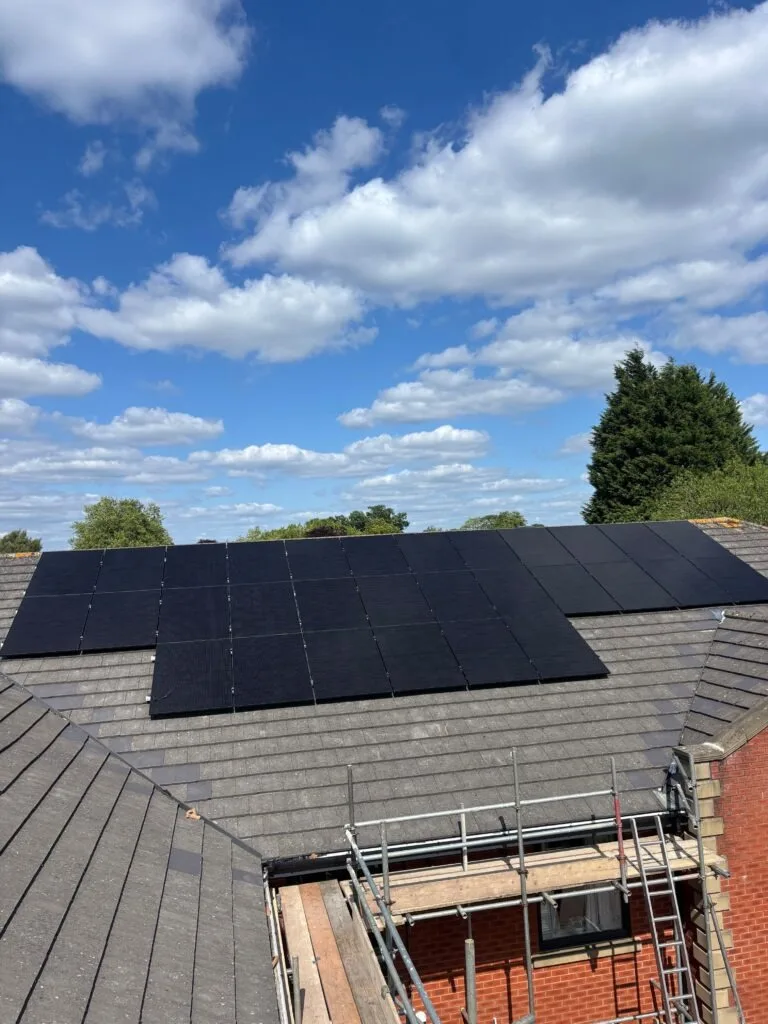
Solar4Good install data insight
Across our many completed UK installations, the most common residential system sizes are in the 10–13 panel range. Indeed, the 5kW (12–13 panel) system sits at the heart of the residential market. For higher-demand properties, see our 10kW solar system guide.
In contrast, a 5kW system becomes less suitable when electricity use is consistently low (under 2,500 kWh/year) and unlikely to change. In those cases, a smaller system may produce a better financial return because less generated energy is wasted through export at low SEG rates.
★★★★★ Trustpilot
“Manan was genuinely helpful in explaining what system size actually made sense for our usage rather than just upselling the biggest package. We ended up with a 5kW system and a 10kWh battery. The monitoring app is brilliant, we can see exactly what we’re generating and saving in real time.”
Verified residential customer, Harrow
04How Much Could You Realistically Save?
Ultimately, the savings from a 5kW system depend almost entirely on how much of the generated electricity you use in your home. For instance, every unit used from your own panels avoids buying from the grid at the Ofgem residential rate of 24.67p/kWh (Q2 2026). Meanwhile, every unit exported earns around 7p/kWh via the Smart Export Guarantee, a fraction of the value. Self-consumption is the key driver.
| Scenario | Estimated annual saving | Notes |
|---|---|---|
| Panels only (no battery) | £400–£700 / year | ~30–50% self-consumption depending on daytime usage |
| Panels + battery storage | £800–£1,050 / year | ~70–80% self-consumption; battery captures evening use |
| SEG export income | Up to ~£382 / year | On surplus units exported, reduced when a battery is fitted |
What actually drives your savings
The panels generate the energy. How you use it, and when, determines the return. Notably, adding a battery is the single most impactful upgrade after system size. See our dedicated solar battery price guide for full capacity and brand breakdowns.
05What Does a 5kW Solar System Cost in the UK? (2026)
Based on Solar4Good’s 2026 pricing across our UK installations, here are general guide ranges for a 5kW residential system. All prices include 0% VAT, which applies to residential solar installations until April 2027.
| System configuration | Typical cost (inc. 0% VAT) | What’s included |
|---|---|---|
| 5kW solar panels only | £7,000–£9,000 | Panels, hybrid inverter, scaffolding, installation, DNO paperwork, MCS certificate |
| 5kW solar + battery storage | £11,000–£13,000 | All of the above plus battery, smart monitoring, and app setup |
Why quotes well below market rate should raise questions
A quote well below the market range almost always means the battery brand, panel wattage or inverter size has been reduced, or all three. Check the spec sheet carefully. MCS certification, HIES consumer protection and a verifiable service record are not optional extras.
Also, residential solar panels attract 0% VAT until April 2027. The Warm Homes Plan is the active government support scheme for eligible lower-income households. Solar4Good can advise whether your property may qualify.
06What Is a 5kW Solar Battery, and What Does It Do?
“5kW solar battery” is one of the most searched terms in UK solar, and one of the most misunderstood. Here is what it actually means and why the terminology matters when you are comparing quotes.
kW vs kWh, the confusion that costs people money
Specifically, kW (kilowatt) describes power, how fast energy flows in or out of the battery. kWh (kilowatt-hour) describes capacity, how much total energy the battery can store. When someone searches for a “5kW battery”, they are almost always asking about a battery with around 5 kWh of storage capacity. In practice, that is at the smaller end of what is recommended for a full 5kW solar system.
| Term | What it means | Why it matters |
|---|---|---|
| 5kW (power rating) | How fast the battery charges or discharges | Affects whether it can power high-demand appliances simultaneously |
| 5kWh (capacity) | How much total energy the battery can hold | Determines how many hours of evening use it covers |
| Usable capacity | The portion of total capacity available in practice | Most batteries quote 90–95% usable, check the spec sheet |
How Much Battery Storage a 5kW System Needs
What size battery do you actually need with a 5kW system?
A 5kW solar system generating 4,250–5,000 kWh per year will produce more electricity than most homes can use during daylight hours, and the surplus needs somewhere to go. A battery with 5 kWh of storage covers a modest evening load, but most households with a 5kW system benefit from 10 kWh or more to meaningfully shift usage to the evening. For a full breakdown of capacities, brands and costs, see our solar battery price guide.
In total, a 5kW solar system with battery storage costs in the region of £11,000–£13,000 (inc. 0% VAT), an all-in package price including panels, inverter, battery, scaffolding, installation and MCS certification. The battery capacity included in this range varies by brand and specification; Solar4Good confirms the exact spec during your site survey.
★★★★★ Trustpilot
“From initial survey to flawless installation, Solar4Good delivered an exceptional experience. The team installed 12 premium panels with a Fox 6kW hybrid battery system in a single day, working meticulously and leaving the site spotless. Clear explanations, transparent pricing with no hidden fees.”
Verified customer, 9.53/10 Checkatrade
07Which Battery Should You Pair With a 5kW System?
Ultimately, the right battery for a 5kW system depends on how much electricity your household uses in the evening, whether you have or plan an EV, and how future-proof you want the system to be. Solar4Good installs batteries from all the leading UK brands, the recommendation is always based on your actual usage, not margin.
| Household profile | Battery capacity to consider | Why |
|---|---|---|
| Smaller home, moderate evening usage | ~5–7 kWh | Covers basic evening load; lower upfront cost |
| 4–5 bed home, typical family use | ~10 kWh | The most common pairing for a 5kW system; balances cost and coverage |
| EV owner or high evening usage | 13–16 kWh | Covers EV top-up and full household evening load |
| Future expansion planned | Modular system starting at 10 kWh | Add capacity later without replacing the whole system |
For a deep-dive into the Sigenergy modular system, including specs, real-world performance and EV charging integration, see our full Sigenergy battery review.
08Can a 5kW System Power an EV?
Overall, a 5kW system generates 4,250–5,000 kWh per year. An average UK EV on typical annual mileage uses roughly 2,000–3,000 kWh per year, so the maths suggests solar could cover a significant portion of EV charging, but timing is everything.
| Charging scenario | Solar contribution | What you need |
|---|---|---|
| Daytime charging (home office, weekend) | High, largely solar-powered | Panels + solar-aware EV charger |
| Evening charging after work | Low without battery | Panels + battery to store daytime generation |
| Winter months, high mileage | Lower solar contribution | Grid top-up; off-peak tariff recommended |
Solar-aware EV chargers make a real difference
In effect, a solar-aware charger automatically diverts surplus generation to your car rather than exporting it at low SEG rates, turning otherwise-wasted electricity into free EV miles. Solar4Good installs compatible EV chargers from multiple brands, ask your site visitor about integration during the site visit.
09How Long Does a 5kW System Take to Pay Back?
Payback period is one of the most searched, and most misrepresented, figures in solar marketing. Here are the honest estimates based on Solar4Good’s 2026 pricing and current UK electricity rates.
| Configuration | System cost | Annual saving | Break-even period |
|---|---|---|---|
| Panels only (no battery) | £7,000–£9,000 | £400–£700 / year | 8–10 years |
| Panels + battery storage | £11,000–£13,000 | £800–£1,050 / year | 10–12 years |
Why payback is longer with a battery, and why it still makes sense
Adding a battery increases both the upfront cost and the annual savings, but the extra cost outweighs the extra savings in the short term. Over the long term, however, the total return is significantly higher with a battery. For households planning to stay 15+ years, the battery option generates more overall.
Indeed, these payback figures are based on the Ofgem Q2 2026 residential rate of 24.67p/kWh. Households with higher daytime consumption, home workers, larger families, EV owners, see faster payback, and rising electricity rates accelerate it further.
★★★★★ Trustpilot
“We were considering solar via a local council scheme but a friend recommended Solar4Good, and we’re really glad we made the switch. A site visit was booked the very next day after we confirmed. Scaffolders were in within the week, and our system was live just 10 days after commissioning.”
Verified residential customer, North London
10What Return Can You Expect After Break-Even?
Most solar guides stop at break-even. Here is what they do not show: the period after break-even is where the real financial return is generated. After all, quality solar panels carry 25-year performance warranties, so the figures below reflect a realistic system lifespan.
| Configuration | Break-even point | Estimated lifetime return after break-even | Lifespan assumed |
|---|---|---|---|
| Panels only | 8–10 years | £13,000–£15,000 | 25 years |
| Panels + battery | 10–12 years | £16,000–£20,000 | 25 years (battery replacement factored in) |
The long-term financial case in plain language
A 5kW solar and battery system costing £11,000–£13,000 today will, over its lifespan, generate an estimated £16,000–£20,000 in net returns after the initial investment is recovered. You are doing this once, and the right system pays back for decades. These are estimates and depend on your usage, tariff and future electricity prices.
11Do You Need DNO Approval for a 5kW System?
Whether a 5kW system requires pre-approval from your Distribution Network Operator (DNO) depends on inverter AC output, not panel capacity. The threshold is 3.68kW per phase.
| Inverter output | Process | Timeline | Who handles it |
|---|---|---|---|
| ≤ 3.68kW per phase (standard for most 5kW systems) | G98, notify DNO after installation | Within 28 days post-install | Solar4Good as standard |
| > 3.68kW per phase | G99, pre-approval required before installation | Typically 11 weeks | Solar4Good manages end-to-end |
As a result, a standard 5kW system uses an inverter of approximately 3.5kW AC output, which falls under G98, notify after installation, no pre-approval needed. Solar4Good handles all DNO paperwork as part of the standard installation package. For full detail see our G99 application guide and DNO solar application guide.
In summaryConclusion
For the majority of 4–5 bedroom UK homes, a 5kW solar panel system is one of the most financially sound home improvements available in 2026. Indeed, it generates meaningful electricity, reduces grid dependence and, with the right battery pairing, delivers strong annual savings and a substantial lifetime return after the initial investment is recovered.
In short, the key decision is not whether to install solar, for most properties the financial case is clear. The decision is how to configure it correctly for your usage. System size, battery choice, inverter brand and how you use electricity all affect both the savings and the payback period.
Importantly, Solar4Good offers a free consultation with no obligation. the site visit gives you a property-specific output estimate, a clear cost and savings breakdown, and honest advice on whether a battery is worth adding for your particular usage. Book your free consultation here.
★★★★★ TrustATrader
“I got three quotes. Solar4Good was not the cheapest, but they were the only installer who talked me through the actual payback maths with our specific usage. Every other company just gave me a headline saving figure. This is a company that tells you the truth.”
Verified customer
Frequently Asked Questions
How many panels is a 5kW solar system?
A 5kW solar system in the UK uses 12–13 panels at 450–500W each. The exact number depends on the panel wattage your installer specifies. Solar4Good installs panels from brands including JA Solar, DMEGC, Jinko, Trina, Aiko and Eurener.
What is the daily output of a 5kW solar system in the UK?
On average, a 5kW system generates 11–14 kWh per day across the year. In summer, output can reach 20–25 kWh on a clear day; in winter, a short December day may deliver only 3–5 kWh. Monthly output typically runs 350–410 kWh.
What does a 5kW solar system cost in the UK in 2026?
As a general guide, a 5kW panels-only system is around £7,000–£9,000 installed (inc. 0% VAT), and a 5kW system with battery storage around £11,000–£13,000. Both figures include panels, inverter, scaffolding, installation, DNO paperwork and MCS certification, and are confirmed at the site visit.
Savings and payback questions
How much can I save with a 5kW solar system?
Without a battery, annual savings run roughly £400–£700; with a battery, savings rise to around £800–£1,050 due to higher self-consumption. The difference is driven by how much of the generated electricity you use directly versus export at the lower SEG rate of around 7p/kWh.
How long does a 5kW solar system take to pay back?
Panels only: roughly 8–10 years. Panels plus battery: roughly 10–12 years. After break-even, the estimated lifetime return is £13,000–£15,000 (panels only) or £16,000–£20,000 (with battery) over the 25-year system lifespan.
Is a 5kW solar system worth it in 2026?
For a 4–5 bed UK home, generally yes. Annual savings in the region of £400–£1,050 depending on configuration, on an investment of £7,000–£13,000, give an 8–12 year payback and a lifetime net return of £13,000–£20,000. With electricity prices expected to stay elevated, those figures are likely conservative.
Suitability and approval questions
Can a 5kW solar system run a house completely?
During peak summer generation, a 5kW system can cover the majority of a household’s electricity needs. During winter, or at night without a battery, grid reliance is unavoidable. With battery storage, around 70–80% of annual consumption can be covered by solar. No 5kW system fully replaces the grid connection across all seasons.
Do I need planning permission for a 5kW solar system?
In most cases, no. Solar panels on a residential roof fall under permitted development rights. Exceptions include listed buildings, certain conservation areas (where only wall-mounted panels facing a highway require permission) and some flat-roofed properties. Solar4Good’s surveyors identify any planning requirements during the site visit.
What is the difference between G98 and G99 for a 5kW solar system?
G98 applies when the inverter output is 3.68kW or less per phase, no pre-approval needed, notify the DNO within 28 days after installation. G99 applies above 3.68kW, pre-approval required before installation. Most 5kW systems use a ~3.5kW inverter and fall under G98. Solar4Good handles all DNO paperwork as standard. See our G99 application guide and DNO application guide.

Matthew has over a decade of UK solar experience, helping homeowners and businesses make clear, confident renewable-energy decisions, from first visit to switch-on.