
Solar Panels & Business Rates: Tax Relief, Full Expensing & Capital Allowances Explained (UK 2026)
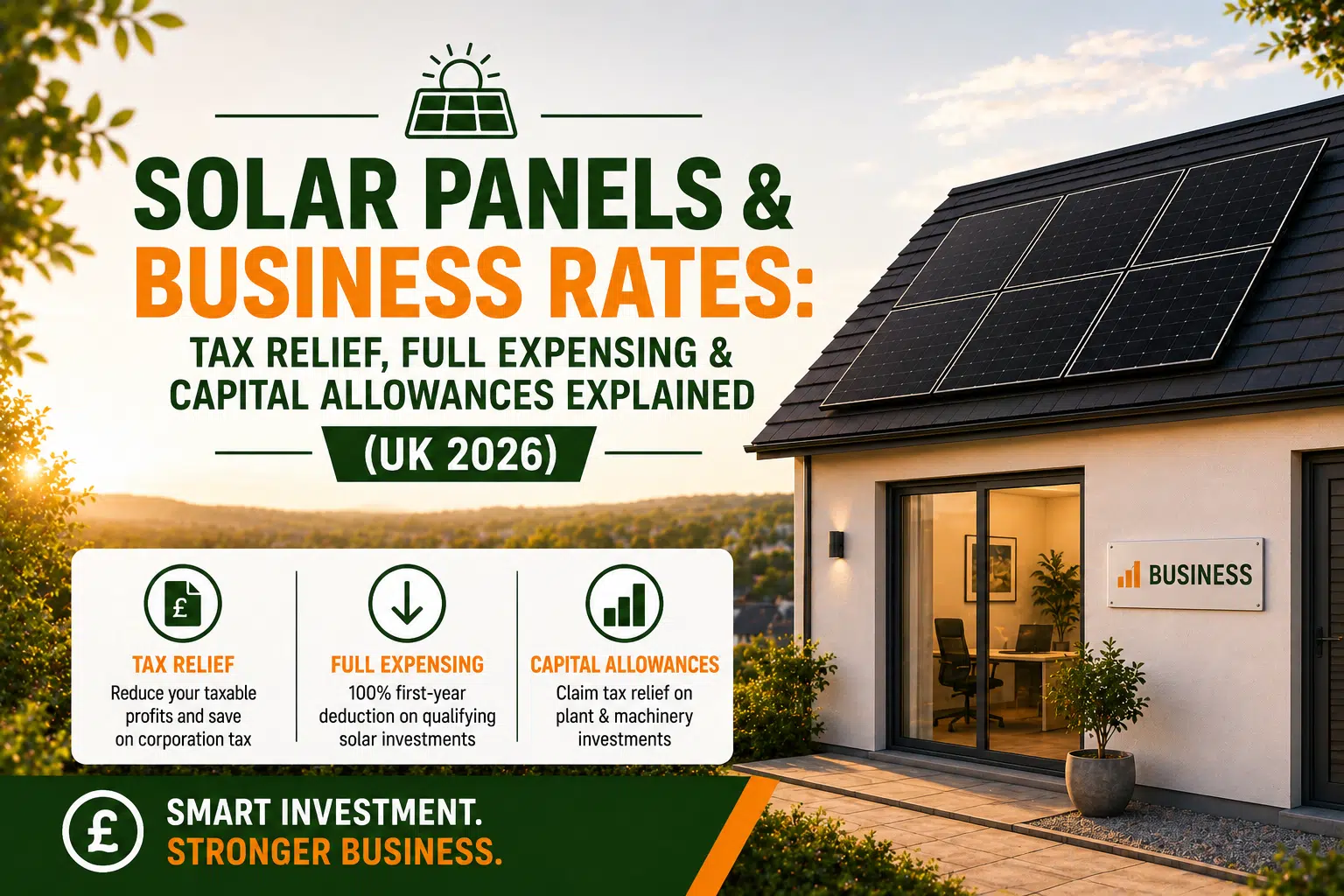

For most businesses, solar panels are no longer just an energy decision — they are a tax strategy. The question is no longer “Should we install solar?” but “Are we leaving money on the table by waiting?” This guide explains the current UK tax position accurately, including the specific distinctions that most solar guides get wrong.
- 1. Do solar panels affect your business rates?
- 2. Business rates exemption for renewable energy (2023–2035)
- 3. Capital allowances: how solar assets are classified
- 4. Annual Investment Allowance (AIA): the route to 100% Year 1 relief
- 5. Full Expensing: what it actually means for solar panels
- 6. VAT on commercial solar — the accurate position
- 7. How to stack these reliefs: a worked example with real numbers
- 8. What your accountant needs to know
- 9. Common mistakes businesses make with solar tax relief
- 10. Pre-purchase checklist
- 11. Conclusion
- 12. FAQs
The Short Version (Read This First)
What UK businesses need to know about solar panels, business rates and tax relief in 2026:
- Commercial solar installations do not increase business rates under the exemption running from 1 April 2023 to 31 March 2035 — the most important and least understood protection available to UK businesses
- Annual Investment Allowance (AIA) lets businesses deduct 100% of qualifying solar costs from taxable profits in Year 1, up to the £1 million annual limit — this is the primary route to immediate tax relief for most businesses
- Full Expensing provides a 50% First Year Allowance on solar panels (generally classified as Special Rate expenditure) and 100% on associated main pool assets — a critical distinction that many solar guides get wrong
- Commercial solar attracts 20% VAT, which VAT-registered businesses can reclaim on their next quarterly return — it is not 0% VAT, which applies only to residential installations
- Battery storage, inverters and associated electrical infrastructure may also qualify for capital allowances alongside the panels
- The purchase structure — outright ownership, leasing or financed purchase — directly determines which reliefs apply and when
- Solar4Good® works alongside accountants and finance teams to structure systems for both energy savings and tax optimisation — call 0800 999 1454 or visit solar4good.co.uk for a commercial consultation
When businesses evaluate commercial solar, they typically focus on electricity savings first. However, for many projects, the bigger financial impact comes from tax treatment. Modern solar installations unlock multiple forms of relief simultaneously — reducing corporation tax, improving cash flow and lowering the true net cost far more than most business owners realise. Moreover, the difference between a financially optimised solar project and a poorly structured one can easily reach tens of thousands of pounds. For a broader overview of commercial solar economics, see our guide to commercial solar for UK businesses.
Do Solar Panels Affect Your Business Rates?
This is usually the first concern businesses raise — especially landlords, warehouse operators, manufacturers and agricultural businesses. In 2026, the answer is reassuring for most: solar panels on commercial buildings do not increase business rates under the current exemption regime. Nevertheless, understanding exactly why, and where the exceptions lie, is important before proceeding with any commercial project. The position has changed significantly in recent years, and consequently many businesses are still operating with outdated assumptions based on the pre-2023 regulatory environment.
Business rates solar panels: the general position for rooftop systems
Historically, businesses worried that adding solar panels would trigger large increases in business rates, because the equipment could affect property valuations. Regulation has substantially addressed that concern. For rooftop solar used primarily for on-site self-consumption: business rates impact is generally nil under the current exemption; reliefs apply automatically without requiring an application; and self-consumption systems attract the most favourable treatment under business rates assessment rules.
Where the position becomes more complex
The position becomes less straightforward for large ground-mounted systems operating as standalone generation assets, export-heavy installations where the majority of output goes to the grid, multi-tenant commercial buildings with complex ownership arrangements, and landlord-owned systems supplying tenants through private wire or sub-metering. In these cases, the Valuation Office Agency may assess the solar installation separately as a commercial electricity generation asset. Therefore, a business rates adviser or commercial accountant should review the position before proceeding with these configurations.
💡 Tax planning context
Business rates should almost never be the primary variable in a solar investment decision. Even a small valuation adjustment, if any arises, is typically insignificant compared to the combined value of capital allowances, VAT recovery and electricity savings. In practice, the tax structure — not the business rates position — drives most of the financial case for commercial solar.
★★★★★ Trustpilot
“We initially looked at solar purely for energy savings, but the tax relief side changed the numbers completely. Solar4Good helped structure everything properly from the beginning.”
— Verified customer
Business Rates Exemption for Renewable Energy (2023–2035)
The business rates solar panels exemption introduced in 2023 is the most important and least widely understood protection available to UK businesses installing solar. Consequently, understanding exactly what it covers — and for how long — is essential context for any commercial solar decision. This exemption directly addresses the primary concern that led many businesses to delay solar investment in previous years.
What the exemption covers
Under the Non-Domestic Rating regulations that came into force on 1 April 2023, solar panel installations on commercial buildings no longer generate additional business rates liability from the panels themselves. In practical terms: installing solar panels does not increase the rateable value of the property; the property remains subject to its existing business rates; and the solar installation’s contribution to rateable value is explicitly excluded from assessment. Importantly, businesses do not need to apply for this relief — it applies automatically under the regulatory framework.
How long the exemption runs
The exemption runs from 1 April 2023 to 31 March 2035 — a 12-year window that covers the majority of the payback period for any system installed in the near term. As a result, any commercial solar installation completed between now and 2035 operates throughout its highest-value years without business rates exposure from the panels themselves.
When additional assessment may still apply
The exemption covers standard rooftop solar installations on commercial buildings. However, it does not automatically extend to standalone ground-mounted solar farms, export-focused systems that operate commercially as power generators, or properties with complex ownership arrangements. In those cases, the Valuation Office Agency may assess the solar installation independently. Always confirm the position with a business rates specialist before proceeding with atypical configurations.
⚠️ Honest note
Some solar marketing claims that “solar has no impact on business rates.” That is a simplification. More accurately, the 2023 exemption covers rooftop solar on commercial buildings until March 2035 for on-site consumption systems. Ground-mounted, export-focused or atypically owned systems may face different treatment. Always confirm the position for your specific installation type before relying on the exemption in your financial model.
Capital Allowances: How Solar Assets Are Classified
Understanding how commercial solar panels fit within the UK capital allowances framework is the essential foundation for all solar tax relief planning. The classification determines which relief mechanism applies, at what rate and when the business can take the deduction. Furthermore, this is where the most common errors in solar tax guidance occur, because the treatment is genuinely more nuanced than simply saying “solar panels qualify for capital allowances.”
Special Rate assets: where solar panels sit
Solar panels generally fall into the Special Rate expenditure category for capital allowances purposes, although businesses should confirm classification for specific installations. Special Rate assets attract a lower annual Writing Down Allowance (WDA) — currently 6% per year — compared to 18% for Main Pool assets. Without a First Year Allowance claimed upfront, therefore, panels added to the Special Rate pool attract only 6% relief per year on the reducing balance. That is precisely why the AIA and Full Expensing mechanisms matter so much for solar projects.
Main Pool assets within a solar installation
Not all equipment in a commercial solar installation sits in the Special Rate pool. Associated assets may qualify as Main Pool plant and machinery instead, which attracts the higher 18% WDA and, under Full Expensing, a 100% First Year Allowance. Assets that often fall into the Main Pool include inverters (depending on configuration), electrical switchgear and distribution equipment, and monitoring and control systems. As a result, the split between Special Rate and Main Pool components can meaningfully affect both the size and timing of capital allowances relief — which is why early accountant involvement pays dividends.
Why this classification matters for tax planning
A properly structured solar project can achieve: 100% Year 1 relief on Main Pool components via Full Expensing; 100% Year 1 relief on the full installation cost via AIA (for businesses within the annual limit); or 50% Year 1 relief on the Special Rate panel element via Full Expensing, with the remaining 50% entering the pool at 6% WDA. Ultimately, the optimal route depends on the business structure, tax position and available AIA headroom.
★★★★★ Trustpilot
“What stood out was that Solar4Good approached the project like a business investment, not just a solar installation. They worked directly with our finance team and explained the tax side clearly.”
— Verified customer
Annual Investment Allowance (AIA): The Route to 100% Year 1 Relief
For most UK businesses installing commercial solar panels, the Annual Investment Allowance is the primary mechanism for achieving 100% tax relief in Year 1. Unlike Full Expensing, which treats solar panel components differently from other assets, AIA applies at 100% to both Main Pool and Special Rate qualifying plant and machinery — including solar panels. Consequently, AIA offers the most straightforward route to maximum Year 1 relief for the majority of commercial solar projects.
Who can use AIA and at what limit
AIA is available to all UK businesses subject to UK tax — limited companies, sole traders and partnerships alike. This is an important distinction from Full Expensing, which only applies to limited companies paying corporation tax. The current AIA annual limit stands at £1,000,000 per year. For the vast majority of commercial solar projects, even large 150kW+ systems, the full installation cost falls within that limit. However, where businesses are associated or under common control, AIA entitlement may be restricted or shared — so confirm the position with your accountant where group structures exist.
How AIA applies to solar panel tax relief
A business claiming AIA on a commercial solar installation at the 25% corporation tax rate deducts the full system cost from taxable profits in Year 1, saving 25p in corporation tax for every £1 of qualifying expenditure. Crucially, this relief is not a grant. Instead, it reduces the corporation tax or income tax payment due — typically within the same tax year or the following one, depending on accounting period timing.
AIA timing and interaction with other reliefs
Generally, AIA applies in the accounting period in which the business incurs the qualifying expenditure for capital allowances purposes. Businesses should therefore confirm timing with their accountant, particularly where projects span accounting periods. Furthermore, where a business has already exhausted its AIA limit in a given year, Full Expensing becomes the relevant mechanism for the remaining solar costs. Where both options are available, AIA is typically the better choice for Special Rate assets like solar panels, because it achieves 100% relief compared to Full Expensing’s 50% FYA for Special Rate expenditure.
📊 Solar4Good commercial insight
Solar panels tax relief in the UK is one of the most commercially powerful aspects of the investment case — but it is also genuinely nuanced. For most SMEs installing commercial solar within the £1m AIA limit, 100% Year 1 relief is achievable. Solar4Good works directly with commercial finance teams and accountants to ensure projects are structured for the strongest available tax outcome.
Full Expensing: What It Actually Means for Solar Panels
Full Expensing became permanent in the Autumn Statement 2023 and applies to qualifying plant and machinery expenditure by limited companies. It represents one of the most significant capital allowances developments in recent years. However, its application to solar panels is more nuanced than most guides acknowledge, and it is a common source of overstated relief projections in commercial solar proposals.
Full Expensing for solar panels: 50% First Year Allowance
Solar panels generally fall into the Special Rate expenditure category for capital allowances purposes. For qualifying Special Rate expenditure, therefore, companies may claim a 50% First-Year Allowance under the permanent capital allowances regime introduced alongside Full Expensing. The remaining 50% enters the Special Rate pool and reduces at 6% per year. This is not the same as 100% immediate relief — and that distinction is precisely where most solar proposals overstate the benefit.
Full Expensing for associated main pool assets: 100%
Where solar installation costs include Main Pool assets — inverters, electrical distribution, switchgear and monitoring systems — Full Expensing delivers 100% First Year Allowance on those components for limited companies. As a result, getting this split right in the accountant’s capital allowances claim directly improves the Year 1 tax recovery figure.
Full Expensing vs AIA: which is better for solar?
For businesses within the AIA annual limit, AIA is almost always more valuable than Full Expensing for solar panels. AIA delivers 100% Year 1 relief on the full installation including panels, whereas Full Expensing only achieves 50% FYA on the panel element. Additionally, sole traders and partnerships cannot use Full Expensing at all — they must rely on AIA or the standard 6% WDA pool.
⚠️ Honest note: a common error in solar proposals
Many commercial solar proposals state that “Full Expensing allows 100% deduction of solar costs.” For solar panels specifically, that claim is incorrect. Solar panels generally attract Special Rate treatment — so Full Expensing delivers 50% FYA, not 100%. The 100% route is AIA. Always verify the relief basis and rate with your accountant before relying on tax saving figures in any investment case.
VAT on Commercial Solar — The Accurate Position
VAT treatment for commercial solar panel installations is frequently misrepresented in guides and installer proposals. The accurate position is straightforward, but it differs meaningfully from what many businesses assume — and getting it wrong creates cash flow problems at the point of purchase. Unlike residential solar, where zero-rating has received significant publicity, commercial installations follow different rules that require careful handling in project budgeting.
Commercial solar VAT: 20% — reclaimable for VAT-registered businesses
Commercial solar panel installations attract 20% VAT as standard-rated supplies. For VAT-registered businesses (currently those above the £90,000 VAT registration threshold, subject to future changes), the business reclaims this VAT as input tax on the next quarterly VAT return — typically within 90 days of the invoice date. In cash flow terms, therefore, the business pays the VAT upfront, recovers it within the quarter, and the net VAT cost is zero.
Businesses below the VAT threshold: 20% is a real cost
For businesses not registered for VAT, however, the 20% VAT on a commercial solar installation is a genuine additional cost with no recovery route. This significantly affects the payback calculation and must be explicitly accounted for in any financial model. Businesses near the VAT registration threshold should additionally consider whether voluntary VAT registration ahead of a large solar purchase makes financial sense — that is a question for their accountant.
The 0% VAT rate does not apply to commercial solar
The 0% VAT rate that received widespread publicity from April 2022 applies to residential solar panel installations only. As a general rule, it does not apply to commercial installations. Any commercial solar quote that states 0% VAT without providing a specific legal basis for the zero-rating should be queried directly with the installer before signing.
💡 VAT cash-flow timing
For VAT-registered businesses, the timing of VAT recovery matters — particularly on larger installations where the VAT amount is significant. If installation completes just after a VAT quarter end, recovery may be delayed by up to three months. For installations above approximately £250,000, therefore, businesses may wish to explore monthly VAT returns to accelerate cash recovery. Discuss VAT timing with your accountant as part of project financial planning.
★★★★★ Trustpilot
“From survey to commissioning, Solar4Good handled everything professionally. The system is performing ahead of projections and the payback is tracking faster than we modelled.”
— Verified customer
How to Stack These Reliefs: A Worked Example with Real Numbers
The value of combining business rates exemption, AIA relief and VAT recovery only becomes clear when real project figures come into play. The example below uses a 100kW commercial solar installation — a system size appropriate for a medium-sized manufacturing unit, large warehouse or dairy farm. All figures use current Solar4Good pricing data and the 25% main rate of corporation tax. Additionally, an illustrative commercial electricity rate of 27p/kWh is used for modelling purposes. Confirm exact figures with your accountant using your business’s specific tax position.
Project figures
| Item | Figure |
|---|---|
| System size | 100kW |
| Installed cost (ex-VAT) | £82,500 |
| VAT at 20% | £16,500 |
| Total invoiced | £99,000 |
| VAT recovered (VAT-registered business) | £16,500 — returned within ~90 days |
| Effective upfront cost after VAT recovery | £82,500 |
Capital allowances tax relief (AIA at 25% corporation tax rate)
| Item | Figure |
|---|---|
| Full system cost claimed under AIA | £82,500 |
| AIA deduction from taxable profits | £82,500 in Year 1 |
| Corporation tax saved at 25% | £20,625 |
| Effective net cost after AIA relief | £61,875 |
| Business rates impact (2023–2035 exemption) | Nil — no additional rateable value |
Annual financial return
| Item | Figure |
|---|---|
| Annual solar generation (MCS irradiance, 850kWh/kWp) | 85,000kWh |
| Self-consumption (80% of generation at illustrative 27p/kWh) | £18,360/yr |
| Illustrative SEG export income assumption (20% exported at 7p/kWh) | £1,190/yr |
| Total annual financial benefit | £19,550/yr |
| Simple payback — gross cost | 4.2 years |
| Simple payback — after AIA tax relief | 3.2 years |
| Year 25 total return (at current electricity prices) | ~£489,000 |
What the numbers show
This example demonstrates the compounding effect of stacking available reliefs. The Year 1 tax saving alone reduces payback by approximately one year. Furthermore, combining nil business rates impact and VAT recovery within the quarter means the effective net cost of the system is significantly lower than the invoiced figure suggests. See our commercial solar cost guide for cost benchmarks across different system sizes.
📊 Solar4Good commercial data
Businesses maximising self-consumption see the strongest payback figures — every unit used on-site saves far more than every unit exported. Consequently, system design around actual half-hourly consumption data, rather than generic templates, is the primary driver of financial performance. Solar4Good designs all commercial solar systems around real consumption profiles.
What Your Accountant Needs to Know
A commercial solar installation should never be treated purely as an energy purchase. The financial structure of the project determines which reliefs apply and when the business realises them. As a result, the most financially successful solar projects are those where the accountant is involved before contracts are signed, not after.
Information to share before the project begins
- Asset ownership: who will legally own the solar system — the business, a connected entity or a third-party financier? Ownership determines who can claim capital allowances.
- Financing structure: outright purchase preserves the full AIA/Full Expensing benefit; qualifying hire purchase arrangements often preserve entitlement to capital allowances, subject to the terms of the agreement; operating leases typically transfer the allowances to the finance provider.
- Asset classification: how the installer has categorised each component (Special Rate vs Main Pool) directly affects the relief calculation.
- VAT registration status: this determines whether the 20% input VAT is recoverable or a real cost.
- Export income projections: export income is generally taxable and should be included within the business’s taxable profits.
- Accounting period timing: AIA generally applies in the period the business incurs the qualifying expenditure — confirm timing with your accountant, particularly where projects span accounting periods.
Questions to ask your installer before committing
Any installer proposing capital allowances solar relief should be able to answer the following clearly. How have you classified the panels — Special Rate or Main Pool? Have you separated the Main Pool and Special Rate components in your pricing? Are you assuming AIA or Full Expensing as the primary relief mechanism? Has a tax professional reviewed the tax saving projection? What happens to capital allowances if we finance rather than purchase outright? If the installer cannot answer these questions confidently, involve your accountant directly before signing anything.
Common Mistakes Businesses Make with Solar Tax Relief
Most businesses that fail to fully optimise solar panels tax relief do so not because the reliefs are unavailable, but because projects are structured or planned in ways that reduce what the business can claim. Fortunately, these errors are largely avoidable when identified early.
Structural mistakes that reduce relief
- Choosing a financing structure that transfers allowances to the lender: operating leases and some rental agreements prevent the business from claiming capital allowances because it does not own the asset. The monthly payment may be deductible as a revenue expense, but the immediate Year 1 relief from AIA or Full Expensing is lost.
- Treating solar panels as one asset class: failing to separate Main Pool and Special Rate components means potentially over-claiming Full Expensing on the panel element (which attracts only 50% FYA) or under-claiming on main pool assets (which attract 100% FYA under Full Expensing).
- Assuming 0% VAT applies: commercial solar attracts standard-rated VAT at 20%. Assuming zero-rating without a specific legal basis leads to underestimating cash flow requirements at purchase.
Planning mistakes that delay or reduce value
- Failing to involve accountants until after contracts are signed: by that point, the ownership structure, financing arrangement and asset classification are usually already fixed and difficult to change.
- Overestimating export income: export income is typically far less valuable per unit than self-consumption savings. Consequently, oversized systems with poor self-consumption profiles underperform their financial models.
- Ignoring AIA annual limit interactions: businesses that are associated or under common control may face restricted AIA entitlement. Additionally, businesses with high capital expenditure in a given year may have already consumed AIA headroom on other assets. Planning the purchase timing around AIA headroom can therefore significantly improve Year 1 relief.
- Treating solar as a facilities decision rather than a finance decision: the strongest-performing projects involve both operations and finance from the outset — rather than finance teams reviewing a facilities purchase after the fact.
★★★★★ Trustpilot
“The system’s performance has exceeded expectations, reducing our grid dependence significantly with immediate savings on electricity bills from the first month.”
— Verified customer
Pre-Purchase Checklist
Before committing to a commercial solar installation, businesses should work through both the tax structure and the technical specification. A project that performs well technically but is poorly structured will underdeliver financially.
Tax and financial structure checklist
- Confirmed: which tax relief mechanism applies — AIA, Full Expensing, or both — and at what rate for panels vs other components
- Confirmed: available AIA headroom in the relevant accounting period, including any restrictions from associated businesses
- Confirmed: ownership structure preserves capital allowances entitlement (outright purchase or qualifying hire purchase arrangement)
- Confirmed: VAT registration status and recovery timeline
- Confirmed: accountant has reviewed the project structure before contracts are signed
- Confirmed: business rates exemption applies (rooftop system, primarily self-consumption)
- Confirmed: export income has been modelled conservatively and included in taxable profits projections
System and supplier checklist
- Confirmed: system sized around actual half-hourly consumption data, not estimated annual totals
- Confirmed: installer holds MCS certification — a requirement for SEG eligibility
- Confirmed: roof condition assessed before installation commitment
- Confirmed: DNO notification requirement (G98 or G99) understood and included in project timeline — see our G99 application guide and DNO application guide
- Confirmed: battery storage evaluated and decision documented — it adds cost but improves self-consumption and may strengthen the capital allowances case
- Confirmed: all quotes are fully itemised — panels, inverter, electrical, scaffolding, DNO, certification
Ready to go Solar?
Conclusion: Why Tax Structure Matters as Much as Panel Efficiency
For commercial solar installations in 2026, tax treatment is often just as important as system performance in determining the real financial return. The interaction of the business rates exemption, Annual Investment Allowance, Full Expensing and VAT recovery can dramatically reduce the effective project cost and compress payback periods — but only when the project is structured correctly from the outset.
Ultimately, the businesses seeing the strongest returns are not simply buying solar panels. Instead, they are strategically reducing operational costs, optimising tax efficiency and stabilising future energy expenditure. Business rates solar panels planning, Full Expensing qualification, capital allowances classification and solar panels tax relief UK strategy all belong in the same conversation — and that conversation should happen before installation, not after.
Solar4Good helps businesses navigate both the technical and financial side of commercial solar, ensuring projects deliver real commercial outcomes. See our commercial solar cost guide for full pricing and ROI benchmarks, or our solar battery cost guide for battery storage detail.
⚠️ Disclaimer
The information in this guide is provided for general informational purposes only and does not constitute tax, accounting or legal advice. Tax treatment depends on individual circumstances and may change over time. Businesses should therefore obtain advice from a qualified accountant or tax adviser before relying on any tax relief, capital allowances, VAT or business rates position discussed in this article.
Frequently Asked Questions
Do solar panels increase business rates in the UK?
No. Under the exemption in force from 1 April 2023 to 31 March 2035, rooftop solar installations on commercial buildings do not increase business rates. The solar panels’ contribution to rateable value is excluded from assessment under current Non-Domestic Rating regulations. This applies to self-consumption-focused systems; however, export-heavy or ground-mounted systems may face different treatment.
Can businesses deduct 100% of solar costs from taxable profits?
Yes, in most cases — but via Annual Investment Allowance (AIA), not Full Expensing. AIA lets businesses deduct 100% of qualifying solar installation costs (including panels, generally treated as Special Rate expenditure) from taxable profits in Year 1, subject to the £1m annual limit. By contrast, Full Expensing provides only 50% First Year Allowance on solar panels and 100% on associated Main Pool assets.
What is Full Expensing and how does it apply to solar panels?
Full Expensing is a capital allowances mechanism for limited companies. Because solar panels generally attract Special Rate treatment, companies may claim a 50% First-Year Allowance under the permanent capital allowances regime. The remaining 50% enters the Special Rate pool at 6% WDA. Associated main pool assets, however, attract 100% First Year Allowance under Full Expensing. For solar panels specifically, AIA is usually the more valuable option.
More on commercial solar tax relief
Does 0% VAT apply to commercial solar installations?
No. Commercial solar installations attract 20% VAT. The 0% rate applies to residential installations only. For VAT-registered businesses (currently those above the £90,000 threshold, subject to future changes), the 20% VAT is recoverable as input tax on the next quarterly return. For businesses below the threshold, however, it is a real additional cost that affects the payback calculation.
Can battery storage qualify for capital allowances too?
Yes — battery storage, inverters and associated electrical infrastructure may qualify for capital allowances alongside panels, though the classification (Main Pool vs Special Rate) depends on the specific system design. A correctly structured installation maximises the proportion of assets in the Main Pool, where both AIA and 100% Full Expensing apply. See our solar battery cost guide for more detail.
Should my accountant be involved before installation?
Yes — before contracts are signed, not after. Once the contract is in place, the ownership structure, financing arrangement and asset classification are largely fixed. Early accountant involvement therefore ensures the project is structured for maximum AIA eligibility, correct VAT handling and appropriate asset categorisation across Main Pool and Special Rate components.
Is commercial solar better financed or purchased outright?
For capital allowances purposes, outright purchase is generally most tax-efficient because the business retains ownership and full access to AIA and Full Expensing. Qualifying hire purchase arrangements often also preserve entitlement to capital allowances, subject to the terms of the agreement. Operating leases, however, typically transfer the allowances to the finance provider. The right structure depends on cash flow strategy and tax position — confirm with your accountant.
What is the biggest mistake businesses make with solar tax relief?
Assuming that Full Expensing provides 100% Year 1 relief on solar panels. In fact, it provides 50% First Year Allowance on the panel element (generally Special Rate expenditure). The mechanism that actually achieves 100% Year 1 deduction on panels is AIA. Many commercial solar proposals incorrectly state 100% relief via Full Expensing — so always verify the relief basis and rate with your accountant before using a tax saving figure in your investment case.
About the Author
Manan Shah
Co-Founder of Solar4Good UK. Leads Solar4Good's commercial strategy and customer relationships, and is quoted as a clean-energy authority by some of the UK's most trusted news publications. Quoted in the Financial Times and The Times on UK solar.
📞 Book a free solar consultation
Call us on 0800 999 1454 or visit solar4good.co.uk
Read over 800+ verified five-star reviews on Trustpilot and Checkatrade
Solar4Good Ltd · 79 College Road, Harrow, HA1 1BD · MCS: NAP/72775/25/4 · HIES: S4G/A/1484