
7kW Solar System UK: Price, Output, Panel Count & Is It Worth It?
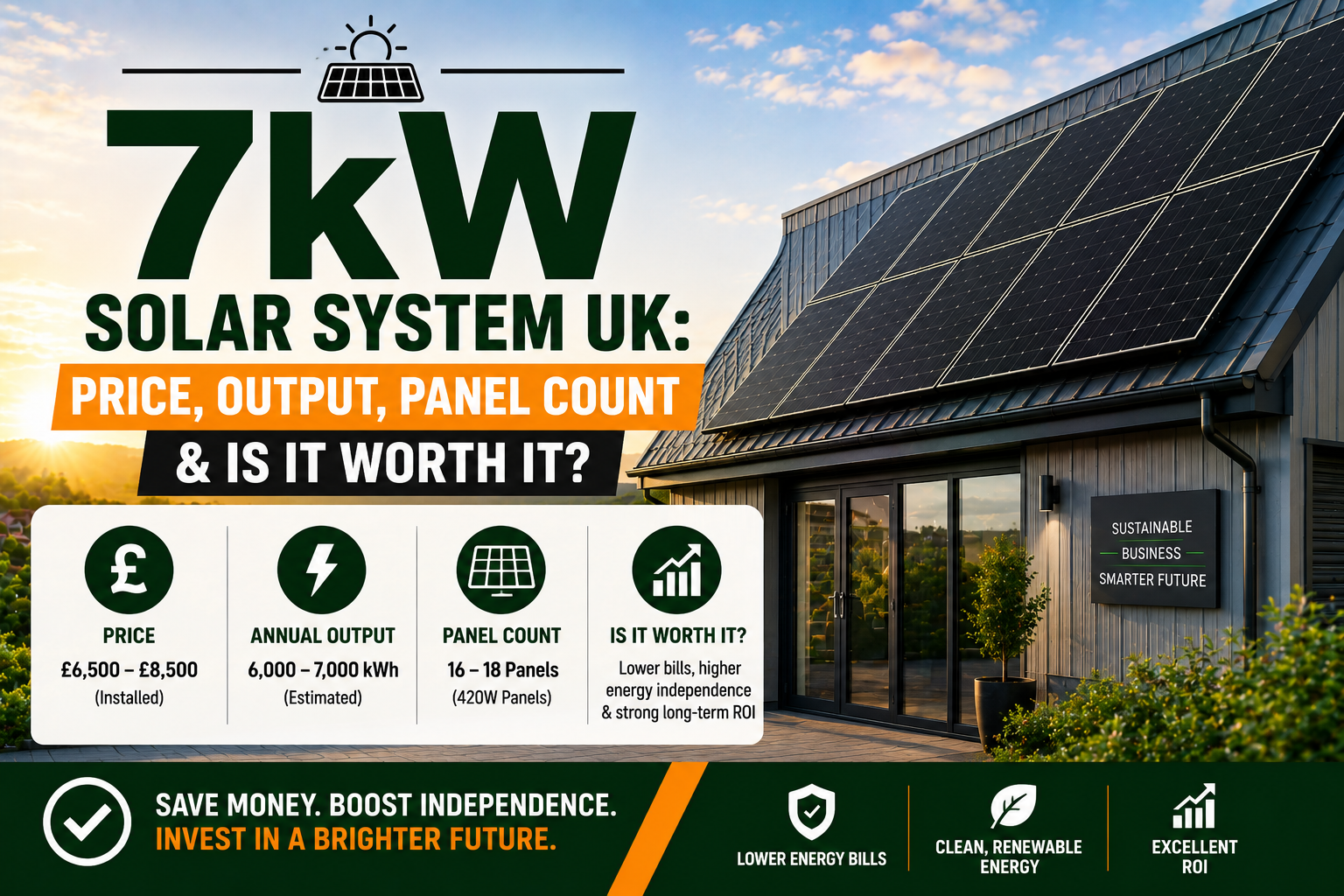

How much does a 7kW solar system actually cost in 2026, and what does it realistically do for your home? When does a system this size actually make sense — and when does it not?
1. What is a 7kW solar system?
2. How much electricity does a 7kW system generate?
3. How much can a 7kW system save you?
4. How much does a 7kW solar system cost in 2026?
5. How many panels are in a 7kW system?
6. How much roof space does a 7kW system need?
7. Who is a 7kW system right for?
8. Can a 7kW system support an EV or a heat pump?
9. Should you add a battery, and which size makes sense?
10. DNO and G99: what happens before installation?
11. Conclusion
12. FAQs
Summary (TL;DR)
Key facts about 7kW solar systems in the UK:
-
A 7kW solar system generates around 5,950 kWh per year under typical UK conditions, well above the needs of a low-usage household, but directly in line with homes that are already high-consumption or moving toward electrification
-
It usually requires 14–18 panels and around 25–32 m² of usable roof space
-
7kW only performs well when the home has enough demand or enough battery storage to use what it produces. Without that alignment, much of the output is exported at a lower rate
-
It is the right size for homes using 4,500 kWh or more per year, or those planning to add an EV charger or heat pump
-
Because the inverter output exceeds the G98 threshold, a G99 application to the DNO is required before installation begins Solar4Good® manages this as standard
A 7kW solar system sits at a point where solar starts to do more than just reduce your electricity bill. It has the capacity to cover a significant portion of your home’s total energy usage, but only if the system is matched properly to how your household actually consumes electricity.
This is why two homes can install the same 7kW system and see very different results. In one case, it can significantly reduce reliance on the grid and deliver strong long-term savings. In another, it can generate more energy than the home can use, reducing its overall financial effectiveness.
This guide breaks that down properly. It covers what a 7kW system actually produces, what it costs in 2026, how many panels and how much space it requires, and most importantly, when a system this size is the right fit for your home.
What Is a 7kW Solar System?
A 7kW solar system is a larger-than-average home setup designed to generate a significant amount of electricity across the year, not just reduce a small portion of your bill.
The ‘7kW’ describes the system’s maximum output in ideal conditions: bright sunlight, no shading and optimal positioning. In reality, output is higher in summer, lower in winter, and varies throughout the day. What really matters is how much energy it produces over time. In the UK, a 7kW system will typically generate around 5,900–6,000 kWh per year.
Smaller systems like 3kW or 4kW tend to cover some of your daytime electricity use and reduce your bill, but you still rely quite heavily on the grid. A 7kW system works at a different level. It produces enough electricity to cover a large portion of your total yearly usage, especially if your home already uses a lot of energy or is moving in that direction.
With a system this size, the question shifts from “will solar help reduce my bill?” to “how much of my home’s energy can solar realistically cover?” That’s what determines whether 7kW is the right choice not just how much roof space you have, but how much energy your home actually uses and when you use it.
How Much Electricity Does a 7kW System Generate?
A 7kW solar system produces around 5,950 kWh per year on average in the UK, but this varies depending on location.
|
Region |
Estimated annual output |
|---|---|
|
UK average |
~5,950 kWh/year |
|
South England |
Up to ~6,500 kWh/year |
|
North / Scotland |
~4,900–5,400 kWh/year |
These differences are driven by sunlight hours, weather patterns and solar irradiance. Southern regions receive more consistent and stronger sunlight; northern regions experience lower annual generation.
However, the regional variation is only part of the picture. The more important factor is how this output compares to your household consumption. A home using around 5,000–6,000 kWh per year is well aligned with a 7kW system. A home using 2,500–3,000 kWh per year will generate far more electricity than it can use without storage. That excess is exported at a lower rate, which reduces the system’s overall financial efficiency.
How Much Can a 7kW System Save You?
A 7kW solar system generates a large amount of electricity, but savings are determined by how much of that electricity is used in the home rather than exported.
This is where many savings estimates become misleading. Some assume that most of the energy is used directly, while also assuming strong export income. In reality, those two outcomes sit on opposite ends of the same spectrum: the more you use, the less you export. The more you export, the less you use.
|
Scenario |
Bill saving |
SEG income |
Total |
|---|---|---|---|
|
No battery (lower self-consumption) |
~£587 |
~£250 |
~£837 |
|
With battery (higher self-consumption) |
~£1,027 |
~£125 |
~£1,152 |
⚠️ Honest note
The savings figures above are calculated at 24.67p/kWh (current Ofgem rate) and a conservative SEG export rate of approximately 7p/kWh. Actual savings depend on your self-consumption profile, electricity tariff and the export rate your supplier offers. Households on smart tariffs like Octopus Go or Agile can improve returns further by charging the battery overnight at lower rates. Solar4Good models savings based on your actual usage at the survey stage — not generic assumptions.
The key point is that a 7kW solar system in the UK does not guarantee high savings simply because it produces more energy. It performs well when that energy is used effectively. Without sufficient demand or battery storage, the system still generates electricity, but the financial benefit is reduced.
How Much Does a 7kW Solar System Cost in 2026?
A realistic installed cost for a 7kW solar system in 2026 sits between £10,000 and £13,000 for solar only, with battery storage increasing the total depending on size and brand.
|
System type |
Typical installed cost |
|---|---|
|
Solar only |
£10,000–£13,000 |
|
Solar + battery |
£13,500–£21,000 |
Older estimates around £9,000 are no longer representative and tend to understate what homeowners should expect. All residential solar installations benefit from 0% VAT.
The cost needs to be understood in context. A 7kW system is not designed to deliver marginal savings — it is designed to offset a substantial portion of electricity usage. Its value depends heavily on how much grid electricity it replaces. In a home with high demand, the system has more opportunity to generate savings. In a lower-usage home, that opportunity is reduced. For a full breakdown of how battery storage costs affect overall system ROI, see our dedicated battery price guide.
Ready to go Solar ?
How Many Panels Are in a 7kW Solar System?
A 7kW solar system in the UK typically uses between 14 and 18 solar panels, depending on the wattage of the panels selected. Higher-efficiency panels produce more power per panel, which reduces the number needed. Lower-wattage panels increase the count slightly.
Panel count should not be treated as a decision factor — it is the result of system design, not the starting point. What matters is total system output and how that output aligns with your energy usage. The choice of panel brand and efficiency tier is where an installer like Solar4Good can help you get the most out of your available roof space. For a full comparison of panel options, see our guide to the best solar inverters in the UK and how they pair with different panel specifications.
How Much Roof Space Does a 7kW Solar System in the UK Need?
A 7kW solar system typically requires around 25 to 32 m² of usable roof space. Most modern panels are roughly 1.7m × 1.05m, which means each panel takes up about 1.7–1.8 m².
-
14 panels (higher efficiency): ~25 m²
-
16 panels (typical setup): ~28–29 m²
-
18 panels (lower wattage): ~31–32 m²
That gives you a clearer picture of what’s required — you’re fitting a defined block of panels, not covering the entire roof. Not all roof space is usable: installation clearances, chimneys or skylights, shading and roof shape all reduce what can actually be installed. Two roofs that look similar in size can end up fitting very different system sizes depending on layout and shading.
As a rough guide, if you have a clear, well-oriented roof section of around 30 m², a 7kW system is usually achievable. If the space is more limited or fragmented, the system size may need to be reduced or redesigned. Higher-efficiency panels can reduce the number needed, making it easier to fit a larger solar system into a tighter space.
These are still estimates. The only way to know exactly how many panels your roof can support is through a proper assessment. Solar4Good offers a free consultation where your roof layout, energy usage and future plans are reviewed, and you receive a tailored system recommendation before making any decision.
💡 Did you know?
If your usage or roof space is significantly higher than the 7kW range, our guide to the 10kW commercial solar system covers what a larger system can deliver for high-demand properties and businesses.
Who Is a 7kW System Right For?
A 7kW solar system isn’t defined by property size, it’s defined by how much electricity your home actually uses and how that’s changing.
|
System size |
Annual usage |
Typical home profile |
How it performs |
|---|---|---|---|
|
3kW |
Up to ~2,500 kWh |
Flats, low-use homes |
Covers daytime usage, limited overall impact |
|
4kW |
2,500–3,500 kWh |
Small families |
Good baseline for average homes |
|
5kW |
3,500–4,500 kWh |
3–4 bed homes |
Strong savings, handles moderate demand well |
|
7kW |
4,500–6,000+ kWh |
Larger homes, EVs, heat pumps |
Covers a large share of total annual demand |
What this shows is that 7kW solar system sits in a different category. It’s not just a step up from 5kW — it’s the point where solar starts to match high or expanding electricity usage, rather than just offsetting part of it.
In practical terms, a 7kW system is usually the right fit when your current usage is already above average (around 4,500 kWh or more), you’re planning to add an EV charger or heat pump, or your household has consistent electricity use throughout the day.
Energy usage in homes doesn’t increase gradually; it jumps. An EV can add around 2,000 kWh per year. A heat pump can add even more. A system that looks well-sized today can quickly become undersized once those changes happen. This is why 7kW solar system is often chosen as a future-proofed system size; it gives you enough generation capacity to absorb those changes without needing to upgrade later.
That said, it’s not always the right choice. If your usage is consistently low and unlikely to change, a 7kW solar system can produce more energy than your home can use efficiently. In that case, more of the benefit shifts into export, where the financial return is weaker. The key decision is whether your home will use what 7kW produces, either now or in the near future.
Can a 7kW System Support an EV or a Heat Pump?
A 7kW system is often chosen specifically because a home is moving toward higher electricity demand, most commonly through an EV charger, a heat pump, or both. The question isn’t whether it can ‘support’ them in theory, but how much of that demand it can realistically cover.
An EV typically adds around 2,000 kWh per year to household usage. A heat pump can add 3,000 kWh or more. A home that previously used 3,000 kWh could quickly be using 6,000–7,000 kWh or more.
-
Daytime charging (best case): if your EV is charged during the day, a large portion of that energy can come directly from solar generation
-
Evening charging (more common): most EV charging happens in the evening, which means solar alone won’t cover it without a battery
-
With a battery: excess daytime generation can be stored and used later, increasing how much of your EV or heating demand is covered by solar
A 7kW system doesn’t ‘run’ an EV or a heat pump on its own. What it does is reduce how much additional electricity you need to buy once those systems are installed. That’s why system size matters here. Smaller systems often struggle to keep up with the step-change in demand that comes with electrification. A 7kW system is large enough to make a meaningful impact, particularly when combined with a battery or when demand can be shifted into daytime hours.
Should You Add a Battery, and Which Size Makes Sense?
At 7kW, battery storage becomes a meaningful decision because the system produces enough energy to create regular surplus during the day. Without a battery, that surplus is exported. With a battery, more of that energy is used in the home, particularly during the evening. For a full breakdown of solar battery costs and which options are available, see our battery price guide.
Most 7kW systems are paired with batteries in the 10–15 kWh range, which aligns with both the level of surplus generation and typical household demand outside daylight hours.
|
Battery size |
Best for |
Recommendation |
|---|---|---|
|
~10 kWh |
Moderate evening usage |
FoxESS / GivEnergy |
|
13–15 kWh |
EVs, heat pumps |
Sigenergy / Tesla Powerwall |
The key is to match storage to usage. A battery that is too small will not capture enough surplus energy, while one that is too large may not be fully utilised. For a detailed review of how the Sigenergy battery system works, including its modular expansion capability, which is particularly relevant at 7kW and above, see our full Sigenergy review.
DNO and G99: What Happens Before Installation?
A 7kW solar system cannot be installed in the same straightforward way as smaller systems. Because it exceeds the 3.68 kW export threshold, it requires a G99 application to your local Distribution Network Operator (DNO) before installation can begin.
In practice, this changes the order of the process rather than the outcome. Instead of installing first and notifying the grid afterwards (as with G98 for smaller systems), your installer applies for approval upfront. This typically adds 4 to 12 weeks to the timeline, depending on your area.
What the approval actually means for your installation
Approval is not always a simple yes or no. In some cases the DNO will approve the system but place a limit on how much electricity can be exported:
-
The system can still generate at full capacity
-
Export may be capped at a set level
-
The inverter is configured to manage export automatically
For most homes, this doesn’t significantly change how the system performs day to day. The majority of solar energy is either used in the home or stored in a battery, not exported at peak levels, where limits would apply. For a full explanation of the G99 process, including what the application contains and typical timelines, see our detailed G99 application guide.
★★★★★ Trustpilot
“We were considering solar via a local council scheme but a friend recommended Solar4Good — and we’re really glad we made the switch. A site visit was booked the very next day after we confirmed. Scaffolders were in within the week, and our system was live just 10 days after commissioning.”
— Verified customer
★★★★★ TrustATrader
“From initial survey to flawless installation, Solar4Good delivered an exceptional solar experience. The team installed 12 premium panels with a FOX 6kW hybrid battery system in a single day, working meticulously and leaving the site spotless. Clear explanations, transparent pricing with no hidden fees.”
— Verified customer
Conclusion
A 7kW solar system is the point where solar starts to cover a meaningful share of your home’s energy, not just reduce your bill slightly. It works well when your electricity usage supports it. That usually means higher-demand homes, or households planning for EVs, heat pumps or increased usage in the near future.
If that demand isn’t there, the system can still work, but it won’t perform at its full potential. The decision comes down to one thing: does your home use enough energy to justify 7kW? If you’re not sure, the next step is simple. Get a free Solar4Good quote and system design to see exactly what size system fits your home, your usage and your future plans.
About the Author
Matthew
Solar Consultant with over a decade of UK solar experience, helping homeowners and businesses make clear, confident renewable energy decisions.
📞 Book a free solar consultation
Call us on 0800 999 1454 or visit solar4good.co.uk
Read over 750+ verified five-star reviews on Trustpilot and Checkatrade
Solar4Good Ltd · 79 College Road, Harrow, HA1 1BD · MCS: NAP/72775/25/4 · HIES: S4G/A/1484