
Is Commercial Solar Worth It for SMEs in the UK? (2026 Guide)
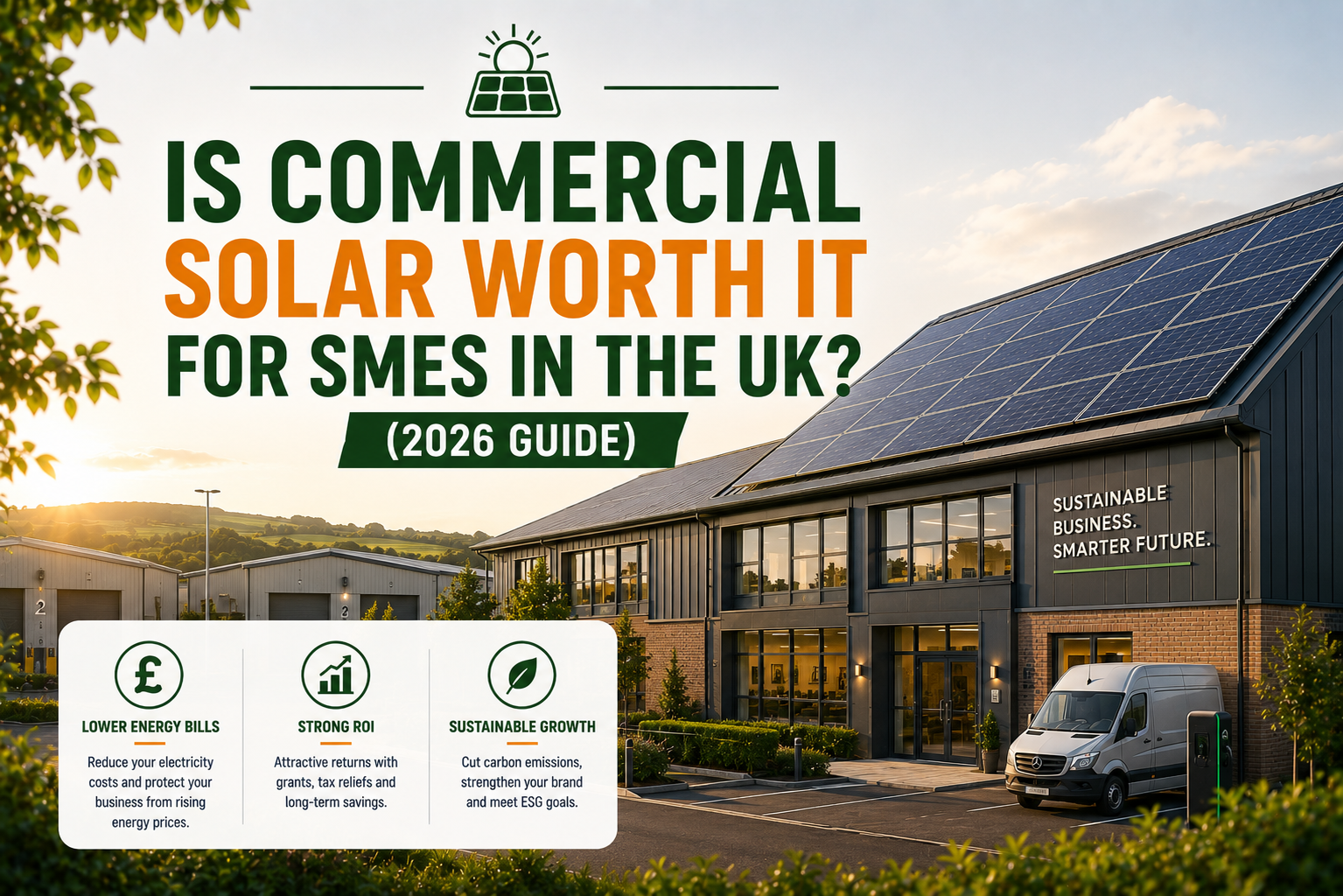

Is commercial solar actually worth the investment for small and medium-sized businesses? And how do you know if it will genuinely reduce your costs — or just look good on paper?
- 1. Is commercial solar worth it for small and medium-sized businesses?
- 2. How much does commercial solar cost for SMEs in the UK?
- 3. How quickly do SMEs see a return on investment?
- 4. Why solar works particularly well for SMEs
- 5. What financing options are available for SMEs?
- 6. What are the risks and limitations?
- 7. Why your installer determines how much value you actually get
- 8. Conclusion
- 9. FAQs
Short Summary
What UK SMEs need to know about commercial solar in 2026:
- For most UK SMEs, commercial solar panels are now a practical cost-saving investment — not a sustainability initiative — with typical payback periods of 3–7 years
- The strongest returns come from businesses that operate during the day — offices, warehouses, retail and manufacturing — because they use a higher proportion of what they generate on-site
- System costs vary by size: smaller SME systems (10–30 kWp) typically start from around £16,000, with VAT reclaimable for VAT-registered businesses
- The Annual Investment Allowance (AIA) allows businesses to offset the full system cost against taxable profits in year one — one of the most significant tax advantages available
- Three financing routes exist: outright purchase (highest return), asset finance (cash-flow friendly), and Power Purchase Agreements (no upfront cost, long-term contract)
- Battery storage isn’t always required — businesses with strong daytime usage often achieve strong payback without it, though it improves flexibility and savings
- Solar4Good® offers free commercial solar assessments — call 0800 999 1454 or visit solar4good.co.uk for a no-obligation site appraisal
⚡ Solar4Good: MCS-certified commercial solar installer
Solar4Good installs commercial solar panels, battery storage and EV chargers for SMEs across the UK. Every installation is MCS-certified (NAP/72775/25/4), designed around your actual business usage profile, and fully documented for AIA tax relief purposes. With 2,500+ completed installations and a 4.9/5 Trustpilot rating, we provide free commercial site assessments with no obligation to proceed.
Energy has shifted from being a background expense to something businesses actively have to manage. Over the last few years, price volatility has made electricity one of the least predictable costs for UK SMEs — which makes planning and budgeting far more difficult than it used to be.
At the same time, expectations around operational efficiency have increased. Customers, investors and supply chain partners are placing more weight on how businesses use energy and how exposed they are to future price changes.
That combination is why more SMEs are now treating solar panels differently. It is no longer framed as a “green upgrade” or a branding decision. It is being treated as infrastructure — something that can stabilise a major overhead, reduce grid reliance, and create long-term cost certainty. This guide examines whether commercial solar is actually worth it for SMEs, what the numbers look like in practice, and where it makes sense and where it doesn’t.
Is Commercial Solar Worth It for Small and Medium-Sized Businesses?
In most cases, yes — but only when the system is designed around how your business actually uses electricity. Commercial solar panels work by replacing electricity you would otherwise buy from the grid. Every unit generated on-site is one you don’t need to purchase at market rates. That is where the savings come from.
For SMEs, this tends to be particularly effective because their usage aligns well with solar generation. Most businesses operate during daylight hours — which means they consume a higher proportion of what they generate on-site rather than exporting it. That difference is important. The more energy you use directly, the faster the system pays for itself.
In practice, commercial solar installations for SMEs are now delivering:
- Typical ROI in the region of 14–20%
- Payback periods generally between 3 and 7 years
- Effective free electricity for the remainder of the system’s lifespan — typically 20–25 years or more
The key question isn’t whether commercial solar works. It’s whether your building and energy usage allow you to take full advantage of it. A site assessment answers that question directly — which is why Solar4Good offers free commercial appraisals before any commitment is made.
★★★★★ Trustpilot
“We were sceptical about solar for our warehouse, but the Solar4Good assessment gave us real numbers based on our actual energy bills. The system paid back in just over four years and we’ve been generating free electricity ever since. The advice was honest and the installation was faultless.”
— Verified customer
How Much Does Commercial Solar Cost for SMEs in the UK?
Costs vary depending on system size, building type and installation complexity, but there are clear benchmarks in 2026:
| System size | Typical cost | Typical use case |
|---|---|---|
| 10–30 kWp | £16,000–£30,000 | Small offices, retail units |
| 30–50 kWp | £30,000–£60,000 | Medium-sized businesses |
| 50–100 kWp | £40,000–£100,000+ | Warehouses, manufacturing |
On a per-unit basis, most systems fall between £800–£1,300 per kWp, with larger systems benefiting from economies of scale. For VAT-registered businesses, VAT is typically reclaimable — which reduces the effective cost further.
💡 Annual Investment Allowance (AIA)
Most SMEs can use the AIA to offset the full system cost against taxable profits in year one. For a £40,000 system with a 25% corporation tax rate, that represents a £10,000 tax saving — significantly reducing the effective cost and accelerating payback. Confirm with your accountant before proceeding.
How Quickly Do SMEs See a Return on Investment?
Ready to go Solar ?
Return on investment is the point most businesses focus on — and it is where solar tends to perform strongly. Payback is primarily driven by one factor: how much of the generated energy is used on-site. Higher self-consumption leads to faster payback.
| Business type | Typical payback period |
|---|---|
| Manufacturing / warehouses | 3–6 years |
| Retail / offices | 5–8 years |
| Average SME range | 3–7 years |
Businesses that operate consistently during the day tend to see the strongest returns — because they rely less on exporting energy at lower Smart Export Guarantee rates and more on direct self-consumption at full grid value.
Once the system has paid for itself, electricity costs reduce significantly, savings continue for decades, and exposure to future grid price increases is materially reduced.
★★★★★ Trustpilot
“Solar4Good designed our system around our actual operating hours and energy profile — not a generic estimate. The payback has come in almost exactly as projected. Professional, transparent and genuinely good value. I’d recommend them to any business owner considering solar.”
— Verified customer
Why Solar Works Particularly Well for SMEs
Solar tends to perform better for businesses than for households — largely because of how commercial energy is used. Most SMEs operate during the day, have larger and more usable roof space, and rely on electricity as a core running cost. That combination means more of the energy generated is used on-site, which is where the financial return comes from.
Daytime energy use matches generation
Most SMEs use electricity during working hours — which aligns directly with when solar panels produce energy. This increases self-consumption and improves financial returns compared to households that are often empty during peak generation hours.
Larger, more usable roof space
Commercial buildings often have flat roofs with fewer obstructions — allowing for larger systems and more efficient panel layouts. More roof space means more generation capacity, which typically means faster payback.
Energy becomes a controllable cost
Solar changes electricity from a variable expense into something more predictable. This improves budgeting, reduces exposure to market fluctuations, and gives businesses more certainty over one of their largest operational overheads. Adding battery storage extends this further — allowing businesses to store surplus generation and deploy it during peak-rate periods.
Additional income through export
Unused electricity can still be exported through the Smart Export Guarantee — providing an additional revenue stream alongside direct cost savings. While export rates are lower than self-consumption savings, they ensure no generated energy is wasted.
📌 The commercial advantage in one sentence
Businesses are at their premises during peak generation hours, have larger roofs to generate more, and pay higher electricity rates than most households — making the financial case for commercial solar stronger across all three dimensions.
What Financing Options Are Available for SMEs?
For most SMEs, the decision isn’t just whether solar is worth it — it’s how to pay for it in a way that fits cash flow and long-term plans. There are three main routes, each with different trade-offs:
Option 1: Outright purchase — highest return, full ownership
Paying upfront gives you full ownership of the system and the strongest long-term returns. Every unit of electricity generated goes directly into reducing your energy costs, with no ongoing payments. This tends to suit businesses that have available capital, want the fastest payback, and plan to stay in the property long-term.
Outright purchase also typically qualifies for the Annual Investment Allowance — allowing businesses to offset the full cost against taxable profits in year one, significantly reducing the effective price.
Option 2: Asset finance or loans — balanced for cash flow
Financing spreads the cost over time — typically 3–10 years, depending on system size and lender. In many cases, the monthly repayment is offset by energy savings. With the right structure, some systems can be cash-positive from day one, where savings exceed repayments. This is often the most common route for SMEs because it avoids large upfront spend, preserves working capital, and leads to full ownership once repaid.
Option 3: Power Purchase Agreement (PPA) — no upfront cost
With a PPA, a third party installs and owns the system on your building. You buy the electricity it generates at a discounted rate — usually below your current tariff. This removes the upfront investment entirely, but comes with a different trade-off.
⚠️ PPA contracts are long-term commitments
Typically 15–25 years. For businesses in leased premises, this can affect flexibility if you plan to move or renegotiate your lease. A PPA removes the upfront cost — but the long-term commitment needs to be assessed carefully against your business plans before proceeding.
The best route depends on your business priorities. If long-term return is the focus, ownership delivers the most value. If cash flow matters more, financing provides a balance. If upfront cost is the barrier, a PPA removes it — with a longer-term commitment. The key shift is that solar is no longer limited by capital. In most cases, there is a structure that allows SMEs to move forward without putting pressure on day-to-day cash flow.
What Are the Risks and Limitations?
Commercial solar works well for many SMEs — but it isn’t automatic. The systems that deliver strong returns are the ones that match how the business uses energy and what the building can realistically support.
Low daytime energy usage
Solar generates during the day. Businesses that operate mainly in the evening or overnight won’t use much of what they produce — which usually means slower payback. Unused energy can still be exported through the Smart Export Guarantee, so the value isn’t lost. But export rates are lower than self-consumption savings, which affects the overall financial case.
Roof constraints
Limited space, shading, structural load capacity, or roof warranty conditions can all affect viability. In some cases, installing panels may void an existing roof warranty, or the structure may require reinforcement to support the additional weight. Both need to be assessed before installation. Solar4Good identifies all of these during the initial commercial site survey.
Lease considerations
If you don’t own the building, you may need landlord approval — and the system needs to align with your lease length. This is a common real-world barrier and often shapes how the system is financed or structured. It is one of the first questions Solar4Good works through during a commercial assessment.
Long-term commitment
Solar is designed to deliver value over time — typically over a 20–25 year lifespan. If your business may relocate, this needs to be factored in. In many cases, systems can be transferred or factored into a property sale — but this should be planned for rather than assumed.
💡 Risk mitigation
None of these factors automatically rule out solar. They determine how the system should be sized, financed and structured. A proper commercial site assessment identifies all of them upfront — which is why Solar4Good’s free appraisal covers all four areas before any recommendation is made.
Why Your Installer Determines How Much Value You Actually Get
A commercial solar system is only as good as the assessment and design behind it. For SMEs, the difference between a system sized correctly for your usage and one based on generic assumptions can be years of payback time.
- Usage-based system design: Solar4Good designs commercial systems around your actual energy profile — working hours, seasonal usage patterns, peak demand periods — not a standard template
- MCS certification: all Solar4Good installations are MCS-certified (NAP/72775/25/4) — required for Smart Export Guarantee registration and insurers’ installation standards
- AIA documentation: Solar4Good provides full system documentation for Annual Investment Allowance claims — giving your accountant everything needed to process the tax relief
- Complete system integration: Solar4Good handles solar panels, battery storage and EV chargers together — so every component works as a single integrated system from day one
- Free commercial site assessment: Solar4Good provides a no-obligation commercial appraisal covering system size, costs, payback projections and financing options — based on your specific building and usage, not general estimates
📃 Solar4Good commercial installation data
Solar4Good has completed 2,500+ installations across the UK — including commercial and industrial projects alongside residential. Every commercial installation is MCS-certified (NAP/72775/25/4), fully documented for AIA tax relief purposes, and designed around the business’s actual usage profile. We install solar panels, battery storage and EV chargers for SMEs across the UK. Our 4.9/5 rating from 750+ verified Trustpilot reviews reflects the standard we apply to every job, commercial and residential alike.
★★★★★ Trustpilot
“The free commercial assessment gave us a proper breakdown — system size, projected savings, payback timeline and financing options. No pressure, just clear numbers. We went ahead and the system has performed exactly as projected. Solar4Good handled everything from G99 paperwork to commissioning.”
— Verified customer
Conclusion: Commercial Solar as a Business Decision
Commercial solar has shifted from being a forward-looking investment to a practical operational decision. With installation costs lower, financing more accessible, and energy prices still uncertain, the case for on-site generation is stronger than it has been in years.
For SMEs, the decision should not be based on general assumptions or headline payback figures. It should be based on your own usage, your building, and how much of your electricity you can realistically offset. For most businesses that operate during the day and own or have access to a suitable roof, commercial solar is no longer a question of whether it works — it’s a question of how quickly.
The next step isn’t committing to a system. It’s getting the numbers for your specific site. A proper assessment will show what system size makes sense, what the payback looks like, and whether the investment holds up in practice.
Explore related guides:
- Solar panels for your home and business: costs and what to expect
- Battery storage UK: how it works and which system is right for you
- EV chargers for business: solar-integrated charging solutions
- 5 solar grants UK homeowners and businesses are missing out on in 2026
★★★★★ TrustATrader
“The system’s performance has exceeded expectations, generating 550+ kWh monthly and reducing my grid dependence by 80%, with immediate 70% savings on electricity bills. Clear explanations, transparent pricing with no hidden fees.”
— Verified customer
Frequently Asked Questions
Is commercial solar worth it for small businesses in the UK?
For most SMEs, yes. Solar panels typically pay back within 3–7 years for businesses with good daytime energy usage, then continue generating savings for 20+ years. The strongest returns come from businesses that use electricity consistently during working hours — offices, warehouses, retail and manufacturing.
Can SMEs claim tax relief on commercial solar panels?
Yes. Most UK businesses can use the Annual Investment Allowance to offset the full system cost against taxable profits in year one. For a business paying 25% corporation tax, this represents a significant reduction in the effective cost of installation. Always confirm with your accountant before proceeding.
Do businesses get paid for excess solar electricity?
Yes. Through the Smart Export Guarantee, businesses with MCS-certified installations can receive payments for electricity exported to the grid. Export rates are lower than the value of self-consumed electricity — so maximising on-site usage should remain the primary objective.
Do I need a battery for commercial solar?
Not always. Businesses with strong daytime electricity usage often achieve strong payback without battery storage. A battery improves flexibility — allowing stored energy to cover evening usage or peak-rate periods — but adds to upfront cost. Solar4Good assesses whether a battery makes financial sense for your specific usage profile at the site survey stage.
How long do commercial solar panels last?
Most commercial systems come with 25-year performance warranties and often continue operating beyond that timeframe. Inverters typically have a shorter lifespan of 10–15 years and may need replacing once during the system’s life — this should be factored into long-term financial projections.
What if my business is in a leased building?
A lease doesn’t automatically rule out solar, but it does affect how the system is structured. You’ll typically need landlord approval, and the system needs to align with your lease length or include provisions for transfer. Solar4Good works through lease considerations as part of the initial commercial assessment — it’s one of the most common real-world factors we address.
About the Author
Matthew
Solar Consultant with over a decade of UK solar experience, helping homeowners and businesses make clear, confident renewable energy decisions.
📞 Book a free solar consultation
Call us on 0800 999 1454 or visit solar4good.co.uk
Read over 750+ verified five-star reviews on Trustpilot and Checkatrade
Solar4Good Ltd · 79 College Road, Harrow, HA1 1BD · MCS: NAP/72775/25/4 · HIES: S4G/A/1484