The Short Version (Read This First)
- A home battery used to do one job: store sunshine by day, release it at night. It now also buys and sells.
- Britain’s electricity prices swing hard within a single day, because the grid is an island system that cannot easily balance its own peaks and troughs.
- A battery on a half-hourly tariff can charge when power is cheap and export when it is expensive. That is a second income stream on top of the bill saving.
- The next step is aggregation: thousands of batteries acting together as one virtual power plant.
- Around 90% of the systems we installed in 2025 included a battery. Five years ago that was the exception.
Batteries connected to solar panels in the UK have changed job. In years past they had one purpose: store sunshine during the day and release it when people came home from work. Those same compact units are now run by software that decides when it is most valuable to export energy and when it is worth holding electricity back. This is what that shift means for the money.
01When batteries became standard
Ten years ago batteries were generally too expensive to attach to home solar in the UK. That meant households could only consume around 40% of the energy they generated, according to the Energy Saving Trust, because most solar power was made while everyone was out.
Five years ago batteries became cheaper and allowed energy to be stored for later. A 2021 report from the then Department for Business, Energy and Industrial Strategy showed self-consumption approaching 80% once a battery is installed alongside panels.
And today? Prices have fallen far enough that a battery is now the norm rather than the extra. Around 90% of the systems we installed in 2025 included one. Batteries have become commonplace — but it is the income stream they open up that has become more interesting.
02Why prices fell so far
Within the last decade solar battery prices have fallen faster than almost any other technology, mobile phones and laptops included.
“The price of batteries has fallen by 90% in about 10 years,” says Kingsmill Bond, an energy strategist at Ember and one of Britain’s leading voices on alternative fuels. “I think batteries will become as ubiquitous as fridges.”
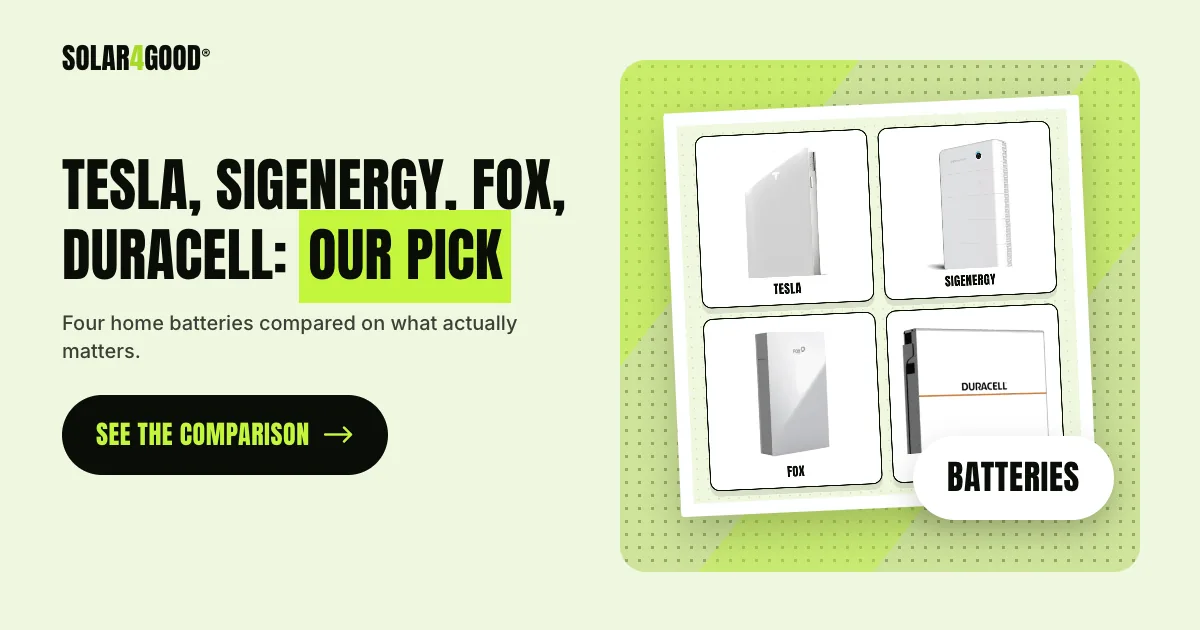
Manufacturers including Fox ESS, Sigenergy, Duracell and Tesla each sell a competitive range of batteries for UK solar systems.
03How buying low and selling high works
Britain is an island, and it is not fully connected to Europe’s wider energy network. Peaks and troughs in generation cannot easily be balanced out. When it is windy the UK has so much power that it pays wind generators to switch off. On a still day wind generation — Britain’s largest source — drops away, and expensive gas-fired stations have to fill the gap.
The result is dramatic swings in price, often within a single day. A battery owner who can store cheap energy — generated from their own panels or bought earlier from the grid — can export when rates rise and take advantage of the difference.
What made this practical is software. AI can track prices, analyse household usage and predict the best hours to import and export. Once it is in charge of the battery, the saving happens without human input. Manufacturers like Fox ESS and suppliers like Octopus Energy now compete on exactly this.
Worth being honest about: arbitrage only works if your tariff lets prices move. On a flat-rate tariff there is no gap between cheap and expensive, so there is nothing for the battery to trade on.
Storing your own solar needs only a battery. Trading needs three more things: a hybrid inverter that can be controlled from outside, a tariff whose price moves through the day, and software allowed to act on both. A quote for “solar and battery” does not automatically include any of them, which is why it is a survey-stage question rather than an afterwards one.
04Where the highest and lowest rates are
Getting the most out of a battery as a trading asset means access to the lowest import and highest export prices. The best known route in 2026 is Octopus Agile, which prices electricity against half-hourly wholesale rates rather than a fixed day and night split.
On a tariff like that, prices can move substantially between one afternoon slot and another. The idea is simple enough: charge the battery through the cheap window, then sell back into the expensive one.
05What happens when batteries join forces
Kingsmill Bond believes the bigger payback comes from uniting thousands of batteries into a virtual power plant, or VPP, that behaves as a constituent part of the national grid. Aggregators such as Axle Energy already manage large fleets of connected home devices this way.
“The holy grail is to use VPPs to make your battery valuable,” Bond says. “Once a number of batteries can be used at a grid level, you will get aggregators who are able to release some of that value to you.” He expects payback periods to shorten as that market matures: “Your payback time on batteries will be quite quick once it’s part of the system.”
Batteries are likely to become more valuable still, because Britain is going through its biggest energy change since the Industrial Revolution. For over a century fossil fuels did the cooking, heating and transport. Those loads are being electrified fast: electric ovens for gas, heat pumps for boilers, EVs for petrol cars. The country is going to need a great deal more electricity, and data centres are adding to that demand — by 2030 they alone could use as much as nearly nine million UK homes, according to NESO’s Clean Power report.
06Four ways a battery pays
| Mechanism | How it works |
|---|---|
| Storing your own daytime solar | Government data shows adding a battery can roughly double self-consumption of the energy your panels generate, to around 80%. |
| Importing cheap, exporting at peak | Buying low to sell high. Half-hourly tariffs can swing considerably within a day, and a battery owner can work the difference. |
| Selling back when the grid needs it | Aggregators run events where they pay a premium to owners who can export at a specific time. |
| Joining a virtual power plant | Thousands of batteries acting together like one power station, with owners paid to take part in grid balancing. |
07Frequently asked questions
Can any home battery buy and sell energy?
No. It needs a hybrid inverter that can be controlled externally, a tariff with prices that move through the day, and software from the manufacturer or your supplier to make the decisions. Plenty of older installations have none of those, which is why this is worth raising at the survey stage rather than afterwards.
Does trading energy wear the battery out faster?
More cycles do use more of a battery’s rated life, which is why cycle ratings matter when choosing one. Mainstream batteries are rated in the thousands of cycles and warranties are written around that, so it is a question to put to your installer with your actual usage in front of you rather than a reason to avoid it.
Do I need to be on Octopus to do this?
No, but you do need a tariff whose price changes through the day. Agile is the best known, and others exist. A flat-rate tariff removes the price gap the battery is trading on.
Is a virtual power plant something I can join now?
Some aggregators already accept home batteries, subject to your hardware being compatible. It is an evolving market, and the terms, including what you are paid and how much control you hand over, vary a good deal between providers. Read what you are signing up to.
How much does a solar battery cost in the UK?
It depends on capacity, brand and whether it is installed alongside new panels or retrofitted to an existing system. Because prices move and every roof is different, the only figure worth acting on is one quoted against your own usage and property.

Tristan is a multi-award-winning journalist who has spent 25 years writing for The Guardian, The Daily Mail and the BBC. Lately he has turned the reporting on himself, chronicling his own solar install, battery optimisation and time-of-use tariffs across The Sunday Times and The Telegraph. Real system, real bills, real numbers.