We fit myenergi systems on UK homes: the zappi solar EV charger, the eddi hot-water diverter and the libbi battery, all working from your own rooftop solar. Most solar exports the surplus. A myenergi system decides what happens next.

If you are looking at myenergi, you have probably already decided that solar is only half the story. The other half is what your home does with the power once the panels are making it. Most solar systems generate electricity and export whatever is not used. A myenergi system is designed to decide what happens next.
At Solar4Good we fit myenergi as a core part of our range, matched to your roof and the way you actually use energy. The zappi charges your car from your own sunshine, the eddi sends leftover solar to your hot water, the libbi stores what is still spare, and the harvi ties it all together without extra wiring. One coordinated ecosystem, one app.
The point is self-consumption. Rather than sell your surplus back to the grid for a few pennies, a myenergi system keeps that energy at home: into the car, into the hot-water tank, into the battery, in a sensible priority order. Over a year that is the difference between a solar system that pays you back slowly and one that works hard every sunny hour.
You work with MCS-certified installers who design the system around your home, handle the electrics safely, and commission everything properly, not a generic checklist.
A myenergi system watches your generation second by second and directs every spare watt in priority order, so almost nothing leaves the house for a pittance. That is the whole idea: keep the energy you paid to make.

Most myenergi setups are shaped by how you live, not by preference. An EV on the drive points to a zappi, an electric hot-water tank points to an eddi, and a home that empties out on sunny afternoons points to a libbi so the surplus is there for the evening. Many homes end up with all four working together.
We fit myenergi as a full solar system: panels and inverter sized to your roof, plus the myenergi devices that make the surplus useful. Everything is British-made and runs from a single app.


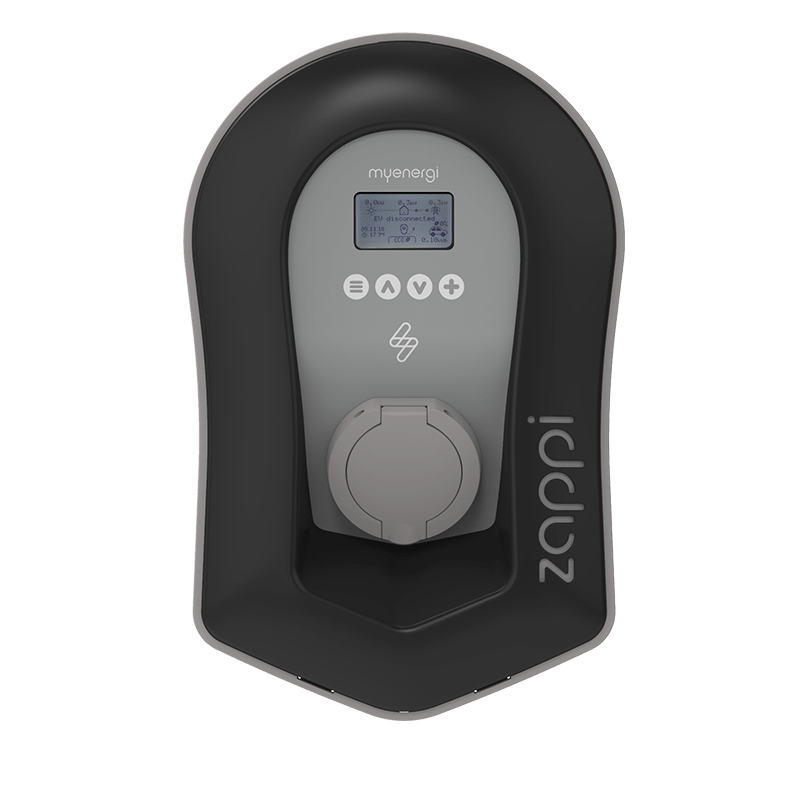
The zappi is not just a fast EV charger. In ECO+ mode it holds off and tops up your car only from the solar you would otherwise export, so the cheapest, greenest miles come straight off your own roof.
EV chargers look alike on the wall, but only a solar-diverting charger like the zappi can decide when to pull from your roof and when to lean on the grid. Here is what the zappi actually delivers, and how its three charge modes let you choose free solar miles, a guaranteed charge, or full speed.
Once the home and the car are covered, the eddi diverts what is left to your immersion tank instead of exporting it. Free hot water from surplus solar, and anything still spare after that charges the libbi.

Rather than sell your surplus back to the grid for a few pennies, a myenergi system keeps it working at home.
Solar diverters and batteries do the same job from two angles: they stop your surplus leaving the house. The eddi turns spare solar into hot water in the moment, and the libbi stores what is left for later. Together they mean a sunny afternoon can carry you well into a dark evening.
A myenergi system is worth it when you want your solar to do more than spin the export meter. If you drive an electric car, heat water with an immersion, or simply want to use more of what your roof makes, the payback comes from self-consumption, not from selling power back cheaply.
For a typical UK home the maths is simple. Every kilowatt-hour you divert into the car, the hot-water tank or the battery is a kilowatt-hour you did not buy from the grid at the full rate. Paired with a smart tariff, the libbi can also charge on cheap overnight electricity and cover the evening peak, squeezing even more out of the setup.
In practice, people tend to choose myenergi because:
For most UK homes with an EV or electric hot water, myenergi is a strong choice, but only when the system is sized to your real usage and fitted properly. Undersize the solar and there is little surplus to divert; oversize it and you pay for generation you rarely use.
There is no single price for a myenergi system, because the cost is driven by your home and your usage, not the brand alone. The size of the solar array, the inverter, whether you add a zappi, an eddi or a libbi, and how your roof and fuse board are laid out all move the figure.
One of the advantages of myenergi is that it is modular. You can begin with solar and a zappi, then add an eddi or a libbi later without replacing anything. Where a battery is added to solar, the whole system qualifies for 0% VAT.
The only way to know what a myenergi system would cost for your home is a proper assessment. We look at your roof, your usage, your car and your fuse board, then give you one clear fixed quote rather than a vague range.
From London and the Home Counties out to the Thames Valley, the Midlands, the South West and beyond, our teams have paired myenergi with solar on real UK homes, each system sized and commissioned to last.
Fitting myenergi well is not about bolting a charger to a wall and hoping. It is about designing the solar, the inverter and the myenergi devices as one system, wiring it safely, and configuring the cascade so your surplus really does go where it is worth the most.
We are MCS-certified, we install under our own MCS registration, and myenergi is a brand we fit day in and day out, so we know how the zappi, eddi and libbi behave together on real UK homes, not just on a datasheet.
Installed to the standard that unlocks the Smart Export Guarantee and protects your warranty.
Fitted and commissioned to the Solar4Good standard, not a generic checklist.
The solar and the myenergi devices are sized and configured together, so the cascade works from day one.
We register the myenergi and workmanship warranties so you are covered for the long haul.
A myenergi install works best when the whole system is designed before anyone touches the fuse board. Most installs follow the same shape, but the final design depends on your roof, your existing electrics, your car and which myenergi devices you are adding.
Understanding your energy We look at your roof and shading, how you use electricity across the day, whether you drive an EV and how you heat your water, then design a system around it.
Designing the system We specify the solar, the inverter and the myenergi devices together, so the zappi, eddi and libbi are matched to your generation rather than bolted on afterwards.
Installing the kit Most residential installs are completed in one to two days by our own teams and vetted partners, with a harvi where needed so the wiring stays tidy even when the meter is far from the charger.
Commissioning and app setup We test and commission the system, set up the charge modes and priority cascade, register the warranties, and walk you through the myenergi app so you can see it working from day one.
Ongoing support After install we stay available for questions, mode tweaks and future upgrades, such as adding a libbi as your needs change.
A solar and EV-charging setup is a grid-connected electrical system on your home for the next couple of decades. When it is installed or configured badly, the problems rarely show up on day one. They appear later as underperformance, a charger that never actually uses the solar, export issues or warranty headaches.
Working with certified installers reduces those risks, because the system is designed, checked and signed off against UK standards rather than internal shortcuts.

MCS certification ties our installs to recognised UK standards, and keeps systems eligible for Smart Export Guarantee payments.
A certified, properly registered install keeps both the myenergi and workmanship warranties valid for the long term.
The charger, diverter and battery are wired and commissioned to UK wiring and grid rules, not to an internal shortcut.
Working through recognised bodies adds a layer of protection beyond the installer itself.
Together, these frameworks shape how myenergi installations are planned and supported at Solar4Good, not just how they are sold.

We do not just sell myenergi, we have a long track record of fitting it alongside solar. Across the UK we have completed 145 myenergi systems, all paired with solar, from our Harrow and Thames Valley heartland out to the Home Counties, London, the Midlands, the South West, the North and Scotland.
Those systems include 102 zappi solar EV chargers across 95 postcode districts and 51 eddi hot-water diverters, all commissioned so you can watch the energy flow in the app from day one. Wherever the home, the system is sized to it, wired safely and set up to keep your surplus at home.
Every myenergi system we fit is installed and commissioned under our own MCS registration, wired to UK standards and registered so your warranties hold. Real work, on real UK homes.
The same Solar4Good engineers who design your system are the ones fitting it.
Every install is completed to MCS and UK wiring rules, then signed off.
We register the system and its warranties so you are protected for the long term.
myenergi is a British company that designs and manufactures its own products at its facilities in Stallingborough, Lincolnshire. The zappi was one of the first EV chargers built specifically to charge from surplus solar, and the eddi, libbi and harvi grew around it into a single, coordinated ecosystem rather than a box of unrelated parts.
That British-made, award-winning pedigree matters when you are trusting one system to run your car, your hot water and your battery. It is designed to work together and to be supported for the long term, with a 3-year warranty as standard on the zappi and eddi and a 10-year warranty on the libbi.
Tell us about your property, your car and how you use energy, and we will show you exactly what a myenergi system would do for you, with one clear fixed quote and no pressure.
Solar4Good installs myenergi systems across the UK.
Manchester, London, Leicester, Glasgow, Exeter, Birmingham, Coventry, Ipswich, Norwich and Cheshire. Wherever you are, you receive the same Solar4Good quality, care and support.
Common questions about myenergi systems, the zappi, eddi and libbi, and installation.
Most solar systems export whatever you do not use. A myenergi system decides what happens next. It watches your generation and sends spare solar in priority order: to the home first, then the car through a zappi, then your hot water through an eddi, then a libbi battery, so almost nothing leaves the house for a low export rate.
The zappi is a solar-diverting EV charger. As well as charging at 7 kW on a single-phase supply or 22 kW on three-phase, it can charge your car from surplus solar only, so you drive on energy your roof would otherwise have exported.
Yes. In ECO+ mode the zappi charges only from excess self-generated solar and pauses if the surplus runs out, so those miles are as close to free as EV charging gets. ECO mode blends solar with a small grid top-up for a steady charge, and FAST mode charges at full speed from the grid when you need range quickly.
A zappi charges at up to 7 kW on a standard single-phase home supply, or up to 22 kW where three-phase power is available, with the actual speed also depending on your car.
Both are available. You can have a tethered zappi with a 6.5m Type 2 cable attached, or an untethered zappi with a locking socket so you use your own cable. Type 2 works with every electric car sold in the UK.
No. The zappi has built-in PEN fault detection and surge protection, so it does not need a separate earth rod. That usually makes the installation tidier and more affordable on a typical British home.
The eddi is a solar power diverter. Instead of exporting your surplus, it sends up to 3.68 kW into your immersion or heating element, across two heaters in turn, so spare solar heats your hot water for free.
The libbi is modular, from 5 kWh up to 20 kWh, with 90% usable depth of discharge and a 10-year warranty. It is tariff-aware, so it stores spare solar by day and can also charge on cheap off-peak electricity for the evening.
Yes. myenergi designs and manufactures its products, including the zappi, eddi, libbi and harvi, at its own facilities in Stallingborough, Lincolnshire.
Yes. You can add a zappi, an eddi or a libbi to a solar system you already have, and bring everything onto one myenergi app. Many homes start with solar and a zappi, then add an eddi or libbi later.
Yes. We have completed 145 myenergi systems across 135 postcode districts, all paired with solar, including 102 zappi chargers across 95 districts, from London and the Home Counties out to the Midlands, the South West, the North and Scotland.