
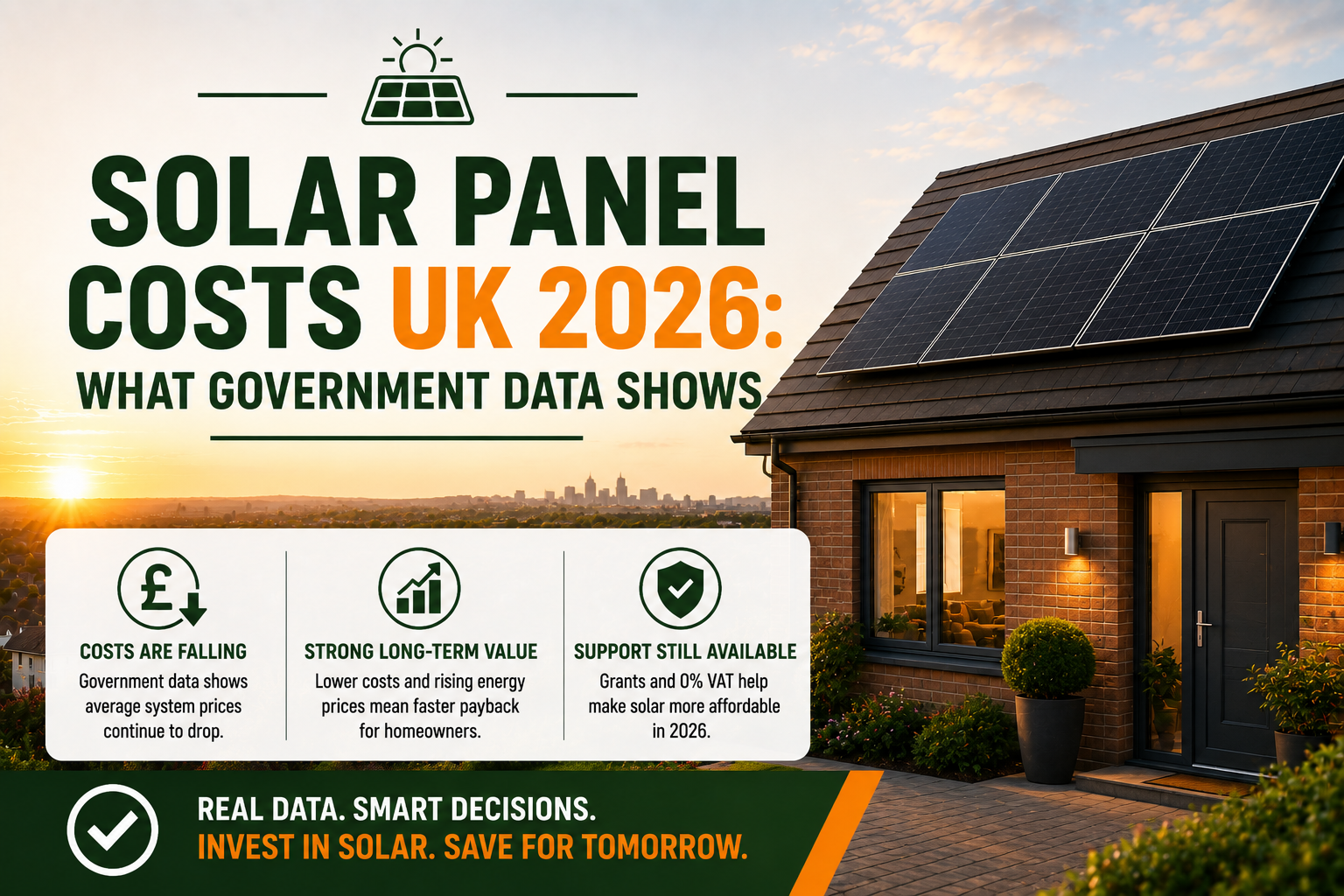
Solar Panel Costs UK 2026: What Government Data Shows

Run a business? See our commercial solar service →
Solar panel prices are often quoted as averages, but what do those numbers actually reflect? And how useful is government cost data when you’re trying to understand what solar might cost for your home?
- 1. Where Does UK Solar Cost Data Come From?
- 2. What Does The Government Data Say About Solar Prices?
- 3. What Are Typical Solar Panel Costs By System Size?
- 4. Why Don’t Government Averages Tell The Full Story?
- 5. What Really Affects The Cost Of A Solar Installation?
- 6. How Should You Use Government Data When Comparing Quotes?
- 7. Bottom Line
Summary (TL;DR)
Key facts about this topic:
- UK government data provides a useful benchmark for solar panel costs, but reflects national averages rather than tailored prices
- Most residential systems fall within a broad price range depending on size, roof complexity, and equipment choice
- Recent DESNZ data shows median installation costs around £1,800–£1,900 per kW for typical domestic systems
- Government figures work best as a sense-check when reviewing quotes, not as guaranteed pricing
Solar panel costs are usually the first thing homeowners look into when considering solar — and understandably so. Installing solar is a long-term investment, and knowing what people typically pay helps set expectations before speaking to installers or requesting quotes.
In the UK, there is official data available that tracks the cost of real solar installations. Government departments publish figures based on thousands of completed systems, giving a broad picture of what households have actually paid rather than what companies claim solar should cost. At face value, this can feel like the most reliable source of pricing information.
However, these figures are often misunderstood. Government data shows averages across a wide range of installations, from simple, low-cost systems to more complex, higher-spec projects. Roof types, system sizes, access requirements, and equipment choices are all blended together, which means the headline numbers don’t always translate neatly to individual homes.
To use government cost data properly, it helps to understand where it comes from, what it includes, and what it leaves out. This guide breaks down the latest UK solar cost data, explains how to interpret it realistically, and shows how it should be used alongside site-specific quotes — not instead of them.
Where Does UK Solar Cost Data Come From?
Most official UK solar cost data is published by the Department for Energy Security and Net Zero and is drawn from installations certified under the Microgeneration Certification Scheme (MCS). Because MCS certification is required for export payments and consumer protections, the dataset captures a large proportion of residential solar installations across the UK. The data is based on completed projects rather than estimates and typically includes:
- Solar panels and inverters
- Mounting systems
- Labour and installation
- Compliance and certification costs
This makes it one of the most reliable high-level views of UK solar pricing, but it’s still an overview, not a personalised quote.
What Does The Government Data Say About Solar Prices?
Government datasets and industry pricing aligned with DESNZ trends suggest that solar panel costs in the UK have fallen over the long term and are now more consistent than in past years, but they still vary significantly depending on system size, installation complexity, and location.
Official cost data collected from installers through the Department for Energy Security and Net Zero (DESNZ) and the Microgeneration Certification Scheme (MCS) shows that average installation costs per kilowatt (kW) have generally trended downward or stabilised in recent reporting years, reflecting both competitive installer markets and more standardised technologies.
Recent DESNZ reporting shows median installation costs around £1,800–£1,900 per kW for typical domestic systems, which helps explain why larger systems often represent better value per kW installed.
When you compare industry pricing with DESNZ/MCS cost-per-kW data, similar ranges appear:
| System Size | Typical Installed Cost (UK, 2026) |
|---|---|
| 2 kW | £3,800 – £5,000 |
| 3 kW | £4,800 – £6,500 |
| 4 kW | £6,000 – £8,000 |
| 5 kW | £7,000 – £9,000 |
| 6 kW | £7,500 – £10,000 |
Key points from the data:
- Larger systems cost more overall, but tend to have lower costs per kW installed, because many installation expenses (like scaffolding and labour) are fixed or don’t scale linearly with system size.
- Smaller systems look more expensive per kW because basic installation costs are spread over fewer panels.
- Many homeowners see a typical 4 kW system, common for average UK homes, fall in the £6,000–£8,000 range, depending on roof access, panel type, and electrical work required.
- Costs reported by industry trackers and government datasets are broadly consistent, suggesting national averages are a reliable reference point, but individual quotes will vary.
Having these figures can help you understand whether an installer’s quote is broadly in line with recent cost trends, but remember, they’re averages, not guarantees. A quote can be lower or higher depending on property-specific factors such as roof shape, electrical upgrades, or additional equipment like batteries.
What Are Typical Solar Panel Costs By System Size?
Ready to go Solar ?
Why Don’t Government Averages Tell The Full Story?
While government data is useful, it has clear limitations.
The main reasons averages can be misleading include:
- Different system specifications grouped together, from budget to premium
- Site complexity not reflected in headline figures
- Time lag between installations and published data
- No visibility into system design quality, which affects long-term performance.
As a result, averages should be treated as context and not predictions.
What Really Affects The Cost Of A Solar Installation?
In practice, the final cost of a solar installation depends on several site-specific factors:
- System size: More panels increase total cost but reduce cost per kWp.
- Roof layout and access: Steep, multi-facet, or awkward roofs increase labour and scaffold costs.
- Equipment choice: Panel efficiency, inverter type, and warranties influence pricing.
- Installation complexity: Cable routes, consumer unit upgrades, and access time matter.
- Optional extras: Monitoring systems, optimisers, and battery storage add cost.
These factors explain why personalised quotes often differ from national benchmarks.
How Should You Use Government Data When Comparing Quotes?
Government cost data works best as a reference point, not a target price.
When reviewing quotes, it helps to:
- Use averages to flag prices that seem unusually high or low
- Ask installers to explain what’s included and why costs differ
- Look for itemised breakdowns rather than headline totals
- Compare system design and expected output, not just price
A good quote should make sense once the property’s specific conditions are taken into account.
Bottom Line
Government data provides a helpful overview of solar panel costs in the UK, but it can’t account for the specifics of individual homes. Use it to understand typical ranges, not to predict exact pricing.
UK government figures show that solar panel costs have become more consistent and accessible over time, but they also highlight how much prices vary between installations. The key takeaway isn’t a single number; it’s understanding what drives those differences.
If you’re considering solar and want a clear view of what it would cost for your property, we can provide an obligation-free consultation. We assess your roof, usage, and system design to provide a transparent, site-specific quote that puts national benchmarks into a real-world context, with no pressure to proceed.
Frequently Asked Questions
How accurate is government solar cost data?
It’s accurate as a national benchmark, but it won’t reflect the specifics of your property. Roof layout, access, and equipment choices can all move the final price up or down.
Why do solar quotes vary so much between homes?
Because no two installations are the same. Roof complexity, scaffolding needs, electrical work, and system design all affect installation time and cost.
Do government cost figures include batteries?
No. Battery storage and other optional upgrades are usually priced separately from standard solar PV installations.
Should my quote match the government average?
Not exactly. The data is best used as a sense-check; a tailored quote will rarely line up perfectly with an average figure.
Is the cheapest solar quote usually the best option?
Not always. Lower prices can mean lower-spec equipment, shorter warranties, or limited system design. It also pays to weigh whether solar panels are worth it for your usage before comparing quotes.
About the Author
Manan Shah
Co-Founder of Solar4Good UK. Leads Solar4Good's commercial strategy and customer relationships, and is quoted as a clean-energy authority by some of the UK's most trusted news publications. Quoted in the Financial Times and The Times on UK solar.
📞 Book a free solar consultation
Call us on 0800 999 1454 or visit solar4good.co.uk
Read over 800+ verified five-star reviews on Trustpilot and Checkatrade
Solar4Good Ltd · 79 College Road, Harrow, HA1 1BD · MCS: NAP/72775/25/4 · HIES: S4G/A/1484