
Tier 1 vs Tier 2 Solar Panels: What Actually Matters When Choosing Panels in the UK
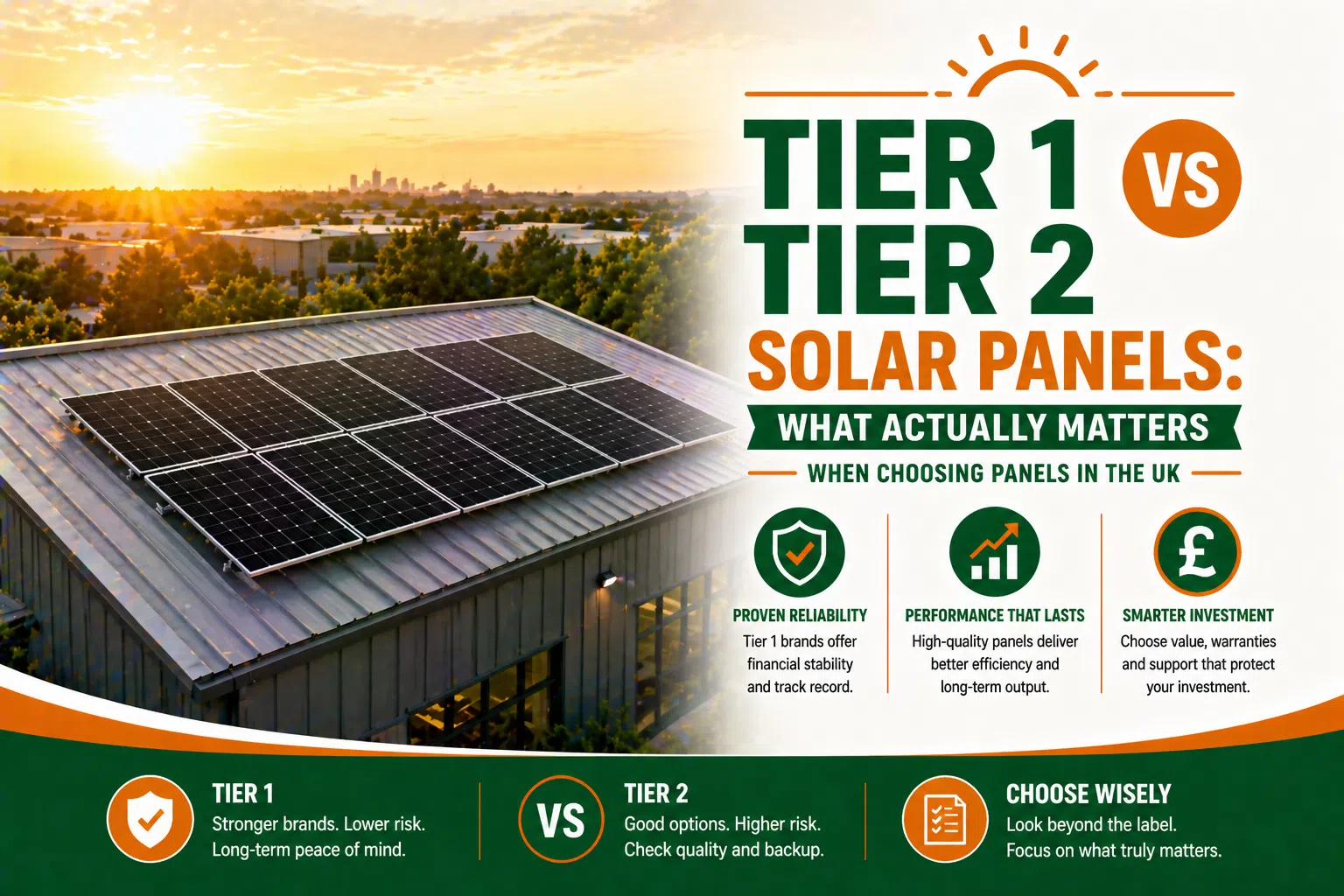

What is the difference between Tier 1 and Tier 2 solar panels? The ‘Tier’ system is a financial ranking of solar panel manufacturers — not a measure of panel quality, efficiency or reliability. Tier 1 means a manufacturer is considered bankable by major lenders; it does not automatically mean the panel is better. Here is what the tiers actually tell you, and what matters far more when choosing panels for a UK home.
The Short Version (Read This First)
Key facts about Tier 1 vs Tier 2 solar panels:
- The ‘Tier’ system is a financial bankability ranking of manufacturers, created by BloombergNEF — it is not a quality, efficiency or performance rating
- Tier 1 means major banks have financed projects using that manufacturer’s panels, signalling financial stability and scale, not superior panels
- BloombergNEF itself states the list should not be used as a guide to product quality
- A Tier 2 panel can match or outperform a Tier 1 panel in efficiency, degradation and durability
- What matters more for a UK home: product and performance warranties, degradation rate, independent reliability testing, MCS approval, and a reputable installer
- Solar4Good® installs panels selected on real-world UK performance and warranty strength — call 0800 999 1454 or visit solar4good.co.uk
When researching solar panels, many UK homeowners come across the terms ‘Tier 1’ and ‘Tier 2’ and assume they describe panel quality — as though Tier 1 panels are premium and Tier 2 panels are inferior. It is one of the most common misunderstandings in the solar market, and it is worth clearing up before you compare quotes.
The tier system has nothing to do with how well a panel performs on your roof. It is a financial classification of the companies that make solar panels, used mainly by banks, investors and large-scale project developers. For a homeowner, it tells you something about the manufacturer’s size and stability, but very little about whether a specific panel is the right choice for your home.
This guide explains where the tier system comes from, what it does and does not mean, and which factors genuinely determine whether a solar panel is a good choice for a UK property.
What Does Tier 1 and Tier 2 Actually Mean?
The solar panel tier system was created by BloombergNEF (Bloomberg New Energy Finance), a research organisation that analyses the energy sector for investors and lenders. The tiers rank manufacturers by ‘bankability’ — essentially, how confident major financial institutions are in lending against projects that use a given manufacturer’s panels.
A manufacturer is classed as Tier 1 if its panels have been used in a number of large, separate projects that were financed by major banks on a non-recourse basis over the previous two years. In plain terms, it means established lenders have been willing to put significant money behind that brand. Tier 2 and Tier 3 manufacturers are typically smaller, newer, or less vertically integrated — they may not yet have the scale or track record that attracts large-scale bank financing.
The key point is who the list is for. It was designed for investors and developers assessing financial risk on utility-scale projects, not for homeowners choosing panels for a roof. The criteria measure financial and commercial stability, not laboratory performance or field reliability. You can read about how the methodology works directly from BloombergNEF, which publishes the tiering framework.
★★★★★ Trustpilot
“Solar4Good explained the panel options in plain English instead of throwing brand names and tier labels at us. We ended up confident we’d chosen the right panel for our roof, not just the most marketed one.”
— Verified customer
Is Tier 1 the Same as High Quality?
No. This is the most important thing to understand. A Tier 1 ranking does not mean a panel is more efficient, more durable, or better made than a Tier 2 panel. BloombergNEF itself has been explicit on this point, stating that the tier system is a measure of bankability and should not be interpreted as a guide to product quality.
There are a few reasons the two get confused. Tier 1 manufacturers tend to be large, well-known brands with significant marketing presence, so their names appear more often and feel more reassuring. Many Tier 1 manufacturers do produce excellent panels — but that is a result of their engineering and quality control, not of the tier label itself. Meanwhile, the size and scale that earn a Tier 1 ranking can come from manufacturing volume and financing history rather than the performance of any single product.
It is entirely possible for a smaller manufacturer to produce a panel with higher efficiency, a lower degradation rate, or a stronger warranty than a Tier 1 competitor, while still sitting in Tier 2 simply because it has not yet built the financing track record that the tier system measures. Quality and tier are related in some cases, but they are not the same thing.
Ready to go Solar?
What Actually Determines Panel Quality?
If the tier system does not tell you whether a panel is good, what should you look at instead? For a UK home, a handful of factors matter far more than a manufacturer’s financial classification.
Product and performance warranties
The product warranty covers manufacturing defects, while the performance warranty guarantees a minimum output level after a set number of years. Strong modern panels typically offer product warranties of 25 years or more, alongside performance warranties guaranteeing a high percentage of output at year 25. Longer, clearer warranties are a meaningful signal of a manufacturer’s confidence in its own product.
Degradation rate
All panels lose a little output each year. The annual degradation rate determines how much electricity the panel still produces decades into its life. A lower degradation rate means more generation over the system’s lifetime — which matters in the UK, where the solar resource is modest and every unit of retained output counts.
Independent reliability testing
Independent laboratories such as PVEL and RETC publish annual reliability scorecards, testing panels for real-world stress factors like thermal cycling, humidity and mechanical load. These results are a far better quality indicator than the tier list, because they assess the actual product rather than the company’s finances.
Cell technology and efficiency
The cell type — for example N-type TOPCon versus older P-type PERC — affects how the panel performs in low and diffuse light, which is common in the UK. Higher efficiency also helps where roof space is limited, allowing more generation from fewer panels.
MCS approval
In the UK, panels should be listed as approved under the Microgeneration Certification Scheme. This is a practical requirement: MCS-certified products and installations are needed to register for the Smart Export Guarantee. Approval is confirmed on the official MCS register.
The installer
Even an excellent panel underperforms if it is poorly specified or installed. System design, panel placement, inverter matching and workmanship often have a bigger impact on real-world output than the difference between two reputable panel brands.
★★★★★ TrustATrader
“They chose panels based on what suited our roof and budget, backed up with the warranty detail. No jargon, no pressure — just a clear recommendation we could understand.”
— Verified customer
Should You Only Buy Tier 1 Solar Panels?
Not necessarily. Choosing a Tier 1 panel is not a bad decision — many Tier 1 manufacturers do produce strong, reliable products, and their scale can offer reassurance that the company is likely to remain in business to honour long warranties. That last point genuinely matters: a 25-year warranty is only as good as the company standing behind it.
However, treating ‘Tier 1’ as the only thing that matters can lead you to overlook better-suited options. A panel’s degradation rate, warranty terms, independent test results and real-world performance in UK conditions are all more useful comparison points than the tier label alone. The most sensible approach is to use the tier system as one small piece of background context — a rough signal of manufacturer scale — while basing your actual decision on the factors that affect generation, longevity and protection.
In practice, a reputable installer will already be working from a shortlist of well-established, MCS-approved panels with strong warranties and proven field performance. Many of these happen to be Tier 1, but they are chosen for their measured performance and reliability, not for the label.
How This Applies to UK Homes
For a UK homeowner, the practical takeaway is straightforward: do not let the tier label drive the decision. The conditions that matter most here — diffuse, cloudy light, partial shading from chimneys and trees, and a need for long-term output stability — are best addressed by looking at the panel’s actual specifications and the quality of the installation.
The panels Solar4Good installs are selected on this basis. Brands such as JA Solar, Jinko, Trina, DMEGC, Aiko and Eurener are assessed on their efficiency, degradation profile, warranty strength and how they perform in real UK conditions — not simply on where they sit on a financial bankability list. The right panel for your home depends on your roof, shading, budget and how you use electricity, which is exactly what a proper survey is designed to establish. For more on matching panels to your property, see our guide on how many solar panels you need.
💡 The simple rule
Tier rankings describe the manufacturer’s finances. Warranties, degradation rates, independent test results and MCS approval describe the panel. When comparing quotes, weigh the panel facts — and the installer’s track record — more heavily than the tier label.
Conclusion
The Tier 1 versus Tier 2 distinction is one of the most misunderstood ideas in residential solar. It is a financial classification built for investors, not a quality rating built for homeowners. A Tier 1 ranking signals manufacturer scale and bankability, which can offer some reassurance about warranty longevity, but it says nothing definitive about how well a panel will perform on your roof.
What genuinely determines a good outcome is the combination of a well-specified panel with strong warranties and a low degradation rate, MCS approval, and a careful installation. If you would like clear, jargon-free advice on which panels suit your property — and why — Solar4Good offers obligation-free consultations. We will assess your roof, explain the real differences between the options, and recommend a system based on performance and protection rather than labels.
📞 Get clear, no-pressure panel advice from Solar4Good
Call us on 0800 999 1454 or visit solar4good.co.uk. Read over 800+ verified five-star reviews on Trustpilot and Checkatrade.
Solar4Good Ltd · 79 College Road, Harrow, HA1 1BD · MCS: NAP/72775/25/4 · HIES: S4G/A/1484
Frequently Asked Questions
Are Tier 1 solar panels better than Tier 2?
Not necessarily. The tier system ranks manufacturers by financial bankability, not by panel quality. A Tier 2 panel can match or beat a Tier 1 panel on efficiency, degradation and warranty. Compare those specifications directly rather than relying on the tier label.
Who decides which manufacturers are Tier 1?
BloombergNEF maintains the tier list. A manufacturer reaches Tier 1 when its panels have been used in multiple large projects financed by major banks over a two-year period. The criteria measure financial stability and scale, not product performance.
Does the tier of a panel affect my warranty?
Not directly. The warranty is set by the manufacturer, regardless of tier. That said, larger, financially stable manufacturers are more likely to remain in business to honour long warranties, which is one reason scale can offer some reassurance.
What should I look at instead of the tier ranking?
Focus on the product and performance warranties, the annual degradation rate, independent reliability testing such as PVEL or RETC scorecards, cell technology, MCS approval, and the reputation of your installer. These tell you far more about real-world performance than the tier list.
Does Solar4Good only install Tier 1 panels?
Solar4Good selects panels based on measured performance, warranty strength and suitability for UK conditions. Many of the brands installed are Tier 1, but they are chosen for their efficiency, durability and warranty — not simply for the label.
About the Author
Matthew
Solar Consultant with over a decade of UK solar experience, helping homeowners and businesses make clear, confident renewable energy decisions.
📞 Book a free solar consultation
Call us on 0800 999 1454 or visit solar4good.co.uk
Read over 800+ verified five-star reviews on Trustpilot and Checkatrade
Solar4Good Ltd · 79 College Road, Harrow, HA1 1BD · MCS: NAP/72775/25/4 · HIES: S4G/A/1484