
Business Solar Panel Grants in the UK: What You Need to Know
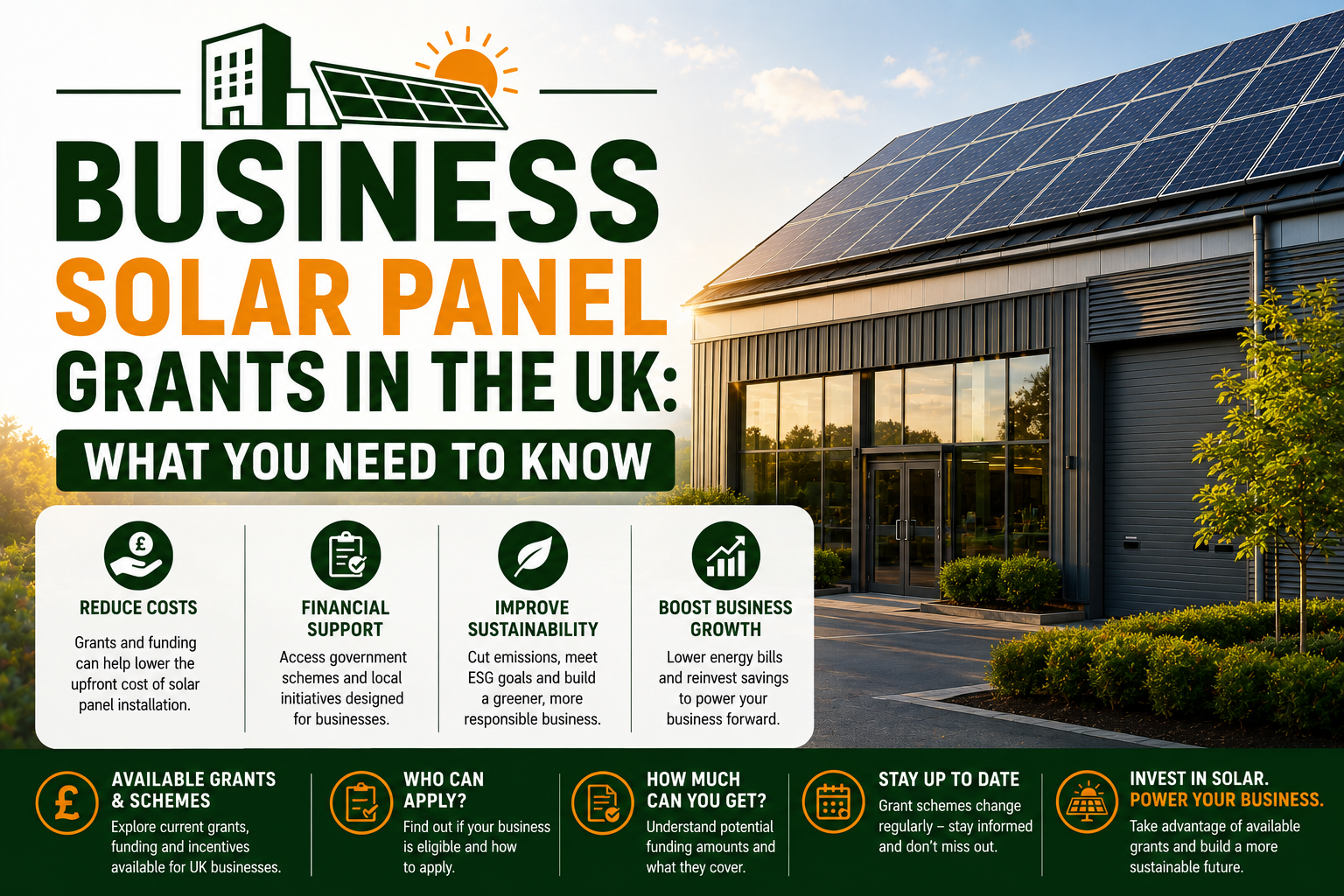

Looking to cut business energy costs? Solar panel grants and tax relief in the UK make commercial solar more affordable than ever, with faster payback periods and better returns on investment.
- 1. Why Are Solar Grants for Business Important?
- 2. Current Business Solar Panel Grants and Incentives in the UK
- 3. How Do You Qualify for Commercial Solar Panel Grants?
- 4. How Do Business Solar Grants Affect Payback and ROI?
- 5. How to Apply for Business Solar Grants in the UK
Summary (TL;DR)
Key facts about this topic:
- UK businesses can claim significant tax relief through Full Expensing or Annual Investment Allowance, often covering 10-40% of solar installation costs
- The Smart Export Guarantee pays 5-15p per kWh for surplus energy exported back to the grid
- Regional grants and 0% interest loans are available, with some schemes offering up to £100,000 in Scotland for SMEs
- Combining multiple incentives can reduce payback periods from 8 years to just 4-5 years
Why Are Solar Grants for Businesses Important?
Every business faces the same question: how do we manage energy costs while staying sustainable? For most, solar ticks every box, but the challenge has always been affordability. That’s why UK business solar panel grants matter so much; they’re not just subsidies but are, in fact, catalysts for modernisation.
Here’s what they help you achieve:
- Lower upfront investment: Grants and tax reliefs can cover 10–40% of total costs.
- Faster ROI: Shorter payback periods mean quicker profitability.
- Carbon accountability: Every funded project supports your sustainability and ESG goals.
- Energy security: Generating your own power stabilises long-term costs.
The UK’s Net Zero Strategy is accelerating corporate support, too, which means more councils and agencies now treat solar as critical infrastructure, not just an environmental upgrade, so basically, more funding routes are opening each year.
What Current Business Solar Panel Grants and Incentives are There in the UK?
Here’s a quick summary of the main commercial solar panel grants and funding mechanisms available in the UK:
| Scheme / Grant | Type | Typical Funding | Who Qualifies | Region | Key Benefits |
|---|---|---|---|---|---|
| Full Expensing Scheme | Tax Relief | 100% first-year capital deduction | All UK businesses | UK-wide | Immediate tax relief on solar costs |
| Annual Investment Allowance (AIA) | Tax Relief | Up to £1M per tax year | SMEs and large companies | UK-wide | Reduces taxable profits and boosts ROI |
| Smart Export Guarantee (SEG) | Tariff | 5–15p per kWh exported | All system owners | UK-wide | Passive income from surplus energy |
| Low Carbon Workspace | Grant | Up to £6,750 | SMEs | South East England | Part-funds solar PV and efficiency upgrades |
| Salix Finance (Public Sector) | Loan | 100% interest-free | Schools, NHS, Councils | UK-wide | Covers full installation cost |
| Scotland SME Loan Scheme | Loan | Up to £100,000 interest-free | Scottish SMEs | Scotland | Supports solar and battery systems |
| Regional Green Business Grants | Grant | Up to £20,000 | SMEs | Regional (e.g. West Midlands, Manchester) | Helps fund carbon-reduction projects |
| Energy Company Initiatives | Discount / Finance | Varies | Commercial clients | UK-wide | Partner schemes with E.ON, Octopus, etc. |
A Friendly Reminder: Each option has unique timelines and documentation requirements, so it’s wise to pair grant applications with professional guidance; that’s where Solar4Good® steps in.
Ready to go Solar ?
How Do You Qualify for Commercial Solar Panel Grants?
Getting your hands on a business solar panel grant isn’t as complicated as it sounds — it’s mostly about showing that your company is serious about sustainability and that your system will make a real impact. Most schemes have similar criteria, so once you meet one, you’re already halfway there for the others.
First off, you’ll need to be a registered UK business, whether that’s a small family-run café, a large manufacturer, or even a nonprofit organisation. The next big box to tick is working with an MCS-certified installer (that’s where we come in). It’s not just a formality; funding bodies want to see your installation meets national standards for safety and performance.
You’ll also need to show how your system will reduce carbon emissions or improve energy efficiency, usually by sharing recent energy consumption data or audit results. Most programs want proof that your solar setup is more than a token gesture, they want measurable change.
Finally, keep in mind that every funding stream comes with its own timeline, typically around 6–12 months from approval to completion, so having a clear project plan in place helps a lot
A Pro Tip: Many funding bodies prioritise projects that include battery storage, EV charging, or energy management systems alongside solar PV. These add-ons strengthen your application and future-proof your setup.
How Do Business Solar Grants Affect Payback and ROI?
Grants can reshape the economics of your project by offsetting a chunk of the upfront cost; they make your solar system profitable sooner, often by several years.
Here’s how it plays out in real terms:
| Scenario | System Cost | Grant / Relief | Payback Period | Annual Savings |
|---|---|---|---|---|
| No Grant | £60,000 | £0 | 8 years | £8,000/year |
| With Grant (20%) | £48,000 | £12,000 | 6 years | £8,000/year |
| With Grant + SEG + AIA | £48,000 | £12,000 + Tax & Export | 4–5 years | £9,500–£10,000/year |
The difference isn’t just financial, it’s strategic. It’s simple, really, businesses with funded solar systems see lower volatility in operational budgets and improved ESG performance, both of which are increasingly valuable for investor and stakeholder confidence.
How to Apply for Business Solar Grants in the UK
Applying for solar power for business grants can seem like a bit of admin at first, but once you know the flow, it’s actually pretty simple. Most funding programs follow a similar rhythm: do your research, get your documents in order, and let your installer handle the technical side.
Here’s how to move through it step by step without losing momentum.
Step 1: Get a Sense of What’s Available
Start by having a look at the current funding options. The UK Government’s Green Funding Tool is a good place to begin, and most local councils now list sustainability grants on their websites. It’s worth a quick search; some of the best schemes aren’t widely advertised.
Step 2: Check Whether You Qualify
Every grant has its own conditions. Some are specifically for SMEs, some are postcode-based, and others are open to almost any business as long as the solar system meets efficiency targets. Take a minute to make sure the scheme fits your setup before you move ahead.
Step 3: Get a Quote from a Certified Installer
Nearly all funding applications will ask for an MCS-accredited quote. That’s just to show the system meets UK standards. If you’re working with us at Solar4Good, we’ll put together the design and breakdown you need for the application, so this part is straightforward.
Step 4: Gather a Few Supporting Documents
You’ll usually need to show your current energy usage. Recent electricity bills, half-hourly data (if you have it), and any sustainability or CSR goals your business is working toward all help paint a clearer picture. Think of this as giving the funder context.
Step 5: Send It Off and Let It Run Its Course
Once everything is submitted, there’s a short waiting period, often somewhere between 4 and 10 weeks. While that’s happening, we can get moving on things like DNO checks and initial system planning so you’re not just sitting around waiting.
Bonus tip: If your business operates across more than one location, don’t assume you’re limited to a single grant. Different sites can sometimes qualify for different regional schemes as long as each application meets that area’s requirements.
Bottom Line:
Business solar panel grants are no longer rare or overly complex; they’re now one of the UK’s most accessible routes to sustainability and cost savings.
The right funding can cut upfront costs by tens of thousands, boost your long-term ROI, and help your organisation stay ahead of green legislation. With energy prices still unpredictable, it’s one of the few investments that actually reduces your risk over time.
Final Thoughts
Going solar for your business isn’t just about saving on bills; it’s about future-proofing your operations.
At Solar4Good, we handle everything from design and installation to aftercare, ensuring your project meets both technical and regulatory standards. Whether you’re after a small 30 kW rooftop system or a multi-site rollout, our MCS-certified team ensures compliance, quality, and maximum returns. Get in touch today for a free site assessment and funding consultation, and discover how much support your business qualifies for before the next funding window closes.
Frequently Asked Questions
What grants are available for business solar panels in 2026?
Active programs include Full Expensing, AIA, SEG, Low Carbon Workspace, and various regional green business grants.
Do all businesses qualify for solar grants?
Most SMEs and large organisations do, especially if they can demonstrate measurable carbon savings.
Can I combine multiple incentives?
Yes. You can stack tax relief, local grants, and SEG income for maximum benefit.
Do grants cover battery storage too?
Many do. Battery integration often strengthens your application.
How long does funding approval take?
Typically 4–10 weeks, depending on your region and documentation quality.
About the Author
Matthew
Solar Consultant with over a decade of UK solar experience, helping homeowners and businesses make clear, confident renewable energy decisions.
📞 Book a free solar consultation
Call us on 0800 999 1454 or visit solar4good.co.uk
Read over 750+ verified five-star reviews on Trustpilot and Checkatrade
Solar4Good Ltd · 79 College Road, Harrow, HA1 1BD · MCS: NAP/72775/25/4 · HIES: S4G/A/1484