
Solar Energy for Small Businesses UK 2026: Options, Costs & How to Start
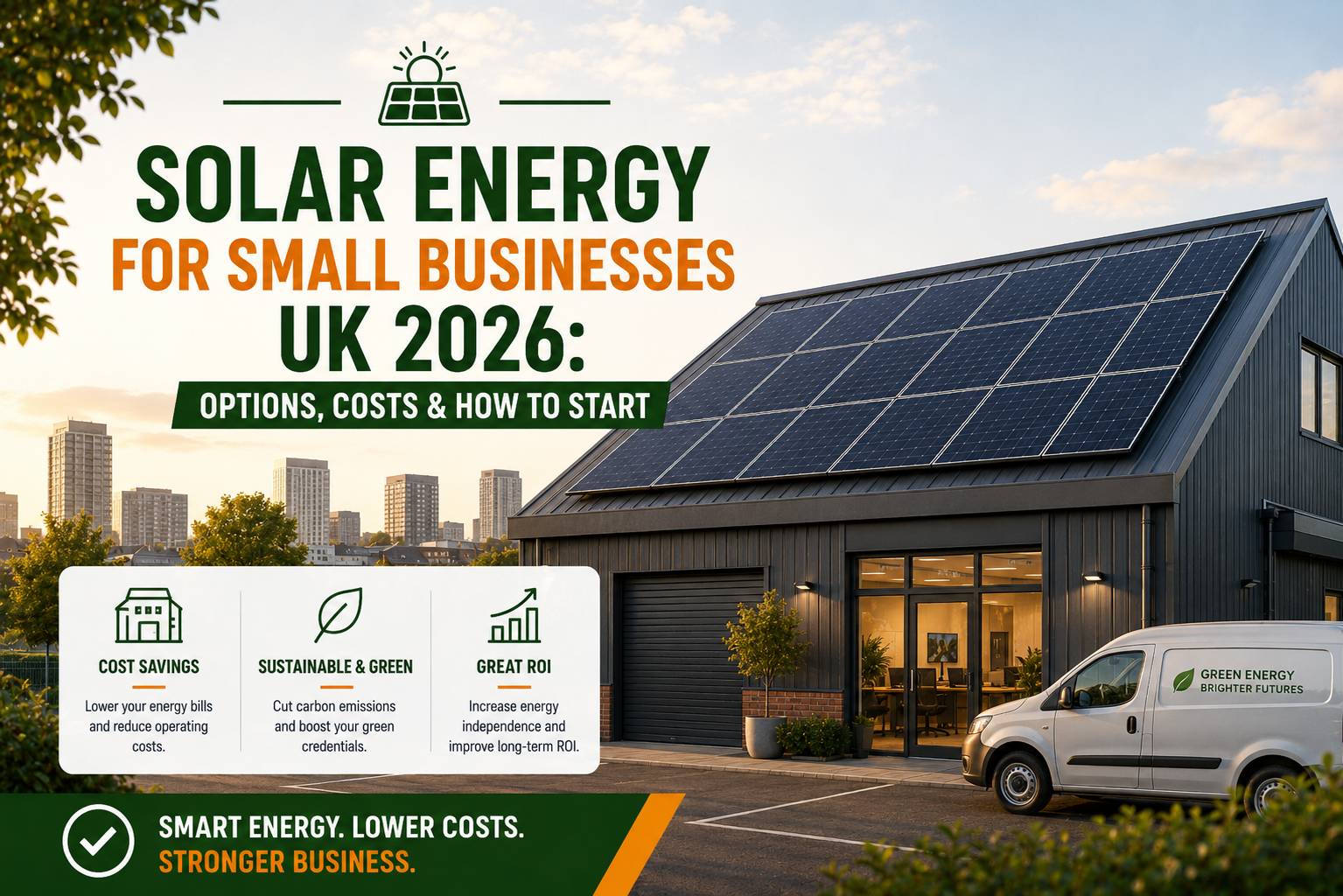

The shift toward solar in small businesses is no longer being driven by sustainability goals alone — it’s primarily a financial decision that’s becoming harder to ignore.
- 1. Why small businesses are going solar now — and why 2026 matters
- 2. Is solar right for your business?
- 3. What solar looks like for different types of small businesses
- 4. What does small business solar cost in 2026?
- 5. How much could your business save?
- 6. Tax relief and incentives explained
- 7. What if you rent your premises?
- 8. Financing options for small businesses
- 9. Should you add battery storage?
- 10. Planning permission and regulations
- 11. How to get started
- 12. Conclusion
- 13. FAQs
Short Summary
What small UK businesses need to know about solar in 2026:
- Solar for small businesses typically pays back within 4–7 years, with systems then delivering 18–21 years of reduced electricity costs
- The core case is straightforward: every unit of electricity you generate yourself is one you do not have to buy at full commercial rates — and businesses have no price cap protection
- Most viable businesses are those with daytime energy use and meaningful annual electricity bills. Businesses that operate primarily during daylight hours see the strongest returns
- The Annual Investment Allowance (AIA) allows you to deduct the full system cost from taxable profits in Year 1 — this is typically the largest single financial lever, not grants
- Most installations can be completed within 8–12 weeks. For most commercial rooftops, planning permission is not required
- Solar4Good® offers free no-obligation assessments for small businesses — call 0800 999 1454 or visit solar4good.co.uk
Electricity has quietly become one of the most volatile and difficult costs for UK small businesses to manage. Over the last decade, commercial electricity prices have risen significantly, with many businesses now paying between 22p and 27p per kWh — and unlike households, businesses are not protected by a price cap. At the same time, solar has moved from a niche investment to a practical and increasingly common solution. A well-designed solar system typically generates electricity at an effective cost of around 5–8p per kWh over its lifetime. That difference is the entire business case: every unit you generate yourself is one you do not have to buy at full commercial rates. This guide is designed to answer the most common questions clearly and realistically — whether solar applies to your building, whether the numbers make sense, and what the first step actually is.
Why Small Businesses Are Going Solar Now — and Why 2026 Matters
The shift toward solar in small businesses is no longer being driven by sustainability goals alone. In 2026, it is primarily a financial decision, and one that is becoming harder to ignore. The core reason is the widening gap between the cost of grid electricity and the cost of generating your own.
| Energy source | Typical cost (2026) |
|---|---|
| Grid electricity (commercial) | 22–27p/kWh (often higher at peak) |
| Solar generation (lifetime effective cost) | 5–8p/kWh |
For a business paying commercial tariffs with no price cap protection, this difference translates directly into operating cost. Electricity costs have risen sharply over the past decade — from around 14p/kWh in 2014 to over 22–27p/kWh today — and remain volatile. At the same time, solar installation costs have stabilised after years of decline, meaning the economics are now predictable in a way they weren’t before.
2026 sits at the point where three things align: high and unpredictable grid electricity prices; stable and relatively low solar installation costs; and increasing adoption across competing businesses. Solar is not just a cost-saving measure — it is becoming a way to stabilise energy spend, reduce exposure to price shocks and remain competitive in a market where energy efficiency is increasingly visible to customers and suppliers alike. For a full breakdown of whether solar is worth it across different business types and circumstances, see our dedicated guide.
★★★★★ Trustpilot
“Solar4Good installed a commercial system at our premises. From survey to sign-off the process was professionally managed, with clear communication at every stage. The system was commissioned on time and is already delivering on the projected savings.”
— Verified customer
Is Solar Right for Your Business?
Solar tends to perform best when your energy usage aligns with daylight hours, your electricity bill is meaningful, and your building can physically support a system. Businesses that operate during the day, have bills above £3,000–£5,000 per year, and have usable roof space are typically strong candidates.
There are also situations where solar is still viable but requires additional planning. If you rent your premises, operate primarily in the evenings, or are located in a conservation area, you may need landlord consent, battery storage or planning approval. These are not barriers, but they do affect how the project is approached. Where solar is usually less viable is where energy usage is very low or where the business has no control over the roof, such as in small leased units within shared buildings.
What Solar Looks Like for Different Types of Small Businesses
Not all small businesses use energy in the same way, and this has a direct impact on how solar performs. The key factor is whether your energy use overlaps with solar generation during the day. Businesses that consume electricity while the system is generating will see the strongest returns.
| Business type | Typical energy profile | Solar fit | What to expect |
|---|---|---|---|
| Café / restaurant | High daytime load | Very strong | High savings, fast payback |
| Retail shop | Steady daytime usage | Strong | Consistent, predictable savings |
| Office | Weekday daytime use | Strong | Reliable ROI |
| Workshop / industrial | High daytime machinery use | Very strong | Larger systems, high savings |
| Hairdresser / salon | Daytime operation | Strong | Good alignment with solar |
| Dental / medical | High equipment load | Very strong | Strong ROI |
| Agricultural | Large roof space | Very strong | Ideal for scale |
| Pub / bar | Evening-heavy usage | Moderate | Battery may be needed |
| Gym | Mixed usage | Moderate | Solar + battery combination |
Ready to go Solar ?
What Does Small Business Solar Cost in 2026?
Solar costs depend primarily on system size. As a benchmark, commercial systems average around £1,300 per kWp installed, with larger systems benefiting from lower per-unit costs.
| Business type | System size | Cost (ex-VAT) | Annual saving |
|---|---|---|---|
| Small office | 10–15 kWp | £13,000–£20,000 | £2,000–£3,500 |
| Retail shop | 15–25 kWp | £20,000–£33,000 | £3,000–£5,500 |
| Café / restaurant | 20–40 kWp | £26,000–£52,000 | £4,500–£9,000 |
| Workshop | 25–50 kWp | £33,000–£65,000 | £5,000–£11,000 |
⚠️ Honest note: VAT on commercial solar
Commercial solar is subject to 20% VAT. VAT-registered businesses (turnover above £90,000) can reclaim this in full on their next quarterly VAT return, so it does not affect the net cost. Businesses below the VAT registration threshold should factor the full gross cost into budget planning. All figures above are ex-VAT. For a full breakdown of costs and ROI across system sizes, see our commercial solar cost guide.
How Much Could Your Business Save?
The most important factor in solar performance is self-consumption: electricity you use directly saves you your full unit rate, while anything exported earns a lower rate. Commercial solar tends to outperform residential because businesses naturally use electricity during the day when solar is generating. Offices, retail units and salons typically land in the 60–80% self-consumption range. Energy-intensive businesses — cafés, restaurants, workshops — can push that to 70–90%.
Here is what a representative mid-sized system looks like in practice:
| Scenario | Value |
|---|---|
| System size | 20 kWp |
| Annual generation | ~18,000 kWh |
| Savings (self-use at 27p/kWh) | ~£3,600 |
| Export income (SEG at 7p/kWh conservative) | ~£360 |
| Total benefit | ~£3,960/year |
On these figures, payback lands at around five years when the Annual Investment Allowance is factored in. Without that, the raw payback is closer to six to seven years. Both sit comfortably within the typical commercial solar range — and either way, the system continues generating savings for the remaining 20-plus years of its life.
★★★★★ Trustpilot
“From initial survey to flawless installation, Solar4Good delivered an exceptional solar experience. The team worked meticulously and left the site spotless. Clear explanations, transparent pricing with no hidden fees.”
— Verified customer
Tax Relief and Incentives Explained
For small businesses, the financial case for solar is not just about energy savings — it’s also shaped by how the system is treated for tax. The most important incentive is the Annual Investment Allowance (AIA). This allows you to deduct 100% of the system cost from your taxable profits in the year of purchase, up to £1 million.
| Example system cost | Corporation tax rate | Tax saving | Net cost after AIA |
|---|---|---|---|
| £40,000 | 25% (main rate) | £10,000 | £30,000 |
| £60,000 | 25% (main rate) | £15,000 | £45,000 |
The main rate of 25% applies to limited companies with profits above £250,000. Companies on the small profits rate pay 19%, which reduces the saving proportionally — on a £40,000 system, that’s £7,600 rather than £10,000. Sole traders and partnerships pay income tax at their marginal rate instead of corporation tax, so the effective saving will vary by individual circumstances. In all cases, confirm the position with an accountant before making an investment decision.
Alongside AIA, there are three additional financial factors that contribute to overall return:
- Smart Export Guarantee (SEG): pays for surplus electricity exported to the grid, typically at 5–17p/kWh
- Business rates exemption: rooftop solar installations are exempt from increased business rates until 2035
- Regional grants: some local authorities offer partial funding, though availability varies by area and scheme
For a full breakdown of tax relief mechanisms and available funding routes, see our commercial solar grants and finance guide.
What If You Rent Your Premises?
Solar is still possible if you rent your premises, but it becomes a commercial and legal decision, not just a technical one. In most commercial leases, installing solar panels is classed as a structural alteration — which means you will need formal landlord consent, usually through a Licence to Alter. That agreement sets out who owns the system, who maintains it, and what happens at the end of the lease.
The challenge is less about permission and more about alignment. Solar can improve the EPC rating of the building and support future compliance with energy regulations, which benefits the landlord. At the same time, the tenant is typically funding the installation, so the financial return depends entirely on how long they remain in the property. Solar tends to work best for tenants where the lease term comfortably exceeds the expected payback period, or where the landlord recognises the long-term value and is supportive of the installation.
If those conditions are not in place, a Power Purchase Agreement (PPA) is often more practical — a third party installs and owns the system while you benefit from lower-cost electricity. This reduces upfront cost and can make landlord approval easier, although the long-term financial return is lower than direct ownership.
Financing Options for Small Businesses
For many small businesses, the decision to install solar is not about whether it works financially — it’s about how to fund it. The key is choosing a financing route that aligns with your cash flow, tax position and how long you plan to stay in the premises.
| Option | Upfront cost | Ownership | Best for |
|---|---|---|---|
| Outright purchase | High | You | Maximum long-term savings + full AIA benefit |
| Asset finance | Low | You | Spread cost; repayments often offset by energy savings |
| Loan | Low | You | Fixed repayments aligned with savings |
| Power Purchase Agreement (PPA) | None | Provider | No upfront cost; lower long-term return |
Outright purchase delivers the strongest long-term return, particularly when combined with AIA tax relief. Asset finance and loans reduce the upfront barrier, and in many cases repayments can be structured so they are offset by energy savings from the system. The right option depends less on the system itself and more on your business position — your cash reserves, appetite for ownership, and how you want solar to sit on your balance sheet.
Should You Add Battery Storage?
Battery storage is often presented as the ‘next step’ after solar, but whether it makes sense depends entirely on how your business uses electricity. A battery allows you to store excess solar energy generated during the day and use it later, rather than exporting it to the grid at a lower rate. The value comes from one simple principle: electricity you use yourself is worth significantly more than electricity you export.
When battery storage adds clear value
Battery storage tends to make the most sense where there is a gap between when energy is generated and when it is used. This typically includes: businesses that operate into the evening (restaurants, gyms, hospitality); sites with early morning or late-day demand; and operations with variable or peak-heavy usage patterns. In these cases, a battery increases self-consumption and can improve overall system return.
When it’s less critical
For businesses that operate primarily during daylight hours — offices, retail and many workshops — solar generation already aligns closely with energy use. In these situations, a large proportion of solar energy is used directly, export volumes are lower, and the additional benefit from a battery is smaller. The battery may still be useful, but it is not essential and can extend the payback period.
The practical decision
Battery storage is not a requirement for most small businesses — it is an optimisation. If your goal is fastest payback, solar alone is often sufficient. If your goal is maximum energy independence or extended usage coverage, battery becomes more relevant. Many businesses start with solar and add battery storage later once they better understand their usage patterns. See our solar battery cost guide for a full breakdown of options and pricing.
★★★★★ Trustpilot
“Solar4Good provided excellent service from beginning to end within 2 weeks. Their advice and professionalism with guiding me through the best suitable solar panels and battery that will suit me now and for the future were excellent.”
— Verified customer
Planning Permission and Regulations
For most small business solar installations, planning permission is not required. Commercial rooftop systems typically fall under permitted development rights, which allows installation without a full planning application, provided the system meets certain conditions around height, positioning and visual impact.
Planning permission is usually required if: the building is listed; the system is ground-mounted rather than roof-mounted; or local planning restrictions (such as Article 4 directions) remove permitted development rights. Conservation areas are a slightly different situation — roof-mounted installations in conservation areas generally remain permitted development, subject to standard conditions. The specific restriction that does apply in conservation areas is narrower: if you are mounting panels on a wall that faces a highway, you will need planning permission. For most commercial rooftop installations, this will not be relevant.
Building regulations and approvals
Even where planning permission is not required, building regulations always apply. A compliant installation will typically include: structural assessment to confirm the roof can support the system; electrical compliance and safety certification; wind load and mounting design (especially for flat roofs); and DNO notification or G99 approval for grid connection. This process is handled by your installer but still needs to be factored into project timelines.
Where delays actually happen
In practice, delays are rarely caused by planning permission. They are more often linked to grid connection approval (G99) for systems above 3.68kW, structural or design adjustments after survey, and late-stage integration into existing buildings. This is why even ‘permitted’ systems benefit from early planning. See our DNO solar application guide for a full explanation of the grid connection process.
How to Get Started
Getting started with solar is less complicated than most businesses expect — but the outcome depends heavily on how the process is structured from the beginning. At Solar4Good, we always start with your energy usage. Reviewing your last 12 months of electricity bills allows us to understand how much energy your business uses, when it’s used, and what you’re paying per kWh. This is what determines the right system size and where the financial return will come from. From there, we assess your building — roof space, orientation and shading all play a role in how much energy your system can generate.
- Site survey and system design — we confirm layout, structural suitability and electrical integration
- DNO application or notification — we handle grid connection approvals, which typically take 2–8 weeks depending on system size
- Installation — most small commercial systems are installed within a few days
- Commissioning and handover — we provide your MCS certificate, set up monitoring and ensure everything is fully operational
From initial enquiry to a live system, the typical timeline is around 8–12 weeks, including approvals. What makes the difference is not just the installation itself, but how early everything is considered. By structuring the process properly from the start, systems are correctly sized, compliant and aligned with how your business actually uses energy.
Conclusion
Solar is now a practical and financially compelling option for many small businesses looking to reduce costs and gain more control over their energy. With electricity prices remaining high and unpredictable, generating your own power provides a level of stability that traditional energy supply cannot. When combined with tax relief, strong daytime self-consumption and improving system economics, solar is no longer just an efficiency upgrade — it is an operational decision that can materially improve long-term cost control.
For most small businesses, the conversation around solar has shifted. It is no longer about whether the technology works — it is about how it fits into your business, your building and your financial strategy. The economics are well established. With electricity prices remaining high and solar delivering predictable long-term generation, many businesses are using it to reduce operating costs and gain more control over one of their most volatile expenses. The key difference comes from how the system is designed and integrated, not just whether it is installed.
📞 Get a free no-obligation business solar assessment from Solar4Good
Call us on 0800 999 1454 or visit solar4good.co.uk. We’ll review your roof, usage and energy goals — and show you what system size, cost and savings would look like before you make any decisions. Read over 661 verified five-star reviews on Trustpilot and Checkatrade.
Solar4Good Ltd · 79 College Road, Harrow, HA1 1BD · MCS: NAP/72775/25/4 · HIES: S4G/A/1484
★★★★★ TrustATrader
“The system’s performance has exceeded expectations, generating 550+ kWh monthly and reducing my grid dependence by 80%, with immediate 70% savings on electricity bills.”
— Verified customer
Frequently Asked Questions
How long does it take from enquiry to having a live system?
Most small business installations take around 8–12 weeks from initial enquiry to commissioning. This includes system design, site survey, DNO approval and installation. The installation itself is usually only a few days — most of the timeline is driven by approvals and coordination.
Can you install solar if you rent your premises?
Yes, but it depends on your lease and landlord. You will usually need formal consent through a Licence to Alter, and the financial case depends on how long you plan to remain in the property. In some cases, a Power Purchase Agreement (PPA) can be a more practical option if ownership is not suitable.
How much can a small business realistically save with solar?
Savings depend on system size and energy usage, but many small businesses reduce electricity costs by £2,000 to £9,000 per year. The strongest returns come from businesses that operate during the day and can use most of the energy they generate.
Do I need planning permission for a commercial solar system?
In most cases, no — rooftop systems fall under permitted development. However, planning may be required for listed buildings or ground-mounted systems. Even where planning isn’t needed, building regulations and grid connection approval still apply.
What affects how quickly solar pays back?
Payback is typically 4–7 years, but it depends on several factors: your electricity rate, how much energy you use during the day, system size, and whether you claim AIA tax relief. Systems that are well-matched to your usage tend to pay back faster and deliver stronger long-term returns.
About the Author
Matthew
Solar Consultant with over a decade of UK solar experience, helping homeowners and businesses make clear, confident renewable energy decisions.
📞 Book a free solar consultation
Call us on 0800 999 1454 or visit solar4good.co.uk
Read over 750+ verified five-star reviews on Trustpilot and Checkatrade
Solar4Good Ltd · 79 College Road, Harrow, HA1 1BD · MCS: NAP/72775/25/4 · HIES: S4G/A/1484