
Top 10 commercial solar companies in London
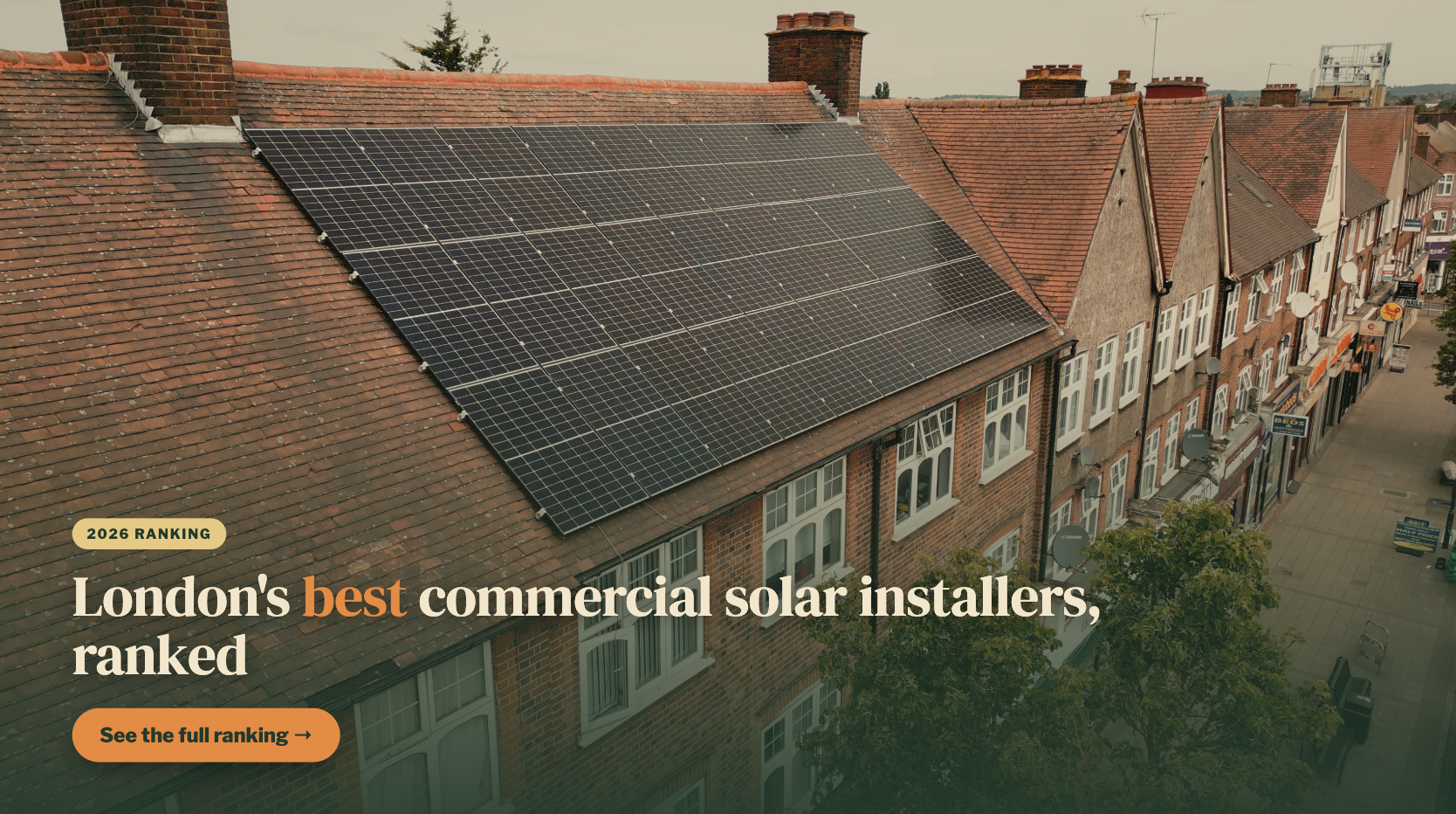

However, looking for the best commercial solar installers in London? This guide compares the top 10 commercial solar companies operating in London in 2026, explains what to look for when choosing an installer. Gives you the cost and profitability figures you need to evaluate the investment.
Therefore, quick answer: The best commercial solar installers in London hold MCS certification, design systems around your actual consumption data (not estimated totals), provide fully itemised quotes. Offer long-term monitoring. Solar4Good®, Perfect Sense Energy, Geo Green Power and Eden Sustainable are among the leading options for London businesses in 2026.
The Short Version (Read This First)
As a result, key facts about commercial solar installers in London in 2026:
- London businesses are increasingly turning to solar to stabilise energy costs and meet sustainability targets. The technology is proven and the financial case is strong
- The best commercial solar companies offer MCS certification, a demonstrable track record in comparable projects. Comprehensive aftercare over the system’s lifetime
- Commercial solar systems typically achieve payback in 5–7 years, with panel performance warranties of 25 years or more
- Larger systems generally cost less per kW than smaller ones. Making scale an advantage where roof space and energy demand allow
- System design based on actual half-hourly consumption data consistently outperforms one built on estimated annual totals
- Solar4Good is an MCS-certified commercial solar installer serving London and the wider UK. Call 0800 999 1454 or visit solar4good.co.uk for a free consultation
For example, across London, warehouses, offices, retail spaces and hospitality venues are turning to solar to stabilise costs and meet growing sustainability requirements. According to Solar Energy UK, commercial solar installations grew by over 20% year-on-year in 2024–2025, with London businesses accounting for a significant share of new capacity. Notably, the businesses moving earliest are locking in the strongest financial returns. However, the central question remains: who should you trust to handle something as complex and long-term as a commercial solar installation?
In practice, that question matters more than ever as commercial electricity prices remain well above long-term averages, sustainability reporting tightens. Battery and EV charging integration become standard parts of commercial energy strategy. Importantly, the right solar partner should not simply install panels. They should design a system around your actual consumption profile, handle the regulatory and DNO paperwork. Remain accountable for performance throughout the system’s 25-year lifespan.
What to Look for in a Commercial Solar Installer
Specifically, the six criteria below separate strong commercial installers from weak ones. In practice, evaluating every shortlisted company against these points before requesting a proposal saves significant time and reduces delivery risk.
MCS certification — non-negotiable
MCS (Microgeneration Certification Scheme) certification is the baseline requirement for any commercial solar installer in the UK. It confirms the installer meets the technical and quality standards required for grid-connected solar. It is a legal condition of Smart Export Guarantee (SEG) eligibility. As a result, a system installed by an uncertified installer cannot earn SEG export payments. In addition, TrustMark and HIES membership add independent consumer protection — HIES, for example, provides financial protection against installer insolvency throughout the installation period.
Demonstrable commercial track record
In short, ask for case studies from commercial projects comparable to yours in building type, system size and sector. Residential experience does not automatically transfer to commercial three-phase design, G99 DNO applications or large-scale commissioning. Indeed, commercial projects above 50kW require substantially more technical complexity than sub-10kW residential systems. Therefore, an installer with a strong commercial portfolio carries far less delivery risk.
In addition, to see how we deliver projects of similar scale and complexity, view our commercial solar case studies.
Consumption-based system design
Meanwhile, the best commercial solar installers request smart-meter half-hourly consumption data before finalising any system design. Specifically, a system sized around real consumption patterns consistently outperforms one built on estimated annual kWh totals, because it maximises self-consumption. The primary driver of financial return. If an installer quotes you without asking for half-hourly data, that is a meaningful red flag.
Transparent and itemised pricing
For instance, a credible commercial solar proposal is fully itemised. Panels, inverter, electrical work, scaffolding, DNO fees, commissioning and certification listed separately. By contrast, lump-sum quotes make genuine comparison impossible and frequently conceal omissions that appear as extra costs after the contract is signed. Always request full itemisation before comparing proposals.
Long-term aftercare and remote monitoring
Notably, commercial solar is a 25-year investment. Confirm what post-installation support the installer provides: remote performance monitoring, fault response times, workmanship warranty duration. What protection exists if the installer ceases trading. Without remote monitoring, a system may underperform for months before the fault is identified. Representing thousands of pounds in lost generation value.
Future-proofing for battery and EV integration
Typically, importantly, specify a hybrid inverter from the outset if there is any chance of adding battery storage or EV charging later. Generally, retrofitting solar compatibility into an incompatible system costs more than specifying correctly upfront. A strong installer discusses these options proactively as part of the initial design conversation.
💡 Questions worth asking every installer
Generally, what happens if my energy demand increases significantly in the next three years? Can batteries be added to this system without replacing the inverter? How quickly do you respond to monitoring alerts showing underperformance? A strong installer answers these confidently and specifically, while a weak one gives vague reassurances.
Who Are the Biggest Commercial Solar Companies in London?
By comparison, the following ten installers represent a cross-section of the commercial solar market serving London and the wider UK. Each has a different area of strength, scale and approach. This list draws on published project portfolios, industry certifications, customer review data and sector reputation as of 2026.
1. Solar4Good — MCS-Certified Commercial Solar Installer Across London and the UK
Solar4Good is an MCS-certified commercial solar installer (MCS: NAP/72775/25/4, HIES: S4G/A/1484) with a strong track record across commercial and industrial installations throughout London and the wider UK. Systems range from small office rooftops to large industrial sites, with every design built around the client’s actual half-hourly consumption profile rather than a generic template.
Of course, solar4Good’s commercial approach combines technical precision with financial transparency. Fully itemised proposals, consumption-based design. Direct engagement with finance teams and accountants so installations are structured correctly for Annual Investment Allowance (AIA) and VAT recovery. Panel options span leading manufacturers including DMEGC, JA Solar, Jinko, Trina and Aiko. By contrast, inverter and battery options include Sigenergy, GivEnergy, FoxESS and Tesla Powerwall.
Indeed, commercial clients consistently cite accurate financial projections, smooth project management and strong post-installation monitoring as the main reasons for recommending Solar4Good. The company holds over 800+ verified five-star reviews across Trustpilot and Checkatrade, and was named FMB Award 2024 winner for Best Customer Service.
★★★★★ Trustpilot
“What stood out was that Solar4Good approached the project like a business investment, not just a solar installation. They worked directly with our finance team and explained the tax side clearly.”
— Verified customer
2. Perfect Sense Energy
Perfect Sense Energy takes a consultancy-led approach to commercial solar. Rather than leading with a system specification, they invest time upfront mapping out the client’s energy needs before any design work begins. As a result, they are a strong choice for businesses that want clarity on the financial case — including modelled payback and self-consumption rates — before committing to a specification.
3. Geo Green Power
Geo Green Power has focused on larger commercial and agricultural solar systems since 2010. Typically, they are engaged on projects where scale is the primary driver — factories, warehouses and farms where high-yield solar makes a material impact on operating costs. Their experience with large ground-mounted arrays and high-voltage three-phase systems makes them a strong option at the larger end of the commercial market.
4. Eden Sustainable
Eden Sustainable, founded in 2014, has established itself as a significant player in UK commercial solar — appearing on the Sunday Times Fastest-Growing Companies list and securing substantial funding for expansion. The company operates across logistics, education and healthcare, and frequently integrates solar into broader corporate ESG and sustainability strategies. In effect, their work shows how solar can form part of a credible, auditable carbon-reduction programme rather than a standalone energy project.
5. TLGEC (The Little Green Energy Company)
TLGEC brings roughly 20 years of experience to the commercial sector. Their distinguishing strength is combining solar with complementary building upgrades — EV charging, LED lighting and building management systems — under a single project scope. Notably, they use 3D modelling tools to optimise panel placement and are known for accurate generation forecasting. Their independence from specific manufacturers allows impartial specification across panel and inverter brands.
6. DCR London
DCR London operates across domestic and commercial solar in the London market. In the commercial space, they are known for hands-on project management and direct client communication. MCS and NICEIC accreditations underpin their technical credentials, and post-installation aftercare quality is frequently cited positively in client reviews.
7. Mypower
Mypower specialises in mid-sized commercial solar projects — a segment often underserved by both large national contractors and small local installers. Their portfolio includes notable installations such as the Gloucester Cathedral rooftop system, demonstrating both technical capability and the ability to work on complex or heritage properties. Their focus is on systems that deliver measurable financial outcomes rather than maximum installed capacity.
8. Excel Energy
In particular, with roughly three decades of experience, Excel Energy is among the longest-established commercial solar providers on this list. Specifically, they specialise in bespoke, turnkey projects where businesses want a single provider to manage the full scope — from initial survey through to commissioning, grid connection and handover.
9. Energize Solar
Energize Solar designs commercial systems with energy-price stability as the primary objective. Their approach focuses on maximising self-consumption to reduce grid dependence — particularly valuable for businesses that have faced significant cost pressure from recent electricity price volatility and want a system engineered to reduce that exposure.
10. Path Energy
Path Energy focuses on making commercial solar accessible and straightforward for a broad range of London businesses. Their installations prioritise clear communication and a well-managed process, which makes them a practical option for businesses approaching commercial solar for the first time, without an existing relationship with an experienced energy consultant.
💡 Further Solar4Good commercial resources
For a deeper look at commercial solar economics, see our guides to commercial solar installation, commercial solar tax relief and capital allowances, and our DNO application guide.
How Much Do Commercial Solar Panels Cost in the UK?
Commercial solar system costs in the UK range from roughly £13,000 for a 10kW installation to £63,900+ for a 50kW+ system, with larger systems costing less per kW as fixed project costs spread across greater capacity. All figures below are ex-VAT; 20% VAT applies to commercial installations and is reclaimable by VAT-registered businesses on their next quarterly return.
| System size | Typical cost range (ex-VAT) | Approx. cost per kW |
|---|---|---|
| Small system (10kW) | £13,000 – £15,000 | £1,300 – £1,500/kW |
| Medium system (20–50kW) | £16,000 – £60,000 | £800 – £1,500/kW |
| Large system (50kW+) | From ~£63,900 | From ~£1,280/kW |
What drives cost variation within each size band
The main variables within any size band are roof complexity and access; electrical infrastructure (particularly three-phase switchgear upgrades); equipment specification (panel wattage, inverter brand, battery inclusion); and whether a G99 DNO application is required. Generally, roof complexity and three-phase electrical upgrades are the largest sources of cost variation on comparable system sizes.
How capital allowances reduce the effective net cost
For most UK businesses, the Annual Investment Allowance (AIA) lets you deduct 100% of the commercial solar installation cost from taxable profits in Year 1, subject to the £1m annual limit. For example, at the 25% main corporation tax rate, AIA on an £82,500 system saves £20,625 in corporation tax — reducing the effective net cost to £61,875 and compressing payback by roughly one year. See our commercial solar tax relief guide for a full worked example.
Is Commercial Solar Profitable?
Yes — for the majority of UK businesses with suitable roof or land space and a meaningful electricity bill, commercial solar delivers a strong and measurable return. The key variable is self-consumption rate: every unit of solar electricity used on-site saves the full grid import rate (currently 24–28p/kWh for commercial customers), whereas every unit exported earns only the SEG rate (typically 4–15p/kWh). As a result, systems achieving 75–85% self-consumption consistently outperform those at 50% on every financial metric.
| Benefit | What it means for your business |
|---|---|
| Reduced electricity costs | Solar replaces grid electricity at 24–28p/kWh with self-generated power at near-zero marginal cost. Most well-designed systems save thousands of pounds annually from month one. |
| Price stability | Self-generated electricity is insulated from grid price volatility. With UK commercial prices having risen sharply in recent years, installing solar now locks in a proportion of energy cost at zero marginal cost for 25 years. |
| Tax efficiency | AIA at 100% in Year 1 significantly reduces the effective net cost and compresses payback — often by 12 months or more at the 25% corporation tax rate. |
| Sustainability credentials | Solar demonstrates measurable carbon reduction to clients, employees and investors — increasingly required as supply-chain sustainability reporting tightens. |
| Long-term free electricity | After payback (typically 5–7 years), the system keeps generating at near-zero marginal cost for another 18–20 years, supporting long-term planning certainty. |
★★★★★ Trustpilot
“The system’s performance has exceeded expectations, reducing our grid dependence significantly with immediate savings on electricity bills from the first month.”
— Verified customer
Final Thoughts: Choosing the Right Commercial Solar Installer
London has no shortage of commercial solar companies, and that makes installer selection genuinely important rather than a formality. The best installers do not simply fit panels and move on. Instead, they explain the financial model clearly, handle the DNO and regulatory paperwork, design around your actual consumption data, and remain accountable for performance long after commissioning.
That said, at Solar4Good, that accountability is central to how we work. We have delivered commercial solar projects across a wide range of building types and sectors, and the approach is consistent throughout: transparent pricing, consumption-based design, direct engagement with your finance team, and long-term remote monitoring so you can verify the system performs as modelled. To find out what commercial solar would deliver for your business, contact Solar4Good for a free, no-obligation consultation.
Frequently Asked Questions
How do I know if commercial solar makes sense for my business?
However, the clearest starting point is your electricity bill. If grid electricity is a significant operating expense, solar is likely to deliver a strong return. A consumption-based assessment from a qualified installer confirms the expected payback period, annual savings and self-consumption rate for your specific site. Solar4Good provides this as part of a free, no-obligation consultation.
What is the typical payback period for commercial solar in London?
Therefore, most UK commercial solar systems achieve simple payback in 5–7 years. The Annual Investment Allowance at 100% in Year 1 typically reduces the effective net cost and compresses payback by around 12 months. After payback, the system generates at near-zero marginal cost for another 18–20 years.
Do I need planning permission for commercial solar panels in London?
As a result, in most cases, rooftop solar on commercial buildings falls under permitted development and does not require a formal planning application. However, listed buildings, conservation areas and installations above certain size thresholds may require consent. Ground-mounted systems also typically need planning permission. Always confirm with your local planning authority before proceeding.
More on commercial solar in London
How much maintenance do commercial solar panels require?
For example, commercial solar panels require minimal maintenance. Modern panels carry performance warranties of 25 years or more and operate reliably in UK weather. Periodic cleaning, annual visual inspection and remote monitoring are typically sufficient. Remote monitoring matters most — it identifies underperformance early, before significant generation loss accumulates.
Will my business remain connected to the grid after installing solar?
Yes. Commercial solar systems operate in parallel with the grid, not instead of it. Solar supplies building loads during daylight first. When generation exceeds demand, the surplus exports under the Smart Export Guarantee. When generation falls below demand, the building draws from the grid normally. Battery storage extends solar coverage into the evening and overnight.
Why does MCS certification matter when choosing a commercial solar installer?
MCS certification confirms the installer meets UK technical and quality standards for grid-connected solar. It is also a legal condition of Smart Export Guarantee eligibility — a system installed by an uncertified installer cannot earn SEG payments. MCS installations also come with a structured complaints and redress process, providing recourse if issues arise.
What tax benefits are available for commercial solar in the UK?
UK businesses can claim the Annual Investment Allowance (100% of installation cost deducted from taxable profits in Year 1, up to £1m) and the business rates exemption (rooftop commercial solar does not increase business rates until March 2035). VAT at 20% is reclaimable by VAT-registered businesses. Solar is a special-rate asset, so it is claimed through capital allowances (AIA) rather than the 100% main-rate relief; always confirm the treatment with your accountant. See our solar tax relief guide for detail.
About the Author
Matthew
Solar Consultant with over a decade of UK solar experience, helping homeowners and businesses make clear, confident renewable energy decisions.
📞 Book a free solar consultation
Call us on 0800 999 1454 or visit solar4good.co.uk
Read over 800+ verified five-star reviews on Trustpilot and Checkatrade
Solar4Good Ltd · 79 College Road, Harrow, HA1 1BD · MCS: NAP/72775/25/4 · HIES: S4G/A/1484