
Battery Storage for Existing Solar Panels: UK Retrofit Guide 2026


Can you add battery storage to your existing solar panels? In almost all cases, yes. Most UK solar systems fitted in the last 10–15 years can take a retrofit battery without replacing the panels or the existing inverter. The method used is called AC coupling. This guide covers compatibility, realistic costs, savings, grants and payback for adding battery storage to existing solar panels in the UK in 2026.
- 1. Can you add battery storage to existing solar panels?
- 2. What does battery storage cost in the UK?
- 3. How retrofit battery systems work
- 4. Benefits of adding battery storage
- 5. Grants and incentives available
- 6. Choosing the right battery system
- 7. Why your choice of installer matters
- 8. Conclusion
- 9. FAQs
The Short Version (Read This First)
What UK homeowners with existing solar need to know about battery storage:
- Battery storage is one of the most effective upgrades you can make to an existing solar system — it turns a daytime-only benefit into an all-day energy solution
- Most UK solar systems installed in the last 10–15 years can be upgraded using AC coupling, without replacing panels or the existing inverter
- It mainly saves money by replacing expensive evening grid imports with stored solar electricity, so the value scales with your evening usage and tariff
- Without a battery, a typical household uses only 30–50% of the electricity it generates — a battery can push this to 70–85%
- 0% VAT currently applies to battery installations until March 2027
- Payback is typically achieved within 5–10 years depending on system size and usage patterns
- Solar4Good® retrofits batteries to existing systems across the UK — call 0800 999 1454 or visit solar4good.co.uk for a free assessment
Adding battery storage to an existing solar system is the single most common enquiry Solar4Good receives from homeowners who installed panels before 2022. It is not hard to see why. A typical 4 kW solar system without storage exports somewhere between 40% and 60% of the electricity it generates. That surplus earns around 4 to 15p per kWh through the Smart Export Guarantee. That same household then buys electricity back at night for 24 to 30p. A battery changes that equation entirely, storing what the panels produce during the day and releasing it when the grid would otherwise charge peak rates.
This guide covers compatibility, the best retrofit battery systems, realistic costs, grants and expected payback for 2026.
Can You Add Battery Storage to Existing Solar Panels?
In most cases, yes — you can add battery storage to an existing solar panel system without replacing your current panels. The key is how retrofit systems are designed. Rather than requiring a full system replacement, modern retrofit batteries connect alongside your existing setup using a method called AC coupling. This approach is compatible with the majority of UK solar systems installed in the last 10–15 years. That makes battery storage a practical upgrade rather than a full replacement project. The decision to retrofit also tends to be more financially straightforward than installing a new system from scratch. The panels are already in place, the roof is already prepared, and the main additional cost is the battery itself plus integration work.
AC coupling: how retrofit battery integration works
In an AC-coupled retrofit setup, electricity flows through your existing inverter as normal, converting DC solar energy into the AC electricity your home can use. The battery system then draws from this AC supply to charge, rather than connecting directly to the solar panels. This involves one additional energy conversion step compared to a new DC-coupled system. However, the efficiency difference in real-world use is small, typically 2–5%. It is far outweighed by the savings from storing energy that would otherwise be exported. Most modern retrofit batteries are designed specifically for AC coupling and come with integrated inverters to handle the conversion efficiently.
When a retrofit may require additional work
While most systems are compatible, some older installations need extra work before a battery can be added. Inverters more than 12–15 years old may not support modern battery communication protocols and could need replacing. Electrical setups that no longer meet current safety standards may need upgrading. A proper site assessment identifies these requirements upfront, so any additional costs are known before work begins. Reputable installers include this assessment as part of the consultation rather than discovering issues mid-project.
★★★★★ Trustpilot
“Adding a battery made a noticeable difference almost immediately. We now use far more of our own solar energy, and our electricity bills have dropped within the first few months.”
— Verified customer
What Does Battery Storage Cost in the UK?
Battery storage for an existing solar system typically costs £4,000–£11,000 installed in 2026, depending on capacity, brand and installation complexity. Unlike adding panels, a battery retrofit involves more than the battery unit. It also includes the system integration, electrical connections and configuration work needed to make it run efficiently alongside your existing setup. Understanding what drives the cost — rather than just the headline price — helps you evaluate quotes properly. It also helps you avoid paying for capacity you won’t use. All figures below include installation and commissioning, and 0% VAT currently applies to residential battery storage. These are general 2026 UK guide prices, not a quote.
Typical retrofit battery costs (UK 2026)
| Battery size | Installed cost (including integration) |
|---|---|
| 5 kWh | £4,000–£6,000 |
| 10 kWh | £6,000–£9,000 |
| 13.5 kWh | £7,500–£11,000 |
What influences the final price?
- Battery capacity: larger batteries provide more storage but at higher upfront cost. The goal is to match capacity to your actual evening usage, not to maximise storage for its own sake.
- Compatibility with your existing system: older inverters or non-standard configurations may require additional integration work.
- Installation complexity: properties with limited electrical panel space or needing extra cable runs attract higher installation costs.
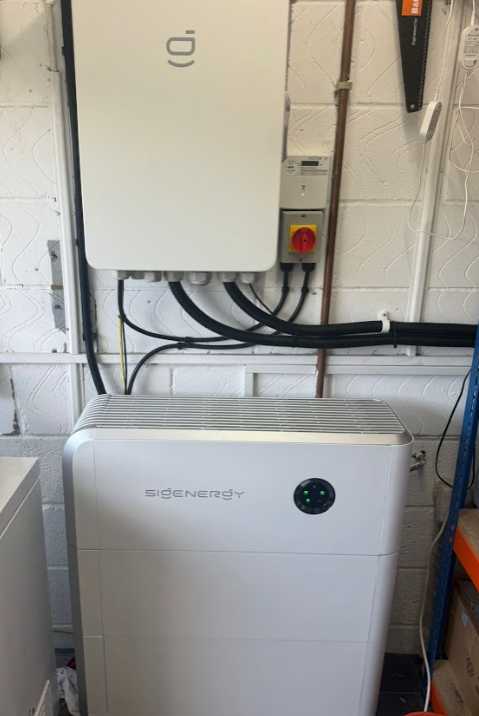
- Brand and chemistry: LFP (Lithium Iron Phosphate) batteries from established manufacturers such as Sigenergy, GivEnergy, FoxESS and Tesla Powerwall command a premium over budget alternatives, but deliver better longevity and safety.
⚠️ An honest note
Oversizing a battery increases cost without delivering proportional savings. A 5 kWh battery in a low-usage home often delivers better value than a 13.5 kWh battery that is rarely fully cycled. A properly sized system based on your real energy usage is the most important decision in any battery retrofit project. For a full breakdown, see our solar battery cost guide.
Ready to go Solar?
How Retrofit Battery Systems Work
A retrofit battery changes how energy flows through your home rather than how much your panels generate. The core change is simple. Instead of excess solar electricity being exported to the grid during the day, it is stored locally and used later when your home needs it. This shift is what drives both the cost savings and the improved self-sufficiency that battery storage delivers. Understanding the flow helps set realistic expectations about what a retrofit battery will and won’t do.
How energy flows in an AC-coupled retrofit setup
During the day, your solar panels generate electricity as they always have, and your home uses what it needs immediately. Any surplus that would previously have been exported is now redirected to charge the battery first. In an AC-coupled setup, the electricity passes through your existing inverter (converting DC to AC) before entering the battery’s own inverter for storage. This two-step conversion is slightly less efficient than a direct DC-coupled system. However, the practical difference is small — most homes see 95–97% of the energy reach the battery.
How this changes your energy usage
Without a battery, energy flows in one direction: out to the grid during the day and back from the grid in the evening. With a battery, that evening import is replaced by stored solar electricity. For a typical household, the share of solar energy used on-site rises from 30–50% to 70–85%. The practical result is lower bills. You import fewer units from the grid at 24.67p per kWh (Ofgem Q2 2026), and export correspondingly less at the much lower SEG rate.
Benefits of Adding Battery Storage
Adding battery storage to an existing solar system improves how your home uses energy rather than how much it generates. The real benefit comes from shifting usage away from expensive grid imports and toward the electricity you have already generated. Most of these benefits compound over time — modest in year one, more significant across the system’s lifetime.
Increased self-consumption of solar energy
A battery stores excess electricity generated during the day instead of exporting it at low SEG rates (typically around 7p/kWh). As a result, a much higher proportion of your solar energy is used within your home rather than sold cheaply and bought back expensively later.
Lower electricity bills over time
By using stored solar energy during peak evening hours, you reduce the electricity bought from the grid at full rate. This shift leads to consistent annual savings, which is particularly valuable for households with higher evening consumption — and that describes most UK families.
Reduced dependence on the grid
Battery storage decreases reliance on external supply during high-demand periods, providing greater energy independence and protection against rising grid prices. As energy costs fluctuate, homes with storage are partially insulated from increases that affect grid-only households.
Smart tariff optimisation
Modern battery systems can be programmed to charge from the grid during off-peak hours, typically overnight at rates as low as 7p/kWh on time-of-use tariffs. They then discharge when rates are higher. This works alongside solar charging to extract maximum value from the battery throughout the day.
Optional backup power capability
Some battery systems offer backup functionality, allowing essential appliances to keep running during power outages. This is not standard across all retrofit systems and typically requires extra configuration, but it adds meaningful resilience for households in areas with unreliable grid supply.
★★★★★ Trustpilot
“Excellent service from start to finish. The installer explained everything clearly, and the battery system has worked perfectly since day one with noticeable savings.”
— Verified customer
Grants and Incentives Available
Financial incentives for battery storage are more limited than in the solar panel market, but two current benefits reduce the real cost of a retrofit. Understanding what each covers — and what it doesn’t — helps set accurate budget expectations. It also avoids disappointment over grants that are no longer available or don’t apply to retrofit-only installs.
0% VAT on residential battery storage
The most significant current benefit is 0% VAT on residential battery storage, which applies until March 2027 under the government’s zero-rate for energy-saving materials. It covers both new installations and retrofit additions to existing solar systems, reducing the effective cost by 20% compared to standard-rated work. No application is required — it is applied automatically by your installer and should be reflected in any written quote.
Smart Export Guarantee (SEG)
The SEG pays homeowners for surplus electricity exported to the grid. With a battery fitted, you typically export less because more energy is stored and used within the home — but any remaining surplus still qualifies. The primary financial benefit of a battery comes from reducing expensive grid imports, not from exporting. The SEG is the secondary benefit, not the main one. Any installer who presents SEG payments as a core financial argument for adding a battery is likely overstating the returns.
💡 Did you know?
The Warm Homes Plan is the government’s current energy efficiency support scheme for lower-income households in lower EPC bands. In some cases it can include battery storage as part of a broader home energy upgrade. Eligibility depends on household income, EPC rating and local authority participation. Solar4Good can confirm whether your household qualifies during the initial consultation.
Choosing the Right Battery System
Choosing the right battery system is one of the most important decisions when retrofitting storage to an existing solar setup. The goal is not to pick the most powerful or best-known product. Instead, choose a system that matches how your home actually uses energy across the day. A battery that is too small won’t make a meaningful difference; one that is too large pays for capacity you may never cycle through. Most of the gap between a strong retrofit and a disappointing one comes from the design and sizing decision, not the brand.
Matching battery size to your energy usage
Battery capacity should reflect your actual evening electricity use, when the panels are no longer generating. The starting point is your half-hourly consumption data, which most smart meters record. It tells you exactly how much electricity your home uses after 5pm, which is what the battery needs to cover. A typical three-bedroom household uses 2–5 kWh in the evening, which points to a 5–10 kWh battery. Adding EV charging increases that calculation significantly.
Compatibility with your existing solar system
Most retrofit systems use AC coupling, which is compatible with the majority of UK solar installations. Ensuring your existing inverter communicates properly with the new battery is essential for correct charging and discharging. Some battery brands publish certified compatibility lists for popular inverters, and your installer should confirm this before specifying equipment.
Battery chemistry and lifespan
Most modern residential batteries use Lithium Iron Phosphate (LFP) chemistry, which is safer, more stable and longer-lasting than older NMC batteries. LFP batteries are designed for daily cycling and typically come with 10-year warranties backed by 4,000–6,000 cycle guarantees. For a retrofit expected to run for 10–15 years, chemistry choice has a direct impact on total lifetime value.
Future-proofing and expandability
Some battery systems allow extra capacity to be added over time. This matters especially if EV charging is planned, since adding a vehicle can double or triple overnight demand and make a larger battery more valuable. Planning for flexibility at the point of installation avoids costly replacements later. Systems such as Tesla Powerwall and Sigenergy offer modular expandability.
Monitoring, control and user experience
A good battery system provides real-time monitoring through a smartphone app, letting you track generation, storage, usage and export. Visibility into your system’s behaviour is how you confirm it is working correctly and optimise settings over time. Poor monitoring is one of the most common complaints about lower-cost battery systems.
Why Your Choice of Installer Matters
Choosing the right installer is as important as choosing the right battery. A properly designed retrofit integrates safely with your existing system. It is correctly sized for your usage, and configured to deliver consistent savings from day one. A poorly designed one may reduce overall system efficiency, fail to qualify for 0% VAT, or create electrical issues that are expensive to correct. The installer determines how well the battery integrates, performs and supports your home over the long term — not just whether it physically fits.
What a professional installer provides
- A proper compatibility check between the battery, your existing solar system and the inverter
- Correct battery sizing based on your real energy usage, not a standard package
- Safe, compliant installation meeting UK electrical standards
- Optimised settings for charging, discharging and tariff integration
- Future-ready design that allows for expansion if demand increases
- Ongoing support, troubleshooting and monitoring assistance
Questions to ask before you commit
Ask any installer: how are you sizing this battery for my specific usage? Is it compatible with my existing inverter? What warranty applies, and who services it in years 5–10? Is scaffolding or electrical work required, and is it included in this quote? A reliable installer answers all of these clearly and in writing before you sign.
Conclusion
For many UK homeowners with existing solar, adding battery storage is one of the most effective ways to improve the system’s financial performance. It increases the share of solar energy used on-site, reduces expensive evening grid imports, and provides greater resilience against rising electricity prices. Upfront cost is a real consideration. Even so, the combination of 0% VAT, consistent annual savings and a 5 to 10 year payback makes a battery retrofit a strong investment. That holds for most homes with south-facing or combined-orientation solar.
The most important decisions are sizing the battery correctly for your actual usage and ensuring proper integration with your existing system. Both are determined by the quality of the installer and the depth of the initial assessment, not by the brand name on the battery label. To see how a battery affects overall returns, see our are solar panels worth it guide.
📞 Book a free battery retrofit consultation from Solar4Good
Call us on 0800 999 1454 or visit solar4good.co.uk. Read over 800+ verified five-star reviews on Trustpilot and Checkatrade.
Solar4Good Ltd · 79 College Road, Harrow, HA1 1BD · MCS: NAP/72775/25/4 · HIES: S4G/A/1484
Frequently Asked Questions
Can I add a battery to my existing solar panels?
Yes. Most UK solar systems can be retrofitted with battery storage using AC coupling, without replacing existing panels. Compatibility depends on inverter age and electrical setup, which a proper survey confirms before any work begins.
How much does battery storage cost in the UK?
Battery storage for existing solar systems typically costs £4,000–£11,000 installed, depending on size, brand and integration complexity. 0% VAT currently applies, reducing the effective cost. These are general guide prices, not a quote.
How much can I save with a battery system?
Most households save several hundred to over a thousand pounds per year by using stored solar energy instead of buying evening electricity from the grid. Savings depend on usage patterns, tariff, and how much solar energy is generated and available to store.
More on retrofit batteries
Is a retrofit battery system efficient?
Yes. AC-coupled retrofit systems are slightly less efficient than new DC-coupled systems, due to the additional conversion step. However, the practical difference is small, typically 2–5%, and most homeowners see strong savings regardless.
How long does a home battery last?
Most modern home batteries last 10–15 years, with a typical manufacturer warranty of 10 years. LFP (Lithium Iron Phosphate) batteries are designed for daily cycling and maintain strong performance throughout their warranted lifespan.
Can a battery power my home during a power cut?
Some battery systems support backup functionality, but this is not standard across all retrofit installations. It requires specific configuration and equipment, so confirm backup capability with your installer before purchasing.
Do I still get SEG payments after adding a battery?
Yes. You can still receive Smart Export Guarantee payments for any surplus exported to the grid. With a battery, you export less because more energy is stored and used at home, but the SEG remains available for genuine surplus.
Is battery storage worth it in the UK?
For most homes with existing solar, yes. Battery storage increases self-consumption, reduces grid imports and provides protection against rising electricity prices. The combination of 0% VAT and consistent bill savings typically achieves payback within 5–10 years.
About the Author
Matthew
Solar Consultant with over a decade of UK solar experience, helping homeowners and businesses make clear, confident renewable energy decisions.
📞 Book a free solar consultation
Call us on 0800 999 1454 or visit solar4good.co.uk
Read over 800+ verified five-star reviews on Trustpilot and Checkatrade
Solar4Good Ltd · 79 College Road, Harrow, HA1 1BD · MCS: NAP/72775/25/4 · HIES: S4G/A/1484