Torn between FoxESS and AlphaESS for your home battery? Here is the straight answer. FoxESS vs AlphaESS is a contest between two value-focused modular LiFePO4 systems — so unlike a premium-versus-budget decision, the winner comes down to your setup. FoxESS leads on price and Intelligent Octopus Flux approval; AlphaESS leads on flexibility, with AC or DC coupling, outdoor-rated heated modules and a larger maximum stack. Both carry 10-year warranties, and Solar4Good® installs both across the UK.
The Short Version (Read This First)
- Both are modular LiFePO4 battery systems with 10-year warranties — the difference is fit, not quality
- FoxESS: EP-series modules (EP5, EP11, EP12) stacking to ~46kWh, the sharpest installed price in its class, and Intelligent Octopus Flux approved when paired with a FoxESS hybrid inverter
- AlphaESS: SMILE G3 platform stacking to ~60kWh, AC or DC coupling (ideal for adding a battery to existing solar without losing FiT payments), IP65 outdoor-rated with optional heated modules, and a 10-year / 10,000-cycle warranty
- Choose FoxESS for a new solar-plus-battery install on an Octopus smart tariff at the lowest cost
- Choose AlphaESS for retrofits, outdoor installation, larger capacity, or off-grid capability
- Solar4Good installs both. Call 0800 999 1454 or visit solar4good.co.uk
01Quick Verdict
Ultimately, this decision usually comes down to what you are starting from. Choose FoxESS if you are installing solar and battery together and want dependable modular storage at the sharpest price, with Intelligent Octopus Flux automation driving the fastest route to payback. Alternatively, choose AlphaESS if you are adding a battery to an existing solar system, need an outdoor installation, or want the largest expandable capacity — its AC-coupling option and weatherproof heated modules give it a flexibility FoxESS does not match. In short, FoxESS is the new-install value pick and AlphaESS is the flexible retrofit pick, and both are strong choices.
★★★★★ Trustpilot
“Solar4Good compared both battery options against our actual usage and tariff before recommending one. No upselling — just clear numbers and a tidy install.”
— Verified customer
02FoxESS vs AlphaESS at a Glance
| Feature | FoxESS | AlphaESS |
|---|---|---|
| Positioning | Value — sharpest price in class | Value to mid-range — flexibility focus |
| Chemistry | LiFePO4 | LiFePO4 |
| Battery modules | EP5 (5.18kWh), EP11 (10.36kWh), EP12 (11.52kWh) | SMILE G3 range incl. 3.8kWh, 4.8kWh, 9.3kWh and 10.1kWh modules |
| Maximum stack | ~46kWh | ~60kWh (6 × 10.1kWh modules) |
| Inverter | K/H-series hybrid — single or three-phase | SMILE G3 hybrid — 3.6–8kW single-phase, 10/20kW three-phase |
| Coupling | DC (hybrid) | DC or AC — retrofit-friendly |
| Usable capacity (DoD) | 90% | ~95% |
| Outdoor installation | Suitable enclosure required for exposed sites | IP65-rated as standard; optional heated modules for cold weather |
| Off-grid capability | Backup via EPS | Off-grid operation supported as standard |
| Warranty | 10 years at 70% retained capacity (~4,000+ cycles) | 10 years / 10,000 cycles (internet connection required) |
| Tariff highlight | Intelligent Octopus Flux approved | Smart-tariff ready, supports dynamic tariffs |
03Price Compared
First, FoxESS holds the price advantage. As a 2026 guide, a FoxESS battery typically costs £3,500–£9,500 installed depending on capacity — a large part of its appeal, and among the sharpest pricing of any established battery brand in the UK. AlphaESS sits in a similar value bracket configuration-for-configuration, though the flexible extras that make it attractive — AC coupling, heated outdoor modules, larger stacks — can move the final figure depending on what your installation actually needs.
Crucially, the cheaper headline system is not automatically the better value. For a straightforward new solar-plus-battery install, FoxESS usually delivers the outcome for less. For a retrofit onto existing panels — especially a FiT-registered system — AlphaESS’s AC-coupled route can avoid inverter replacement costs entirely, which changes the maths. Eligible residential installations carry 0% VAT until 31 March 2027 either way. See our solar battery price guide for full figures.
New install or retrofit — which pays back faster for you?
04Specs and Features
In practice, both are modern modular LFP platforms and day-to-day performance is strong with either. FoxESS stacks its proven EP-series modules to around 46kWh with a 90% usable depth of discharge and wide installer familiarity across the UK. AlphaESS’s SMILE G3 platform stacks to around 60kWh using 10.1kWh modules, with roughly 95% usable capacity and a 200% PV oversizing allowance on the inverter side.
Instead, the differences show in deployment flexibility. FoxESS keeps things simple and cost-effective: one hybrid-inverter architecture, well understood by installers, optimised for new installs. AlphaESS is built for awkward situations — IP65-rated for outdoor mounting without an extra enclosure, optional integrated heating so the battery performs in low temperatures, AC or DC coupling, and off-grid operation supported as standard rather than as an add-on.
📋 Capacity note: stack limits are per-model. FoxESS’s ~46kWh and AlphaESS’s ~60kWh maximums both far exceed what a typical UK home needs — most households are well served between 5kWh and 15kWh. The bigger stacks matter mainly for large homes, heat-pump households and small commercial sites.
★★★★★ Trustpilot
“Our battery had to go outside on a north-facing wall. Solar4Good recommended the weatherproof option, explained why, and the system has run flawlessly through winter.”
— Verified customer
05Warranty Compared
On paper both carry 10-year warranties on LiFePO4 modules, but the small print differs. FoxESS guarantees 70% retained capacity at year ten, covering roughly 4,000+ cycles. AlphaESS backs the SMILE G3 for 10 years and up to 10,000 cycles — a higher cycle allowance — but with one important condition: the system must stay connected to the internet for monitoring, or the warranty reduces to 3 years. Either way, installation and registration through an MCS-certified installer keeps the cover valid, and correct commissioning matters as much as the paperwork.
06App and Tariffs
FoxESS Cloud is clear and functional, showing live energy flows and letting you set charge and discharge windows manually or on schedules. The AlphaESS app (AlphaCloud) offers similar live monitoring with 24/7 remote diagnostics — which doubles as the warranty’s internet-connection requirement working in your favour, since firmware updates and performance checks happen remotely.
On tariffs, FoxESS holds the formal edge: paired with a FoxESS hybrid inverter, it sits on the Intelligent Octopus Flux approved list, automating peak-rate export at up to around 30p/kWh. AlphaESS is smart-tariff ready and designed to work with dynamic tariffs, but does not carry the same formal Flux approval. For either brand, tariff automation drives a large share of the saving — this is often worth more per year than any spec difference between the two.
💡 Tariff tip: if you are already an Octopus customer (or planning to switch), FoxESS’s Intelligent Octopus Flux approval is the single strongest argument in its favour — automated peak-time export with no manual scheduling.
07Retrofit and Existing Solar: Where AlphaESS Pulls Ahead
This is the scenario that most often decides the comparison. If you already have solar panels — particularly a system registered for Feed-in Tariff payments — AlphaESS can be installed AC-coupled: the battery sits alongside your existing inverter, monitors your generation and household load, and stores the surplus, all without touching the original array. That preserves FiT payments and avoids replacing a working inverter.
FoxESS’s hybrid architecture is at its best when installed as part of a new solar-plus-battery system, where its price advantage is fully realised. It is not the natural choice for FiT-protected retrofits. For a full breakdown of adding storage to an existing array, see our battery retrofit guide.
★★★★★ Checkatrade
“We’ve had panels since 2015 and didn’t want to lose our FiT payments. Solar4Good AC-coupled the new battery alongside the old inverter — payments untouched, evening grid use nearly gone.”
— Verified customer
08Which Should You Choose?
Choose FoxESS if you are installing solar and battery together, budget and payback lead your decision, and you are on (or moving to) an Octopus smart tariff. It delivers dependable modular storage and Intelligent Octopus Flux automation at the sharpest price.
Choose AlphaESS if you are retrofitting a battery onto existing solar, need outdoor installation, want off-grid capability, or expect to expand capacity significantly over time. Its flexibility is the differentiator.
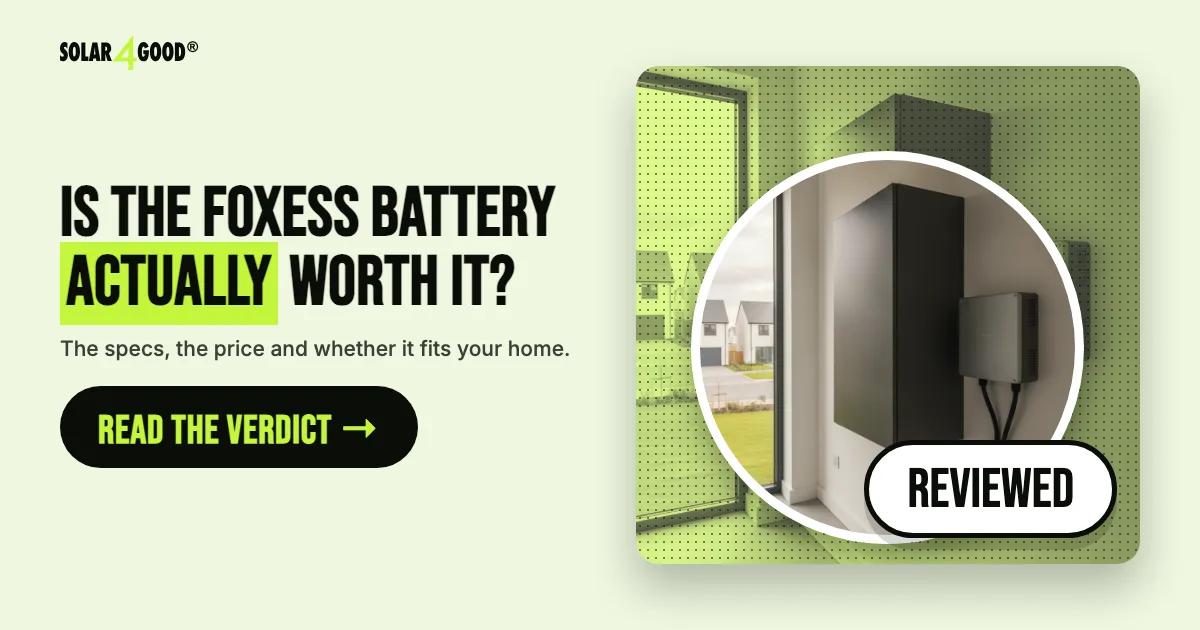
Either way, the system should be sized around your actual usage, since that decision affects your savings more than the brand. For deeper detail on each system, read our full FoxESS battery review and AlphaESS battery review.
★★★★★ Trustpilot
“Two quotes, two brands, one honest recommendation based on our tariff and roof — not on what earned the most commission. Exactly what you want from an installer.”
— Verified customer
Frequently Asked Questions
Is FoxESS better than AlphaESS?
Neither is universally better — they win different scenarios. FoxESS is the stronger pick for new solar-plus-battery installs on Octopus smart tariffs, at the sharpest price. AlphaESS is the stronger pick for retrofits onto existing solar, outdoor installations, larger capacities and off-grid capability. Both are modular LiFePO4 platforms with 10-year warranties.
How much does a FoxESS battery cost compared to AlphaESS?
FoxESS typically costs £3,500–£9,500 installed depending on capacity. AlphaESS sits in a similar value bracket for equivalent configurations, with the final figure depending on coupling type, module choice and installation requirements. We confirm exact pricing for both with a survey and quote.
Do FoxESS and AlphaESS have the same warranty?
Both carry 10-year warranties on LiFePO4 modules, with different terms. FoxESS specifies 70% retained capacity at year ten, covering roughly 4,000+ cycles. AlphaESS covers up to 10,000 cycles over 10 years, but requires the system to remain internet-connected for monitoring — without connection, cover reduces to 3 years. In both cases, installation through an MCS-certified installer keeps the warranty valid.
Which is better for adding a battery to existing solar panels?
AlphaESS, in most cases. Its AC-coupling option lets the battery sit alongside your existing inverter and array — which preserves Feed-in Tariff payments and avoids replacing working equipment. FoxESS’s hybrid architecture is optimised for new combined installs rather than retrofits.
Which works better with Octopus tariffs?
FoxESS has the formal edge: paired with a FoxESS hybrid inverter, it is on the Intelligent Octopus Flux approved list, automating peak-rate export at up to around 30p/kWh. AlphaESS is smart-tariff ready and supports dynamic tariffs, but without the same formal Flux approval. For either, correct setup drives most of the saving.
Can both be expanded later?
Yes. FoxESS stacks EP-series modules to around 46kWh, and AlphaESS stacks 10.1kWh modules to around 60kWh. Expansion rules on matching modules apply to both, so it is worth planning likely future capacity at the design stage. We cover this at survey.

Manan co-founded Solar4Good to do solar differently, as a partner, not a salesperson. After 15 years in London finance, he treats a solar system as the financial decision it is: every customer gets an honest, numbers-first projection of cost, savings and payback, not a sales promise.