
How Much Energy Do Solar Panels Produce in the UK?
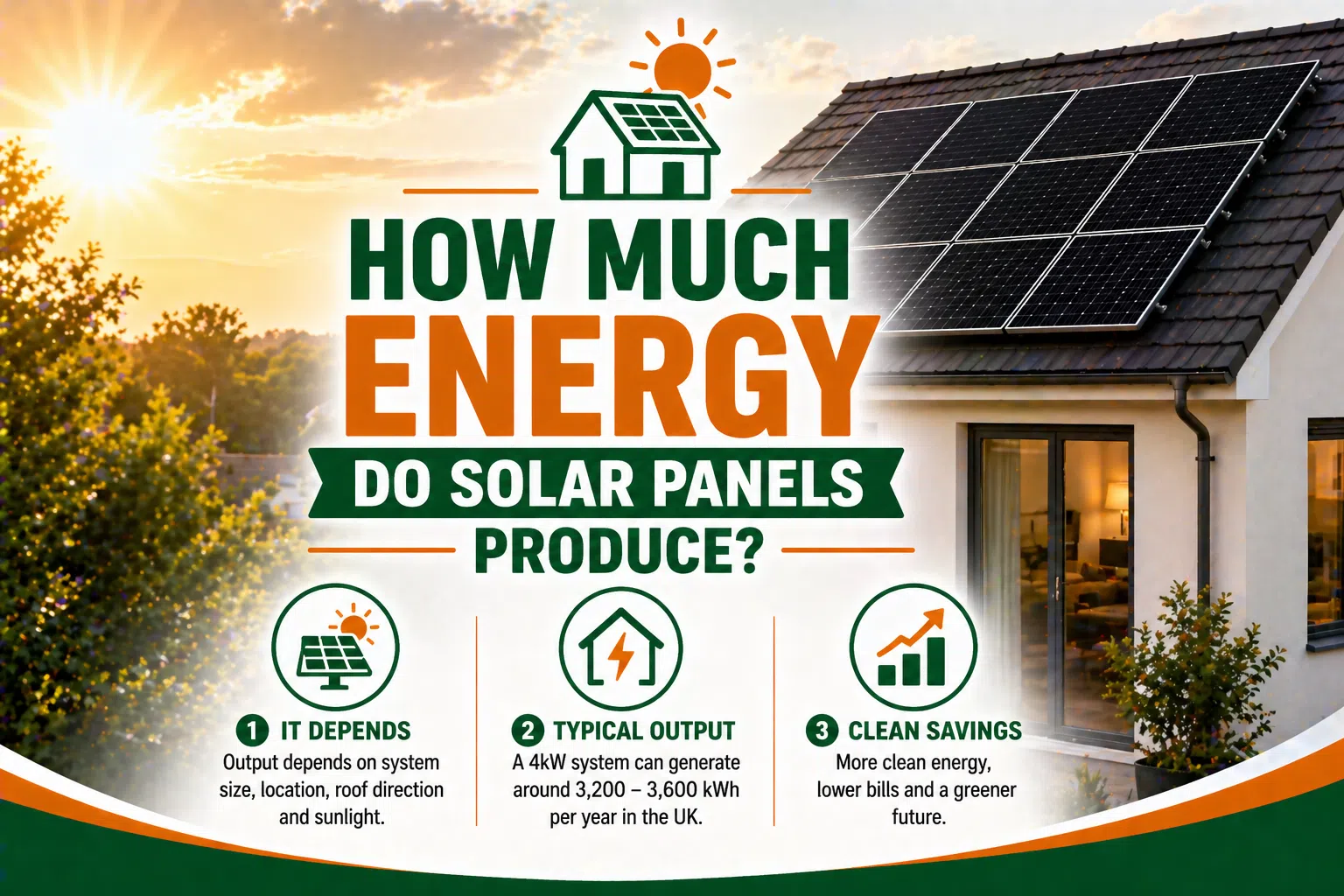

How much electricity do solar panels produce in the UK? As a rule of thumb, every 1 kW of panels generates roughly 850–1,000 kWh a year — so a typical 4 kW system lands somewhere near 3,400–4,200 kWh. But that is only the average. What your own roof actually produces can sit well above or below it, and the gap comes down to a few factors most homeowners underestimate. Here is how to work out your real number — and what that electricity can power day to day.
- 1. How much electricity do solar panels produce in the UK?
- 2. How much energy does a typical home solar system generate?
- 3. What factors affect solar panel energy production?
- 4. How does solar output change throughout the year?
- 5. What can solar panels actually power in a home?
- 6. How can you increase the energy output of solar panels?
- 7. Frequently Asked Questions
The Short Version (Read This First)
Key facts about solar panel energy production in the UK:
- Solar panels typically generate 850–1,000 kWh of electricity per year for every kilowatt (kW) of installed capacity
- A common 4 kW residential system usually produces around 3,400–4,200 kWh annually
- This can cover a large portion of a household’s electricity use
- Actual output depends on roof orientation, sunlight levels, shading, and system design
Solar panels generate electricity by converting sunlight into usable power for your home. While the UK is not known for constant sunshine, modern photovoltaic systems still produce a meaningful amount of electricity throughout the year.
In fact, rooftop solar panels are now installed on more than a million homes across Britain and play an increasingly important role in household energy generation. Solar power contributed around 6.4% of the UK’s total electricity generation in 2025, highlighting how widely the technology is being adopted.
For homeowners considering solar panels, one of the most common questions is how much energy they actually produce. The answer depends on several factors, including system size, the location of the property, the direction of the roof, and seasonal sunlight levels.
Most residential solar systems in the UK are designed to offset a large portion of a household’s electricity use. When systems are properly sized and installed on a suitable roof, they generate thousands of kilowatt-hours (kWh) of electricity each year. This guide explains how much electricity solar panels typically produce in the UK, how output varies by system size and location, and what influences the performance of a solar installation over time.
How Much Electricity Do Solar Panels Produce in the UK?
Solar panel output is usually measured in kilowatt-hours (kWh), the same unit used on household electricity bills. What homeowners often want to know is how much electricity a solar system realistically generates over a full year.
In the UK, a useful rule of thumb is: 1 kW of installed solar panels typically produces around 850–1,000 kWh of electricity per year.
Actual output depends on several factors such as roof direction, shading, panel efficiency and location within the UK, but this estimate gives a good starting point for understanding how system size translates into energy production. The table below shows typical annual generation ranges for common residential system sizes.
| System size | Typical annual output | What it could cover |
|---|---|---|
| 2 kW | 1,600–2,000 kWh | Smaller homes or partial electricity use |
| 3 kW | 2,400–3,000 kWh | Lower-consumption households |
| 4 kW | 3,400–4,200 kWh | Close to average UK household electricity usage |
| 5 kW | 4,000–5,000 kWh | Larger homes or homes with EVs/heat pumps |
For context, the average UK household uses roughly 2,700–3,500 kWh of electricity per year, meaning a 4 kW solar system can often cover a large portion of a home’s annual electricity demand, especially when combined with smart energy use or battery storage.
While these figures provide a useful benchmark, the exact output of a solar system depends on how well it is designed for the property, including roof layout, panel placement and local sunlight levels.
How Much Energy Does a Typical Home Solar System Generate?
The amount of electricity a solar system produces depends mainly on system size, roof orientation and location within the UK. Most residential installations fall between 3 kW and 5 kW, which suits the roof space and electricity usage of many households.
Using the 850–1,000 kWh-per-kW estimate, common residential system sizes typically produce the following:
| System size | Typical annual output | What it could cover |
|---|---|---|
| 3 kW | 2,500–3,000 kWh | Smaller homes or lower electricity use |
| 4 kW | 3,200–4,000 kWh | Close to the average UK household electricity demand |
| 5 kW | 4,200–5,000 kWh | Larger homes or homes with EVs/heat pumps |
Generation is not evenly spread throughout the year. Most solar electricity is produced between spring and early autumn, when daylight hours are longer and sunlight intensity is higher. During winter, production is lower, but panels keep generating whenever daylight is available.
Because every roof is different, installers design systems based on roof space, panel layout and actual household electricity usage, rather than simply choosing a standard system size. The independent Energy Saving Trust offers useful background on what UK homes can realistically expect.
★★★★★ Trustpilot
“The output estimate Solar4Good® gave us has matched reality almost exactly across the first year. Realistic numbers, no exaggeration — and the monitoring app proves it.”
— Verified customer
What Factors Affect Solar Panel Energy Production?
Ready to go Solar?
The amount of electricity a solar system produces depends on several real-world factors related to the property, panel placement and system design. While location plays a role, the way the system is designed often has an even bigger impact on long-term performance.
Roof direction (orientation)
Roof orientation determines how much direct sunlight the panels receive throughout the day. South-facing roofs usually generate the most electricity in the UK, east–west roofs still perform well and often produce steadier generation across the day, and north-facing roofs typically produce significantly less. In many modern installations, east–west layouts are common because they spread generation across the morning and afternoon rather than concentrating it around midday.
Roof angle (pitch)
Solar panels produce the most energy when positioned at an angle that captures sunlight efficiently. For most UK installations, the ideal tilt is around 30–40 degrees, which aligns well with the pitch of many residential roofs. Fortunately, panels still perform well outside this range, which is why most installations use the existing roof structure rather than additional mounting frames.
Location within the UK
Solar output varies slightly across the country because some regions receive more annual sunlight than others. Southern parts of the UK tend to produce slightly higher yearly generation than northern regions, simply due to longer sunlight hours and higher solar irradiance. However, the difference is not as large as many people expect. Panels remain effective across the entire UK, and systems installed in northern regions still generate strong yearly output when designed correctly. A system in southern England may produce around 1,050–1,100 kWh per kW installed each year, while systems further north may generate closer to 850–1,000 kWh per kW, depending on local conditions.
Shading around the roof
Objects that block sunlight, such as trees, neighbouring buildings, chimneys or dormers, reduce panel output. Even partial shading can affect generation if panels are connected in the same electrical string. Modern designs often use optimisers or microinverters to minimise shading losses and maintain consistent output.
Panel efficiency and system design
Higher-efficiency panels convert more sunlight into electricity, which is useful where roof space is limited. However, overall system design often matters more than panel efficiency alone. Factors such as panel placement, inverter choice and system sizing all influence how much electricity an installation produces over time. A well-designed system tailored to the property typically delivers stronger long-term performance than a standardised installation built around fixed panel packages.
How Does Solar Output Change Throughout the Year?
Solar panel production in the UK follows a clear seasonal pattern because daylight hours and sun intensity change throughout the year. Systems typically generate the most electricity during late spring and summer, while winter production is naturally lower.
In general, around 65–75% of a solar system’s annual electricity is produced between April and September, when days are longer and the sun sits higher in the sky. This is why many households see their systems generating large amounts of electricity during the warmer months.
During winter, panels still generate electricity, but the production window is shorter. Most generation occurs between late morning and mid-afternoon, when daylight is strongest. A typical seasonal pattern for UK solar generation looks like this:
- Summer: highest production due to long daylight hours and stronger sunlight
- Spring and autumn: moderate generation with steady daily output
- Winter: lower generation because days are shorter and sunlight is weaker
Although winter contributes a smaller portion of yearly output, panels keep producing whenever daylight is available. Over a full year, the stronger spring and summer generation usually balances out the quieter winter months. For many homes, this seasonal cycle still results in thousands of kilowatt-hours of clean electricity annually, helping reduce grid energy use over time.
What Can Solar Panels Actually Power in a Home?
One of the easiest ways to understand solar generation is to look at what the electricity produced by your panels can actually run in everyday life. Solar energy is measured in kilowatt-hours (kWh), the same unit used on household electricity bills. One kWh represents the electricity needed to run a 1,000-watt appliance for one hour, or smaller appliances for longer.
Here are some examples of what 1 kWh of electricity can power in a typical home:
| Appliance | Approximate usage |
|---|---|
| Washing machine | 1 full wash cycle |
| Dishwasher | 1 cycle |
| Laptop | ~15–20 full charges |
| LED lighting | 50–60 hours |
| Refrigerator | roughly 24 hours |
To put this into perspective, a typical 4 kW residential system in the UK generates around 3,200–4,000 kWh per year, depending on roof direction and location. That level of generation could cover a large share of the electricity used for everyday appliances, such as lighting, kitchen appliances, TVs and electronics, washing machines and dishwashers, and refrigeration.
For many homes, solar panels end up powering most daytime electricity usage, with any surplus either exported to the grid or stored in a battery for evening use. This is why solar is often most effective when households shift some electricity use, such as running washing machines or dishwashers, to daytime hours when panels are generating power.
How Can You Increase the Energy Output of Solar Panels?
While solar panels generate electricity automatically whenever daylight is available, there are several practical ways to improve system performance and maximise long-term energy production.
Optimise panel placement
Panel placement has a major impact on how much electricity a system generates. In the UK, panels typically perform best on south-facing roofs with minimal shading, although east–west layouts can also produce strong results when designed correctly. Avoiding shading from chimneys, trees or nearby buildings helps maintain consistent generation throughout the day.
Install high-efficiency panels
Modern photovoltaic panels convert more sunlight into electricity. Higher-efficiency panels are particularly useful where roof space is limited, allowing the system to generate more power using fewer panels.
Add battery storage
Battery storage allows households to capture excess electricity generated during the day and use it later in the evening when solar production stops. This does not increase total generation, but it does help maximise how much of your solar electricity you actually use rather than exporting it to the grid.
Keep panels clean and unobstructed
Solar panels generally require very little maintenance, but dust, leaves or debris can slightly reduce efficiency over time. Rain often helps keep panels clean, though occasional inspection ensures nothing is blocking sunlight from reaching them.
Monitor system performance
Most modern systems include monitoring apps or dashboards that show how much electricity your panels are generating. Monitoring helps identify potential issues early and allows homeowners to adjust energy use to make better use of solar generation.
Work with an experienced installer
One of the most important factors in solar performance is system design. A qualified installer like Solar4Good can assess your roof layout, electricity usage and shading conditions to design a system that performs efficiently over the long term.
Because every roof and household energy profile is different, the most reliable way to understand solar potential is through a professional system assessment. A tailored design ensures the panels, inverter and any battery storage are configured to make the best use of the available roof space and sunlight. If you are considering solar panels and want to understand what your property could realistically generate, the Solar4Good team can help. Get in touch for a free consultation, and we will review your roof, estimate potential solar output, and design a system suited to your home or business.
★★★★★ TrustATrader
“They designed the system around how we actually use electricity, not a fixed package. The result generates more than we expected for the roof we have.”
— Verified customer
Frequently Asked Questions
How much electricity does one solar panel produce in the UK?
A modern residential solar panel typically produces 350–600 kWh of electricity per year, depending on its wattage, efficiency and how much sunlight the roof receives. Higher-efficiency panels on well-positioned roofs produce closer to the upper end of that range.
How much electricity does a 4 kW solar system produce?
A typical 4 kW solar system, one of the most common sizes for UK homes, usually generates around 3,200–4,000 kWh per year depending on roof direction, shading and location. For many households, this covers a large portion of annual electricity usage.
Do solar panels work on cloudy days?
Yes. Solar panels generate electricity from daylight rather than direct sunshine, so they still produce energy under cloudy conditions. Output is lower than on bright sunny days, but panels often continue generating between 10% and 50% of their normal output depending on cloud cover.
Do solar panels generate electricity in winter?
Yes. Solar panels keep generating electricity throughout winter, although output is lower because days are shorter and sunlight is less intense. Most generation occurs between spring and early autumn, but panels still contribute during winter daylight hours.
Can solar panels power an entire home?
In some cases, yes. If a system is properly sized for the household’s electricity use, it can generate a large share of the home’s annual energy needs. Adding battery storage further increases how much solar electricity is used in the home by storing surplus energy for evening use.
About the Author
Matthew
Solar Consultant with over a decade of UK solar experience, helping homeowners and businesses make clear, confident renewable energy decisions.
📞 Book a free solar consultation
Call us on 0800 999 1454 or visit solar4good.co.uk
Read over 800+ verified five-star reviews on Trustpilot and Checkatrade
Solar4Good Ltd · 79 College Road, Harrow, HA1 1BD · MCS: NAP/72775/25/4 · HIES: S4G/A/1484