
What You Need to Install an EV Charger at Home in the UK (2026 Guide)
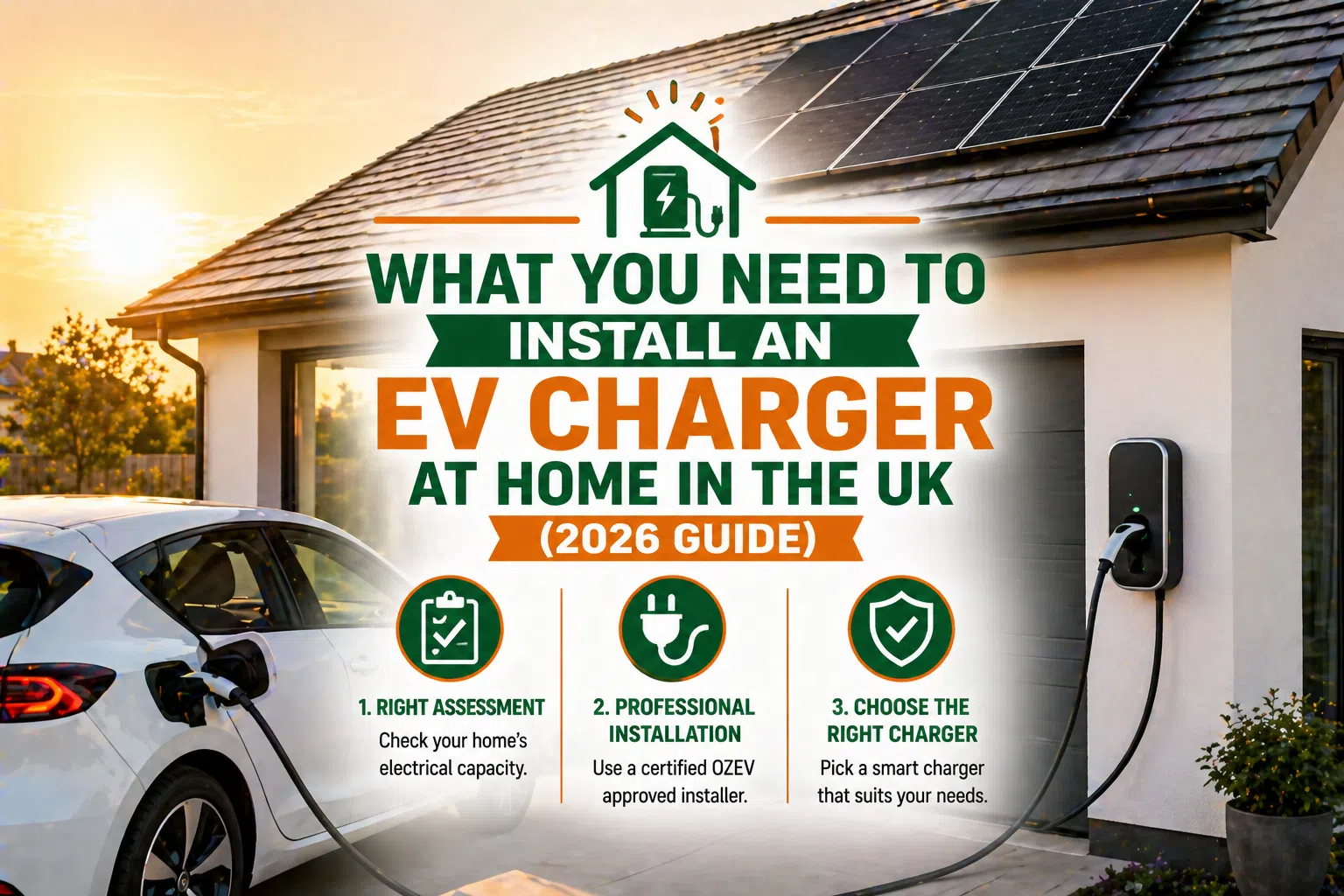

Installing an EV charger at home sounds like a simple upgrade — and for many homes it is. But a surprising number of UK installations stall or fail outright, almost always for reasons that only surface once the checks begin. Essentially, the basics are off-street parking, a suitable electrical supply, a reliable internet connection for the smart charger, and a safe, compliant spot to mount it. The catch is that each one carries a condition that quietly rules out homes that assumed they would be fine — and knowing those conditions in advance is the difference between a smooth install and a wasted survey. Ultimately, this guide walks through each one, so you can tell early whether your property qualifies.
- 1. What are the legal requirements to install an EV charger at home?
- 2. Do you need off-street parking for an EV charger?
- 3. Is your home’s electrical supply suitable for an EV charger?
- 4. Do EV chargers need internet or smart connectivity?
- 5. Where can (and can’t) an EV charger be installed?
- 6. What type of EV charger can UK homes install?
- 7. Common reasons EV charger installations fail
- 8. Conclusion
- 9. FAQs
The Short Version (Read This First)
Key facts about installing an EV charger at home in the UK:
- Most UK homes can install an EV charger, but not all can do so without checks, upgrades or limitations
- You typically need off-street parking, permission if you don’t own the property, a suitable electrical supply, and a smart-compliant charger with reliable internet connectivity
- Installations most often fail due to parking access, limited electrical capacity, poor connectivity, or unsafe placement — discovering these early avoids wasted time
- All new domestic EV chargers must be smart-enabled under UK regulations — able to schedule charging and respond to grid demand signals
- Pairing your EV charger with solar panels allows you to charge from your own generation rather than paying grid rates
- Solar4Good® installs EV chargers alongside solar and battery systems — call 0800 999 1454 or visit solar4good.co.uk
By 2026, a combination of electrical regulations, smart charging legislation and public safety rules shapes every EV charger installation in the UK. Indeed, these rules exist for good reason. They prevent fire risk, manage peak demand, avoid overloaded circuits, and stop hazards such as cables crossing pavements. This guide explains what you actually need to install an EV charger at home in the UK in 2026 — not in theory, but in practice. In short, it covers legal requirements, parking rules, electrical supply limits, smart connectivity, placement restrictions, and the most common reasons installations fail.
What Are the Legal Requirements to Install an EV Charger at Home?
Installing an EV charger at home is a regulated electrical installation, not a DIY task. The first legal requirement is property rights — you must own the property or have written permission from the landlord or freeholder. Naturally, this applies to rented homes, leasehold properties, flats, and any location with shared parking.
Furthermore, all installations must comply with BS 7671 wiring regulations and the IET Code of Practice for EV Charging Equipment. Every charger needs its own dedicated circuit, the correct fault protection, and grounding designed specifically for EV charging loads.
Since the introduction of the Electric Vehicles (Smart Charge Points) Regulations, all new domestic chargers installed in England, Scotland and Wales must be smart chargers — meaning they must be able to schedule charging, respond to grid demand signals, and avoid charging during periods of network stress. Houses do not usually need planning permission. However, listed buildings, conservation areas and certain flats sometimes do.
★★★★★ Trustpilot
“From initial survey to flawless installation, Solar4Good delivered an exceptional experience. The team installed our panels and a hybrid battery system in a single day, working meticulously and leaving the site spotless. Clear explanations and no hidden fees.” — Verified customer
Do You Need Off-Street Parking for an EV Charger?
In most cases, yes. In short, off-street parking is essential for home EV charger installation in the UK. Indeed, regulations do not allow charging cables to trail across public pavements or shared walkways, which rules out most on-street-only parking.
Generally, acceptable arrangements usually include a private driveway, an attached or detached garage, or a parking bay clearly linked to the property. Moreover, if your vehicle sits elsewhere overnight, installers will not proceed without formal approval from the local highways authority. In practice, such approvals are uncommon. For flats and shared car parks, additional requirements apply: written approval from the freeholder or management company, a clearly assigned parking space, and agreement on how electricity use is metered and billed.
⚠️ The most common reason installations fail
Notably, lack of suitable parking is the single most common reason home EV charger installations cannot proceed. Hence, if the car does not reliably park where the charger would sit, the installation cannot go ahead. Confirming this early — before surveying, ordering equipment or booking installation dates — saves significant time.
Is Your Home’s Electrical Supply Suitable for an EV Charger?
Typically, most UK homes have a single-phase electricity supply, which supports chargers up to 7kW. This suits overnight charging for most EVs. However, the rest of the electrical system must also handle the extra load safely. Before installation, an electrician assesses your supply. Specifically, they check the main fuse rating, the spare capacity in your consumer unit, and whether they can safely add a dedicated circuit.
However, problems arise when homes already operate near capacity due to electric showers, induction hobs, heat pumps or battery systems. In these cases, installers may suggest load-balancing devices, a consumer unit upgrade, or, more rarely, a supply upgrade via the DNO. Installing a higher-rated charger does not increase charging speed if the supply cannot support it. As a result, matching charger size to supply capability is essential, and people frequently get it wrong.
Ready to go Solar?
Do EV Chargers Need Internet or Smart Connectivity?
Yes. Additionally, all new domestic EV chargers in the UK must be smart-enabled, needing either Wi-Fi or mobile data. Likewise, smart connectivity lets chargers schedule off-peak charging, respond to grid demand signals, and meet national smart charging rules. Consequently, without reliable connectivity, chargers may fail commissioning, lose scheduling and tariff features, or breach the regulations.
This matters most for garages far from the main house, rural homes with weak broadband, and basement or underground parking. For instance, installers may recommend Wi-Fi extenders or chargers with built-in SIM connectivity. In fact, poor signal at the install location is a common, avoidable cause of failed installations. For context on how smart charging interacts with solar generation, see our solar panels and EV charger step-by-step guide.
★★★★★ Trustpilot
“Solar4Good provided excellent service from beginning to end within 2 weeks. Their advice and professionalism guiding me through the best suitable solar panels and battery for now and the future were excellent.” — Verified customer
Where Can (and Can’t) an EV Charger Be Installed?
EV chargers ultimately belong in locations that are safe, accessible and compliant with regulations. In most cases, they are wall-mounted and positioned to minimise cable strain and trip risk.
- Commonly suitable locations: external walls facing a driveway; inside garages; private carports
- Problematic or restricted locations: areas within 2 metres of public pavements; positions requiring cables to cross walkways; flood-prone or poorly drained areas; shared walls without permission
Height and accessibility rules also apply. As a result, poor placement can invalidate compliance, delay commissioning, or prevent installation altogether.
What Type of EV Charger Can UK Homes Install?
Generally, most UK homes install AC chargers rated between 3.6kW and 7kW. By contrast, faster chargers only make sense where both the electrical supply and the vehicle support them. Key decisions include charging speed (limited by supply and vehicle, not charger branding), tethered vs untethered (convenience versus flexibility), and smart features including scheduling, tariff integration and load management. Conversely, buying a charger more powerful than your home or vehicle can use provides no benefit. Ultimately, the right charger is the one that fits your electrical limits, parking layout and charging habits. For a comparison of cable types, see our guide to solar panels and EV charging.
Common Reasons EV Charger Installations Fail
In practice, most failed installations result from predictable issues that nobody checked early enough. Therefore, understanding these constraints upfront saves time and frustration.
- No off-street parking: the most common blocker
- Landlord or freeholder refusal: applies to rented, leasehold and flat properties
- Insufficient electrical capacity: homes near their fuse limit cannot support an additional dedicated circuit without upgrades
- Poor internet connectivity: mandatory for smart chargers; rural and basement locations are most affected
- Unsafe or non-compliant placement: proximity to pavements, walkways or shared structures
★★★★★ Trustpilot
“We were considering solar via a local council scheme but a friend recommended Solar4Good — and we’re really glad we made the switch. A site visit was booked the very next day, scaffolders were in within the week, and our system was live shortly after commissioning.” — Verified customer
Conclusion
Installing an EV charger at home in the UK is straightforward only when the property meets specific conditions. In short, parking access, electrical capacity, smart connectivity and safe placement all matter more than the charger brand itself. Above all, the biggest mistakes happen when people assume chargers work like household appliances — they don’t. Instead, they are permanent electrical installations with legal, technical and practical constraints.
If you are unsure whether your home meets the requirements, or you are planning to pair an EV charger with solar panels and battery storage for the strongest long-term value, Solar4Good offers obligation-free consultations to clarify what is possible, what needs upgrading, and what will not work — before you commit to equipment or installation.
📞 Get a free EV charger and solar consultation from Solar4Good
Call us on 0800 999 1454 or visit solar4good.co.uk. Read over 750+ verified five-star reviews on Trustpilot and Checkatrade.
Solar4Good Ltd · 79 College Road, Harrow, HA1 1BD · MCS: NAP/72775/25/4 · HIES: S4G/A/1484
★★★★★ TrustATrader
“The system’s performance has exceeded expectations, generating strong monthly output and noticeably reducing our reliance on the grid.” — Verified customer
Frequently Asked Questions
Do I need planning permission to install an EV charger at home?
In most cases, no. Standard home EV charger installations on houses do not require planning permission. However, you may need approval if the property is a listed building, sits in a conservation area, or forms part of a block of flats.
Can I install an EV charger if I park on the street?
Generally, no. Indeed, UK regulations do not allow charging cables to trail across public pavements or footpaths. If you rely on on-street parking, a home EV charger is usually not viable unless the local authority has approved a specific solution, which is uncommon.
What charging speed can most UK homes support?
Most UK homes have a single-phase electricity supply, which typically supports chargers up to 7kW. Installing a higher-rated charger will not increase charging speed unless both the home’s supply and the vehicle can support it.
Do EV chargers significantly increase electricity bills?
Charging at home increases electricity usage. Even so, the cost per mile is usually far lower than petrol or public charging. Pairing your EV charger with solar panels allows you to charge from your own generation during the day, and smart charging on off-peak tariffs can reduce costs further. Our guide to cheapest times to use electricity covers the most effective tariff strategies.
Can I install an EV charger myself?
No. Home EV chargers require a qualified electrician for installation, to comply with UK electrical safety regulations. Besides, DIY installation is not permitted and may invalidate insurance or create serious safety risks.
About the Author
Matthew
Solar Consultant with over a decade of UK solar experience, helping homeowners and businesses make clear, confident renewable energy decisions.
📞 Book a free solar consultation
Call us on 0800 999 1454 or visit solar4good.co.uk
Read over 750+ verified five-star reviews on Trustpilot and Checkatrade
Solar4Good Ltd · 79 College Road, Harrow, HA1 1BD · MCS: NAP/72775/25/4 · HIES: S4G/A/1484