
100kW Solar System UK: The Complete 2026 Guide for Large Commercial Sites
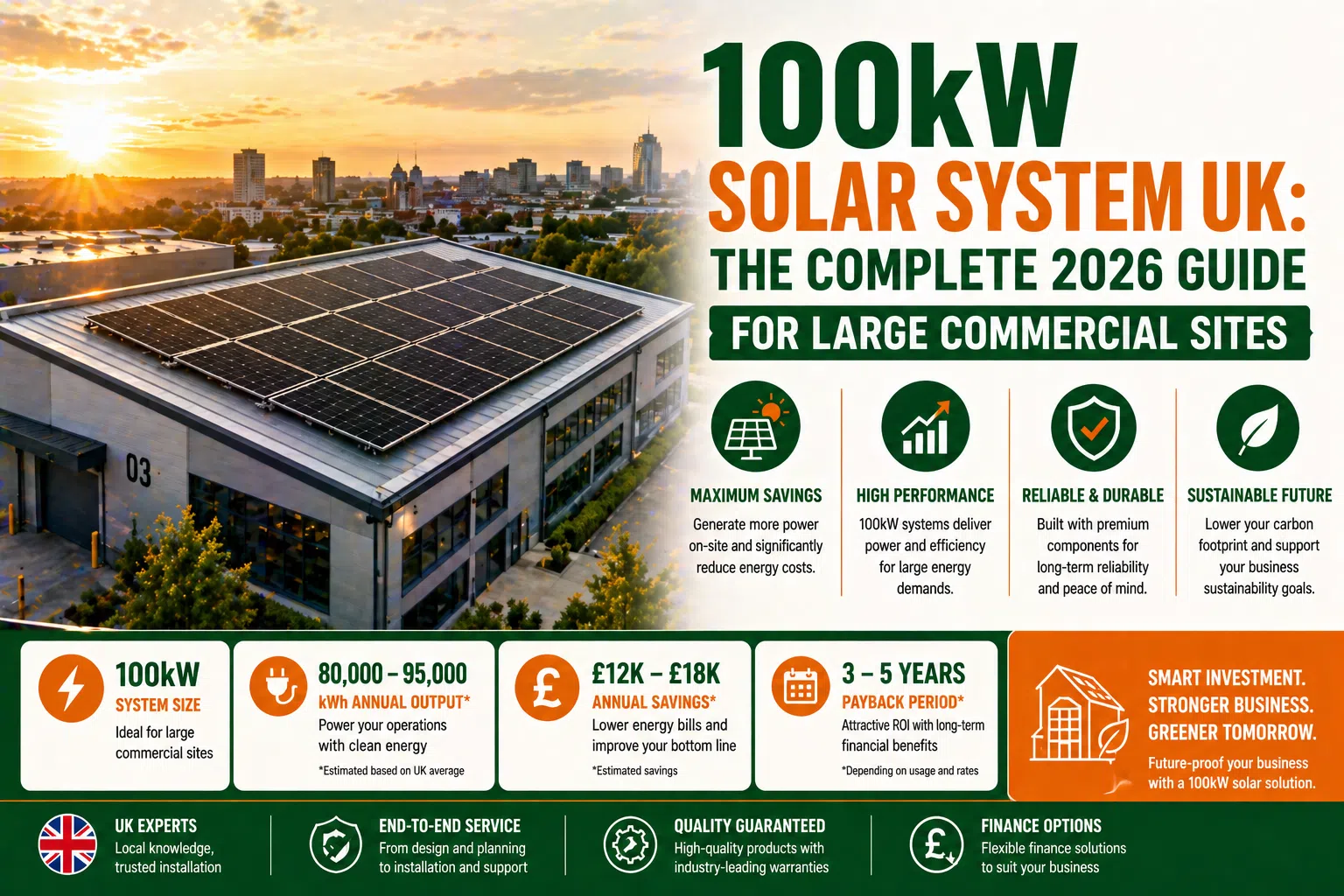

A 100kW solar system typically costs £80,000–£85,000 (ex-VAT), and at this scale solar stops being a simple energy-saving measure and becomes a capital allocation decision. The real question is no longer whether solar works — it is whether it outperforms other uses of the same capital. For a site with strong daytime demand, the answer is usually yes.
- 1. When does a 100kW system make financial sense?
- 2. How much electricity does a 100kW system actually offset?
- 3. What does a 100kW solar system cost in real terms?
- 4. The ROI: how this performs as a capital investment
- 5. The tax case: why AIA changes the decision
- 6. When does battery storage materially improve ROI?
- 7. G99 and export limits: what can affect performance
- 8. How a 100kW system is delivered on-site
- 9. Financing: capex vs funded models
- 10. Conclusion
- 11. FAQs
The Short Version (Read This First)
What large commercial sites need to know about 100kW solar in 2026:
- A 100kW system generates around 85,000 kWh per year, which covers a substantial portion of energy use for most commercial sites at this scale
- It is typically suited to organisations with a high annual electricity spend and a large proportion of daytime demand
- The Annual Investment Allowance (AIA) lets the full system cost be deducted from taxable profits in Year 1, which significantly compresses payback
- For sites with strong daytime demand, payback typically sits at three to four years after tax relief
- G99 approval is mandatory before installation and takes 6–12 weeks — this is the main project timeline driver, not the installation itself
- Battery storage only materially improves ROI where a significant proportion of generation would otherwise be exported or curtailed
- Solar4Good® delivers turnkey 100kW+ commercial installations across the UK — call 0800 999 1454 or visit solar4good.co.uk for a commercial assessment
At this scale, the question shifts from whether solar works to whether it outperforms other uses of capital. A 100kW system typically requires £80,000–£85,000 upfront (ex-VAT), or roughly £60,000–£64,000 after tax relief. The difference between a strong and a weak outcome is rarely the system itself. Instead, it is how well the system matches the way the site actually uses electricity. For a broader overview of commercial solar costs across all system sizes, see our dedicated guide.
💡 A note on the figures
The cost ranges here are general 2026 UK guide prices, and the savings, payback and ROI figures are illustrative estimates based on typical sites — not a quote or a guarantee. Actual returns depend on your tariff, usage profile, roof and grid conditions. A site-specific assessment gives accurate numbers.
When Does a 100kW System Make Financial Sense?
A 100kW system becomes financially viable once energy spend and the usage profile reach a certain threshold. In practical terms, this tends to be when electricity costs exceed roughly £25,000 per year and a large share of that demand falls during working hours. At that point, solar is no longer offsetting a small slice of usage. Instead, it directly reduces a significant operating cost.
| Business type | Annual consumption | Load profile | Fit |
|---|---|---|---|
| Distribution / logistics hub | 120,000–300,000 kWh | High daytime | Strong |
| Manufacturing site | 150,000–400,000 kWh | Continuous | Strong |
| School / campus | 200,000–500,000 kWh | Daytime-heavy | Strong |
| Healthcare facility | 250,000–600,000 kWh | 24/7 | Strong |
| Hotel / hospitality | 300,000–700,000 kWh | Evening-heavy | Conditional |
| Leisure / gym group | 200,000–500,000 kWh | Mixed | Conditional |
What matters at this level is not whether the building is large enough, but whether the load profile supports self-consumption. A site with strong daytime demand naturally uses a large share of the energy it generates, which drives savings. A site with evening-heavy usage generates the same energy, but more of it goes to export at a lower value unless you add storage. This is why two similar-sized sites can see very different returns from the same system. For more on how commercial planning and regulations affect system design, see our guide to commercial solar panel regulations in the UK.
★★★★★ Trustpilot
“Solar4Good installed a commercial system at our warehouse. From survey to sign-off it was professionally managed, with clear communication at every stage. The system was commissioned within the agreed timeline and is already delivering on the projected savings.”
— Verified customer
How Much Electricity Does a 100kW System Actually Offset?
A 100kW system generates around 85,000 kWh per year, using the MCS standard irradiance figure of 850 kWh/kWp/year. That number on its own is not particularly useful. What matters is how much of your existing demand it replaces.
| Metric | Output |
|---|---|
| Annual generation (UK average, 850 kWh/kWp) | ~85,000 kWh |
| South England (~950 kWh/kWp) | ~95,000 kWh |
| North / Scotland (~765 kWh/kWp) | ~76,500 kWh |
| Daily average | ~230 kWh |
For a business using 150,000–300,000 kWh annually, this represents a substantial portion of total consumption. However, the financial value depends on when you use that energy. Electricity used on site offsets purchases at full commercial rates, currently around 27p/kWh. Electricity exported to the grid earns significantly less. That difference is what makes self-consumption the single most important factor in system performance.
In practice, a well-matched site might use 70–80% of this generation directly. A poorly matched one might use closer to 50–60%. That difference alone can shift annual returns by several thousand pounds.
What Does a 100kW Solar System Cost in Real Terms?
Based on current UK installation pricing, a 100kW system typically costs between £80,000 and £85,000 (ex-VAT), reflecting the economies of scale that apply at this size.
| Item | Typical cost |
|---|---|
| System size | 100 kW |
| Cost per kW (ex-VAT) | £800–£850 |
| Total system cost (ex-VAT) | £80,000–£85,000 |
At this scale, economies of scale are a major factor. Larger systems spread fixed costs such as design, labour and access across more capacity, which reduces the cost per unit of generation. The more relevant comparison is between system cost and energy spend. A site installing a 100kW system is typically already spending tens of thousands per year on electricity. The investment, therefore, targets that ongoing cost over the long term.
Ready to go Solar?
⚠️ Honest note: VAT on commercial solar
Commercial solar installations are subject to 20% VAT. Most VAT-registered businesses (turnover above £90,000) can reclaim this as input tax on their next quarterly VAT return, so the effective cost equals the ex-VAT price. For businesses below the VAT registration threshold, the 20% VAT is a real additional cost that must be factored into budget planning. All figures in this guide are ex-VAT unless stated otherwise.
A worked VAT example
Here is a worked example using the upper end of the range:
| Scenario | Cost |
|---|---|
| System cost (ex-VAT) | £85,000 |
| VAT (20%) | £17,000 |
| Total paid upfront | £102,000 |
| VAT reclaimed (VAT-registered businesses) | £17,000 |
| Effective cost to VAT-registered business | £85,000 |
The final cost varies depending on site conditions. Roof complexity, access requirements and existing electrical infrastructure can all affect pricing. However, the overall range is consistent enough to model returns accurately at the feasibility stage.
★★★★★ Trustpilot
“Solar4Good handled our commercial rooftop project end to end. The design team modelled our usage carefully, the grid application was managed for us, and the system was commissioned on schedule. Clear, professional and transparent throughout.”
— Verified customer
The ROI: How This Performs as a Capital Investment
At 100kW, you should evaluate the system in the same way as any other capital project. In effect, you are comparing a net investment of roughly £60,000–£64,000 (after AIA — see Section 5) against a predictable annual return driven by reduced electricity spend. The critical factor is not total generation. Instead, it is how much of that generation replaces electricity purchased at full commercial rates.
For a site with strong daytime demand:
| Metric | Solar only | Solar + battery |
|---|---|---|
| Self-consumption | ~75% | ~88% |
| Electricity offset | ~63,750 kWh | ~74,800 kWh |
| Annual benefit (at 27p/kWh) | ~£17,200 | ~£20,200 |
| Payback (after AIA) | ~3–4 years | ~4–5 years |
For a site with mixed usage:
| Metric | Solar only | Solar + battery |
|---|---|---|
| Self-consumption | ~55% | ~80% |
| Electricity offset | ~46,750 kWh | ~68,000 kWh |
| Annual benefit (at 27p/kWh) | ~£12,600 | ~£18,400 |
| Payback (after AIA) | ~4–5 years | ~4–5 years |
The key takeaway is that return is driven by how effectively generation is used, not just how much is produced. Two identical systems on different sites can therefore deliver very different payback periods depending on load profile. For a full breakdown of ROI and payback across different commercial system sizes, see our commercial solar cost guide.
The Tax Case: Why AIA Changes the Decision
At this level, tax treatment has a direct impact on viability. The Annual Investment Allowance (AIA) lets you deduct the full system cost from taxable profits in Year 1. As a result, it significantly compresses the effective payback period.
| Scenario | Value |
|---|---|
| System cost (ex-VAT) | £85,000 |
| AIA tax saving at main rate (25%) | £21,250 |
| Net cost after tax relief | £63,750 |
| AIA tax saving at small profits rate (19%) | £16,150 |
| Net cost after tax relief (small profits rate) | £68,850 |
This reduces the effective investment while leaving the savings unchanged, and that is what compresses payback. Businesses should confirm with their accountant which corporation tax rate applies. The main rate (25%) applies to profits above £250,000, and the small profits rate (19%) applies to profits below £50,000.
💡 Did you know?
Rooftop solar installations are currently exempt from business rates increases until 2035. For systems of this size, that can represent a meaningful avoided cost which standard ROI models often leave out. The commercial solar grants guide covers this alongside the available capital allowance mechanisms.
When Does Battery Storage Materially Improve ROI?
At 100kW, battery storage is best considered on operational need, rather than added as a default. The key question is whether there is a meaningful gap between when energy is generated and when it is used.
| Scenario | Solar only outcome | With battery |
|---|---|---|
| Daytime-heavy operations | High utilisation, strong savings | Marginal improvement to ROI |
| Mixed usage profile | Moderate export, some value lost | Improved utilisation, better returns |
| Evening-heavy demand | Lower savings without storage | Significant uplift — storage likely worthwhile |
A battery increases the proportion of energy used on site. It stores excess generation and releases it later, which therefore improves the value of each unit generated. However, if most energy is already used during the day, the battery adds capital cost without significantly improving returns. The decision should rest on an accurate picture of your site’s electricity usage pattern, rather than being added as a standard line item.
G99 and Export Limits: What Can Affect Performance
At 100kW, grid approval is not just a formality — it is one of the few factors that can influence both timeline and system design. A G99 application must be in place before installation, and it typically takes 6–12 weeks. The more important point is what comes back from that approval.
The grid operator does not simply say yes or no. In some cases, they apply conditions that affect how the system can operate. The most common of these is an export limit. Your system can still generate at full capacity, but the grid will only accept a fixed amount of exported electricity at any one time. The system must then use anything above that limit on site, store it in a battery, or curtail it.
| Scenario | Impact of export limit |
|---|---|
| High daytime usage | Minimal — most energy is already used on-site |
| Moderate usage | Some export value is lost unless managed with storage or controls |
| Low daytime usage | Greater impact — more energy is exported or curtailed |
For a warehouse or manufacturing site, this is often not a major issue, because a large share of generation is already being consumed. For sites with lower daytime demand, it becomes more important. This is where system design matters. If an export limit is expected, we can design the system around it. For example, we might adjust the system size, integrate battery storage, or use export limitation controls (G100). That way, the system stays compliant without losing unnecessary value. Grid constraints rarely stop a project at this scale, but they do shape how you should configure the system.
How a 100kW System Is Delivered On-Site
At 100kW, the physical installation is not the complex part. The complexity sits in the design decisions and grid approval, which together determine both timeline and performance. Most projects take 8–16 weeks from start to finish, and G99 approval and design drive the majority of that time. Once the team resolves those, delivery on site moves quickly.
Step 1: Site survey
This stage either sets the project up properly or compromises it early. The survey covers roof condition, usable space and electrical infrastructure, but the critical part is understanding how the site actually uses electricity. If the survey does not capture the usage profile accurately, the installer can size the system incorrectly, which directly affects ROI.
Step 2: System design
At this level, design is not just about fitting panels on a roof. It is about deciding how much generation the site can realistically use. This is where the team makes the decisions around system size, inverter configuration and potential export limits. A well-designed system maximises usable generation, not just total output.
Step 3: G99 approval
This is the step that sets the timeline. A G99 application typically takes 6–12 weeks and, in some cases, comes with conditions such as export limitations. These conditions matter because they influence how much value the system delivers and whether storage should be considered. Installation cannot begin until the operator grants approval.
Step 4: Structural assessment
At 100kW, we take roof loading seriously. This step confirms the structure can safely support the system. It is usually straightforward for modern commercial buildings, but older or more complex roofs may need adjustments, which can affect cost and design.
Step 5: Installation
Once approvals are in place, installation is relatively fast. Panels, inverters and wiring go in over several days, with most work taking place on the roof. For most sites, disruption is minimal and operations continue as normal.
Step 6: Commissioning
The team tests and connects the system to confirm it performs as expected. This is where we verify generation, monitoring and safety systems before going live.
Step 7: Handover
We set up monitoring and finalise the export arrangements. At this point, the system becomes operational and starts reducing electricity costs immediately.
Financing: Capex vs Funded Models
At 100kW, the financing decision directly affects your return. The key trade-off is simple: lower upfront cost versus higher long-term savings.
| Option | Upfront cost | Long-term return | When it makes sense |
|---|---|---|---|
| Outright purchase | High | Highest — full AIA benefit and all savings retained | You have capital and want maximum ROI |
| Asset finance | Medium | High — repayments often close to or below energy savings | You want to spread cost but keep most savings |
| Power Purchase Agreement (PPA) | None | Lower — you buy solar electricity at a discount, not own it | Capital is constrained or allocated elsewhere |
Outright purchase delivers the strongest financial outcome, because you keep all the savings and fully benefit from AIA. At this scale, that typically means a three-to-four-year payback, followed by decades of reduced energy costs.
Asset finance sits in the middle. Providers often structure repayments so they sit close to or below the energy savings. As a result, the project can be cash-flow neutral or positive from year one.
A PPA removes the upfront cost entirely. However, you then buy the solar electricity at a discounted rate rather than generating it yourself, which reduces the long-term benefit. Ultimately, the decision comes down to how you view capital, and whether maximum return or cash preservation takes precedence.
★★★★★ TrustATrader
“The system’s performance has exceeded our expectations, noticeably reducing our grid dependence and cutting electricity costs from the first month. Clear explanations and transparent pricing throughout.”
— Verified customer
Conclusion
A 100kW solar system is not a marginal upgrade. It is a capital investment that directly reduces a major operating cost. For sites with strong daytime demand, AIA tax relief and energy savings together typically produce a three-to-four-year payback. After that, the system delivers long-term cost reduction on an essential operating input.
The next step is to understand how a system would perform on your specific site. A few key variables decide this: your electricity usage profile, roof suitability, grid connection capacity and operating hours. Together, they determine whether a 100kW system is correctly sized, or whether a larger or smaller one would deliver a better return. Solar4Good designs and delivers commercial solar systems across the UK with full project management from survey through to commissioning and handover.
📞 Get a commercial solar assessment from Solar4Good
Call us on 0800 999 1454 or visit solar4good.co.uk. Read over 800+ verified five-star reviews on Trustpilot and Checkatrade.
Solar4Good Ltd · 79 College Road, Harrow, HA1 1BD · MCS: NAP/72775/25/4 · HIES: S4G/A/1484
Frequently Asked Questions
Does a 100kW system need planning permission?
Usually no. Most commercial rooftop systems fall under permitted development. The main exceptions are listed buildings or sites in conservation areas. For standard warehouses or commercial units, planning is rarely the blocker. See our commercial solar panel regulations guide for what applies at this scale.
How long does G99 approval take?
Typically 6–12 weeks. This is the main factor that determines the project timeline, because installation cannot begin until approval is granted. The G99 application guide explains the process in detail.
How much roof space is required?
Around 440–500m² of usable roof space, which equates to roughly 215–220 panels at 450–500W. The key is usable space, not total roof size — rooflights, plant, access hatches and shading all reduce the effective area.
How does AIA affect cost?
AIA reduces the real cost of the system by lowering your corporation tax bill. On an £85,000 system, tax relief at the main rate (25%) reduces the effective cost to roughly £63,750, which shortens payback significantly. Speak to your accountant to confirm which rate applies to your business.
Should a battery be included?
Only if your site uses a significant proportion of electricity outside solar generation hours. If most demand is during the day, solar-only usually gives the best return. A battery simply adds capital cost that takes longer to recover when self-consumption is already high.
Will export limits affect performance?
An export limit can reduce export income, but it does not affect how much energy the system generates. For sites with high daytime usage, the impact is usually limited because the site consumes most generation. For sites with lower daytime demand, you should design the system to account for the limit from the start.
About the Author
Matthew
Solar Consultant with over a decade of UK solar experience, helping homeowners and businesses make clear, confident renewable energy decisions.
📞 Book a free solar consultation
Call us on 0800 999 1454 or visit solar4good.co.uk
Read over 800+ verified five-star reviews on Trustpilot and Checkatrade
Solar4Good Ltd · 79 College Road, Harrow, HA1 1BD · MCS: NAP/72775/25/4 · HIES: S4G/A/1484