
Commercial Solar Carport Costs & ROI: What Businesses Can Expect in the UK
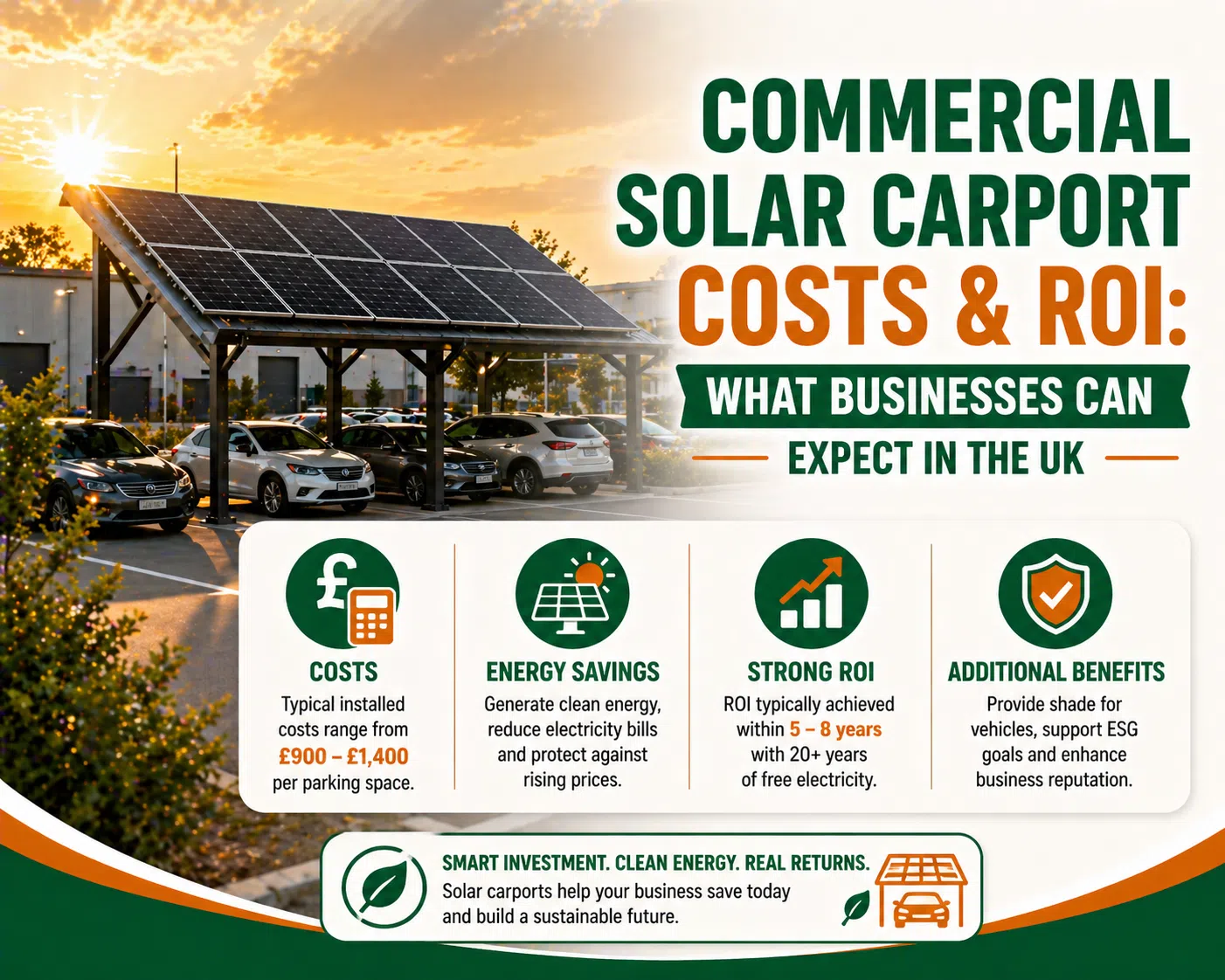

A commercial solar carport turns an underused car park into productive energy infrastructure, generating electricity on site while sheltering vehicles. For UK businesses that have maxed out rooftop solar — or cannot use it because of structural or lease limits — the car park is often the last large space capable of delivering meaningful on-site generation. This guide covers what drives the cost, how the return works, and when a carport genuinely makes financial sense.
- 1. What makes up the cost of a commercial solar carport
- 2. What determines your carport cost?
- 3. Why does carport pricing vary between quotes?
- 4. Should you fund a carport via CAPEX or OPEX?
- 5. How does a commercial solar carport generate a return?
- 6. What affects the payback period?
- 7. When does a carport make financial sense?
- 8. When does a carport not make sense?
- 9. Bottom line
- 10. Frequently Asked Questions
The Short Version (Read This First)
Key facts about commercial solar carports in the UK:
- A commercial solar carport is a hybrid asset — both an energy system and a permanent structure — so steel canopies, foundations, and civil works all shape the overall cost
- There is no single price; we engineer every carport for the specific car park, ground conditions, and grid connection, so accurate costing always needs a site assessment
- CAPEX ownership maximises long-term return and control, while OPEX lowers upfront spend but shares the financial upside with a third party
- The strongest returns come from systems sized for daytime self-consumption, not headline generation capacity or export
- A carport makes sense where rooftop solar is limited, site control is long-term, and daytime demand is high and predictable
- Solar4Good® is MCS certified (NAP/72775/25/4), HIES protected (S4G/A/1484), and has completed 2,610+ UK installations across commercial and industrial sites
Energy costs are now a board-level concern for UK businesses. Volatile tariffs and long-term price uncertainty mean organisations can no longer treat energy as a simple overhead. Many companies have already maximised rooftop solar, or find it impractical because of structural or lease limits. For these businesses, the car park is one of the last untapped areas capable of large-scale on-site generation.
A commercial solar carport turns that space into productive infrastructure, combining generation with shelter for vehicles. Unlike rooftop solar, however, a carport is both an energy system and a permanent structure. Foundations, steel canopies, drainage, and grid integration all add to the cost. Therefore, businesses must weigh upfront spend against long-term savings and decide whether CAPEX or OPEX funding best suits their objectives.
What Makes Up the Cost of a Commercial Solar Carport
A commercial solar carport is best understood as a hybrid asset: it functions as both an energy system and a permanent structure, and both sides carry cost implications. That structural element is the biggest thing separating a carport from rooftop solar.
Structural and civil works
The structure itself is the largest cost driver. A commercial solar carport requires:
- Steel canopies engineered for wind, snow loading, and long-term fatigue
- Foundations sized to the ground conditions and vehicle impact risk
- Drainage, ground reinstatement, and compliance with site safety standards
- Bollards, clearance planning, and access protection
On many projects, these structural and civil elements make up the majority of the build. This is also where poor design decisions quietly undermine the return later.
Solar generation equipment and installation
Panels, inverters, cabling, and monitoring are broadly comparable to rooftop solar. However, installation is more complex, because working at height over live parking areas and within restricted access windows increases labour time and coordination.
Electrical integration and grid alignment
A carport must integrate cleanly with existing site infrastructure. Distance to the main LV boards, export limitations imposed by the DNO, and any protection or capacity upgrades all affect the work involved. Weak grid alignment is one of the fastest ways to undermine the return, regardless of how good the structure looks on paper.
💬 Want a cost specific to your site?
A commercial solar carport is not a product with a fixed price — it is a constructed asset engineered for your car park, ground conditions, grid connection, and energy goals. Because of that, costing always depends on your situation. The fastest way to get an accurate figure is a free site assessment, where our team reviews your car park and gives you a clear, itemised projection with no obligation. Call 0800 999 1454 or get in touch here.
What Determines Your Carport Cost?
Because a carport is engineered for a specific site, the final cost depends on a combination of factors rather than a single rate. The main variables are:
- System size: Larger systems spread fixed structural and design costs across more generation capacity, which usually improves long-term value even when total spend is higher.
- Ground conditions: Slopes, drainage runs, service ducts, and load-bearing capacity all affect how much steel and groundwork is needed.
- Structural design choices: Wind loading, foundation depth, and steel sizing influence both cost and long-term durability.
- Grid connection: Export limits, protection upgrades, or capacity constraints can shape what is possible as much as the structure itself.
- Site complexity: Awkward bay layouts, access restrictions, and working over live parking add coordination and labour.
Smaller installations often look disproportionately expensive because the fixed structural costs do not scale linearly. A larger, well-optimised carport generally delivers better long-term value. However, the only reliable way to know what your site will cost is a proper assessment.
Want a figure for your car park?
Why Does Carport Pricing Vary Between Quotes?
At first glance, commercial solar carport quotes can look broadly similar. Capacity, layout, and headline savings may all appear aligned. The real difference usually sits in the assumptions behind the numbers, and those assumptions show up in two places: what the carport costs on day one, and how it performs financially over the years that follow.
How the structure is designed
Some installers design to the bare minimum needed to pass compliance checks. Others build in more headroom for wind loading, foundation depth, and steel sizing. The second approach costs more upfront, but it usually aims to avoid movement, remedial work, or structural limits later.
What is assumed about the ground and layout
Car parks are rarely uniform. Slopes, drainage, tree roots, service ducts, and awkward bays all affect how much steel and groundwork is required. Therefore, quotes based on “typical” ground conditions often change once surveys are done, which is why early estimates can move.
How grid limits are treated
This is one of the quietest but most important differences. Some quotes assume the site can use or export all generated power; others factor in export caps, curtailment, or future grid constraints. Those assumptions change the real return over time, which is why two proposals that look similar on paper can perform very differently after construction.
★★★★★ Trustpilot
“From initial survey to flawless installation, Solar4Good delivered an exceptional solar experience. The team worked meticulously and left the site spotless. Clear explanations, transparent pricing with no hidden fees.”
— Verified commercial customer
Should You Fund a Carport via CAPEX or OPEX?
You can fund a commercial solar carport through CAPEX or OPEX, and the two approaches serve different objectives. CAPEX maximises long-term return and control, while OPEX prioritises lower upfront spend and risk transfer.
| Consideration | CAPEX (Buy It) | OPEX (Service / Lease) |
|---|---|---|
| Upfront cost | Large initial outlay | Zero to low |
| Asset ownership | Business owns it outright | Third party owns and manages it |
| Maintenance | Owner’s responsibility | Provider’s responsibility |
| Electricity savings | Maximum (pay only for O&M) | Fixed discount (pay per kWh) |
| Contract length | N/A | Typically 10–25 years |
| Long-term return | Highest (asset adds book value) | Lower (but preserves cash flow) |
| Risk profile | Performance risk is yours | Provider takes the risk |
When CAPEX is the stronger choice
CAPEX works best when a business can absorb the upfront outlay and wants the full financial upside. It suits organisations that have long-term control of the site (ownership or a lease beyond 20 years), can deploy capital without jeopardising other priorities, and want full exposure to the benefit of rising tariffs over the asset’s life. In these cases, the business internalises all the savings and makes every sizing decision without third-party constraints.
When OPEX is appropriate
OPEX suits businesses where capital is tight or earmarked elsewhere, where balance-sheet treatment matters, or where management prefers to transfer performance risk. Because a third party funds and owns the system, the cost usually stays off the balance sheet — which can be decisive for organisations with strict CAPEX limits or debt covenants. The trade-off is that the funder shares the financial benefit, so the overall return falls below owning outright. In short, OPEX is best seen as an access route rather than a way to maximise returns.
How Does a Commercial Solar Carport Generate a Return?
A commercial solar carport generates a return by displacing grid electricity with on-site generation during daytime operating hours. It does not reduce how much energy you use; instead, it reduces the cost of meeting that demand. The main value drivers are offsetting high daytime import tariffs, reducing exposure to volatile peak pricing, and improving long-term cost predictability.
Export revenue is usually secondary. Export rates sit far below the cost of importing power during the day, and grid constraints often cap how much you can export. Consequently, the strongest returns come from systems that maximise self-consumption, not from chasing headline generation capacity.
What Affects the Payback Period?
Because we size and price every carport for its site, payback varies from one project to the next. Rather than a single figure, a handful of factors shape the period:
- Daytime demand match: The more solar you self-consume during working hours, the faster the return.
- Tariff levels: Higher grid import rates widen the gap between solar and grid electricity, which shortens payback.
- Grid constraints: Heavy reliance on export, or strict export caps, lengthens payback.
- System sizing: A system sized for self-consumption performs better than an oversized one that exports a large share.
- Funding model: CAPEX and OPEX produce very different cash-flow and return profiles.
Because a carport is a long-life asset — panels typically carry 25-year performance warranties — payback alone understates its value. The full picture includes lifetime electricity savings, reduced exposure to price volatility, and the durability of the structure itself.
💬 Want to know your likely payback?
Payback depends entirely on your site — your demand profile, tariffs, grid connection, and how the system is sized. There is no accurate generic figure. Our team can model your specific payback as part of a free site assessment. Call 0800 999 1454 or get in touch and we will run the numbers for your car park.
When Does a Carport Make Financial Sense?
A commercial solar carport makes sense when the expected energy savings and risk reduction clearly outweigh the upfront and ongoing costs. Sustainability goals alone do not justify it; measurable financial return over the asset’s lifetime does. The strongest cases share these features:
- Rooftop solar is constrained: If the roof is full or cannot support more panels, a carport is the only large-scale generation option left.
- Long-term site control: A secure occupancy horizon of 20+ years lets the business realise the full return; short leases or planned changes put that at risk.
- High, predictable daytime demand: Offices, hospitals, logistics hubs, and manufacturing sites often hit this benchmark, which maximises self-consumption.
- Sized for self-consumption: Right-sizing to actual demand protects the return, whereas oversizing for export erodes it.
When Does a Carport Not Make Sense?
A carport is unlikely to deliver a strong return when the site or demand does not support self-consumption or recovery within a reasonable horizon. Businesses should review daytime demand, site control, and export limits before committing. A carport rarely stacks up when:
- Daytime demand is low or intermittent: Low or unpredictable daytime use increases reliance on export, which is poorly remunerated in the UK.
- Site use is temporary: If the space might be repurposed or the lease is short, the investment horizon is too short.
- Export constraints dominate: Strict export limits or low export rates make surplus energy hard to monetise.
- Site control is shorter than the return horizon: Any site unlikely to stay under control for 15–20 years risks failing to recover the investment.
Avoiding a poorly aligned carport matters just as much as pursuing a strong one. Quantified demand data, tariff analysis, and certainty over site control are what determine feasibility.
★★★★★ Trustpilot
“Solar4Good provided excellent service from beginning to end. Their advice and professionalism guiding us through the best suitable system for now and the future were excellent.”
— Verified customer
Bottom Line
A commercial solar carport is a long-term infrastructure investment. The cost stacks up when the system matches daytime demand, uses correct sizing, and maximises self-consumption. CAPEX generally offers the strongest return, while OPEX suits capital-constrained situations. Well-designed carports deliver predictable savings and reduce exposure to volatile tariffs; poorly aligned projects risk underperformance. Because the cost and return both depend entirely on your site, a site-specific assessment is the only reliable way to know whether a carport is worth pursuing.
If you are weighing up a commercial solar carport, the most useful next step is a free, site-specific review. At Solar4Good, we offer free consultations where we look at your car park layout, energy demand, grid position, and funding options in plain terms — so you can decide whether a carport is genuinely worth it, or whether your capital is better used elsewhere.
Frequently Asked Questions
Cost and funding
How much does a commercial solar carport cost in the UK?
There is no single fixed price, because we engineer a carport for your specific site rather than selling it as a standard product. The cost depends on system size, ground conditions, structural design, and grid connection. The most reliable way to get an accurate figure is a free site assessment — our team reviews your car park and provides a clear, itemised projection with no obligation. Call 0800 999 1454 or get in touch to arrange one.
Should my business fund a carport via CAPEX or OPEX?
It depends on your priorities. CAPEX maximises long-term savings and gives you full ownership and control, but it requires upfront capital. OPEX removes the upfront cost by having a third party fund the system, but the financial benefit is shared, so the overall return is lower. CAPEX is typically preferred when capital is available and the business wants the full upside.
Return and suitability
What drives the return on a commercial solar carport?
Daytime demand alignment, system sizing, and electricity tariffs mainly drive the return. Self-consumption — using the power on site rather than exporting it — is far more valuable than export revenue. The strongest returns come from systems sized to match real daytime demand rather than to maximise generation.
What payback period can a business expect?
It varies by site, because payback depends on your demand profile, tariffs, grid connection, and how the system is sized. There is no accurate generic figure. Our team can model your specific payback as part of a free site assessment, so you see a realistic projection based on your own data rather than an average. Call 0800 999 1454 to arrange this.
Can a commercial solar carport improve energy resilience?
Yes. By displacing grid electricity during peak periods, a carport stabilises energy costs and reduces exposure to price volatility. With battery storage added, it can also provide limited backup during outages. Over a 25–30 year life, it functions as durable infrastructure rather than a short-term upgrade.
Do solar carports need planning permission?
Often, yes. Unlike rooftop solar, a carport is a new standalone structure, so it more frequently requires planning permission, particularly on larger or visually sensitive sites. Solar4Good checks the planning position for your site as part of the assessment and manages applications where they are needed.
About the Author
Manan Shah
Co-Founder of Solar4Good UK. Leads Solar4Good's commercial strategy and customer relationships, and is quoted as a clean-energy authority by some of the UK's most trusted news publications. Quoted in the Financial Times and The Times on UK solar.
📞 Book a free solar consultation
Call us on 0800 999 1454 or visit solar4good.co.uk
Read over 750+ verified five-star reviews on Trustpilot and Checkatrade
Solar4Good Ltd · 79 College Road, Harrow, HA1 1BD · MCS: NAP/72775/25/4 · HIES: S4G/A/1484