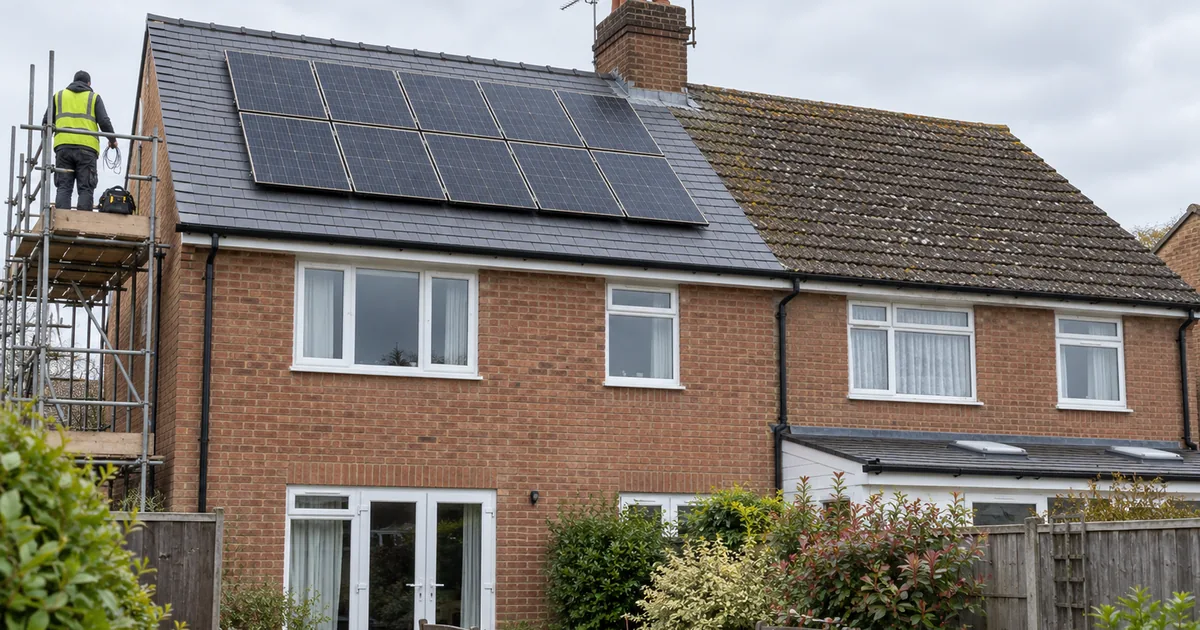
Here is the problem nobody warns you about when you buy solar. The roof eventually needs work, and when that day comes you find that most roofers will not touch the panels, and most solar companies will not come out just to take an array off. You are left holding two quotes that each depend on the other. That gap is exactly what solar panel removal and reinstallation exists to fill.
The Short Version (Read This First)
Re-roofing a house that has solar on it:
- For a full re-roof the array comes off. The covering cannot be lifted underneath live panels, rails and all.
- For a small repair away from the array, working around it is sometimes possible. We will tell you honestly which one you are.
- Your roofer sets the dates, not us. Panels off before the roof opens, back on once the new covering is finished and the scaffold is still up.
- Share the scaffold. Access is the biggest single cost in a removal, and your roofer's is already up.
- While the system is down and the roof is open is the cheapest moment it will ever be to renew tired fixings or add a battery.
01Why Your Roofer Will Not Touch the Panels
It is not awkwardness. A solar array is a live electrical installation that generates whenever there is daylight, and it cannot be switched off at a fuse board the way a lighting circuit can. A roofer who unbolts panels is working on something outside their trade, outside their insurance, and outside whatever warranty still stands on the system.
The mirror image is just as common. Plenty of solar companies only want new installations, so a call asking them to take an existing array off for a week gets a polite no, or a price designed to make you go away.
So the homeowner ends up in the middle, with a roofer who cannot start and a solar firm who will not come. The fix is simply a solar team who treats removals as ordinary work and will book around a roofer's programme, which is the job we do every week.
02Do You Have to Remove Solar Panels to Replace a Roof?
Not always, and it is worth establishing before anyone quotes. Removing solar panels for roof repair and removing them for a full replacement are two different jobs with two different answers.
A full re-roof: yes. If the tiles or slates are coming off across the whole roof, the array has to come off first, rails and mounting fixings included. There is no way to re-lay a covering underneath panels that are bolted through it.
A repair away from the array: often not. A slipped tile at the other end of the roof, a chimney repoint, a valley or a bit of flashing can usually be reached without disturbing the panels, as long as the scaffold can be set clear of them and nobody needs to walk across the array to get there.
A repair underneath or beside the array: it depends. Sometimes only the affected panels need to come off rather than the whole thing. That is a judgement made on the roof, not on the phone, and it is one of the things the survey is for.
Be wary of anyone who answers this question without seeing the roof. "You will have to take them all off" and "we can work around them" are both easy things to say and expensive things to get wrong.
03How the Job Is Sequenced With Your Roofer
This is where re-roofing with solar panels usually goes wrong, and it is almost always a diary problem rather than a technical one.
The order is fixed. Scaffold up. Panels off and into storage. Roofer strips and re-lays the covering. Panels back on, reconnected and tested. Scaffold down. The two dates that matter are the day the roof needs to be clear and the day the new covering is finished, and both of those come from your roofer.
So we work to their programme rather than asking them to work around ours. In practice that means telling us, when you ask for a price, who the roofer is and what dates they have pencilled in. A removal booked without that is a removal that gets rebooked.
04How Long Are the Panels Off?
On a typical domestic system, roughly half a day to take the array off and half a day to put it back. The time in between is not ours: it is however long your roofer needs, which on a full re-roof is usually a week or two depending on the size of the house and the weather.
Each panel is numbered as it comes off and stored flat and padded, so it goes back in the same position with the same wiring run. Flat matters, because panels are strong face-on and easy to damage when they are leaned, stacked badly or moved around a busy site.
05What Happens to Your Generation and Your FIT
While the panels are down they generate nothing, so for a week or two you buy all your electricity from the grid as you did before solar. On a winter re-roof that is a small number. Over a bright fortnight in June it is worth factoring in.
If you are paid a feed-in tariff, tell your supplier before the work rather than after. Your agreement is with them, the rules on what counts as a change to the installation are theirs, and it costs nothing to have the answer in writing first. Take a meter reading the day the system comes off and another when it goes back on, so there is no argument about a quarter with a gap in it.
Need a cost?
Tell us your postcode, what the roofer is doing and when, and we will come straight back with a quote.
Get your quote →06Share the Scaffold. It Is the Biggest Saving Available.
Safe access is the single largest variable in what a removal costs, which is why we quote it separately rather than folding it into one figure. An eaves-height bungalow and a three-storey townhouse are not the same job even with the same number of panels.
On a re-roof, the scaffold is going up for the roofer anyway. If it can stay until the array is back on, you pay for access once instead of twice. Ask your roofer that question early, because a week of overlap at the end of their job is almost always cheaper than a second scaffold a fortnight later.
07What Gets Checked Before the Panels Go Back
A new roof with ten-year-old fixings screwed back into it is a false economy, and it is the detail that separates a careful refit from a quick one.
Before anything goes back we look at the mounting hooks and brackets, the rails, and the weatherproofing where the fixings pass through the covering. Tired hooks get renewed while the roof is open and the scaffold is up, not two years later when it means paying for access all over again. We also check how the flashing and seals have been made good around each fixing, because that is where a refit leaks if it is going to.
Then the panels go back in their numbered positions, the wiring is reconnected, and the system is recommissioned and tested before we leave, including a check that it is generating as it was before it came down.
Our workmanship warranty on a removal and reinstallation is 5 years, depending on the scope of the work, and it applies whether or not we installed the system in the first place. Worth knowing separately: your original installer's workmanship cover may not survive another company disturbing the roof fixings, so read your terms with them before the work starts.
08The One Upgrade That Is Cheapest Right Now
While the array is down, the roof is open and the system is isolated, every other job on that system is at its cheapest, because the expensive parts are already paid for.
That makes a re-roof the natural moment to replace an ageing inverter, or to add battery storage if it was on the list anyway. Doing either as a separate visit later means paying for scaffold and isolation twice. It is also the moment to rethink the layout if the original array was awkwardly placed, since the rails are coming off regardless.
If you are weighing up whether the same panels are worth refitting at all, our guide on whether solar panels can be removed and reinstalled covers what survives the journey and what does not.
Frequently Asked Questions
Do I have to remove solar panels to replace my roof?
For a full re-roof, yes. The covering cannot be stripped and re-laid underneath panels that are bolted through it, so the array, the rails and the mounting fixings all come off first and go back once the new roof is finished. For a repair away from the array it is often possible to work around it.
Will my roofer take the panels off for me?
Almost certainly not, and they are right not to. A solar array generates whenever there is daylight, so it is a live electrical installation rather than something to unbolt. It sits outside a roofer's trade, their insurance and whatever warranty still stands on your system.
Can you work around the panels for a smaller repair?
Often, yes. A slipped tile at the other end of the roof, a chimney repoint or a bit of flashing can usually be reached without disturbing the array, as long as the scaffold can be set clear of it. Sometimes only the affected panels need to come off rather than the whole system. It is a judgement made on the roof rather than over the phone.
How long will my panels be off the roof?
On a typical domestic system, roughly half a day to take the array off and half a day to put it back. What sits in between is your roofer's programme, not ours, which on a full re-roof is usually a week or two depending on the size of the house and the weather.
What happens to my feed-in tariff while the panels are down?
The system generates nothing while it is off the roof, so there is a gap in that quarter. Tell your FIT supplier before the work rather than after, and take a meter reading the day the system comes off and another when it goes back on. The rules on what counts as a change to the installation are the supplier's, so get their answer in writing first.
Do I need to pay for scaffolding twice?
You should not have to. The scaffold is going up for your roofer anyway, and if it can stay until the array is back on, you pay for access once. Ask your roofer early whether it can remain, because a week of overlap at the end of their job is almost always cheaper than a second scaffold afterwards.
Will the old mounting fixings be reused on the new roof?
Only if they are fit to be. Hooks, brackets and rails that have been up for a decade are checked before anything goes back, and tired ones are renewed while the roof is open and the scaffold is still up. Refitting worn fixings into a brand-new roof is the kind of saving that costs more later.

Matthew has over a decade of UK solar experience, helping homeowners and businesses make clear, confident renewable-energy decisions, from first visit to switch-on.