Which home battery is the better buy in 2026. Sigenergy or Tesla Powerwall? In short: the Tesla Powerwall 3 wins on simplicity, brand track record and app experience, while the Sigenergy SigenStor wins on flexibility, scalability and cost per kWh. Most UK homeowners start with Tesla because it’s the name they know, but the right choice depends on how your home actually uses energy. At Solar4Good we install both, so this isn’t a one-sided comparison.
The Short Version (Read This First)
Key differences between the Sigenergy SigenStor and Tesla Powerwall for UK homes:
- Tesla Powerwall 3 is a fixed 13.5 kWh system, reliable, well-established, with a strong 10-year warranty and a best-in-class app
- Sigenergy SigenStor is modular (around 6–54 kWh), start smaller, expand as needed, with a lower cost per kWh and more flexibility for homes expecting demand to grow
- The core trade-off: Tesla means simplicity and a proven track record; Sigenergy means flexibility and scalability
- If you plan to add an EV charger or heat pump, or want to build capacity over time, Sigenergy is usually the more practical choice
- If your usage is predictable and you want a system that just works without adjustment, the Tesla Powerwall is a strong option
- Solar4Good installs both, call 0800 999 1454 or visit solar4good.co.uk for a recommendation based on your home’s actual usage
A note on the prices in this guide
The figures below are general 2026 UK guide prices, included to help you compare the two systems fairly. They are not quotes. Your actual cost depends on system size, your property, the electrical work involved and whether solar is installed at the same time. We give you an exact figure after a site visit.
01Which Battery Is Right for Most Homes?
The easiest way to decide is to look at how fixed or flexible your energy usage is likely to be.
- Tesla Powerwall is often the simpler fit when demand is predictable and you want a system that runs without much adjustment
- Sigenergy is usually the better option when your usage is likely to grow or change. For instance, it suits homes planning an EV charger or heat pump, wanting more capacity over time, or preferring not to commit to a fixed size upfront
The key difference is simple. Tesla is a fixed 13.5 kWh system; Sigenergy lets you start smaller and expand as needed. For many UK homes, usage does not stay static. As a result, a modular system tends to be the more practical choice. It adapts as your needs change, rather than forcing you to work around a fixed size.
★★★★★ Trustpilot
“From initial survey to flawless installation, Solar4Good delivered an exceptional experience. The team worked meticulously and left the site spotless. Clear explanations, transparent pricing with no hidden fees.”
Verified customer
02Sigenergy vs Tesla Powerwall: Key Differences at a Glance
| Feature | Sigenergy SigenStor | Tesla Powerwall 3 |
|---|---|---|
| Battery size | Modular (around 6–54 kWh) | Fixed 13.5 kWh |
| Scalability | Highly expandable in stages | Add another full unit |
| Inverter | Built-in hybrid (multiple sizes) | Built-in hybrid inverter |
| Round-trip efficiency | Up to ~97.6% | Up to ~97.5% |
| Cost per kWh | Lower, especially as you scale | Higher |
| Warranty | 10 years (LFP cells) | 10 years, ~70% capacity, unlimited cycles |
| Backup capability | Whole-home capable | Whole-home capable (11.5 kW output) |
| Three-phase support | Yes | Limited |
| Integrated EV charging | Optional DC module | Not integrated |
| Brand maturity | Newer, growing fast | Long, established track record |
| App experience | Strong | Industry-leading |
This is the core trade-off: Tesla keeps things simple and consistent, while Sigenergy gives you more flexibility to build and expand a system around your home. For more on how inverters integrate in both systems, see our guide to the best solar inverters in the UK.
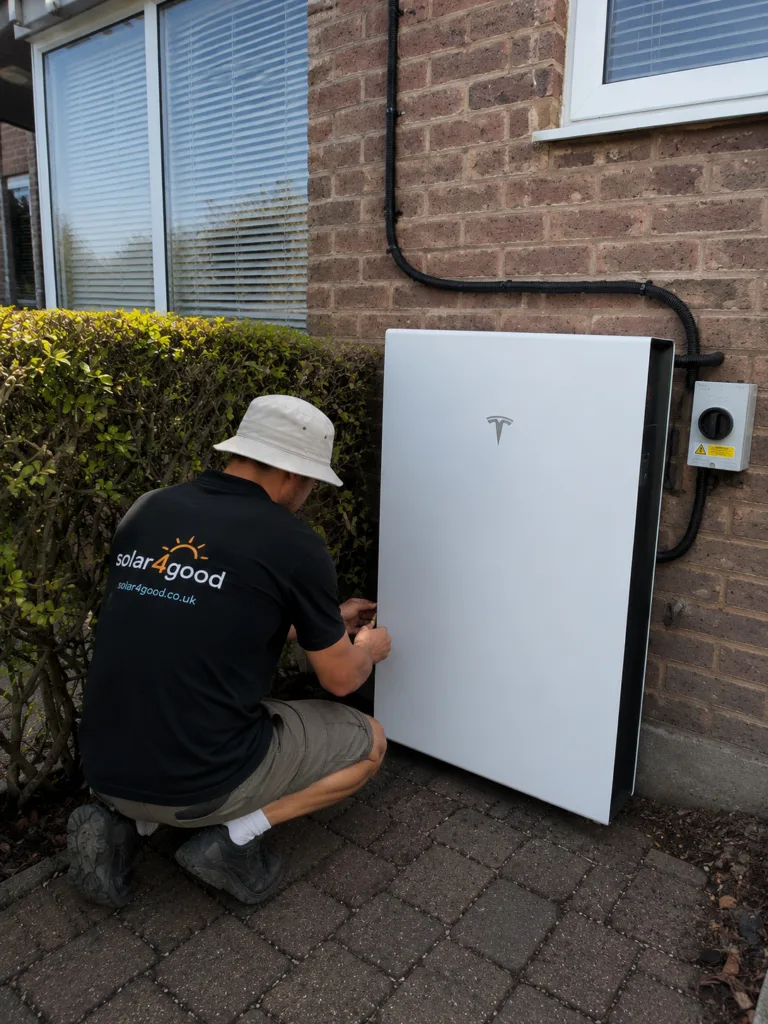
03What Tesla Powerwall Does Better
Tesla’s advantage is not flexibility, it is reliability and simplicity. Tesla has installed the fixed Powerwall 3 at scale for years, so there are fewer unknowns. For homeowners who would rather not think too much about system design or future changes, that simplicity is a genuine benefit.
- Strong warranty terms: a 10-year warranty guaranteeing at least 70% capacity retention with unlimited cycles under normal use, among the strongest in the market
- Proven service and support: in one Solar4Good case, Tesla replaced a Powerwall flagged for degradation after several years, at no cost to the customer
- Best-in-class app and monitoring: clear, real-time visibility of generation, storage and usage, with automatic optimisation in the background
- All-in-one design: the built-in hybrid inverter reduces complexity and keeps installation straightforward, with a high continuous output of 11.5 kW
The real difference is how Tesla handles ownership over time. The system is continuously monitored, so issues are often picked up early, which makes the warranty feel active rather than just contractual. So for homeowners who prioritise a proven track record, strong support and a system that simply works, the Tesla Powerwall remains a dependable choice.
★★★★★ Trustpilot
“Solar4Good provided excellent service from beginning to end within two weeks. Their advice guiding me through the best suitable panels and battery for now and the future was excellent.”
Verified customer
04Where Sigenergy Is the Stronger Option
Sigenergy stands out when your home does not fit neatly into a fixed system size. Instead of choosing a single battery and working around it, the SigenStor lets you build capacity around how your home uses energy. Better still, you can adjust it over time if that changes.
Say your usage increases, by adding an EV charger or running a heat pump. A fixed 13.5 kWh system can then start to feel restrictive. With Sigenergy, you expand in stages rather than replacing the unit or overcommitting upfront. It is also one of the few systems that works properly in more complex setups: for larger UK homes on a three-phase supply, or homes combining solar, battery and EV charging, Sigenergy is often easier to design around. The SigenStor uses lithium iron phosphate (LFP) cells, carries a 10-year warranty and scales from roughly 6 kWh to 54 kWh per tower.
Did you know?
Solar4Good has completed Sigenergy installations alongside Tesla Powerwall installs across the UK. In our experience, the homes that benefit most from Sigenergy’s modular approach are those already planning for EV charging or additional electricity demand within the next two to three years.
05Cost, Scalability and Long-Term Value
Both systems qualify for 0% VAT on residential installation until 31 March 2027. After that, VAT returns at 5% rather than the standard rate. The table below gives general 2026 UK guide prices to help you compare, not quotes.
| Scenario | Sigenergy SigenStor | Tesla Powerwall 3 |
|---|---|---|
| Entry system (battery only, installed) | Small modular systems from roughly £4,500–£6,000 | 13.5 kWh from roughly £7,000–£8,500 |
| Cost per kWh | Lower, especially as you scale | Higher |
| Expansion | Add modules in stages | Add another full 13.5 kWh unit |
| Larger systems | Around £9,600 at ~18 kWh, up to ~£21,000 at 54 kWh | Multiple units; cost rises per unit added |
These ranges are battery-only and exclude solar panels; a combined solar-and-battery project is priced separately. Installation complexity, your existing setup and whether backup is included all move the final figure.
What this means in practice
With Tesla, you make a more fixed upfront decision. A single 13.5 kWh unit covers many homes. However, if you need more later, you add another full unit at a higher cost per kWh. With Sigenergy, you build capacity gradually, start closer to your actual usage and expand in smaller steps as demand grows.
Why this affects long-term value
- If your usage increases, Sigenergy lets you scale without overpaying upfront
- If your usage stays the same, Tesla’s simplicity may be all you need
- If you are unsure, Sigenergy reduces the risk of oversizing early
For a fuller breakdown across brands and capacities, see our dedicated solar battery cost guide. Independent background on storage is also available from the Energy Saving Trust.
★★★★★ Trustpilot
“We were considering solar via a local council scheme but a friend recommended Solar4Good, and we’re really glad we made the switch. A site visit was booked the very next day, and our system was live shortly after commissioning.”
Verified customer
06What to Choose Based on Your Home
If you are comfortable committing to a fixed system size and your usage is already clear, the Tesla Powerwall is a straightforward option. You install it, it works, and there is very little to adjust.
If you are less certain, or you would rather not lock yourself into one size from the start, Sigenergy gives you more room to adapt as you go. For most homeowners, the question is not which system is ‘better’. Instead, it is whether you want to make that sizing decision once, or keep the option to adjust later.
Honest note
Solar4Good installs both Tesla Powerwall and Sigenergy SigenStor systems. We recommend whichever fits your home best, not whichever carries the higher margin. If your roof, usage and future plans point clearly to one system, we will tell you which and why.
In summaryConclusion
The Tesla Powerwall offers simplicity, reliability and strong warranty support. Sigenergy offers flexibility, scalability and lower cost per kWh. For many UK homes, especially those with changing or higher demand. Sigenergy is often the more practical choice. Tesla, meanwhile, suits homes that want a fixed, proven system with little to manage.
Choosing between them is not about picking the ‘better’ product, it is about choosing the system that fits how your home actually uses energy. If you are comparing options and want a clearer answer based on your property, request a solar and battery quote from Solar4Good. We design your system around your usage, layout and future plans, so you know exactly which option makes the most sense before you commit.
Get a battery recommendation based on your home
Call us on 0800 999 1454 or visit solar4good.co.uk. Read over 775+ verified reviews on Trustpilot.
Solar4Good Ltd · 79 College Road, Harrow, HA1 1BD · MCS: NAP/72775/25/4 · HIES: S4G/A/1484
Frequently Asked Questions
Is Sigenergy as good as the Tesla Powerwall?
Can I expand a Sigenergy battery later?
Yes. Sigenergy systems are modular, so you can add capacity over time. You can start smaller and expand up to around 54 kWh per tower as your energy needs grow.
Does the Tesla Powerwall 3 come with its own inverter?
Yes. The Powerwall 3 includes a built-in hybrid inverter, so solar panels can connect directly to the system without a separate inverter component.
Which battery is better for larger UK homes?
Sigenergy is generally better suited to larger homes, particularly those with higher demand, EV charging or three-phase supply, thanks to its scalability and flexibility.
What warranty does the Tesla Powerwall have?
Tesla provides a 10-year warranty guaranteeing at least 70% capacity retention with unlimited cycles under normal residential use. In practice, lithium batteries often continue performing well beyond the warranty period.

Manan co-founded Solar4Good to do solar differently, as a partner, not a salesperson. After 15 years in London finance, he treats a solar system as the financial decision it is: every customer gets an honest, numbers-first projection of cost, savings and payback, not a sales promise.