
Commercial Solar vs Generator: Which Is Better for Business Backup Power?
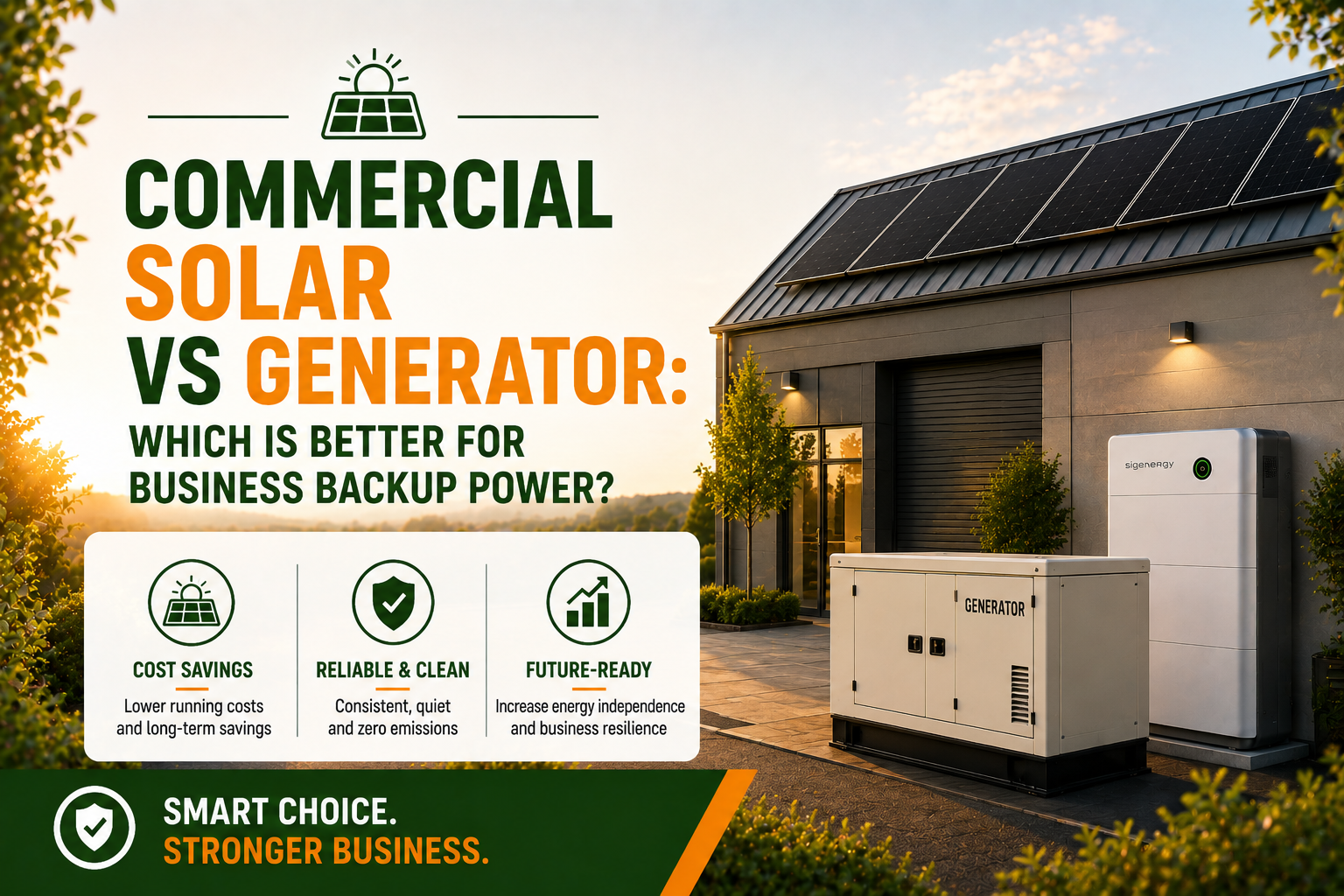

When businesses compare commercial solar vs generator backup, they usually think they’re choosing between two technologies. In reality, they’re choosing between two different philosophies of resilience — with very different 25-year cost profiles. A generator delivers instant high-load emergency backup but earns nothing the rest of the time; a solar-plus-battery system cuts electricity costs every single day while also providing outage cover. This guide works through both honestly, with real figures, so you can decide which solves your actual operational risk.
- 1. What businesses are actually trying to solve
- 2. How commercial generators work: costs and limitations
- 3. How solar + battery backup works
- 4. Total cost of ownership: the 25-year comparison
- 5. Planning, noise and emissions constraints
- 6. The hybrid approach: solar + battery + generator
- 7. Which solution fits which business type?
- 8. Decision framework: evaluate your own situation
- 9. Conclusion
- 10. FAQs
The Short Version (Read This First)
What businesses need to know about backup power options in 2026:
- Generators provide immediate high-load emergency backup but carry ongoing fuel, servicing and emissions costs that are consistently underestimated in upfront comparisons
- Solar + battery systems reduce daily electricity costs while also providing outage resilience — unlike generators, they work every day rather than sitting idle
- Over 25 years, a comparable solar + battery system typically delivers a net positive financial return, while a generator accumulates net cost with no offsetting savings
- Generators remain operationally essential for very high-load applications and extended outages — this guide reaches that conclusion honestly, not as a footnote
- Hybrid systems combining solar, battery and generator are increasingly the optimal choice where businesses need both daily savings and long-duration emergency capability
- The right answer depends on outage tolerance, load profile, fuel risk exposure and whether the business would benefit from daily cost reduction
- Solar4Good® designs resilience strategies around operational risk, not one-size-fits-all assumptions — call 0800 999 1454 or visit solar4good.co.uk
A diesel generator says: “when the grid fails, we survive temporarily.” By contrast, a solar-and-battery system says: “we reduce our grid dependence every day and gain backup capability at the same time.” In truth, neither approach is automatically better. For some businesses, generators still make complete operational sense. For others, generators are quietly becoming one of the most expensive forms of “cheap backup power” once fuel, maintenance and compliance costs are tracked over 10–25 years. So the real question is not which technology is better. It is what type of operational risk your business is trying to solve, and which system solves it most cost-effectively over its full life.
What Businesses Are Actually Trying to Solve With Backup Power
Different businesses buy backup systems for completely different reasons, and the gap between those reasons determines the right technology. Businesses that conflate “emergency backup” with “energy resilience” often buy the wrong system for their actual risk profile. The first step in any serious evaluation is defining exactly what the system needs to do. After all, keeping emergency lighting alive and running a production facility through a 12-hour outage are not the same problem, and they don’t need the same solution.
The four distinct backup requirements
- Critical-load continuity: keeping specific systems alive during an outage — servers, refrigeration, security, EPoS, access control. Often achievable for several hours with battery storage alone.
- Full-operation continuity: running the entire facility at normal capacity through an outage. Typically requires a generator for any duration beyond battery capacity.
- Demand and cost resilience: protecting against electricity price volatility rather than physical outages. Solar generation and battery storage address this; generators do not.
- Extended emergency endurance: maintaining operation through multi-day outages. Only generators with fuel supply can deliver this; battery storage alone cannot.
Why backup requirement type determines technology
Take a cold storage facility in the first category, keeping refrigeration running through a 2–4 hour outage. It can often be served entirely by a well-sized battery system with no generator. A manufacturer needing the fourth category — maintaining production through a 48-hour disruption — needs a generator regardless of how much solar and battery capacity is installed. In practice, most businesses fall into the first or second category, which changes the comparison significantly. The mistake is often buying a generator designed for the fourth category when the real risk is in the first.
★★★★★ Trustpilot
“The cost modelling was the most useful part. Seeing the 25-year comparison between generator fuel costs and battery-backed solar completely changed our thinking.”
— Verified customer
How Commercial Generators Work: Costs, Fuel Volatility and Limitations
Generators remain common because they solve one problem very effectively. Specifically, they provide instant high-load backup that runs continuously as long as fuel is available. For hospitals, industrial manufacturing, emergency infrastructure and critical refrigeration, this capability is irreplaceable. However, the financial reality of generator ownership over 10–25 years is consistently underestimated when businesses focus on purchase price alone. The ongoing cost structure is where the comparison with solar battery systems becomes most revealing.
The real annual operating costs of a commercial generator
A commercial generator carries several recurring annual costs. These include a maintenance contract (oil, filters, inspections and load testing), fuel for testing and minor operational use, compliance and emissions reporting, and acoustic enclosure upkeep. Together these add up to a meaningful yearly running cost that is easy to overlook when focusing on the purchase price alone.
On top of annual running costs, most sites also pay for an acoustic enclosure, a mid-life major overhaul around year 10–12, and a replacement unit around year 15–20. A business that calculates generator cost as “purchase price plus occasional fuel bill” typically underestimates the true 25-year total by a wide margin.
Fuel cost volatility: the risk most generator buyers underestimate
UK diesel prices rose by roughly 40–60% between 2020 and 2023. For emergency-only applications with low annual fuel use, this volatility has limited impact. For businesses using generators more intensively, the picture changes. With frequent short outages, commercial-scale load testing, or operations where grid failure is common, fuel becomes an open-ended liability that grows as energy prices rise. A generator that runs intensively burns a significant volume of fuel per hour. So an operation with a few hundred running hours a year faces a substantial annual fuel bill, before any maintenance or compliance costs. That figure rises with diesel prices, with no offsetting savings elsewhere in the energy budget.
How Solar + Battery Backup Works
A commercial solar and battery system works on a fundamentally different economic model from a generator. It is not idle infrastructure that costs money until needed. It works every single day, reducing electricity imports during generation hours, storing surplus for the evening, and providing backup capability during outages. So the financial model has two distinct value streams: the operational cost saving that runs continuously from day one, and the resilience capability that activates only during outages. This dual-value structure is what makes the 25-year comparison so different from the upfront capital comparison.
What a commercial solar battery system delivers
- Daily electricity cost reduction: every unit of solar consumed on-site saves about 27p (commercial rate), every operating day for 25 years.
- Battery backup during outages: stored energy powers critical loads during grid failure, typically for 2–6 hours depending on capacity and load.
- Peak demand management: battery discharge during demand peaks reduces the demand component of half-hourly metered bills.
- SEG export income: surplus solar exported to the grid earns 4–15p/kWh under the Smart Export Guarantee.
The backup duration of a battery system is its key honest limitation. A 100kWh battery supplying a 50kW critical load provides 2 hours of coverage; supplying 25kW, it provides 4 hours. For most UK commercial sites, outages are infrequent and short, with fewer than 5 hours of disruption annually. In those cases, battery backup is often sufficient. Where extended outages are a genuine risk, a hybrid configuration is the appropriate answer. For commercial battery options, see our battery storage page.
Total Cost of Ownership: The Rigorous 25-Year Comparison for Commercial Solar vs Generator
This is the comparison most commercial solar vs generator guides avoid, because it requires honest figures for both sides. The worked example below uses a medium commercial site: a 50-person warehouse or office with consistent daytime operations. It compares a 100kVA diesel generator (emergency-only, standard backup) against a 50kW solar system with a 100kWh battery, which provides both daily savings and short-duration backup. The figures use current UK pricing and are honest about the battery’s limitations.
25-year cost comparison: generator vs solar + battery
Over a full 25-year life, the two options behave very differently. The generator has a much lower upfront cost. However, it adds an acoustic enclosure, ongoing maintenance and fuel, a mid-life major overhaul and an eventual replacement unit, none of which produce any return. The solar and battery system has a higher upfront cost and a mid-life battery replacement, but it generates electricity savings every single operating day. Across 25 years those savings substantially exceed the system’s total costs. As a result, it ends in a net positive position. The generator, by contrast, only ever accumulates cost. The Annual Investment Allowance improves the solar position further by letting the business deduct the full capital cost from taxable profits in Year 1.
What the numbers actually show
Over 25 years, the generator only ever accumulates cost, with no offsetting return. The solar + battery system has higher gross expenditure in nominal terms. However, its electricity savings exceed those costs substantially, leaving it in a net positive position. In addition, the Annual Investment Allowance improves the solar position by letting the business deduct the full capital cost from taxable profits in Year 1, at the 25% corporation tax rate. You can read the full framework on the gov.uk Annual Investment Allowance guidance.
Where the generator still wins: honest limitations of the comparison
This comparison applies to a specific scenario. It assumes a medium commercial site where the solar + battery system’s 2–4 hour backup duration is sufficient, and where daytime consumption is high enough to generate meaningful savings. It changes materially in these scenarios:
- Low daytime electricity consumption: if the site uses little electricity during daylight hours, solar savings are smaller and the 25-year advantage narrows significantly.
- Very high instantaneous load requirements: machinery needing 200kW+ at startup needs a generator; no commercial battery handles this economically.
- Extended outage risk: businesses facing genuine multi-day disruption need a generator regardless of solar and battery capacity.
- Capital-constrained businesses: if the larger upfront investment isn’t available, a generator is the viable option. However, the trade-off is that long-term costs are higher.
Need a backup power assessment?
★★★★★ Trustpilot
“Solar4Good didn’t try to oversell batteries as a magical replacement for generators. They actually helped us build a layered resilience strategy that made operational sense.”
— Verified customer
Planning, Noise and Emissions Constraints
Planning and compliance are increasingly where generators create friction that wasn’t anticipated at purchase. Solar + battery systems avoid most of these constraints by design. Even so, it is worth understanding the specific generator constraints affecting UK commercial deployments, because they affect both cost and operational flexibility over time.
Generator planning and compliance requirements
Commercial generators may require planning permission where they affect nearby properties through noise, emissions or visual impact. Several requirements can apply. One is acoustic enclosures where noise exceeds permitted development thresholds, needed on most urban commercial sites. Another is Environment Agency permits for generators above certain emission thresholds. A third is fuel storage compliance under the Control of Pollution Act and HSE regulations. At some sites, planning conditions also impose restricted operating hours. These requirements have tightened significantly since 2015 and are expected to continue doing so as net zero commitments translate into local planning policy.
Why solar + battery avoids these constraints
By contrast, battery systems operate silently and produce zero direct emissions. They require no fuel storage, no acoustic enclosure, no emissions permit and no restricted-hours condition. In most cases, a commercial battery system and associated solar installation qualifies as permitted development on an existing commercial building without a formal planning application. This is a practical advantage that compounds over time as generator planning requirements tighten further.
Beyond Commercial Solar vs Generator: Adding Battery for Tiered Resilience
For many enterprise sites, the commercial solar vs generator framing is a false choice. The most resilient and financially efficient strategy often combines all three technologies in a deliberate tier structure, where each component handles the load type it suits best. This approach is increasingly common among logistics operators, manufacturers and healthcare-adjacent facilities where both daily savings and extended emergency capability are genuine requirements.
How a tiered resilience strategy works in practice
- Solar handles: daytime operational demand, battery charging and electricity cost reduction, generating a financial return every working day.
- Battery handles: short-duration outages (2–6 hours), peak demand shaving, evening demand offset, and transition power when switching from grid to generator.
- Generator handles: extended outages beyond battery capacity, very high instantaneous startup loads, and long-duration emergency operation.
In a well-designed hybrid system, the generator runs far less often. This is because the battery handles most short outages entirely, while the solar system reduces grid dependency throughout normal operations. This cuts fuel consumption, maintenance cycles and compliance exposure compared to a generator-only strategy, while keeping full heavy-load capability when needed.
Which Solution Fits Which Business Type?
Ultimately, the right backup strategy is determined by operational risk profile, not business size. Two businesses in identical buildings can need completely different solutions based on how they use electricity and what failure means operationally. The table below maps typical business types to their most appropriate strategy, with the reason stated explicitly.
| Business type | Best-fit solution | Primary reason |
|---|---|---|
| Office buildings | Solar + battery | Short outage tolerance; strong daytime consumption; daily savings compound well |
| Warehouses and logistics | Solar + battery | Consistent daytime loads; forklift and HVAC use; short outage risk |
| Cold storage and refrigeration | Hybrid | Critical load continuity required; battery covers short outages; generator for extended |
| Heavy manufacturing | Generator + battery | High instantaneous startup loads; battery reduces peak charges |
| Data-heavy operations | Hybrid | IT infrastructure critical; battery for clean switchover; generator for extended |
| Healthcare-adjacent facilities | Generator dominant | Regulatory continuity requirements; extended duration non-negotiable |
| Schools and public buildings | Solar + battery | Strong term-time daytime demand; short outage tolerance; sustainability objectives |
💡 The question behind the table
The most important variable is not business type — it is outage tolerance. A cold storage facility that can tolerate a 4-hour outage has very different needs from one that cannot tolerate 30 minutes. Solar + battery systems suit the first; only a hybrid or generator-primary strategy suits the second. Defining outage tolerance precisely is the first step in any serious backup power assessment.
★★★★★ TrustATrader
“From initial assessment through to installation, Solar4Good understood both our energy costs and our resilience requirements. The hybrid design they proposed has delivered on both fronts.”
— Verified customer
Decision Framework: How to Evaluate Your Own Situation
The following framework is designed for facilities managers and commercial property directors evaluating backup power options. It replaces the qualitative “which is better?” debate with a structured set of questions that produce a defensible recommendation for a specific site. Work through each dimension before requesting quotes from any supplier.
Dimension 1: Outage risk profile
- How often does your site experience outages? (The UK average is 3–5 hours/year; rural grid areas can be much higher.)
- What is your maximum acceptable outage duration? (Minutes means battery only; hours means battery or hybrid; days means generator essential.)
- What happens operationally and financially if power fails for 2 hours? For 8 hours? Quantify the actual loss, not the worst-case fear.
Dimension 2: Load profile and solar opportunity
- What is your annual consumption, and what share falls during solar generation hours? If daytime consumption is low, the case for solar + battery weakens.
- What are your critical loads in a backup scenario? List them and their kW draw; this sets the minimum battery capacity required.
- Do you have high-instantaneous-load equipment? Motors, compressors and large machinery with startup loads above 50kW mean battery alone can’t handle the transition.
Dimension 3: Practical and compliance constraints
- Are there planning, noise or emissions constraints on your site? Urban or residential-adjacent sites face tightening generator restrictions.
- How exposed is your operation to fuel price volatility? A generator used 200+ hours/year has meaningful diesel exposure; one used 10 hours/year does not.
- What are your sustainability reporting obligations? Scope 1 emissions from diesel generators are directly visible in ESG reporting in a way grid electricity is not.
What the answers indicate
Short outage tolerance, strong daytime consumption, an urban site and sustainability pressure together point to solar + battery as the primary strategy. Extended outage risk, high instantaneous loads, a fuel-accessible site and limited daytime consumption mean a generator remains necessary, with solar + battery as a supplement. Where both conditions are present across different operational areas, a hybrid system is the appropriate answer.
⚠️ An honest note
Solar batteries are not perfect replacements for generators in every scenario. For heavy industrial loads or long-duration emergency backup, generators remain operationally essential in many environments. Solar4Good focuses on designing resilience systems around real operational risk, not forcing every business toward one technology because it suits one side of the comparison.
💡 Ask your installer
Ask any installer presenting a backup power proposal three questions. First, what is the maximum continuous load this system supports in backup mode? Second, how long will it support that load? And third, what happens after the battery is depleted? A credible proposal answers all three explicitly before any contract is signed.
Conclusion: Backup Power Is Operational Strategy
The old backup power model was simple: buy a generator, test it quarterly and hope you rarely need it. That model is not obsolete, but it is increasingly incomplete. Businesses now operate where electricity prices are volatile, emissions compliance is tightening, and grid stability is more variable than the infrastructure planning of 20 years ago assumed. Done rigorously over 25 years with real cost data, the comparison is clear. Solar + battery systems outperform generators financially for most medium commercial sites where outage duration risk is manageable and daytime consumption is meaningful. Even so, generators retain a clear role for extended outages and high-instantaneous loads no battery currently handles economically.
The honest conclusion is not “solar wins”. It is: define what you need backup for precisely, quantify what failure costs, and choose the system that solves that specific problem at the lowest 25-year net cost. For most medium commercial businesses, that is solar + battery or hybrid. For some industrial operations and high-risk continuity requirements, it still includes a generator. Solar4Good helps businesses work through that analysis properly — not with a predetermined answer, but with the actual numbers.
📞 Get a backup power assessment for your site from Solar4Good
Solar4Good assesses your site’s outage risk profile, load requirements and solar opportunity before recommending a strategy. Call 0800 999 1454 or visit solar4good.co.uk. Read over 800+ verified five-star reviews on Trustpilot and Checkatrade.
Solar4Good Ltd · 79 College Road, Harrow, HA1 1BD · MCS: NAP/72775/25/4 · HIES: S4G/A/1484
Frequently Asked Questions
Is solar battery backup better than a generator for businesses?
For most medium commercial sites with consistent daytime use and outage durations below 4–6 hours, solar + battery systems win financially over 10–25 years. They also provide equivalent backup capability. For businesses with very high instantaneous loads or genuine multi-day outage risk, generators remain essential. In that case, the right answer is a hybrid system rather than a choice between one or the other.
Are generators cheaper than solar batteries?
Upfront, yes — a generator has a much lower purchase price than an equivalent-capability solar + battery system. Over 25 years, though, the generator only accumulates net cost with no offsetting savings. Meanwhile, the solar + battery system generates substantial electricity savings and ends in a net positive position. The long-term comparison typically favours solar + battery.
Can solar batteries power an entire commercial building during outages?
Some can support full-building operation temporarily, but batteries are better sized around critical loads — refrigeration, IT, security, emergency lighting — rather than full-building operation. A 100kWh battery supplying 50kW of critical loads provides 2 hours of backup; supplying 25kW, it provides 4 hours. Defining which loads are truly critical is the most important step in any design.
More on backup power
Do generators require planning permission in the UK?
Some commercial generator installations require planning permission where noise, emissions or fuel storage affect nearby properties. Acoustic enclosures, Environment Agency permits and restricted operating-hour conditions are increasingly common on urban commercial sites. Battery systems avoid these constraints by operating silently and without direct emissions.
How does fuel price volatility affect the generator comparison?
UK diesel prices rose 40–60% between 2020 and 2023. For emergency-only generators used 10–20 hours per year, this has modest impact. For generators used more intensively, fuel becomes an open-ended liability that compounds as energy prices rise. Solar + battery systems have no fuel exposure; their cost profile is fixed at the point of installation.
What businesses benefit most from solar battery backup?
Warehouses, offices, logistics sites, schools and commercial facilities with strong daytime consumption and outage tolerance of 2–4+ hours typically achieve the strongest return. The combination of daily electricity savings and backup capability makes the investment case compelling where both apply at once.
What is the biggest mistake businesses make with backup power planning?
Calculating cost on purchase price rather than 25-year net cost. A generator’s apparent upfront affordability versus a solar + battery system masks the fact that the generator returns nothing over its life while accumulating fuel, maintenance and replacement costs. The 25-year net comparison reverses the apparent advantage entirely for businesses with strong solar savings potential.
About the Author
Manan Shah
Co-Founder of Solar4Good UK. Leads Solar4Good's commercial strategy and customer relationships, and is quoted as a clean-energy authority by some of the UK's most trusted news publications. Quoted in the Financial Times and The Times on UK solar.
📞 Book a free solar consultation
Call us on 0800 999 1454 or visit solar4good.co.uk
Read over 800+ verified five-star reviews on Trustpilot and Checkatrade
Solar4Good Ltd · 79 College Road, Harrow, HA1 1BD · MCS: NAP/72775/25/4 · HIES: S4G/A/1484