
Enphase vs SolarEdge 2026: Why Microinverters Win on UK Roofs
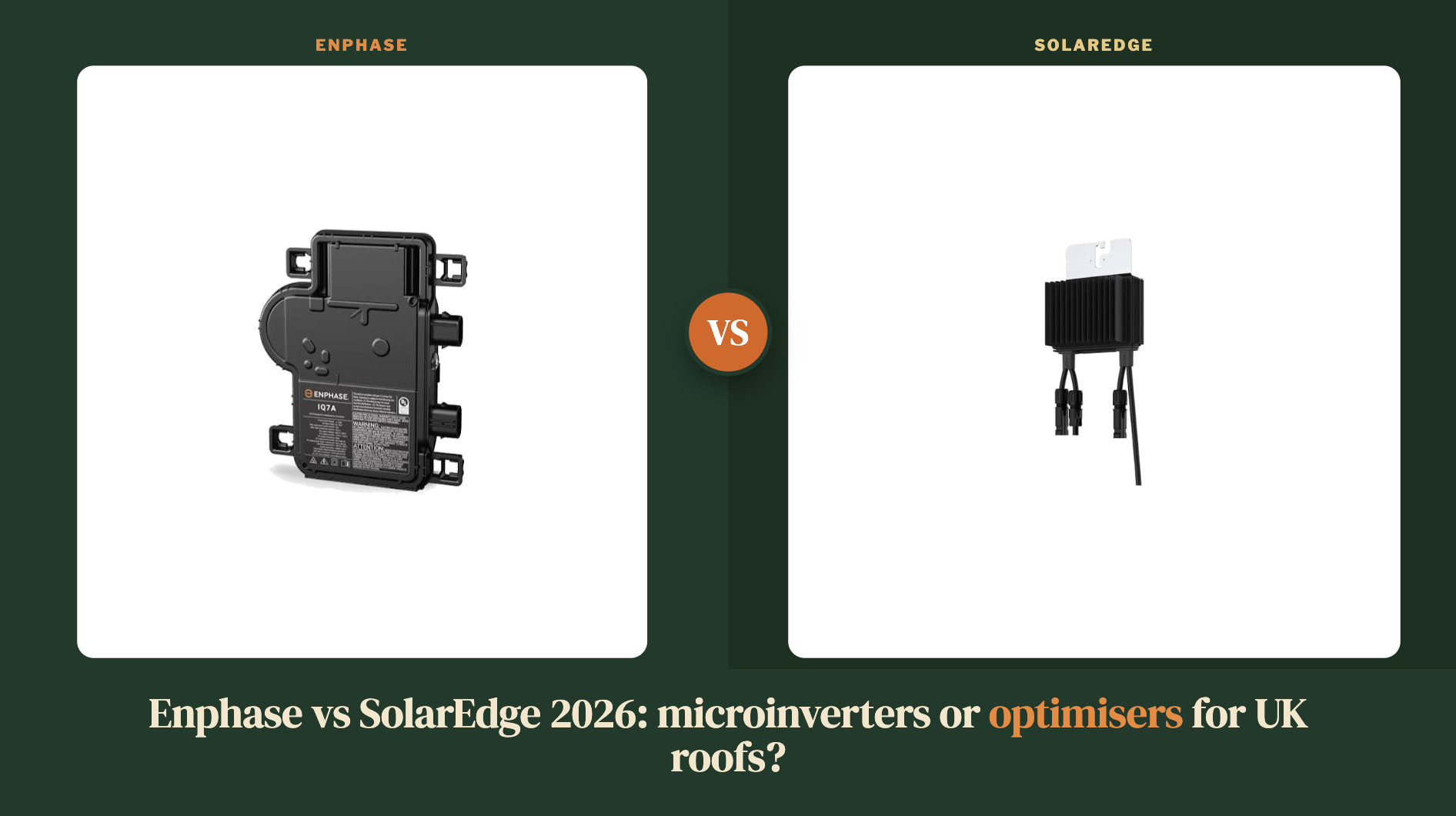

Choosing between Enphase and SolarEdge for a shaded or complex roof, and want to know which one you will still be glad you picked in 20 years? Here is the straight answer. Enphase is the stronger choice for most UK homes: it fits a complete microinverter to every panel, so there is no central inverter to fail, no high-voltage DC on your roof, and a 25-year warranty covering the whole conversion. SolarEdge is a capable system, yet it keeps one central inverter that carries just 12 years of cover as standard. Solar4Good® installs Enphase across the UK.
The Short Version (Read This First)
- Enphase wins for most UK homes. A full microinverter sits on every panel, so each one is an independent generator
- No single point of failure. Enphase has no central inverter at all, while every SolarEdge panel routes through one
- Warranty gap: Enphase covers the whole conversion for 25 years. SolarEdge covers optimisers for 25 years but its central inverter for only 12 as standard
- Any roof size: Enphase scales down to a single panel. SolarEdge needs a minimum string of roughly 6 to 7 panels
- Safer by design: Enphase converts to AC at the panel, so no high-voltage DC runs across your roof
- SolarEdge is still a credible system, and both beat a plain string inverter on shaded roofs. The architecture is what separates them
- Solar4Good installs Enphase. Call 0800 999 1454 or visit solar4good.co.uk
Quick Verdict
Enphase is the better long-term choice for most UK roofs, and the reason is architectural rather than marketing. Because Enphase converts power at each panel, the system has no central inverter, which is the component most likely to fail and the one carrying the shortest warranty in a SolarEdge setup. Consequently, you get true per-panel independence, 25-year cover on the conversion, and a system that keeps producing even if one component ever stops.
SolarEdge deserves credit for pioneering panel-level optimisation, and it comfortably outperforms a plain string inverter on a difficult roof. Even so, it stops halfway: the optimisers give you panel-level control, yet everything still funnels through one box on the wall.
★★★★★ Trustpilot
“Our roof faces three ways with a chimney casting shade. Solar4Good explained the optimiser-versus-microinverter choice clearly and fitted Enphase. Seeing every panel in the app has been brilliant.”
Verified customer
Enphase vs SolarEdge at a Glance
| Feature | Enphase | SolarEdge |
|---|---|---|
| Technology | Full microinverter per panel | DC optimiser per panel, plus a central inverter |
| Where DC becomes AC | At each panel, on the roof | At one central inverter |
| Single point of failure | None | Yes, the central inverter |
| Warranty on conversion | 25 years | 12 years as standard |
| Optimiser warranty | Not applicable | 25 years |
| Minimum system size | One panel | Around 6 to 7 panels per string |
| High-voltage DC on roof | No | Yes |
| If one component fails | One panel drops out | The whole system stops |
| Panel-level monitoring | Yes | Yes |
How the Two Technologies Differ
Both systems fix the core weakness of a plain string inverter, where one shaded panel drags down the whole string. Specifically, each adds electronics to every panel so that panels perform independently. What those electronics actually do is where the two part company.
Enphase fits a complete microinverter to each panel, converting DC to AC right there on the roof. As a result, every panel becomes a self-contained AC generator, and no central inverter exists anywhere in the system. SolarEdge takes a halfway approach instead. It fits a DC optimiser to each panel for panel-level control and monitoring, yet the actual conversion still happens at a single central inverter on your wall. In short, Enphase distributes the work, while SolarEdge concentrates it. Our microinverters guide explains the technology in depth.
The Single Point of Failure
Notably, this is the difference that matters most across a 25-year system life. Because SolarEdge routes every panel through one central inverter, that inverter is a single point of failure. If it stops, your entire system stops with it, and generation halts until an engineer replaces the unit.
By contrast, an Enphase system has no central inverter to lose. Consequently, if one microinverter ever fails, only that single panel drops out while every other panel keeps producing. You lose a fraction of your generation rather than all of it, and often you would not notice until the app flagged it. For a component expected to run for decades on a roof, that resilience is a genuine engineering advantage rather than a talking point.
Warranty: The 13-Year Gap
Warranty exposes the clearest gap between the two, and it follows directly from the architecture. Enphase covers its IQ8 microinverters for 25 years, matching the panels themselves and covering the entire DC-to-AC conversion. SolarEdge covers its optimisers for 25 years too, which sounds equivalent at first glance.
Look closer, though. The SolarEdge central inverter, the part doing the actual conversion and the part most likely to fail, carries only 12 years of cover as standard. Extending it to 20 or 25 years costs extra. Consequently, an unextended SolarEdge system may face an out-of-warranty inverter replacement around year 12, roughly halfway through the panels’ life. An Enphase system avoids that cost by design, because there is no central inverter to replace. Both manufacturers are large and financially sound, so honouring claims is not the worry here. The coverage length is.
Shading, Small Roofs and Safety
Naturally, both handle partial shading far better than a plain string inverter, isolating a shaded panel so it cannot drag down its neighbours. On a moderately complex roof, either delivers a strong result, and that shared strength is real.
Small and broken-up roofs, though, clearly favour Enphase. SolarEdge needs a minimum string of roughly 6 to 7 panels to function at all, so very small arrays or roofs split into awkward sections can be difficult or simply unviable. Enphase scales down to a single panel, since each one operates alone. Additionally, Enphase converts to AC at the panel. As a result, no high-voltage DC runs across your roof, which is a safety point many UK homeowners value once it is explained to them.
Which Should You Choose?
Choose Enphase for a shaded, complex or multi-aspect roof. You get true per-panel independence, no single point of failure, 25-year cover on the conversion, panel-level monitoring, no high-voltage DC overhead, and the flexibility to fit any roof down to a single panel. That combination is why Solar4Good installs it.
SolarEdge remains a reasonable option for homeowners who specifically want a central inverter and are willing to pay to extend its warranty to match the panels. Ultimately, though, if you are already paying for panel-level technology, it makes sense to buy the version without a single point of failure. On a simple, unshaded roof, mind you, a good string or hybrid system may deliver similar output for less, and an MCS-certified installer should assess shading honestly before recommending anything. Eligible home installations carry 0% VAT until 31 March 2027. See our best solar inverters guide for the wider field.
📞 Get honest advice on panel-level solar
Solar4Good installs Enphase and will tell you plainly whether a panel-level system suits your roof at all. Call 0800 999 1454 or visit solar4good.co.uk. Read over 500+ verified five-star reviews on Trustpilot and Checkatrade.
Solar4Good Ltd · 79 College Road, Harrow, HA1 1BD · MCS: NAP/72775/25/4 · HIES: S4G/A/1484
Frequently Asked Questions
Is Enphase or SolarEdge better?
Enphase is the better choice for most UK roofs. A full microinverter on every panel means no central inverter, no single point of failure, and 25-year cover on the whole conversion. SolarEdge uses optimisers plus one central inverter, which carries only 12 years as standard and stops the entire system if it fails.
What is the difference between Enphase and SolarEdge?
Enphase fits a complete microinverter to each panel, converting DC to AC on the roof with no central inverter. SolarEdge fits a DC optimiser to each panel for panel-level control, but conversion still happens at one central inverter. Enphase distributes the work; SolarEdge concentrates it in a single box.
Which has the better warranty, Enphase or SolarEdge?
Enphase, clearly. Its microinverters carry 25 years covering the entire conversion. SolarEdge covers optimisers for 25 years, but the central inverter doing the actual work carries only 12 years as standard, extendable at extra cost. That leaves a 13-year gap on the component most likely to fail.
More on Enphase vs SolarEdge
Which is better for a small or heavily shaded roof?
Enphase. It scales down to a single panel, since each operates independently. SolarEdge needs a minimum string of around 6 to 7 panels, so very small or broken-up roofs can be awkward or unviable. Enphase also puts no high-voltage DC on the roof, which many homeowners prefer.
What happens if a component fails on each system?
With Enphase, a failed microinverter takes out only that one panel while the rest keep producing. With SolarEdge, a failed central inverter stops the whole system until it is replaced. That difference follows from the architecture, not the build quality of either brand.
Do both offer panel-level monitoring?
Yes. Both show the performance of every individual panel, so shading, faults and underperformance are easy to spot on either system. That shared strength is a real advantage over a plain string inverter, and it is one area where the two are genuinely level.
About the Author
Manan Shah
Co-Founder of Solar4Good UK. Leads Solar4Good's commercial strategy and customer relationships, and is quoted as a clean-energy authority by some of the UK's most trusted news publications. Quoted in the Financial Times and The Times on UK solar.
📞 Book a free solar consultation
Call us on 0800 999 1454 or visit solar4good.co.uk
Read over 800+ verified five-star reviews on Trustpilot and Checkatrade
Solar4Good Ltd · 79 College Road, Harrow, HA1 1BD · MCS: NAP/72775/25/4 · HIES: S4G/A/1484