
Top 10 Solar Panel Installers in Cornwall: Are They Worth It for Your Home or Business?
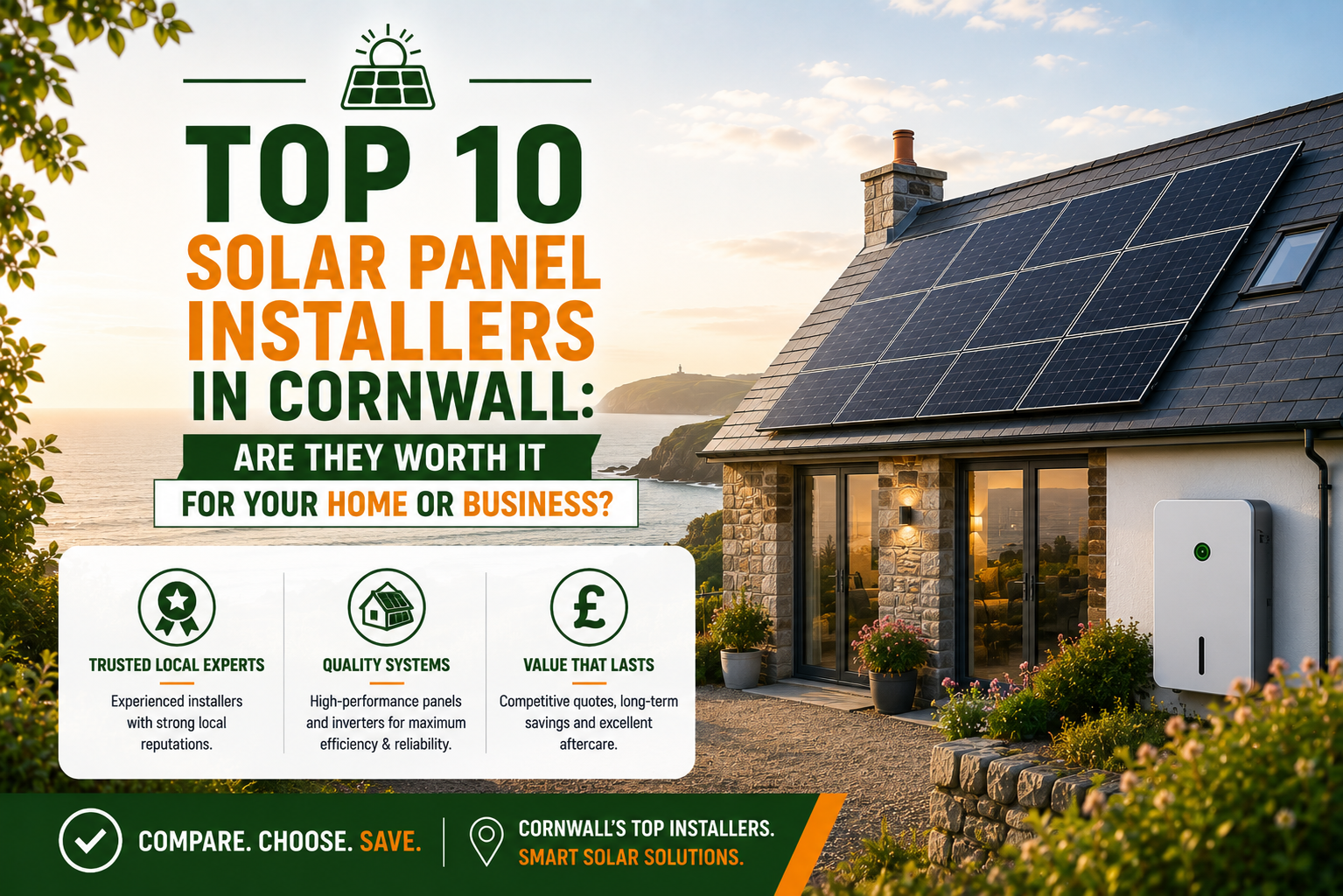

Cornwall is one of the UK’s strongest regions for solar panels — higher sunlight levels and longer summer daylight hours mean strong annual output, particularly for south-facing roofs. Coastal conditions, protected landscape rules and the mix of older cottages, farm buildings and modern homes mean system design still matters — even in a sunny region.
- 1. Top 10 solar panel installers in Cornwall
- 2. Cornwall solar snapshot: costs, output & local context
- 3. Why solar panels work well in Cornwall
- 4. What solar panels typically cost in Cornwall
- 5. Comparing solar installers in Cornwall
- 6. Grants & incentives available in England
- 7. Expected solar output in Cornwall homes
- 8. Solar4Good®’s installation process in Cornwall
- 9. Conclusion
- 10. FAQs
Short Summary
What Cornwall homeowners need to know before choosing a solar installer:
- Cornwall is one of the UK’s strongest regions for solar panels — higher sunlight levels and longer summer daylight hours mean strong annual output, particularly for south-facing roofs
- Coastal conditions, protected landscape rules and the mix of older cottages, farm buildings and modern homes mean system design still matters — even in a sunny region
- A typical 4–5 kWp residential installation produces around 3,800–5,200 kWh per year, placing Cornwall among the top-performing regions in England
- Upfront grants are limited — the main financial benefits come from lower electricity bills, SEG export payments and 0% VAT on residential installations
- Comparing installers on system design, coastal installation experience and aftercare is more important than simply choosing the lowest quote
- Solar4Good installs across Cornwall for homes, farms and commercial properties — call 0800 999 1454 or visit solar4good.co.uk for a free no-obligation assessment
Cornwall has quickly become one of the UK’s most active regions for solar, and it’s not hard to see why. Higher sunlight levels, plenty of open roof space and a strong local push toward renewables mean many homes and businesses already see solar as a practical upgrade rather than something experimental. That doesn’t mean every installation looks the same, though. Coastal conditions, planning rules in protected landscapes and the mix of older cottages, farm buildings and modern homes across the county mean layout and design still matter a lot. The difference often comes down to how panels are positioned, which inverter setup is used, and how the system is tailored to everyday energy use rather than just roof size.
Top 10 Solar Panel Installers in Cornwall
Choosing a solar installer in Cornwall involves more than simply comparing prices. System design, installer experience, equipment quality and long-term support all influence how well a solar system performs over the next 20–25 years. Below are ten solar installers operating in Cornwall and the surrounding region, not ranked — the right installer usually depends on your property, roof layout and long-term energy goals.
Solar4Good
Solar4Good installs solar systems across Cornwall for homes, farms and commercial properties, helping property owners turn unused roof space into long-term energy savings. The company focuses on designing systems that match how electricity is actually used rather than relying on fixed installation packages. Each project begins with a detailed assessment of the property, including roof orientation, shading, structural layout and expected energy demand — particularly valuable in Cornwall where coastal exposure, rural properties and mixed building styles often require careful system planning.
Core services: residential solar panel installations, commercial systems for businesses and agricultural buildings, battery storage integration, EV charger installation, and system monitoring.
Solar4Good was listed by the Federation of Master Builders (FMB) as the Best Solar Panel Installer of 2026 and was awarded Best Customer Service by independent review platform Eco Experts. As an MCS-certified installer, Solar4Good manages grid connection approvals, commissioning and ongoing aftercare.
Naked Solar
Based in Newquay, Naked Solar is one of the most recognised solar installers operating across Cornwall. The company provides residential solar installations alongside Tesla Powerwall battery systems and EV charger integration. Their projects typically involve rooftop solar installations designed to maximise household energy independence.
Sun Sparks Limited
Operating from Troon near Camborne, Sun Sparks Limited focuses on residential solar installations across Cornwall. The company is known for producing detailed system proposals and helping homeowners understand how different panel layouts and battery options affect long-term performance. Their approach often suits households comparing several quotes before deciding on a system design that fits both their roof and energy usage.
Smarter Green Energy
Smarter Green Energy operates from Fraddon near St Columb and focuses primarily on residential solar panel installations and battery storage systems. The company takes a more personal approach to projects, often working closely with homeowners to refine system settings and performance over time. Their ongoing involvement can be helpful for households new to solar, particularly when adjusting battery settings or understanding seasonal generation patterns.
Devon & Cornwall Electrical
Although based in Plympton near Plymouth, Devon & Cornwall Electrical covers installations throughout Cornwall as well as Devon. The company provides solar panel installations alongside electrical services, giving them strong expertise in wiring integration and system setup. Their work includes both new installations and the removal or replacement of existing systems, useful for properties upgrading older solar equipment.
Generation Solar
Generation Solar operates from Bude and focuses on residential solar panel systems across northern Cornwall and neighbouring areas. The company is run by a small team that prioritises clear communication and flexible installation planning. Some projects involve installing inverter or battery equipment ahead of the solar array itself, allowing homeowners to spread installation steps over time.
Simon Annear Solar & Electrical
Based in the Redruth and Scorrier area, Simon Annear Solar & Electrical is a long-established local business offering solar panel installations alongside plumbing, heating and air-source heat pump systems. Their experience working across older Cornwall properties can be particularly useful where roof structures or electrical systems require additional attention during installation.
MW Solar
MW Solar operates from Helston and provides residential solar installations throughout Cornwall. The company is led by a small hands-on team, with the owner often directly involved during installation projects. Their work focuses on practical solar systems designed to reduce electricity costs and improve resilience during power interruptions when paired with battery storage.
Harvest Cornwall
Harvest Cornwall, based in Newquay, installs solar panels alongside renewable heating systems such as air-source heat pumps. Their projects often involve helping homeowners integrate multiple renewable technologies. One feature that sets them apart is their willingness to apply for higher export limits with the grid operator on behalf of customers, allowing systems to export more electricity where network capacity allows.
Key Solar Ltd
Located in Liskeard, Key Solar Ltd provides solar panel installations, battery storage systems and EV charger setups across Cornwall. The company also carries out repairs or upgrades to systems originally installed by other providers, useful for homeowners dealing with older installations or equipment issues.
★★★★★ Trustpilot
“From initial survey to flawless installation, Solar4Good delivered an exceptional solar experience. The team installed 12 premium panels with a FOX 6kW hybrid battery system in a single day, working meticulously and leaving the site spotless. Clear explanations, transparent pricing with no hidden fees.”
— Verified customer
Cornwall Solar Snapshot: Costs, Output & Local Context
Before comparing installers or system designs, it helps to understand how solar typically performs across Cornwall.
| Factor | Cornwall context |
|---|---|
| Typical annual output | 3,800–5,200 kWh/year for most residential systems (4–5 kWp) |
| Roof orientation | South-facing for maximum output; east–west common across newer estates |
| Coastal considerations | Salt air and wind exposure may require corrosion-resistant mounting hardware |
| Typical costs | Residential installations often fall between £7,500 and £13,000 before batteries |
| Local adoption | Around 10% of Cornwall households already use solar — more than double the UK average |
Why Solar Panels Work Well in Cornwall
Cornwall’s reputation as one of the UK’s strongest solar regions isn’t just marketing — it comes down to a mix of sunlight levels, climate conditions and long-term renewable investment across the county.
- Higher sunlight levels: Cornwall receives some of the highest solar irradiance in the UK — areas like Truro see around 1,298 kWh/m² annually, roughly 19% above the national average, which helps shorten typical payback periods
- Longer annual sunshine hours: with around 1,450–1,600 hours of sunshine each year, solar panels in Cornwall often achieve strong annual output — a standard 4kW residential system can generate close to 3,800 kWh annually
- Coastal climate supports panel efficiency: Cornwall’s maritime weather provides mild temperatures that reduce the risk of panels overheating, while coastal winds provide natural cooling during sunnier months
- Stronger winter generation: because Cornwall sits further south, winter daylight hours remain longer than in northern regions, creating a steadier year-round production profile
- Local installation expertise: around 10% of households in Cornwall already use solar — more than double the UK average — which has built a strong local network of experienced installers familiar with coastal conditions
Ready to go Solar ?
What Solar Panels Typically Cost in Cornwall
Costs vary depending on system size, roof complexity and installer approach.
| Property type | Typical system size | Estimated cost range |
|---|---|---|
| Smaller homes | 2–3 kWp | £4,500–£6,500 |
| Medium homes | 4 kWp | £7,500–£10,500 |
| Larger homes | 5–6 kWp+ | £11,000–£16,000+ |
Battery storage is increasingly common across Cornwall, particularly for households looking to maximise self-consumption during evenings. Where pricing differs most is system design rather than equipment alone — two installations with similar panel counts may perform very differently depending on layout planning, inverter pairing and aftercare.
Customer testimonial
★★★★★ Trustpilot
“Solar4Good provided excellent service from beginning to end within 2 weeks. Their advice and professionalism with guiding me through the best suitable solar panels and battery that will suit me now and for the future were excellent.”
— Verified customer
Comparing Solar Installers in Cornwall
Most homeowners in Cornwall end up speaking to more than one installer before deciding. Instead of focusing on rankings or reviews alone, it’s usually more helpful to understand how different companies approach system design.
National installers
Some UK-wide providers offer streamlined systems built around fixed packages. These can work well for newer homes or straightforward rooftops where installation is relatively predictable, although flexibility around layout or equipment choice may be limited.
Local and regional installers
Cornwall has a strong network of local solar companies, many of which understand planning considerations in protected landscapes and the practical realities of coastal installations.
Design-led engineering installers
Other installers focus on building systems around real energy usage rather than a standard template. This approach often includes detailed layout planning, inverter pairing and battery integration from the start. Solar4Good works this way — prioritising long-term performance and realistic output expectations over quick-fit packages.
What’s worth comparing
- How system size is calculated based on real energy use
- Whether monitoring and aftercare are included
- How clearly export tariffs and battery options are explained
- Experience with coastal or rural properties
Grants & Incentives Available in England
Upfront solar grants are limited, but several incentives still support installations. For businesses, our commercial solar grants guide covers the full range of available funding mechanisms.
Smart Export Guarantee (SEG)
Energy suppliers pay homeowners for surplus electricity exported to the grid. Rates vary depending on tariff and supplier.
0% VAT on Residential Solar
Solar installations on residential properties currently benefit from 0% VAT until March 2027, reducing upfront costs compared with standard tax rates.
Local group-buying initiatives
Schemes like Solar Together occasionally run in parts of England, offering collective pricing through council-backed programmes. Rather than relying on grants alone, many Cornwall homeowners focus on export tariffs, battery storage and long-term energy savings.
Expected Solar Output in Cornwall Homes
A typical 4–5 kWp installation in Cornwall often generates between 3,800 kWh and 5,200 kWh annually, placing the region among the stronger performers in England.
- South-facing systems produce the highest totals
- East–west layouts provide steadier generation across the day, well-suited to households using electricity at different times
- Most electricity is generated between March and September, although systems continue producing energy year-round
- Even in a strong solar region, shading, roof pitch and panel placement can influence long-term performance more than postcode alone
Solar4Good’s Installation Process in Cornwall
Every solar installation starts with understanding the property and how electricity is actually used. Cornwall homes range from coastal cottages and farm buildings to modern developments, so designing a system that fits the roof and local conditions is key to reliable long-term performance.
Step 1: Initial review and site assessment
The process begins with a review of the property’s roof orientation, available space and potential shading. Coastal conditions, wind exposure and roof structure are also considered, especially in rural or seaside locations where mounting systems may need additional reinforcement.
Step 2: System design and equipment selection
The system layout is designed around how the building actually uses electricity. Panel placement, inverter configuration and optional battery storage are planned to maximise usable generation.
Step 3: Installation and system commissioning
Most residential installations take one to two days. Once everything is in place, the system is tested and commissioned to ensure it operates safely and performs as expected.
Step 4: Monitoring and long-term support
After installation, monitoring tools allow homeowners to track generation, energy usage and export performance. Solar4Good provides ongoing guidance to help customers understand how their system performs across seasons.
Customer testimonial
★★★★★ Trustpilot
“We were considering solar via a local council scheme but a friend recommended Solar4Good — and we’re really glad we made the switch. A site visit was booked the very next day after we confirmed. Scaffolders were in within the week, and our system was live just 10 days after commissioning.”
— Verified customer
Conclusion
Cornwall offers some of the strongest solar potential in England — but long-term performance still depends on thoughtful system design and realistic expectations rather than headline sunlight figures alone. Solar panels here benefit from strong yearly sunlight levels, but the real difference comes from how systems are planned around the property itself. Roof layout, energy usage and installer approach all shape how well a system performs over time.
If you’re thinking about solar panels in Cornwall, start with a proper look at your roof and electricity use. Speak to the Solar4Good team for a no-obligation assessment — we’ll review your setup, answer your questions and give you a clear picture of what solar could look like for your property.
Get a free Cornwall solar assessment from Solar4Good
Call us on 0800 999 1454 or visit solar4good.co.uk. Read over 661 verified five-star reviews on Trustpilot and Checkatrade.
Solar4Good Ltd · 79 College Road, Harrow, HA1 1BD · MCS: NAP/72775/25/4 · HIES: S4G/A/1484
Customer testimonial
★★★★★ TrustATrader
“The system’s performance has exceeded expectations, generating 550+ kWh monthly and reducing my grid dependence by 80%, with immediate 70% savings on electricity bills. Clear explanations, transparent pricing with no hidden fees.”
— Verified customer
Frequently Asked Questions
Are solar panels worth it in Cornwall?
Often, yes. Cornwall’s higher sunlight levels mean systems can generate strong yearly output, but roof layout and system design still matter more than location alone. Our solar panels worth it guide covers the full financial case for UK homeowners.
How much electricity can solar panels produce in Cornwall?
A typical 4–5 kWp system often produces around 3,800–5,200 kWh per year, depending on orientation, shading and panel placement. South-facing roofs usually generate the most.
Do coastal conditions affect solar panels?
Panels themselves are built for outdoor conditions, but coastal installs may use corrosion-resistant mounting and careful placement to handle salt air and wind exposure.
Do I need planning permission for solar panels in Cornwall?
Most homes fall under permitted development, though listed buildings or protected landscapes may need additional checks during the design stage.
Is battery storage worth adding in Cornwall?
Many households add batteries to use more of their daytime generation in the evening. Whether it’s worthwhile depends on energy usage and export tariffs. See our solar battery cost guide for pricing and options.
How long does installation take?
Most residential systems are installed within one to two days, although preparation, approvals and scheduling happen beforehand.
Should I compare multiple installers?
Yes. Installer approach, system design and aftercare can affect long-term performance as much as panel choice or price.
About the Author
Matthew
Solar Consultant with over a decade of UK solar experience, helping homeowners and businesses make clear, confident renewable energy decisions.
📞 Book a free solar consultation
Call us on 0800 999 1454 or visit solar4good.co.uk
Read over 800+ verified five-star reviews on Trustpilot and Checkatrade
Solar4Good Ltd · 79 College Road, Harrow, HA1 1BD · MCS: NAP/72775/25/4 · HIES: S4G/A/1484