Commercial Solar Panels for UK Businesses

Fully-installed commercial solar systems for UK businesses — designed, installed, and commissioned end-to-end by Solar4Good engineers.

  • 0.02% return rate across 10,000+ panels installed — the most reliable in the category
  • In-house MCS-certified engineers — no subcontractors, full workmanship warranty
  • DNO / G99 application + Full Expensing guidance handled in-house
Get your business solar quote →
60s — exactly what happens after you submit (no spam, no broker, real engineer call within one working day)

No high-pressure sales. We don't share your details. A real engineer will respond within one working day.

Real install — Islamic Centre of Brent
10,000+
Panels installed across the UK
0.02%
Return rate — the 10k:2 standard
85+
Commercial systems delivered
100%
In-house engineers — no subcontractors
MCS RECC HIES TrustMark
★★★★★ Excellent on Trustpilot, Checkatrade & Google
Trusted by UK businesses across every sector
The Pinn Medical Centre Limes Care Home Sun Mark Ltd Gatwick White House Hotel Strata Windows Fortune Group London The Sacred Heart Church + 15 more

As seen on and accredited by

How it's priced

How commercial solar is priced — what actually moves the number

Every commercial solar system is priced individually because every commercial roof is different. Five factors decide your final number: system size, roof complexity, hardware tier, DNO outcome, and current market conditions. Below is exactly how each one moves the price — so you know what to ask any installer, not just us.

FACTOR 01

System size (kW)

Bigger systems share fixed costs (scaffolding, design, DNO application, project management) across more panels, so the cost per kW drops as the system grows. A 30 kW SME system has a higher per-kW cost than a 150 kW industrial install. We size to your actual demand, not the maximum the roof can hold.

FACTOR 02

Roof complexity

Flat ballasted roofs, pitched tile, standing-seam metal, trapezoidal industrial sheeting, and asbestos all require different mounting systems and access plans. Multi-pitch roofs, height restrictions, fragile coverings, or structural reinforcement requirements all move the number. Confirmed at survey.

FACTOR 03

Hardware tier

Tesla Powerwall and SIG Energy sit at the top tier — best long-term reliability, best warranty position. Duracell and AlphaESS are solid middle-tier. Fox ESS, GivEnergy, Solis, and Dyness give a tighter-budget option without compromising MCS compliance. We recommend the right tier for your business, not the highest-margin product.

FACTOR 04

DNO outcome (G98 / G99)

Systems under 3.68 kW per phase clear G98 automatically. Most commercial systems above that need G99 approval from your local Distribution Network Operator. The outcome — full approval, export-limited approval, or upgrade-required — directly affects the inverter and battery sizing of your final system. We lodge the G99 application on your behalf.

FACTOR 05

Market conditions

Panel, inverter, and battery prices shift quarterly with global supply, currency, and policy. Scaffolding and labour rates move locally. We re-benchmark our pricing every quarter against actual market costs — so the quote you receive reflects today, not last year.

Typical 2026 ranges
What UK commercial solar actually costs in 2026

Below are typical fully-installed price ranges Solar4Good quotes for UK commercial systems in 2026. The £/kW figure drops as systems scale, because fixed costs (scaffolding, design, DNO application) spread across more panels. The "best annual bill" column shows the bill range a business should have for that system size to make sound financial sense.

System size £ / kW range Total fully installed Best annual bill
30 kW £900 – £1,000 £27,000 – £30,000 £8,000 – £14,000
40 kW £1,000 £40,000 £12,000 – £18,000
50 kW £900 – £950 £45,000 – £47,500 £18,000 – £24,000
60 kW £900 – £950 £54,000 – £57,000 £24,000 – £30,000
70 kW £900 – £950 £63,000 – £66,500 £30,000 – £36,000
80 kW £850 – £900 £68,000 – £72,000 £36,000 – £42,000
100 kW £800 – £850 £80,000 – £85,000 £42,000 – £50,000
120 kW £750 – £800 £90,000 – £96,000 £54,000 – £62,000
150 kW £750 – £800 £112,500 – £120,000 £72,000 – £80,000

Why we publish ranges, not fixed prices

Every commercial roof is different. A 50 kW install on a clean, accessible single-pitch metal roof costs less than a 50 kW install on a heritage building with multi-pitch tile and limited access. Hardware tier moves the number too — Tesla and SIG Energy sit at the top end; Fox ESS and GivEnergy sit at the budget end.

Publishing the range is the honest move. Fixed prices on a landing page either inflate to cover the worst case (overcharging the easy jobs) or set unrealistic expectations (undercharging the complex ones). We confirm your exact figure after a free site survey — and the survey is free whether you choose us or not.

The only way to know your precise number is a free site survey. We confirm to the pound after seeing the roof.

Get a precise quote →
The 10k:2 rule

Why our installs stay installed

Across 10,000+ panels installed by Solar4Good in the past 12 months, we've had exactly 2 service-call returns. That's 0.02%.

We publish this number because nobody else in the UK commercial solar market does — and it's the single most important number in solar installation. The cheapest quote often produces the most expensive long-term outcome: panels that fail, inverters that drop offline, mounting that loosens. A 25-year roof investment is the wrong place to discover your installer cut a corner.

The 10k:2 figure is what reliability actually looks like, measured against installs, not against marketing. It's also why we're picky about the hardware we put on commercial roofs — Tesla and SIG Energy at the top tier, Duracell and AlphaESS as the solid middle, Fox ESS and GivEnergy for tighter budgets without compromising MCS compliance.

RETURN RATE
0.02%
2 returns across 10,000+ panels
No comparable UK commercial installer publishes this number. Ask why.
Commercial packages

Choose the right size for your business

Basic
30 kW system
from £27,000 (£27k – £30k)
  • Panels: 70 × DMEGC or Jinko 440 W (Tier-1)
  • Annual generation: ~28,500 kWh
  • Inverter: Fox ESS three-phase, 10-yr warranty
  • Battery: Fox ESS 13 kWh add-on available
  • Monitoring: Solar4Good app, lifetime access
  • Warranty: 25 yr panel · 10 yr inverter · 5 yr workmanship
  • DNO / G99: filed by Solar4Good (G98 fast-track for some setups)
  • Best annual bill: £8,000 – £14,000
Best for SME workshops, small offices, and retail with a moderate daytime load.
Professional
100 kW system
from £80,000 (£80k – £85k)
  • Panels: 225 × Trina or Aiko 440 W (Tier-1, bifacial option)
  • Annual generation: ~95,000 kWh
  • Inverter: Fox ESS or SigenStor commercial, 10-yr warranty
  • Battery: SIG Energy or Tesla Powerwall, 50 kWh add-on available
  • Monitoring: Solar4Good platform + Sigen Cloud / Tesla app
  • Warranty: 25 yr panel · 10 yr inverter · 5 yr workmanship
  • DNO / G99: filed by Solar4Good, typical approval 4–8 weeks
  • Best annual bill: £42,000 – £50,000
Best for large warehouses, industrial sites, and multi-roof deployments.

Final design and hardware mix depend on roof, demand profile, hardware tier, battery configuration, and DNO outcome — confirmed after a free site survey.

Annual bill not in one of these three brackets? See the full 9-row ranges table in § 4 — we install systems from 20 kW (£8k bill) up to 1 MW. Multiple sites or unusual roof type? Our commercial team handles bespoke design. Talk to our commercial team →

Sizing calculator

What size system does your business need?

Tell us about your business

Your estimate

Recommended system
55 kW
~125 panels · fits your 320 m² roof
Est. cost installed
£49,500 – £52,250
Annual savings
£10,800 – £13,200
Annual generation
52,000 kWh
Bill offset
68%
Payback
4–5 years
CO₂ offset / year
10.8 t

Based on UK commercial averages and Solar4Good's actual install data. Exact figures, including the financial breakdown, are confirmed after a free site survey by an MCS-certified engineer.

Commercial Solar Solutions for UK Businesses
Why Solar4Good

UK businesses pick us because the maths is honest

Manan Shah
Solar Expert, Solar4Good

Manan is a core leader at Solar4Good, known for his "leader without title" philosophy — leadership is earned through truth, service, and customer-first thinking. With 15+ years of financial consulting experience across the UK and Europe and extensive experience educating customers about solar, he brings clarity and trust to renewable energy decisions for UK businesses. Manan has spoken at the Everything Electric Show and The Care Show, and has been featured on the BBC, Lyca Radio, Asian Voice, The Mirror, and The Independent. "Think of us less as sellers, more as partners — always learning, always serving."

  • Family-run, UK-based — no broker, no commission-driven sales
  • In-house engineers — Eddie's team has installed 75% of all S4G jobs
  • 85+ commercial systems delivered, MCS-certified throughout
Before you quote

Three things every UK commercial buyer should know

Most commercial solar quotes confuse buyers because three pieces of UK-specific jargon do real work in the maths. Here they are, in plain English, before you talk to anyone.

DNO / G99

Your local grid has to say yes

Any commercial system above 3.68 kW per phase needs a G99 application to your Distribution Network Operator (UKPN, Western Power, SSEN, etc). The DNO decides whether your local grid can take the export. Approval takes 2–8 weeks. Solar4Good lodges it for you and handles the back-and-forth. For systems where it applies, a G98 fast-track can save weeks.

Three-phase

Most commercial sites have it — solar must match

Almost every UK commercial building runs on a three-phase electricity supply (vs single-phase in homes). Your solar inverter must match. A residential single-phase inverter on a commercial site will work poorly, fail compliance, and likely fail at the DNO stage. Every Solar4Good commercial design specifies a three-phase inverter — Fox ESS, Solis, or SigenStor — from day one.

Capital Allowances

HMRC effectively pays a quarter of your system

Under Full Expensing (active to March 2026 and extended), your business can deduct 100% of the system cost from taxable profits in the year of purchase. At 25% corporation tax that's £25 back for every £100 spent. A £50k system becomes £37.5k net. Combined with 0% VAT and SEG export income, the effective payback can drop below 4 years. We provide the paperwork; your accountant files it.

If your installer can't answer these three questions in plain English, find a different installer. The DNO, the phase, and the tax position should never be a mystery to a UK commercial buyer.

How it works

How a commercial solar install actually works

Commercial solar installation is not the same job as residential. Below are the eight stages we run every UK commercial project through — from first call to monitoring handover.

1

Free site survey

A Solar4Good engineer visits, checks roof structure, electrical supply (single-phase vs three-phase, available capacity), DNO context, and inspects for asbestos, shading, and access constraints. No quote signed yet.

2

DNO / G99 application

For any system above 3.68 kW per phase we lodge the G99 application with your DNO (UKPN, Western Power, SSEN, etc). We handle the technical drawings, energy modelling, and back-and-forth. Approval: 2–8 weeks.

3

System design + fixed quote

Detailed design with panel layout, hardware specs (panel brand/wattage, inverter, battery), generation modelling in kWh, payback maths, Capital Allowances calculation, and SEG export projection. Fixed price, written, all assumptions on the page.

4

Scaffolding & access planning

For commercial roofs we plan scaffolding and access separately — most installs are scaffolded externally so your operations continue uninterrupted. For warehouses and industrial sites we use cherry-picker or rope-access where appropriate. Method statement and CDM-compliant.

5

Install + commissioning

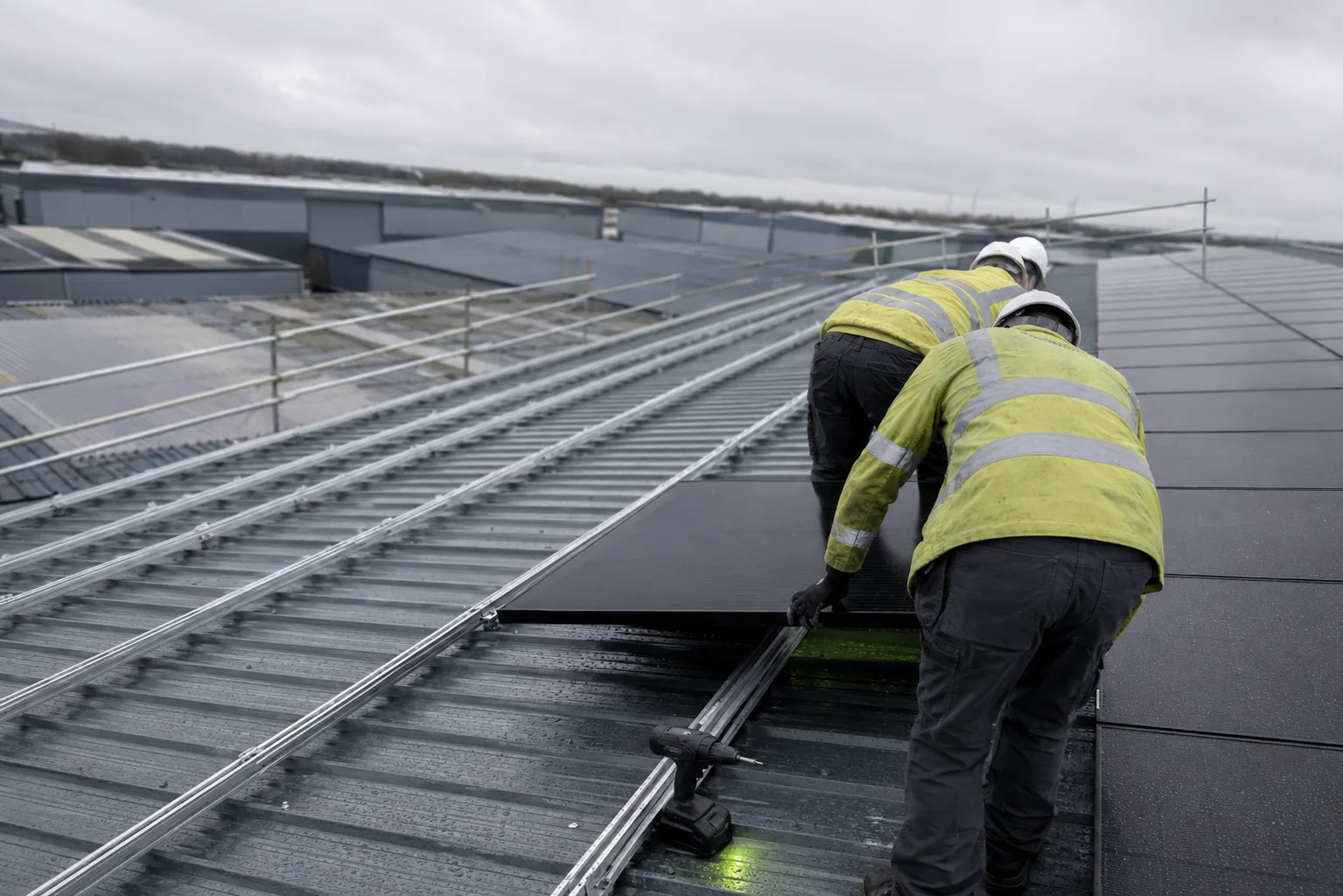
In-house engineers (no subcontractors), MCS-compliant. Typical install time: 3–10 days for 30–100 kW; 10–20 days for 100–500 kW; longer for multi-roof or ground-mount. Commissioning includes inverter setup, monitoring connection, and DNO export sign-off.

6

MCS sign-off

MCS certificate issued on completion — required for SEG registration, insurance, and Capital Allowances paperwork. Solar4Good MCS registration: NAP/72775/25/4. We also issue the HIES insurance-backed workmanship warranty.

7

Monitoring + handover

Solar4Good monitoring app installed and demonstrated. Your finance team gets the Capital Allowances paperwork. Your operations team gets the kit manuals, SEG registration, and a 24/7 dashboard showing live generation, consumption, and export.

8

Ongoing support

Lifetime monitoring access. Phone, WhatsApp, and on-site engineer visits where needed. 25-year panel warranty, 10-year inverter warranty, 5-year workmanship warranty — all backed by Solar4Good directly, not a finance partner.

Book a free site survey →

Sectors

Solar panels for business — sector by sector

Solar panels for business work differently depending on what you run. A warehouse with large flat roofs has a different solar profile than a care home with 24/7 demand, or a farm with mixed roof and ground-mount opportunities. Below are the 15 UK sectors Solar4Good installs commercial solar PV systems across — each with a dedicated page covering sector-specific design, planning, and funding.

Real installs

Commercial systems we've delivered

Twenty-two UK businesses — surgeries, care homes, hotels, retailers, manufacturers, and property groups — that cut their energy bills and accelerated their net-zero targets with Solar4Good. Below are three with full published numbers.

Healthcare · Pinner
The Pinn Medical Centre
49.2 kW · 120 × 410W panels · £86,593/yr saved · 73% bill reduction
Read full case study →
Care home · Birmingham
Limes Care Home
79.65 kW · 177 panels · multi-orientation roof · DMEGC Tier-1 panels · Fox ESS inverter
Read full case study →
Distribution · UK
Sun Mark Ltd
51.6 kW · ~58,000 kWh / yr clean power · grid-independence project · price stabilisation
Read full case study →
Grants & funding

Commercial solar grants & funding (2026)

There are very few direct cash grants for commercial solar in the UK in 2026. What does exist — and adds up to more than most grants would — is a stack of tax reliefs and incentives. Combined, these meaningfully reduce the true cost of a commercial solar system. The Solar4Good team handles the eligibility paperwork as part of every commercial install.

Full Expensing

Deduct the full cost of qualifying capital expenditure from taxable profits in the year of purchase. Available to companies paying UK corporation tax.

Annual Investment Allowance

An alternative or complement to Full Expensing for qualifying expenditure. Useful for smaller businesses or where Full Expensing doesn't apply.

0% VAT on commercial solar

Confirmed for 2026 — eliminates the VAT line on the install vs alternative kit.

Smart Export Guarantee

Payment from your energy supplier for excess electricity exported to the grid. Rates vary by supplier; we identify the best fit for your install.

Enhanced Capital Allowances

Specific to energy-efficient equipment. We confirm which assets in your system qualify for the enhanced relief.

Sector-specific schemes

Salix Finance (public sector / schools), Welsh Government, Scottish SME loan, local authority programmes. Coverage shifts; we keep a current list.

Business rates & tax relief

Solar panels and business rates: what UK businesses need to know

Solar panels installed on a commercial property do not increase your business rates in England, Wales, or Scotland. The Valuation Office Agency excludes microgeneration assets from rateable value. Combined with Full Expensing and 0% VAT, commercial solar carries one of the most tax-favourable positions of any capital asset a UK business can install.

  • No business rates increase on solar installed on commercial property (VOA microgeneration exclusion, England / Wales / Scotland)
  • Full Expensing lets you deduct qualifying capital expenditure from taxable profits in year one
  • 0% VAT on commercial solar — confirmed for 2026
  • SEG income is paid by your energy supplier on exported surplus
  • No effect on the rateable value of the building if you sell or refinance the premises

The exact tax position for your business depends on your corporation tax rate, accounting period, and capital allowance history. Your accountant confirms the position; we provide the documentation needed.

Read the full business rates & tax relief guide →
FAQs

Commercial solar — frequently asked questions

Cost & ROI

UK commercial solar typically runs £750–£1,000 per kW fully installed in 2026. A 30 kW system is around £27,000–£30,000; a 50 kW £45,000–£47,500; a 100 kW £80,000–£85,000. The price per kW drops as systems scale because fixed costs (scaffolding, design, DNO) spread across more panels. Exact figure confirmed at survey.
Typical payback for UK commercial solar is in the 4–7 year range, depending on system size, your current electricity bill, and how you use the building during daylight hours. Combined with Full Expensing and 0% VAT, the effective payback after tax relief is typically meaningfully shorter.
The right size depends on your annual electricity bill, available roof area, and demand profile. As a rule of thumb: a moderate annual bill suggests a 30 kW system; a higher one suggests 50 kW; a large industrial load suggests 100 kW+. Use our commercial sizing calculator above for a tailored estimate.
Most of our commercial customers purchase outright to maximise Full Expensing benefits, but we can introduce you to vetted finance partners offering asset finance, leasing, or PPA structures. We don't earn commission from finance partners — we recommend the option that suits your situation.

Process & Install

Typical timeline is 6–12 weeks for systems under 50 kW. Larger systems requiring G99 DNO approval add 2–8 weeks for grid sign-off. Site survey happens in week 1; design and quote in week 2; the install itself runs 3–10 days for most commercial systems.
Most installs are scaffolded externally with all roof work done from outside. Internal disruption is minimal — typically a few hours for the inverter and meter wiring, scheduled around your operations. For 100 kW+ systems we can phase the install across multiple days.
Yes — we lodge the G99 application directly with your DNO (UKPN, Western Power, SSEN, etc) for any system above 3.68 kW per phase and handle the back-and-forth. Typical approval takes 2–8 weeks. We include paperwork, energy modelling, single-line diagrams, and structural calcs. Your only job is signing the application form.
Flat roofs use ballasted mounting and are common for commercial solar. Older roofs typically need a structural check during the survey — most are fine. Asbestos roofs require a specialist assessment; we advise on whether the roof needs treatment or replacement first.
Yes. Most commercial systems are designed with future battery storage and capacity expansion in mind — we specify inverters and switchgear that support adding 20–50 kWh of battery (Fox ESS, SIG Energy, Tesla Powerwall) or extending the array. Adding storage typically takes 1–3 days and qualifies for the same Capital Allowances treatment.

Finance & Tax

There are very few direct cash grants for commercial solar in the UK in 2026. What does exist — and adds up to more than most grants would — is a stack of tax reliefs: Full Expensing, 0% VAT, Annual Investment Allowance, and SEG. We handle the paperwork.
No. Solar panels on a commercial property do not increase business rates in England, Wales, or Scotland. The Valuation Office Agency excludes microgeneration assets from rateable value. This sits alongside Full Expensing, 0% VAT, and the Smart Export Guarantee — and the exemption applies whether you own outright or finance the system.
Yes, assuming you pay UK corporation tax. Full Expensing lets you deduct 100% of the qualifying system cost from your taxable profits in the year of purchase — at 25% corporation tax that's £25 back for every £100 spent. Your accountant confirms eligibility; we provide the documentation they'll need.
Solar systems can transfer with the property (typical) or be uninstalled and reinstalled at a new site — though the latter is usually only economic for systems under 5 years old. Most commercial property buyers value the existing system; some pay a premium.

Ready to talk to a real engineer?

A Solar4Good engineer will call you within one working day. No high-pressure sales. No commission-driven recommendations.

Behind every Solar4Good install — what to expect

Watch the 60-second walkthrough. A real Solar4Good engineer reviews your details and calls you back within one working day — no sales scripts, no pressure.

No high-pressure sales. We don't share your details. A real engineer will respond within one working day.